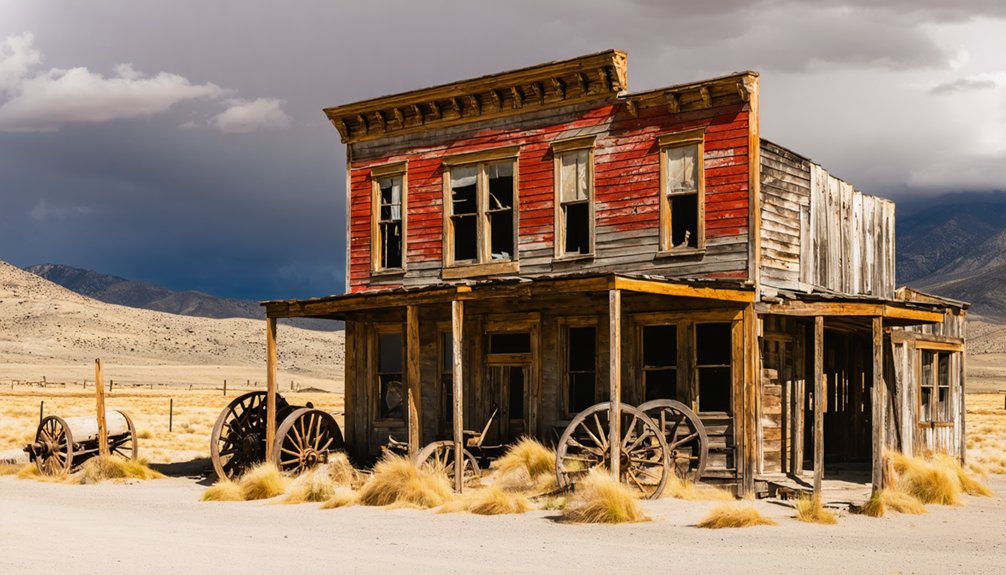
You’ll find authentic ghost town filming locations concentrated in Oregon’s Elkhorn Mountains, where Sumpter’s Crescent and Buckeye Mines starred in the Ghost Mine series, and along Highway 97, where Shaniko’s weathered 1901 structures and Antelope appeared in Wild Wild Country. Golden’s temperance-town architecture offers unique visual contrast with its churches replacing saloons, while Monte Cristo in Washington provides dramatic wilderness backdrops accessible via an 8-mile hike. These preserved sites feature original buildings, minimal modern interference, and authentic frontier atmospheres that reduce production costs while enhancing period accuracy—with strategic route planning connecting multiple locations efficiently.
Key Takeaways
- Ghost Mine TV series filmed at Crescent Mine and Buckeye Mine near Sumpter, Oregon, featuring authentic mining techniques and paranormal investigations.
- Shaniko, Oregon preserves weathered 1901 structures on the National Register, offering authentic ghost town atmosphere with minimal restoration required.
- Silver City, Idaho contains 75 original structures from the 1860s-1900s without modern utilities, ideal for period film scenes and boom-town storytelling.
- Golden, Oregon provides unique temperance town architecture with churches replacing saloons, managed by Oregon Parks and Recreation for film productions.
- Monte Cristo, Washington offers remote wilderness setting with historic mining relics, though access requires 8-mile hike and special permits for filming.
Sumpter Oregon: Home of the Ghost Mine Series
Production crews set up cameras throughout Sumpter, though primary filming occurred at the Buckeye Mine group near Bourne, six miles north.
The series featured local father-son miners Duck and Dick Secord conducting EVP sessions and documenting spirit encounters.
Their paranormal investigations uncovered the site’s connection to Chinese miners and century-old violence, blending gold extraction with unexplained phenomena.
The filming incorporated authentic mining procedures including traditional timbering, roof bolting, and the use of jackleg drills with tires, reflecting genuine underground mining practices despite some dramatized elements. Portland-based paranormal investigator Patrick Doyle participated in the investigations alongside the mining crew.
Crescent Mine and Buckeye Mine: Two Filming Sites in One Region
You’ll find the Ghost Mine series filmed at two distinct Oregon locations near Sumpter—the Crescent Mine and Buckeye Mine. Both are embedded in the region’s century-old gold mining corridors.
These operational sites sit within 15 miles of each other along weathered mountain roads that connect Sumpter to the abandoned settlement of Bourne.
Rusted equipment and timber portals mark active and dormant claims in this area.
Accessing either location requires high-clearance vehicles and awareness of seasonal road closures.
Both mines remain on private property within working mining districts. The Crescent Mine served as a filming site when the Ghost Mine TV series production began in 2013. The Washington peninsula’s Peggy Mine operated as the largest manganese producer in the region from 1923 to 1954.
Ghost Mine Series Overview
When Syfy launched *Ghost Mine* on January 16, 2013, the network merged two distinct television genres into a single paranormal reality series that placed investigators underground alongside working miners.
You’ll find paranormal investigators Kristen and Patrick Doyle working three-month stints at eastern Oregon’s gold mining operations—a stark contrast to the standard one- or two-night investigations typical of competing shows.
The production focused on hard rock mining near Sumpter, where father-and-son miners Duck and Dick Secord searched for gold deposits while investigators documented unexplained phenomena.
The show’s exploration of mining history included segments on Chinese miners who faced racial violence and burial prohibitions in the 1800s.
These paranormal investigations connected EVP sessions to documented historical tragedies, including the Hells Canyon massacre.
Mine owner Larry Overman reported that his previous crew had quit due to the reported hauntings at Crescent Mine.
The eight-episode series aired on Wednesdays on Comcast channels 59 or 759 in HD.
Sumpter’s Historic Mining Legacy
Since five prospectors from South Carolina discovered gold near Cracker Creek in 1862, Sumpter’s mining legacy has transformed this Elkhorn Mountains settlement from a primitive cabin site into what locals called the Queen City.
You’ll find evidence of revolutionary mining technology everywhere—from the 35 deep shaft operations that extracted nine million dollars by 1900 to the massive floating dredges that operated 24/7 from 1913 to 1954. The last dredge alone pulled over four million dollars in gold before ceasing operations in 1954. The Sumpter Valley Railway delivered up to six carloads of mining equipment daily to sustain these intensive operations.
Today’s historic preservation efforts let you explore the Sumpter Valley Dredge at the state park, ride restored narrow gauge railroad steam engines, and examine authentic equipment at Cracker Creek Mine Museum—tangible connections to an era when freedom-seeking miners built sixteen saloons and seven hotels in this remote valley. This Elkhorn Scenic Byway destination remains surrounded by the mountains, rivers, and streams that originally drew settlers to the region.
Accessing Both Mine Locations
Though separated by nearly 200 miles of Washington wilderness, Crescent Mine near Lake Crescent and Buckeye Mine on Philadelphia Mountain’s northeast slopes offer distinct filming location profiles worth understanding together.
You’ll find Crescent at 1,250 feet elevation within Olympic National Forest—manganese operations that ran from 1924 to 1954, extracting over 50,000 tons. Mine access follows trails near Lake Crescent, though you’ll need to verify historic boundaries against current national forest designations and private property risks. The site operated on 10 levels, drilling over 7,500 feet to extract three separate manganese lenses.
Buckeye sits higher at 2,001 feet in Snohomish County’s Index Mining District, where silver and copper operations left tunnels and shafts through granite-hosted shear zones. Claims dating to 1898 created the Buckeye Group’s consolidated workings. The region’s geology features nearly horizontal beds of arkosic sandstone and quartz-pebble conglomerate containing well-rounded feldspar and quartzite pebbles derived from underlying granitic sources.
Both locations maintain ghost town remnants—tailings, structural foundations—that production designers value for authentic period atmosphere.
Antelope Oregon: Star of the Wild Wild Country Documentary
The 64,281-acre Big Muddy Ranch near Antelope, Oregon became the controversial site of Rajneeshpuram, a short-lived utopian community that sparked one of America’s most bizarre conflicts between spiritual seekers and rural residents.
You’ll discover this story through Netflix’s Emmy-winning “Wild Wild Country,” which premiered at Sundance in 2018. The documentary reveals haunted legends of bioterror attacks, FBI raids, and mass deportations that ended the commune in 1986.
Visit Antelope’s mini-museum at Maupin and Main streets, plus the “Good Riddance” memorial plaque between Union and Maupin. Access the town via Oregon Route 218’s Journey Through Time Scenic Byway.
The abandoned structures at Big Muddy Ranch now serve as Young Life’s Washington Family Ranch—strictly private property, so skip that treacherous 20-mile unpaved approach.
The Highway 97 Ghost Town Corridor: A Filmmaker’s Dream
Stretching 280 miles from the California border to the Columbia River, Highway 97 cuts through Oregon’s high desert plateau where weathered ghost towns cluster like forgotten film sets waiting for their close-up.
Oregon’s Highway 97 carves through high desert terrain where ghost towns stand frozen in time, perfectly preserved for production crews.
You’ll find abandoned storefronts, weathered wooden structures, and dusty main streets that production scouts covet for their authentic Western atmosphere. These locations require minimal set dressing—just add cameras and crew.
Preservation efforts have maintained these towns’ structural integrity while keeping them accessible for filming. Shaniko’s historic hotel and wool warehouse offer ready-made backdrops, while urban legends surrounding these settlements add narrative depth to supernatural thrillers.
You’re looking at production-friendly sites with minimal permitting hassles, existing infrastructure, and that raw, untouched aesthetic modern sets can’t replicate. It’s independent filmmaking at its most resourceful.
Shaniko Oregon: Historic Preservation Meets On-Screen Appeal
Since 1901, Shaniko’s weathered storefronts have witnessed boom, bust, and preservation—a trajectory that’s transformed Oregon’s former Wool Capital into a filmmaker’s ready-made period set.
You’ll find National Register-listed structures including the 1901 hotel, schoolhouse, jail, and wool sheds—all maintained through ghost town archaeology and adaptive reuse rather than heavy restoration.
The Shaniko Preservation Guild’s preservation techniques prioritize authenticity: original boardwalks, hand-restored storefronts, and relocated wood-framed buildings create continuity from the wool-boom era.
With 23-33 residents, you’re accessing a functioning ghost town where sagebrush, wind, and period architecture dominate without modern intrusions.
Fire chief Mark Haskett and the volunteer community protect infrastructure while welcoming film crews seeking unvarnished Western backdrops—no permits blocking your creative vision in this suspended-in-time High Desert location.
Silver City Idaho: Pacific Northwest’s Most Cinematic Mining Town
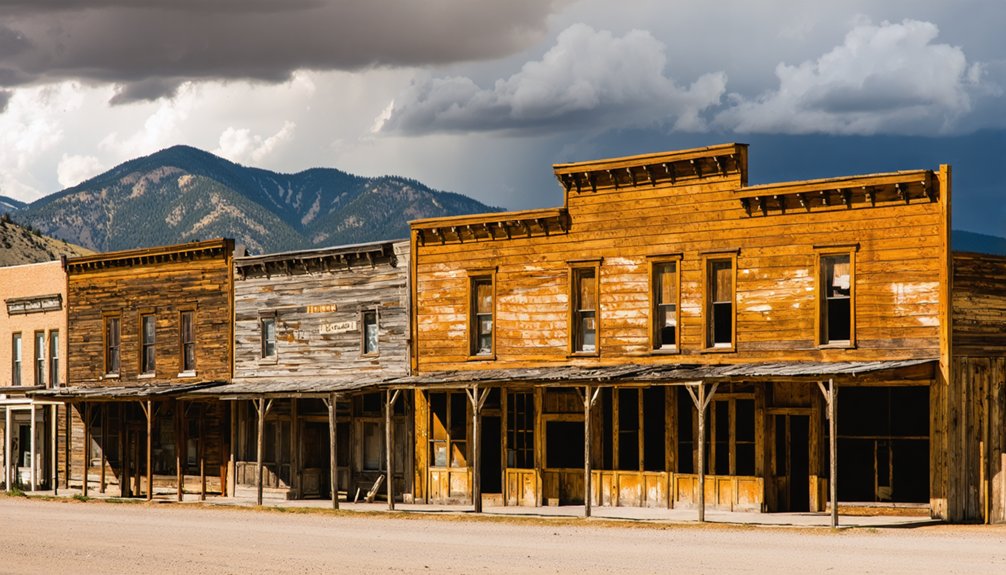
Perched at 6,200 feet in Idaho’s Owyhee Mountains, Silver City delivers 75 original structures spanning the 1860s to early 1900s—a mining-era streetscape where your crew won’t battle power lines, asphalt, or cell towers.
What makes this location worth your scouting trip:
- Themed photography gold: The 1869 Masonic Lodge, 1898 church, and Idaho Hotel’s original Wells Fargo office provide authentic backdrops without set dressing.
- Local legends fuel storylines: Mine wars from the 1860s—complete with log forts and hired gunmen—offer ready-made conflict narratives.
- Zero modern interference: No electricity or indoor plumbing means your Western productions remain untainted by contemporary intrusions.
- Logistical authenticity: Former county seat infrastructure includes telegraph office locations and eight saloon sites for establishing shots.
You’ll access proven cinematic terrain where $60 million in extracted wealth created genuine boom-town architecture—no historical fabrication required.
Golden Oregon: the Unique Temperance Town With Visual Appeal
Unlike every other gold rush town in Southern Oregon, Golden offers a temperance settlement where two churches anchor the streetscape instead of saloons—a visual anomaly that delivers immediate narrative contrast for period productions.
You’ll find the 1892 Campbellite church, Ruble family residence, 1904 general store, and supporting structures preserved through historical preservation efforts by Oregon Parks and Recreation Department since 2011.
*Gunsmoke* capitalized on this distinctive layout, leaving wooden headstones and crosses that remain as filming artifacts.
*Ghost Adventures* utilized the church for paranormal content, demonstrating the community impact these productions generate.
The site’s position above Coyote Creek valley provides elevation changes and natural backdrops.
Four authenticated structures from the 1890s mining era deliver production-ready authenticity without extensive set construction, reducing your location budget while maintaining period accuracy.
Monte Cristo Washington: A Hiking Destination Turned Film Location
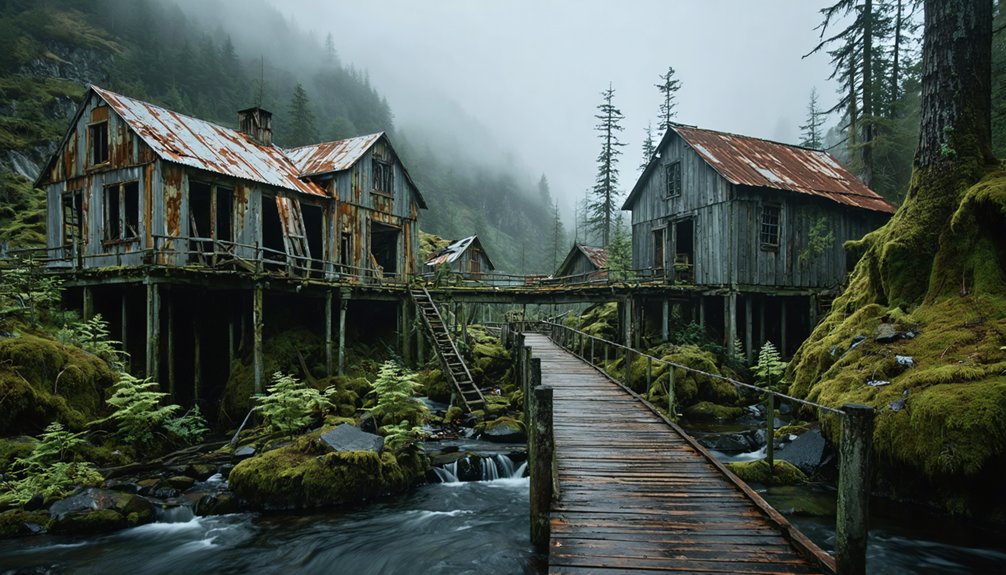
Reaching Monte Cristo requires commitment that most ghost town locations don’t—an 8-mile hike along a washed-out mining road from Barlow Pass, where stream crossings and muddy stretches replace the Mountain Loop Highway access that vanished with repeated floods in 2003 and 2006.
You’ll find rusted equipment and labeled building sites marking where Rockefeller’s syndicate once invested millions between 1889 and 1907.
Despite promotion as a filming location, no verified TV productions have shot here.
Preservation challenges from arsenic contamination, private property restrictions, and wildlife encounters make crew access impractical.
What remains are interpretive signs along Dumas Street, scattered relics, and a Forest Service partnership limiting modern commercial use.
- Washington Forest Pass required for trailhead parking
- Extensions to Gothic and Glacier Basins available
- No-trespassing signs mark privately owned lots
- 1983 lodge fire accelerated vandalism
Preserved Architecture: Why Ghost Towns Attract Production Companies
Production scouts choosing ghost towns over studio backlots aren’t chasing authenticity alone—they’re calculating budgets. Abandoned structures slash set construction costs while delivering genuine 1800s mining-era facades you’d spend hundreds of thousands replicating.
Historical preservation efforts in towns like Sumpter and Shaniko maintain seven hotels, sixteen saloons, opera houses, and jails without modern interference—ready-made period sets requiring minimal dressing.
Architectural variety distinguishes these locations from cookie-cutter soundstages. You’ll find Burke’s canyon-adapted buildings, Golden’s religious community structures minus saloons, and Cornucopia’s shootout-era establishments offering distinct visual storytelling opportunities.
Remote sites like Bayhorse and Molson eliminate contemporary intrusions—no traffic lights, power lines, or cell towers disrupting your shots.
When Sumpter hosted “Ghost Mine,” producers leveraged this combination: authentic architecture, diverse backdrops, and isolated terrain delivering production value without construction crews.
Planning Your Own Ghost Town Filming Location Tour
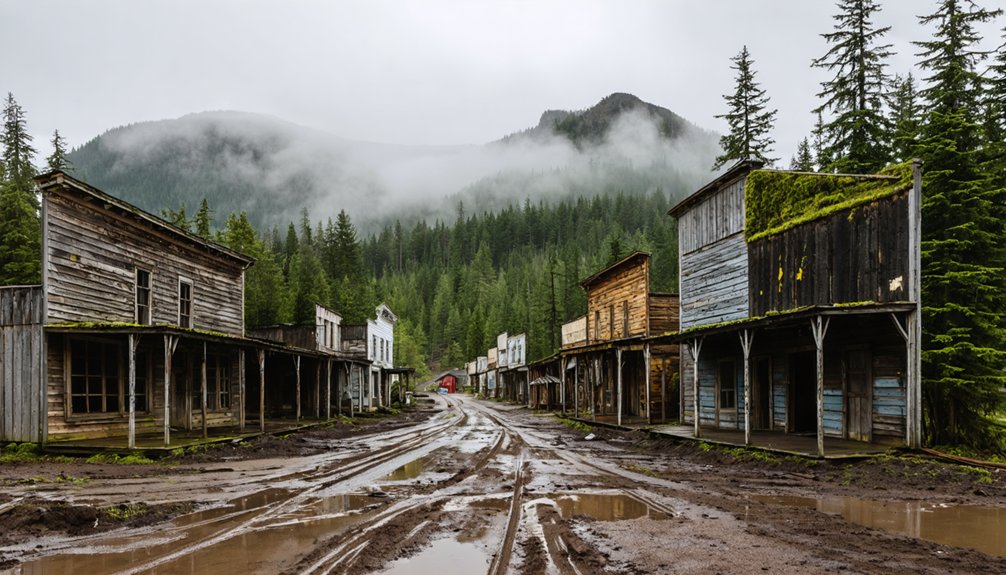
When mapping your Pacific Northwest ghost town filming tour, you’ll confront a three-state logistics puzzle spanning 400+ miles between Washington’s Cascade peaks and Idaho’s eastern mining corridors.
Your route requires strategic clustering. Consider these approaches:
Smart ghost town filmmaking demands geographic grouping—maximizing sites per region while minimizing windshield time between decaying structures and mountain passes.
- Highway-accessible hubs first: Shaniko and Sumpter in Oregon offer drive-through convenience with vehicle-based equipment transport capabilities.
- Multi-site concentrations: Yankee Fork State Park delivers three interconnected ghost towns (Bayhorse, Custer, Bonanza) within single-park boundaries.
- Trail-accessed locations: Monte Cristo demands 8.7-mile hikes—schedule adequate daylight hours for round-trip exploration.
- Permit coordination: Heritage sites like Golden require advance authorization through state preservation offices.
Cultural preservation efforts maintain authentic structures, while urban revitalization hasn’t compromised historical integrity. Pack navigation tools for remote Idaho mining corridors where cellular coverage disappears between abandoned settlements.
Frequently Asked Questions
What Permits Are Required to Film at Ghost Town Locations?
You’ll need permits from the local county’s Real Property Manager, since ghost towns lack formal filming policies. Contact Josephine County for historical preservation sites like Golden and Waldo. These tourist attractions require advance coordination before filming.
Can Production Crews Stay Overnight in These Ghost Towns?
You’ll likely lodge elsewhere—historic preservation rules restrict ghost town accessibility for overnight stays. Production crews typically camp nearby or commute from modern towns like Baker City, since these sites lack infrastructure and require special permits for extended access.
Which Ghost Towns Have Electrical Hookups for Film Equipment?
The Boardman Area ghost town offers functional electrical hookups inside its abandoned buildings, with working power systems throughout. Unlike historic landmarks at Shaniko, these fiber optic infrastructure sites maintain grid connections, giving you reliable electricity for production equipment.
Are There Local Filming Coordinators for Pacific Northwest Ghost Towns?
You’ll find virtually zero dedicated filming coordinators at Pacific Northwest ghost towns. Instead, you’ll contact historical preservation groups like Shaniko Historic Preservation or BLM officials managing tourist attractions. State parks and forest services handle production permits independently.
For those interested in exploring film locations in the Pacific Northwest, the scenic backdrops can add a unique dimension to any project. Many filmmakers are drawn to the stunning landscapes that range from lush forests to rugged coastlines, making it a prime destination for outdoor shooting. It’s essential to research specific areas ahead of time to navigate the various permits that may be required for filming.
What’s the Average Cost to Film at These Locations?
You’ll spend $7,500 daily on average across Pacific Northwest ghost towns. Historical preservation fees and tourism impact considerations drive costs between $1,200-$20,000, depending on your crew size, equipment needs, and required insurance coverage for accessing these remote locations.
References
- https://www.rvoutwest.com/episodes/13-ghost-towns-across-the-pacific-northwest
- https://traveloregon.com/things-to-do/culture-history/filmed-in-oregon/find-favorite-oregon-film-location/
- https://www.islands.com/2063968/five-best-abandoned-ghost-towns-visit-pacific-northwest/
- http://pnwphotoblog.com/filming-locations/
- https://www.youtube.com/watch?v=GX_z7FC8_HI
- https://www.youtube.com/watch?v=CuEIWySDQ20
- https://www.youtube.com/watch?v=KwOQ_Z0MOlU
- https://www.mindat.org/mesg-305927.html
- https://kval.com/outdoors/ghost-mine-filmed-in-oregon-premieres-this-week-on-syfy
- https://bakercityherald.com/2012/12/31/tv-show-filmed-near-sumpter-premieres-jan-16/