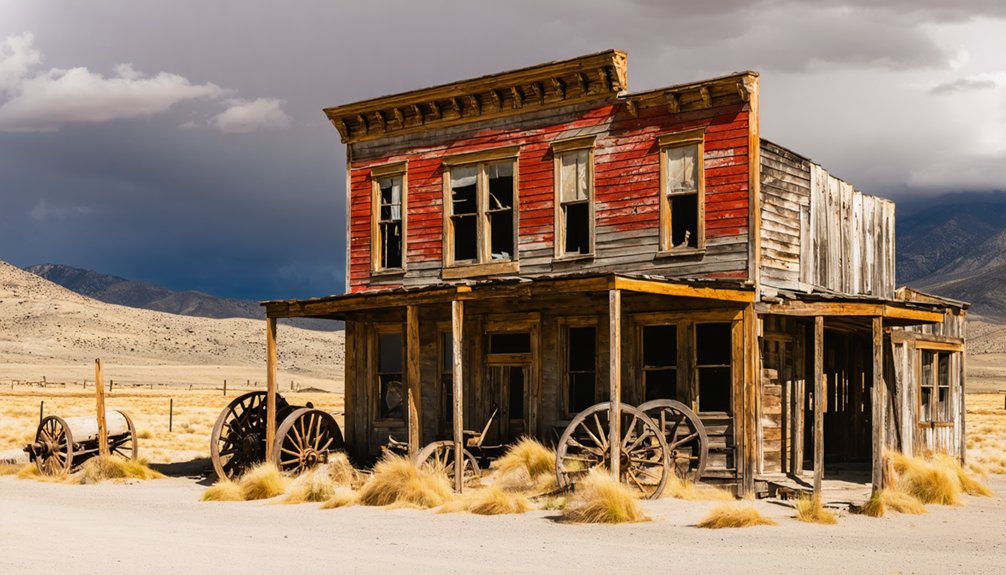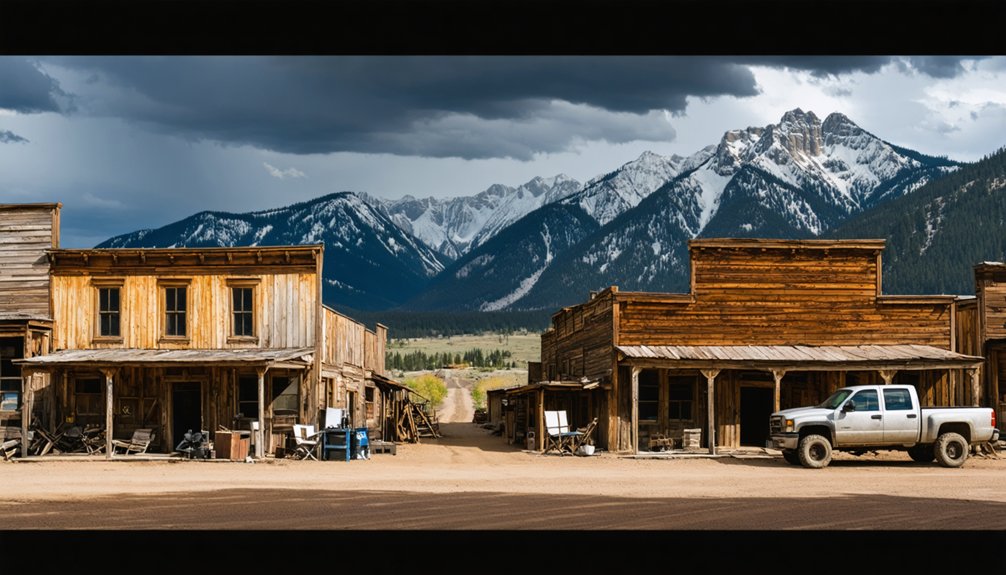
You’ll find Ashcroft at 9,961 feet served as the backdrop for *Sergeant Preston of the Yukon* (1955–1958), while Keota’s weathered structures anchored *Centennial*’s frontier scenes across Pawnee National Grassland. These preserved ghost towns offer production crews over 120,000 square feet of authentic 1880s buildings—eliminating costly set construction. San Juan County’s Animas Forks sits at 11,200 feet with period-appropriate architecture, though high-altitude filming demands 4×4 access and crew acclimatization. The article ahead details specific locations, seasonal accessibility windows, and logistical considerations for both filmmakers and visitors.
Key Takeaways
- Ashcroft served as the primary filming location for *Sergeant Preston of the Yukon* (1955–1958), featuring 43 preserved wooden buildings.
- Keota was the main filming site for the TV series *Centennial*, with authentic frontier structures within Pawnee National Grassland.
- Animas Forks at 11,200 feet elevation offers well-preserved 1800s buildings ideal for period productions requiring authentic mining town settings.
- Ghost towns provide over 120,000 square feet of genuine Western scenery, eliminating expensive set construction for historical productions.
- High-altitude locations require specialized equipment, crew acclimatization, and summer scheduling due to severe weather and accessibility constraints.
Ashcroft: Training Ground Turned Television Set
When silver deposits emerged near Castle Creek’s headwaters in 1880, prospectors transformed the alpine wilderness into Castle Folks City—a settlement that would rebrand twice before settling on Ashcroft in 1882.
You’ll find this boomtown peaked at 2,000 residents by 1883, outpacing Aspen with twenty saloons and dual newspapers.
Shallow ore veins triggered collapse by 1885, reducing population to seasonal holdouts.
The settlement officially became a ghost town in 1912 after the population had dwindled to nearly nothing.
Today, the Aspen Historical Society maintains the site as one of Colorado’s best-preserved mining towns.
The Sergeant Preston of the Yukon Connection
You’ll find Ashcroft’s shift from military training site to television production location remarkably efficient. The ghost town‘s existing structures and mountain backdrop required minimal modification for *Sergeant Preston of the Yukon*’s exterior scenes.
The production team leveraged the same handful of buildings throughout the series’ three-season run from 1955 to 1958, rotating camera angles and snow dressing to create distinct Yukon settlements. The show’s lead dog Yukon King became essential for breaking trails through the mountain terrain during filming sequences.
This location-reuse strategy aligned perfectly with Trendle-Campbell-Meurer’s thrift-oriented production model, where standing sets and established mountain access points reduced logistics costs for their weekly Thursday broadcasts. The series premiered on CBS with 33 episodes in its first season, establishing the production pattern that would rely heavily on Ashcroft’s ghost town settings.
Ashcroft’s Military Training History
Before Ashcroft transformed into a filming location for “Sergeant Preston of the Yukon,” it served a critical wartime purpose that would directly shape its television legacy. In 1942, Ted Ryan leased the abandoned mining site to the U.S. Army for just $1 annually. This leasing enabled 14,500 soldiers of the 10th Mountain Division to master alpine warfare techniques.
You’ll find that these “soldiers on skis” utilized Ashcroft’s rugged terrain for mountaineering training, winter camping, and specialized combat exercises throughout summer 1942. The division’s motto “We climb to conquer” embodied the elite mountain warfare focus that made Ashcroft an ideal training location.
This military chapter proved essential to ghost town preservation—Ryan later recruited Stuart Mace, a 10th Mountain Division veteran, as site caretaker in 1948. Mace’s dog sled operation and preservation efforts maintained Ashcroft’s authenticity, creating the perfect backdrop for television production while honoring its mining history. The site’s disambiguation from other Ashcroft locations in historical records helped establish its unique identity as both a military training ground and entertainment venue.
Mid-1950s Television Production
After Stuart Mace’s preservation efforts maintained Ashcroft’s authentic frontier atmosphere throughout the late 1940s, the ghost town caught Hollywood’s attention as the ideal backdrop for *Sergeant Preston of the Yukon*.
Charles E. Skinner Productions established remote work operations in June 1955, transforming Ashcroft’s weathered structures into Klondike Gold Rush settings for CBS’s three-season production.
You’ll find the same handful of buildings appear repeatedly across 78 episodes—a cost-effective approach that maximized location value while minimizing transportation expenses between California and Colorado.
The series’ film preservation archives reveal how Richard Simmons and his Alaskan Malamute utilized Ashcroft’s mountain backdrops for exterior sequences, while Westfilm Studios handled interior shots.
This dual-location strategy let producers maintain production schedules without sacrificing authentic frontier aesthetics.
Production oversight shifted when Tom R. Curtis Productions assumed control in December 1956, relocating studio operations to Paramount Studios for subsequent seasons.
The show’s creator George W. Trendle had previously established successful formulas with The Lone Ranger and The Green Hornet before bringing his vision to the Yukon territories.
St. Elmo’s Rocky Mountain PBS Spotlight
When Rocky Mountain PBS premiered Season 5 Episode 4 of its flagship Colorado Experience series, it dedicated 26 minutes and 40 seconds to exploring three of the state’s best-preserved ghost towns—St. Elmo, Animas Forks, and Ashcroft.
You’ll find St. Elmo‘s cinematic appeal stems from its architectural uniformity: every visible structure dates within a single 10-year boom period, making it unique among Western ghost towns.
At 9,961 feet elevation in the Sawatch Range, the location’s harsh winters necessitate precise filming techniques during accessible months.
Historic preservation efforts maintain the town’s 43 original wooden buildings—five hotels, schoolhouse, newspaper office, and jail—as authentic visual backdrops. The site’s National Register listing enhances its credibility as a filming destination for productions seeking historically authenticated locations.
The production captures how these silent structures serve as emissaries from Colorado’s mining past, offering you unrestricted access to genuine frontier architecture frozen since the railroad’s 1922 discontinuation.
The miner’s exchange, a popular photography location, served as the town’s trading post where miners weighed and received payment for their valuables.
Preserving History Through Documentary Filming
Documentary crews transform ghost towns into permanent historical records through calculated filming strategies that protect while they document. You’ll find non-invasive techniques like drone photography capturing Animas Forks’ structures at 11,200 feet without physical contact.
Satellite imagery maps entire districts before crews step foot on-site, while seasonal scheduling prevents weather-related erosion to exposed buildings. Post-production reveals details you’d miss—interior wallpaper, foundation layouts, structural integrity markers.
These methods verify local folklore against hard evidence. When documentarians investigated Bannack’s 10,000-resident peak or Nevadaville’s still-active Masonic lodge, they created accessible archives for future generations.
Colorado’s 600 remaining ghost town sites benefit directly—increased visitor numbers post-broadcast generate preservation funds. You’re watching history protected through technology, not threatened by it.
Each frame captures what neglect destroys: architectural details, mining remnants, and verifiable timelines that separate myth from documented fact.
Keota’s Role in Bringing Centennial to Life
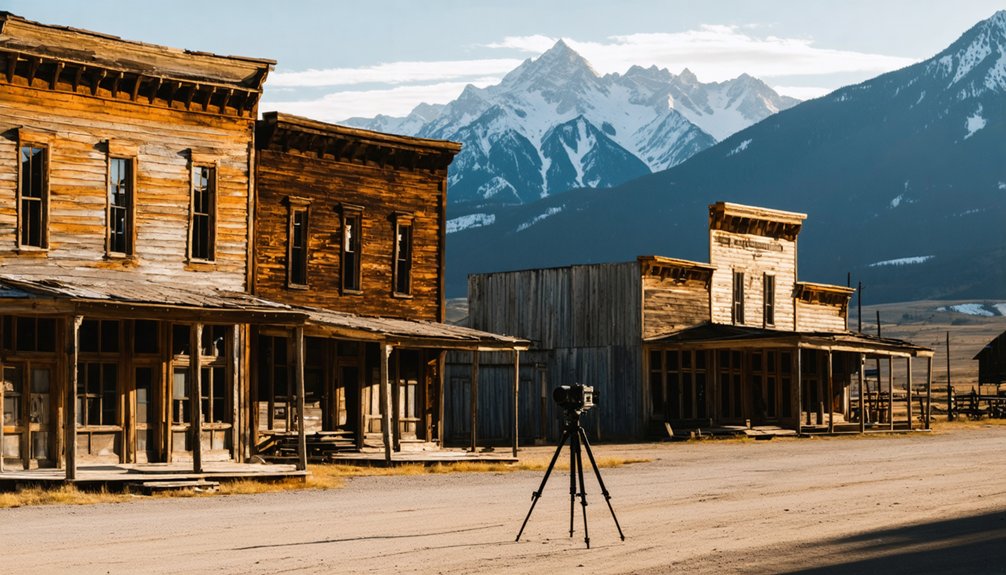
Fifty miles east of Greeley, Keota emerged as the production team’s essential plains location, anchoring Centennial’s frontier authenticity within the Pawnee National Grassland‘s 11,000-acre expanse. You’ll find this tiny settlement delivered unmodified Wild West landscape—expansive prairie vistas requiring zero artificial construction.
Keota’s untouched prairie landscape provided Centennial’s production team with authentic frontier vistas that required zero artificial construction within the grassland’s vast expanse.
The production’s author actually lived in Keota during filming operations, embedding directly into the terrain that embodied Colorado’s Frontier Era transformation.
The grassland’s raw topography eliminated set-building constraints while maintaining period-accurate isolation patterns typical of 19th-century plains communities. Keota functioned within Centennial’s broader multi-location Colorado strategy, complementing filming sites at Highlands Ranch and Orchard.
The Pawnee National Grassland provided what soundstages couldn’t replicate: authentic geological character spanning two centuries of Western settlement. This location-based approach prioritized environmental reality over controlled studio environments, capturing the untamed aesthetic central to Michener’s narrative.
From Ghost Town to Screen: Michener’s Vision
You’ll find Michener’s 1974 novel drew directly from northeastern Colorado’s landscape, positioning fictional Centennial at the Cache la Poudre and South Platte junction near Greeley—terrain he’d studied firsthand during the late 1930s.
The 1978 miniseries production required authentic Western locations that could represent two centuries of frontier history, prompting location scouts to identify structures and landscapes matching the author’s geographical specifications.
Universal Studios selected rural Morgan County near Orchard to construct the namesake town set, while dispersing additional filming across Colorado sites including Pawnee National Grasslands and Rocky Mountain National Park to achieve the novel’s sweeping historical scope.
Keota Inspires Centennial Characters
When James Michener established his headquarters in Keota during the development of *Centennial*, the abandoned Colorado settlement provided more than workspace—it became the foundation for his fictional town’s authenticity.
You’ll find the ghost town’s physical remnants—boarded-up structures, weathered mailboxes, carpet-strewn interiors—directly influenced character creation. Levi Zendt’s town-founding journey mirrors Keota’s pioneer settlement patterns from 1880.
Hans Brumbaugh’s agricultural innovations reflect northeastern Colorado’s farming legacy. Oliver Seccombe’s cattle operations echo the region’s ranching heritage visible in remaining storage buildings.
Historical preservation transforms these locations into tangible research sites where writers explore authentic frontier conditions.
Film tourism now draws visitors seeking connections between Keota’s deteriorating landscape and *Centennial*’s two-century narrative spanning French trappers, wagon trains, and territorial development across Colorado’s Pawnee National Grasslands.
Literary Legacy Meets Television
James Michener’s 909-page novel arrived in bookstores through Random House in 1974, delivering a two-century chronicle of northeastern Colorado’s plains that traced human occupation from prehistoric epochs through mid-1970s modernity.
You’ll find his fictional Centennial composited real settlements like Greeley’s Union Colony, founded 1869, while drawing from Michener’s late-1930s residence there.
When producers transformed this literary sprawl into television’s 1978-1979 miniseries, they secured Morgan County’s rural landscapes near Orchard as their primary set.
Cultural memory preservation became tangible at Centennial Village Museum in Greeley, where original miniseries artifacts remain cataloged.
The Highlands Ranch Mansion portrayed Venneford Ranch before suburban development engulfed it.
This translation from page to screen captured Dust Bowl remnants across Pawnee National Grasslands, establishing museum preservation standards for western storytelling.
Exploring Filming Locations in San Juan County
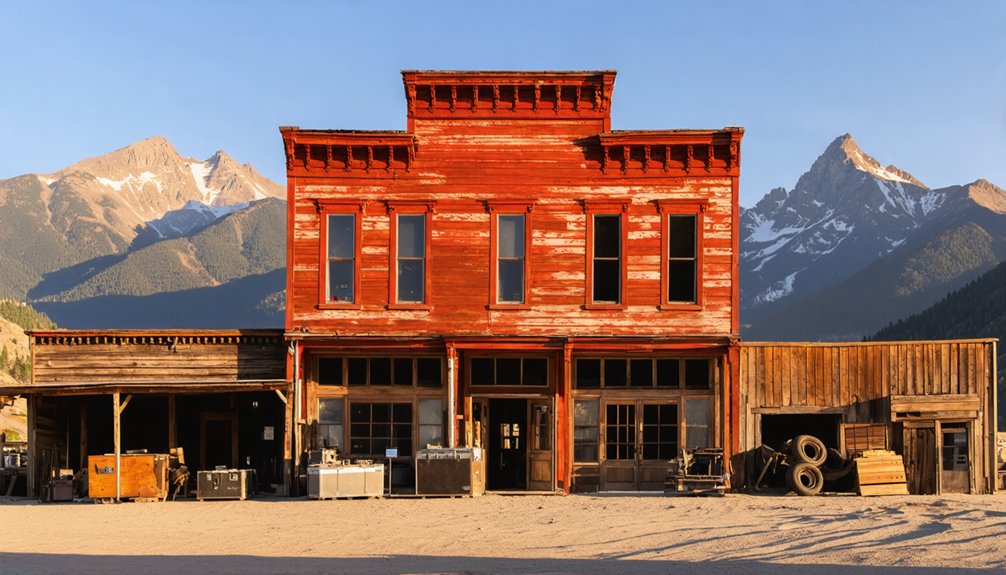
Nestled between Silverton and Ouray at 11,200 feet, Animas Forks anchors San Juan County’s concentration of authentic ghost town filming locations. You’ll access this production-ready site via County Road 2’s 12-mile route from Silverton, requiring high-clearance 4WD vehicles.
Ten to twelve original structures provide diverse shooting angles—cabins, mine buildings, and ancient architecture that production scouts prize for period authenticity.
The Red Mountain Mining District delivers additional location options along Route 550’s Million Dollar Highway.
Ironton’s 300 structures, built rapidly in 1883, offer weathered white facades and interior wallpaper details that minimize set dressing requirements.
Howardsville completes your location scouting triangle, featuring rugged mining remnants and mountain legends embedded in San Juan’s highest settlements.
BLM and county resources provide essential mapping data, though summer-only access restricts production schedules to seasonal windows.
Accessibility and Production Value in Mountain Settings
You’ll need four-wheel-drive vehicles to transport crews and equipment to high-elevation sites like Animas Forks at 11,200 feet, while lower towns such as St. Elmo accommodate standard production trucks on maintained access roads.
The existing wooden storefronts, mining structures, and preserved building facades eliminate construction costs for period-accurate sets, particularly for Gold Rush-era productions.
Altitude sickness, reduced equipment performance, and unpredictable mountain weather patterns require extended shooting schedules and specialized crew acclimatization protocols above 10,000 feet.
Vehicle Requirements for Crews
When production crews target ghost towns in the Rocky Mountains for filming, vehicle selection becomes as critical as location scouting itself. You’ll need specialized equipment to reach sites like St. Elmo or Animas Forks, where unpaved roads and 11,000-foot elevations demand serious capability.
In addition to the challenging terrain, you’ll also encounter a unique atmosphere in ghost towns in the Rocky Mountains, where time seems to stand still. These locations offer stunning backdrops for storytelling, evoking a sense of mystery and adventure that captivates both filmmakers and audiences alike. Proper preparation is key, as the remoteness can make logistics tricky, and ensuring reliable access to these hidden gems enhances the overall production experience.
Essential vehicle requirements include:
- 4×4 systems with low-range gearing for traversing steep, eroded trails
- High-clearance trucks or SUVs with reinforced undercarriages against washouts
- All-terrain tire packages rated for seasonal snow and mud conditions
- Compact crew vehicles accommodating limited turnaround space at remote sites
Proper vehicle maintenance prevents costly breakdowns 50+ miles from trailheads, while crew safety depends on winter-rated equipment and skilled drivers.
Though 4×4 rentals increase transport budgets 30-50%, they’re non-negotiable for accessing authentic Rocky Mountain backdrops.
Preserved Structures Reduce Costs
Production budgets shrink dramatically when ghost towns offer standing structures instead of demanding full set construction from scratch. You’ll eliminate expenses like the 300,000 feet of lumber and 20,000 pounds of nails required for replica builds when filming at preserved sites like Carson or Nevadaville.
Remote logistics become manageable through existing four-wheel-drive roads reaching Gaskill in Kawuneeche Valley and gravel access to Nevadaville’s original buildings. Preservation techniques have maintained authentic structures at elevations exceeding 12,000 feet, delivering ready-made Western sets without construction crews hauling materials up mountain passes.
Carson’s well-preserved buildings provide instant visual authenticity against Weminuche Wilderness backdrops, while Tomboy’s expansive 1880s mining camp structures eliminate set design costs entirely. You’re accessing 120,000 square feet of authentic scenery without building permits or material procurement delays.
High-Altitude Filming Challenges
Above 8,000 feet, your cast and crew face immediate physiological obstacles that directly impact shooting schedules and production efficiency. Altitude sickness strikes without warning, forcing mandatory acclimatization periods that delay your timeline.
Meanwhile, weather unpredictability demands flexible contingency planning as conditions shift rapidly in mountain environments.
Your production confronts these critical challenges:
- Equipment performance degrades in -30°F conditions, compromising camera systems and battery reliability.
- Crews require specialized transportation, extended per diems, and remote accommodations that inflate budgets.
- UV exposure intensifies at elevation, necessitating additional protective protocols.
- Emergency medical support becomes essential infrastructure rather than optional coverage.
Ghost town locations compound these difficulties—isonlation limits equipment sourcing to distant hubs like Atlanta or LA, while satellite communication systems become mandatory safety requirements rather than production conveniences.
How Ghost Towns Capture Authentic Western Atmosphere
Ghost towns deliver unmatched authenticity for Western productions because their weathered structures, untouched landscapes, and preserved artifacts eliminate the need for elaborate set construction.
Weathered structures and preserved artifacts in ghost towns provide filmmakers with ready-made authenticity that no studio set can match.
You’ll find locations like St. Elmo offering 40+ antique structures with wooden storefronts and dusty streets that look straight out of classic Westerns.
Town preservation efforts at South Pass City maintain 30,000 original artifacts and authentic buildings from the 1800s mining era.
Historical authenticity extends to remote settings—Ashcroft’s seven wooden buildings surrounded by elk ranges and mountain fog create atmospheres impossible to replicate on studio lots.
These sites give you rowdy saloon backdrops, old log cabins, and mining relics that reflect genuine Wild West life.
You’re accessing real cultural remnants where prospectors, outlaws, and frontier settlers actually lived and worked.
Planning Your Visit to These Historic Filming Sites
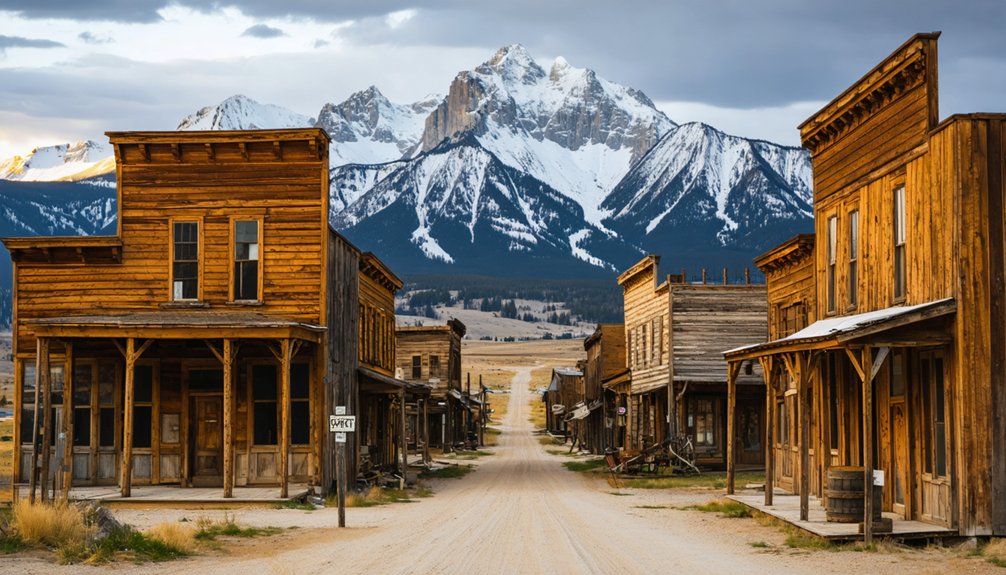
While these authentic locations provide filmmakers with irreplaceable Western backdrops, you’ll need careful preparation to reach and explore them safely.
Unlike urban redevelopment projects with paved infrastructure, these remote sites demand self-reliance and proper equipment.
Essential planning considerations:
- Vehicle requirements – Four-wheel drive mandatory for Animas Forks via Alpine Loop; regular cars suffice for St. Elmo’s graded roads.
- Elevation acclimatization – Animas Forks sits at 11,200 feet; monitor altitude symptoms carefully.
- Seasonal timing – Summer access high-altitude passes; spring mud season renders San Juan Mountain routes impassable.
- Weather monitoring – Rapid Rocky Mountain conditions shift without warning; verify forecasts before departure.
Modern tourism hasn’t sanitized these preserved sites. You’ll encounter unstable structures with peeling facades at Ironton and isolation at Vicksburg.
Check supplies, fuel, and emergency gear before venturing into these filming locations where authenticity trumps convenience.
Frequently Asked Questions
What Permits Are Required to Film Television Productions in Colorado Ghost Towns?
You’ll need state film permits through Colorado’s Office of Film, Television, and Media, plus landowner authorization. Federal or municipal permits apply depending on location ownership. Certificate of insurance is mandatory. Check license restrictions and preservation efforts governing historic ghost town sites.
Which Other Ghost Towns Have Been Featured in Popular Western Films?
You’ll find Ashcroft’s historical preservation enabled its 1950s transformation for *Sergeant Preston of the Yukon*, creating authentic Canadian settings. The production generated significant local community impact, employing resident Stuart Mace while respecting the town’s architectural integrity.
Are There Ghost Town Tour Guides Who Worked on Film Productions?
You’ll find historical preservation experts like George White, who founded Moab’s Film Commission while owning Red Cliffs Lodge, bridging tourist engagement with production work. Dean Teaster similarly transformed Maggie Valley’s Ghost Town Village into an authentic filming location.
What Safety Precautions Do Film Crews Take in Abandoned Mining Structures?
Film crews conduct thorough hazard assessments before shooting, identifying unstable roofs, flooded shafts, and explosive remnants. You’ll see structural stabilization with temporary supports, posted danger zones, emergency lighting systems, and mandatory safety officers monitoring every abandoned mine location.
How Much Do Television Productions Pay to Use Ghost Town Locations?
You’ll pay location fees ranging from $500 to $10,000 weekly depending on site accessibility and preservation status. Filming costs include permits, insurance requirements, and potential add-ons like road preparation or mandatory site monitoring for larger productions.
References
- https://www.coloradolifemagazine.com/printpage/post/index/id/172
- https://www.rmpbs.org/shows/colorado-experience/episodes/ghost-towns-b96fft
- https://en.wikipedia.org/wiki/List_of_ghost_towns_in_Colorado
- https://www.youtube.com/watch?v=ANRfGraiDrg
- https://roadtrippers.com/magazine/filming-locations-stephen-king-movies/
- https://www.colorado.com/articles/colorado-ghost-towns
- https://www.youtube.com/watch?v=lVhiFYh_4RI
- https://www.youtube.com/watch?v=gXrjIoj4Bh0
- https://www.uncovercolorado.com/ghost-towns/
- https://www.mccartneyproperties.com/aspen-blog/fall-aspen/aspens-ghost-towns-and-historic-sites