You’ll find several Midwest ghost towns that production crews regularly scout for authentic decay and period atmosphere. Keweenaw Peninsula’s copper mining ruins in Michigan offer skeletal mineshafts and roofless structures across 38 accessible acres, while Fergus Falls State Hospital in Minnesota provides 120 acres of Romanesque and Tudor Revival architecture spanning 1890-2005. Whiting, Iowa’s cornfields served as the fictional Gatlin in *Children of the Corn*, capturing agricultural isolation that soundstages can’t replicate. The locations below reveal specific coordinates, permit requirements, and architectural features that make each site production-ready.
Key Takeaways
- Keweenaw Peninsula copper mining ghost towns feature skeletal mineshafts and preserved structures accessible through the Keweenaw County Historical Society’s summer visitor programs.
- Central Mine’s 38-acre site offers roofless buildings and mining infrastructure from Michigan’s 1850-1881 copper boom era for atmospheric filming opportunities.
- Fergus Falls State Hospital spans 120 acres with Romanesque and Tudor Revival architecture, maintained by Otter Tail County Historical Society since closing in 2005.
- Whiting, Iowa served as fictional Gatlin in *Children of the Corn*, with Hansen’s Café, City Hall, and grain silos available for guided tours.
- Sioux City Railroad Museum provides 30 acres of vintage locomotives, 1917-era machinery, and industrial decay without requiring filming permits.
Keweenaw Peninsula Michigan: Copper Mining Ghost Towns of the Upper Peninsula
When copper ore depleted in the Keweenaw Peninsula’s mines during the early 1900s, entire communities transformed into ghost towns scattered across Michigan’s Upper Peninsula. You’ll find locations like Central Mine, where mining heritage remains visible through skeletal mineshafts and roofless structures along U.S. Route 41.
Copper’s decline turned thriving Keweenaw communities into abandoned ghost towns, leaving skeletal ruins dotting Michigan’s Upper Peninsula landscape.
The peninsula’s boom era produced over three-quarters of the world’s copper from 1850 to 1881, operating shafts exceeding 3,000 feet deep. Central’s population crashed from 1,200 residents in 1887 to just 100 by 1903. The town’s copper deposits were left by glaciers approximately 9,000 years ago, extending over a 150-mile stretch that made Keweenaw a nationwide mining hub.
Today, ghost town preservation efforts maintain 38 acres at Central, where you can explore restored buildings and mining infrastructure. The Keweenaw County Historical Society operates a visitors center in a preserved old house and maintains several structures decorated with period antiques that open during summer months.
The Cliff Mine near Eagle River offers authentic remnants including the peninsula’s oldest permanent structures and original steam engines from operations that closed in 1870.
Peirce Mansion Sioux City: Gothic Stone Architecture in Paranormal Productions
Rising from Sioux City’s landscape since 1891, the Peirce Mansion showcases Richardsonian Romanesque architecture through its South Dakota quartzite exterior walls and 21-23 room interior layout.
You’ll find this $80,000 original construction features hand-carved details, elaborate woodwork, and stained glass throughout its 10-foot ceilings. The mansion’s Victorian architecture delivers authentic period elements that production crews seek for paranormal filming—from the main staircase to the library’s original portrait installations.
Since shifting from museum operations in 2011, you can access the National Register-listed property for productions during restoration periods. The quartzite construction and Gilded Age design elements provide dramatic backdrops for supernatural narratives. Architect Charles P. Brown designed the mansion during Sioux City’s boom period before the economic decline that followed the 1893 recession. Hansen Bros. handled the construction of this financier’s residence, which was built for John Peirce in 1893.
Quarterly open houses let you scout locations before booking this historic venue at coordinates 42°31′15″N 96°24′8″W.
Historical State Hospital Fergus Falls: Abandoned Asylum as Documentary Backdrop
Since opening in 1890 as Minnesota’s Third State Hospital for the Insane, this 120-acre Fergus Falls complex offers documentary filmmakers an authentic Kirkbride Plan asylum with intact period architecture across multiple building styles.
A 120-acre Kirkbride asylum complex preserving 130 years of institutional architecture and authentic therapeutic landscapes for documentary filmmaking.
You’ll find abandoned buildings spanning Romanesque, Tudor Revival, Craftsman, and modernist designs—all preserved through National Register listing since 1986.
The site’s documentary appeal centers on:
- Original therapeutic infrastructure including linear ward plans designed for light and air circulation
- Complete institutional landscape with main complex, staff quarters, hospital farm, and 8-acre cemetery
- Documented treatment history from homeopathic medicine through lobotomies and drug therapy across 115 years
Historic preservation efforts maintain the property’s authenticity while providing unrestricted access to 40,000 patient stories.
The facility operated until 2005 as the Fergus Falls Regional Treatment Center, offering insights into evolving attitudes toward mental health care.
Records held by Otter Tail County Historical Society support research-driven productions requiring period accuracy.
The hospital initially accepted only male patients when it opened, with women being admitted beginning in 1893.
Whiting Iowa Cornfields: Rural Horror Settings in Stephen King Adaptations
When you scout rural Midwest locations for horror productions, Whiting, Iowa’s vast cornfield expanses demonstrate how agricultural landscapes generate psychological isolation on screen.
The 1984 *Children of the Corn* adaptation leveraged these monotonous rows of stalks—stretching to every horizon—to establish spatial disorientation and entrapment for characters maneuvering through the fictional Gatlin. Production designers capitalized on the corn’s dense verticality and rustling audio properties to construct a living maze that transforms pastoral farmland into claustrophobic threat zones.
While the narrative positions its action in Nebraska, the production team actually filmed in Western Iowa, selecting Whiting, Hornick, and Sioux City for their authentic agricultural settings. The film’s legacy continues through annual July screenings at Whiting City Hall Community Center, where fans gather at the original shooting site to experience the horror classic.
Children of the Corn Setting
The 1984 adaptation of Stephen King’s “Children of the Corn” transformed the small agricultural community of Whiting, Iowa, into the fictional horror setting of Gatlin, Nebraska, establishing it as one of the Midwest’s most recognizable rural filming locations.
Director Fritz Kiersch utilized eastern Iowa’s authentic agricultural infrastructure to create the film’s distinctive atmosphere, spawning urban legends and ghost sightings that persist decades after production wrapped.
Key production sites included:
- Hansen’s Café at 613 Whittier Street for principal diner sequences
- Whiting City Hall Community Center flagpole for Malachai’s iconic “Outlander!” proclamation
- Grain silos near 604 Wells Street for critical escape cinematography
The production also constructed a false cellar door behind one of the filming houses, allowing actors to simulate ascending stairs during crucial basement scenes.
The film employed location stitching techniques, shooting Hansen’s Café exterior scenes in Whiting while filming interior sequences featuring Isaac at the window in Hornik, located 10 miles away, seamlessly combining the locations to create a unified setting.
You’ll find On Set Cinema now conducts guided walking tours through downtown Whiting’s preserved filming locations, while overnight accommodations are available in the actual production house.
Endless Cornfields Create Dread
Beyond Whiting’s architectural elements, Iowa’s agricultural landscape itself became the film’s primary antagonist. The endless cornfields surrounding this tiny town created visceral cornfield isolation that no soundstage could replicate.
You’ll find that “He Who Walks Behind The Rows” concept gains supernatural credibility when filmed against authentic Midwest cornfield vastness. The production leveraged natural rural horror inherent in these agricultural expanses—where civilization ends abruptly at field boundaries, and something malevolent potentially lurks within those dense stalks.
This proximity between town structures and cornfields intensified the film’s core tension: normalcy versus hidden evil. Directors choosing similar locations understand that Iowa’s agricultural geography provides ready-made dread.
The cornfields don’t just serve as backdrop—they function as living antagonists, their uniform rows stretching endlessly toward horizons that promise no escape.
Ishpeming Michigan: Authentic Small Town Courtroom Drama Locations
Long before streaming services discovered the appeal of Midwest authenticity, Otto Preminger’s 1959 masterpiece “Anatomy of a Murder” transformed Ishpeming, Michigan into a landmark filming location that still draws cinephiles and location scouts today.
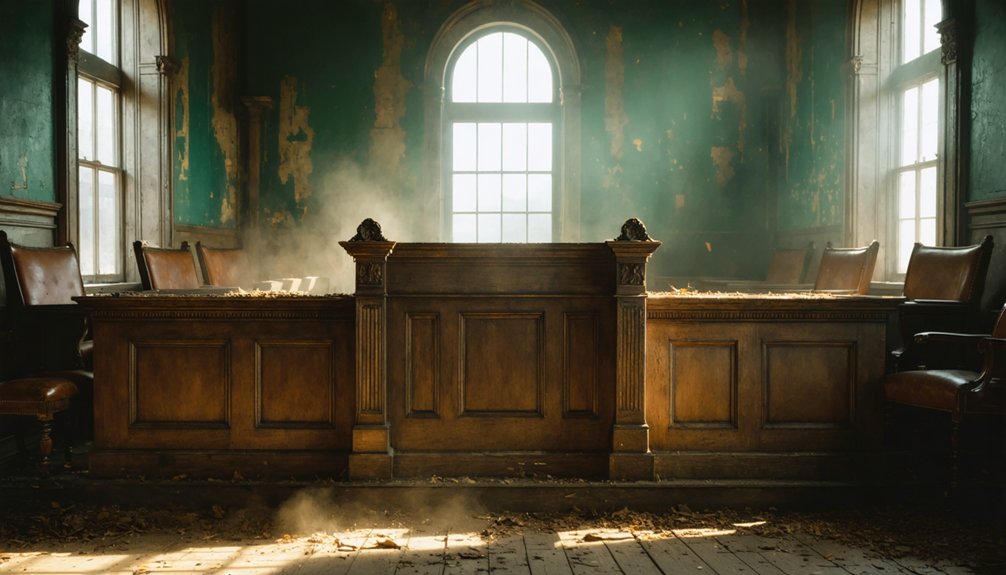
Preminger rejected studio sets entirely, shooting the Jimmy Stewart vehicle on authentic courtroom interiors at Marquette County Courthouse and throughout the Upper Peninsula’s untouched locations.
The production’s commitment to genuine small town courthouses established a blueprint for location-based filmmaking:
- Second-floor courtroom with stained glass dome and mahogany woodwork provided period-authentic production design
- Main Street exteriors and the Carnegie Library delivered small-town atmosphere without set dressing
- Local establishments like Nault’s Bar (now Jack’s Teepee) served as practical filming locations
You’ll find these sites still standing, offering production teams unvarnished Americana that no backlot can replicate.
Railroad Museum Sioux City: Midwest Historical Sites for Haunted Television
Sprawling across 30 acres along Highway 12, Sioux City Railroad Museum‘s former Milwaukee Railroad Shops delivers production teams a National Historic Register location with genuine industrial decay that CGI can’t replicate.
You’ll find 41 resources including roundhouse remnants, vintage locomotives, and machinery dating from 1917—perfect for period pieces requiring railroad history authenticity.
The haunted ambiance emerges naturally from century-old structures where workers once serviced steam engines for 65 years.
Sioux City’s film-friendly reputation (no permits required, 30+ productions shot locally) means you’ll navigate logistics smoothly.
The interpretive trail system provides camera-ready paths through six contributing buildings and archaeological sites.
Productions seeking atmospheric Midwest locations between Loess Hills and Big Sioux River gain access to preserved industrial architecture that transforms into compelling haunted television backdrops without extensive set construction.
Frequently Asked Questions
Can Tourists Visit These Midwest Ghost Town Filming Locations Today?
You’ll find most Midwest ghost town filming locations accessible for exploration. These sites reveal hidden secrets of Wild West-era mining operations through preserved foundations, cemeteries, and hiking trails. Paranormal investigation opportunities and special events enhance your authentic documentary location experiences.
Among the most striking examples of ghost towns in the midwest are those that were once bustling railway hubs. The remnants of these once-thriving communities provide a vivid contrast to their present desolation, inviting exploration and storytelling. Visitors often report eerie sightings, adding to the allure of these historical sites and fueling local legends.
What Permits Are Required to Film at Abandoned Historical Sites?
You’ll need permits from federal, state, or local jurisdictions depending on ownership. The permissions process requires commercial filming applications addressing historical preservation concerns, liability insurance, crew size documentation, and potential impact assessments before shooting begins.
How Do Production Companies Ensure Safety in Abandoned Buildings?
Like explorers charting dangerous territory, you’ll conduct thorough hazard assessments before entering abandoned structures. Production companies implement complete safety protocols including structural inspections, PPE requirements, emergency evacuation plans, and on-site medical personnel for crew protection.
Are Local Residents Compensated When Filming Occurs in Their Towns?
You’ll find compensation depends on property rights—private landowners negotiate location fees directly, while ghost town filming rarely benefits remaining residents unless production companies voluntarily offer community benefits like infrastructure repairs or local hiring preferences.
Which Streaming Services Feature Documentaries Filmed at These Locations?
You’d think abandoned landscapes perfect for remote filming would be everywhere online, but MPV’s ghost town documentaries don’t specify streaming platforms. You’ll need to contact MPV directly to access their Midwest paranormal productions featuring these haunted locations.
References
- https://www.motionpicturevideo.com/top15locations
- https://www.homestratosphere.com/best-small-towns-in-the-midwest-for-visiting-famous-small-film-locations/
- https://www.youtube.com/watch?v=7-vjuqiGWJU
- https://www.youtube.com/watch?v=15KsasKUnQ8
- https://www.youtube.com/watch?v=lfj6aeZEVJY
- https://www.youtube.com/watch?v=cDninq2Q5ys
- https://www.atlasobscura.com/lists/abandoned-places-midwest
- https://en.wikipedia.org/wiki/List_of_ghost_towns_in_Michigan
- https://lostinmichigan.net/central-mine-ghost-town/
- https://www.smithsonianmag.com/history/once-a-year-this-19th-century-michigan-ghost-town-comes-to-life-180982695/