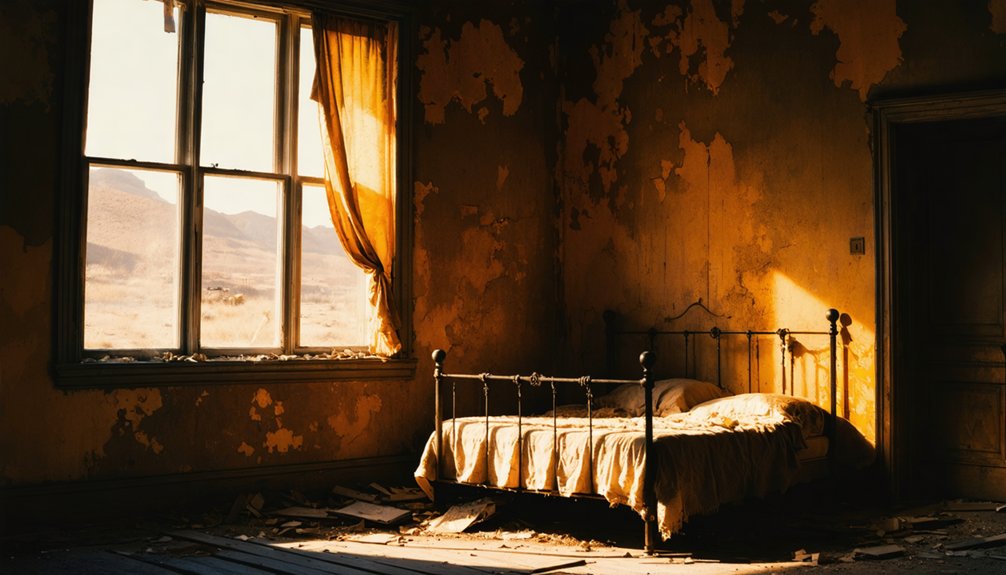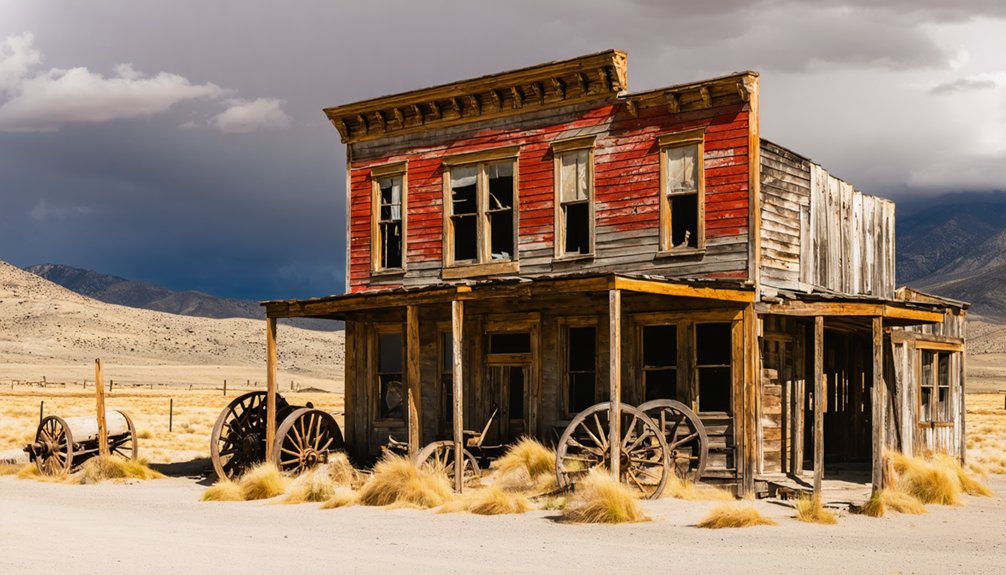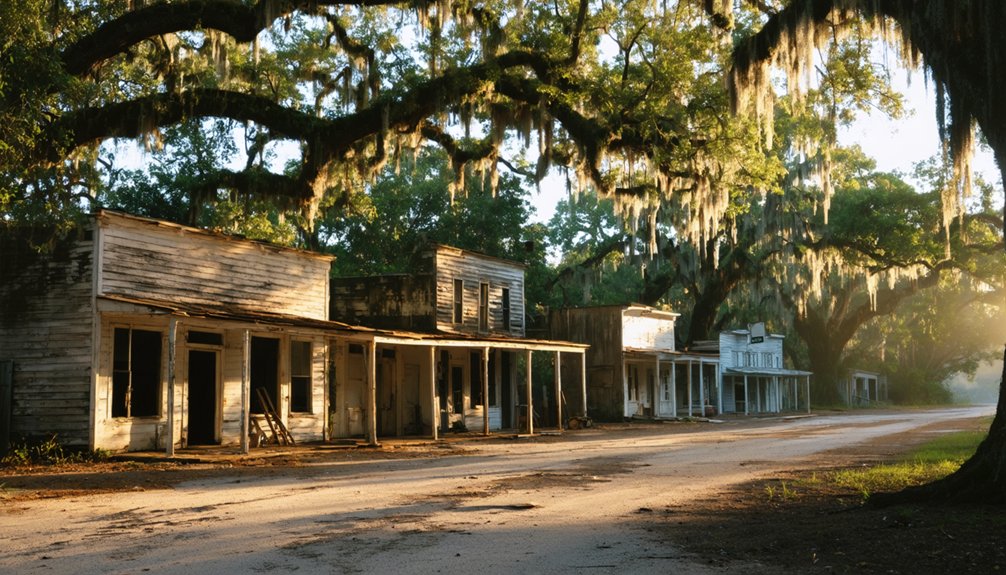
You’ll find Henry River Mill Village in North Carolina famously served as District 12 in “The Hunger Games” (2012), while South Carolina’s Babcock Building provided authentic psychiatric hospital settings for “Chattahoochee.” Vicksburg’s Duff Green Mansion appeared in Ghost Hunters Season 12, investigating Civil War-era hauntings. Georgia’s Toomsboro features prominently in documentary road trips capturing Southern decay, and federal-restricted Dunbarton within the Savannah River Site offers genuine post-evacuation landscapes for regional productions seeking period-specific authenticity that constructed sets can’t replicate.
Key Takeaways
- Henry River Mill Village, North Carolina served as District 12 in “The Hunger Games” (2012), featuring the iconic Everdeen house.
- Babcock Building, South Carolina provided authentic psychiatric hospital settings for films like “Chattahoochee” without requiring constructed sets.
- Wilson and Mortimer, South Carolina ghost towns are used as film locations emphasizing decay and historical Southern decline.
- Duff Green Mansion in Vicksburg appeared in Ghost Hunters Season 12, showcasing Civil War-era paranormal investigation themes.
- Toomsboro, Georgia’s 40-acre historic district attracts filmmakers seeking authentic Southern decay visuals across twenty derelict buildings.
Henry River Mill Village: The Hunger Games’ District 12 in North Carolina
Nestled along a small gorge in Burke County, North Carolina, Henry River Mill Village stands as one of the Deep South’s most cinematically significant ghost towns. Founded in 1904, this self-contained textile community operated 12,000 spindles at its peak, producing fine cotton yarns until economic pressures shuttered operations in the early 1970s.
You’ll find 35 modest worker homes, a steel truss bridge, and a debris-strewn dam—remnants of an era when mill preservation wasn’t prioritized. The village gained worldwide recognition as District 12 in 2012’s “The Hunger Games,” its authentic decay perfectly capturing dystopian poverty. The only accessible building from the films is the Everdeen house, which visitors can safely enter. The property was purchased in 2017 by local residents who envision transforming it into a business district, museum, and tourist destination.
Today, you can explore this National Register site just off I-40 near Hildebran, where textile history meets Hollywood, offering unregulated access to Carolina’s industrial past.
Babcock Building: Gary Oldman’s Chattahoochee Filming Site in South Carolina
Rising from the grounds of the South Carolina State Hospital complex in Columbia, the Babcock Building served psychiatric patients from its construction between 1857 and 1885 until all residents were relocated in 1990.
For over a century, the Babcock Building’s imposing structure housed psychiatric patients before standing vacant in 1990.
You’ll find this former asylum’s abandoned rooms became Gary Oldman’s filming location for “Chattahoochee,” where his character enters a hospital after a suicide attempt. The production didn’t need constructed sets—the deteriorating institutional spaces provided filming authenticity through original infrastructure and naturally eerie atmosphere.
This adaptive reuse represents South Carolina’s industrial heritage finding new purpose in cinema. The building’s large-scale structure offered multiple vacant rooms with period-appropriate visual elements intact. The facility replaced smaller institutions when officials consolidated mental health services into this centralized location. Rather than demolishing this functionally obsolete facility, filmmakers transformed its authentic institutional design into a compelling backdrop.
This demonstrates how abandoned spaces serve creative industries while preserving architectural history.
Vicksburg’s Haunted Locations Featured in Paranormal Television
Where better to investigate supernatural phenomena than a city whose Civil War siege left countless souls in its wake?
Vicksburg, Mississippi hosts two nationally-recognized haunted legends that’ve drawn paranormal investigations to the Deep South. Ghost Hunters filmed Season 12’s “You’ve Been Warned” at Duff Green Mansion, where former owner Harry Sharp documented decades of activity before selling to skeptic Harley Caldwell.
The team conducted EVP sessions using authentic Civil War bullets throughout the bed and breakfast. Investigators recorded potential voice recordings, including whispers referencing amputated limbs from the mansion’s wartime hospital operations.
Meanwhile, McRaven House—built in 1797 as a highwayman’s hideout—earned Mississippi’s most haunted distinction. This layered structure served as a Civil War hospital during the siege, accumulating 220+ years of tragic events across its Pioneer, Empire, and Bobb sections. The mansion’s exterior still displays over 120 bullet holes from when it was caught between Union and Confederate lines during the 1863 bombardment.
Both locations tie Vicksburg’s wartime past directly to unexplainable phenomena you’re free to explore.
Peak and Pomaria: South Carolina’s Forgotten Towns Captured on Film
You’ll find Peak and Pomaria nestled along South Carolina’s remote Midlands corridor, where documentary filmmakers have captured their evolution from railroad prosperity to virtual abandonment.
Peak, once a thriving 1850s railway stop on the Broad River destroyed by Sherman’s forces, now houses just 54 residents with a median age of 64.3 years.
The town preserves its heritage through vintage Coca-Cola signage and oversized bottle cap decorations that mark its historic commercial district.
These paired ghost towns have appeared in urban exploration videos that document their eerily quiet streets and repurposed rail lines, now part of the Palmetto Trail system.
The town was named after H.T. Peak, the railroad superintendent who oversaw operations during its prosperous mid-19th century period.
Wilson’s Location Amid Decay
Nestled along U.S. Route 521 between Manning and Greeleyville, Wilson stands as proof to Clarendon County‘s boom-and-bust cycle. You’ll find this unincorporated community at 118 feet elevation, where urban decay tells the story of exhausted timber resources and abandoned railroad infrastructure.
The historical context reveals Thomas Wilson, a Scotsman from Airdrie, built his sawmill here in the late 19th century, establishing an 8-mile railroad to the Atlantic Coast Line by 1888. Within three years, depleted timber supplies forced the mill’s closure.
Wilson relocated, though he served as railroad president until his 1921 death in New York City. The Northwestern Railroad of South Carolina abandoned its tracks in 1935 post-Depression, leaving behind the skeletal remains you’ll discover today—perfect for authentic Deep South filming backdrops. Similarly, North Carolina’s Mortimer along Wilson Creek met its demise through devastating floods in 1940, forcing residents to abandon what had been an incorporated town since 1907.
Video Documentation and Exploration
Modern explorers have documented Peak and Pomaria through amateur film projects that preserve what remains of these Newberry County settlements before nature reclaims them entirely. You’ll find independent videographers traversing abandoned main streets, capturing crumbling storefronts and overgrown railroad beds that once connected these mill towns to greater South Carolina commerce.
Aerial footage reveals the full scope of abandonment—entire blocks reduced to foundations, textile mill ruins standing sentinel over empty lots. These preservation efforts, though unofficial, create visual records of communities that state historians have largely overlooked.
The documentation shows you precisely what television location scouts discovered: authentic decay untouched by restoration committees or heritage tourism, offering production crews genuinely desolate backdrops unavailable in more protected ghost towns throughout the Deep South. Similarly, “Dean Teasters Ghost Town” was shot at Ghost Town Village, featuring original gunfighters from the 1961 crew to document the park’s Wild West heritage.
The region is rich with abandoned movie sets in Louisiana, where filmmakers can capture a sense of nostalgia and timelessness. These locations become playgrounds for creativity, inspiring artists to reenvision forgotten stories in settings that feel authentically immersive. As the sun sets over these relics, they take on an almost mythical allure, drawing both filmmakers and tourists alike to explore their haunting beauty.
Toomsboro: Georgia Ghost Town in Documentary Road Trips
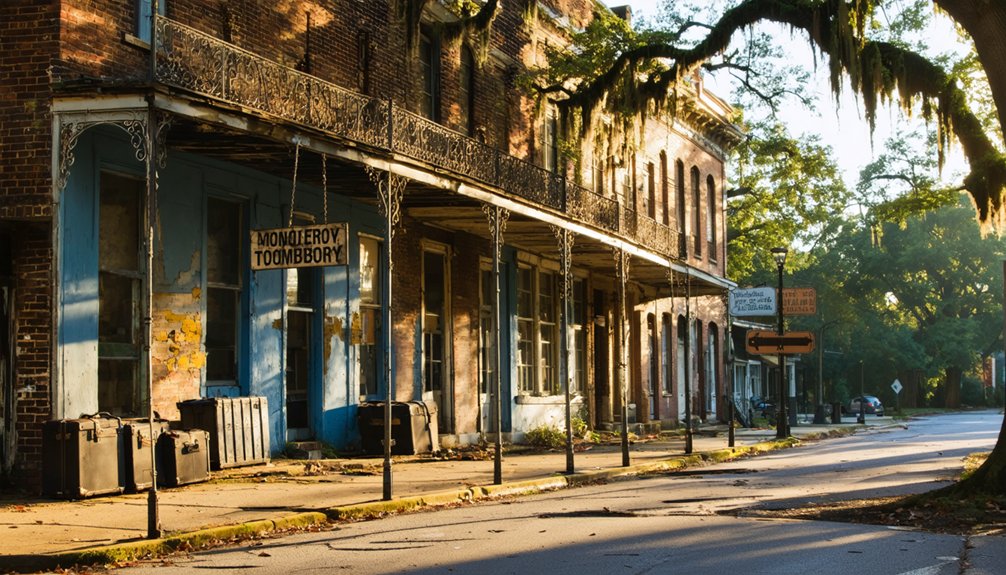
You’ll find Toomsboro positioned strategically along central Georgia’s kaolin belt, making it an essential stop on the five-day Southern Georgia Photography Circuit that connects Macon to Sandersville’s abandoned railroad communities.
Documentary crews favor the town’s compact 40-acre historic district, where you can capture Murray Hall General Store, the 1916 Swampland Opera House, and the deteriorating railroad depot within a single day’s shoot.
The route typically anchors multi-day abandonment documentation projects, as Toomsboro’s post-1904 architecture provides concentrated visual records of early 20th-century railroad decline without the geographic spread that complicates filming schedules in more dispersed ghost towns.
Southern Georgia Photography Circuit
Along the rural backroads of Wilkinson County, Toomsboro anchors Day Three of the “South Georgia Photography Road Trip” documentary series, appearing at timestamp 37:20 following the De Soto segment.
You’ll navigate a 34-mile route capturing abandoned architecture through black-and-white compositions that emphasize weathered textures and structural decay.
The 13-minute segment showcases over twenty derelict buildings across five square miles, including the collapsed 1907 hotel and mill ruins damaged by river flooding from the Oconee.
This circuit connects you to broader Georgia ghost town networks, pairing Toomsboro with Bartow, Wadley, Stilson, and Stillmore.
You’ll document isolation patterns mirroring other southern routes visiting Auraria, Haralson, and Gay.
The itinerary targets photographers seeking historical remnants without restrictions, exploring sites where post offices closed in the 1950s and populations dropped below 100 residents.
Five-Day Abandonment Documentation Route
For documentary filmmakers and urban exploration photographers, the five-day abandonment route through central Georgia positions Toomsboro as the anchor site on Day Three.
You’ll spend six hours documenting the 40-acre historic district between 9 AM and 3 PM for ideal natural lighting.
Urban decay manifests authentically across 36 properties—the pre-Civil War Murray Hall General Store retains original merchandise, while the 1916 Swampland Opera House and railroad depot showcase preservation strategies through benign neglect.
You’ll capture boarded storefronts, the abandoned restaurant, and the former syrup mill without restrictions or permits.
The Freedom Georgia Initiative’s 97-acre community development adds contemporary context to your historical documentation.
Plan midday coverage of the Toomsboro Historic Hotel’s weathered facade at 151 Main Street, where architectural details reveal the town’s 1851-1930s railway prosperity before highway rerouting triggered economic collapse.
Rural Decay Visual Records
When documenting Toomsboro’s rural decay, position yourself at the intersection of Main Street and Railroad Avenue by 8 AM to capture fog-shrouded storefronts before tour groups arrive at the 40-acre historic district.
You’ll find the Swampland Opera House, Murray Hall General Store, and Toomsboro Historic Hotel forming a time capsule of 1916-era architecture.
Frame your shots to include the abandoned railroad depot where Union cavalry destroyed trestle work during Sherman’s March.
The $1.7 million listing in 2018 attracted filmmakers seeking authentic Southern decay.
Document the Freedom Georgia Initiative‘s 97-acre purchase, where nineteen Black families are pursuing community revitalization while maintaining the town’s historical preservation value.
Your footage captures both abandonment and renewal—essential visuals for productions requiring genuine ghost town aesthetics without Hollywood fabrication.
Dunbarton: Barnwell County’s Abandoned Setting for Regional Productions
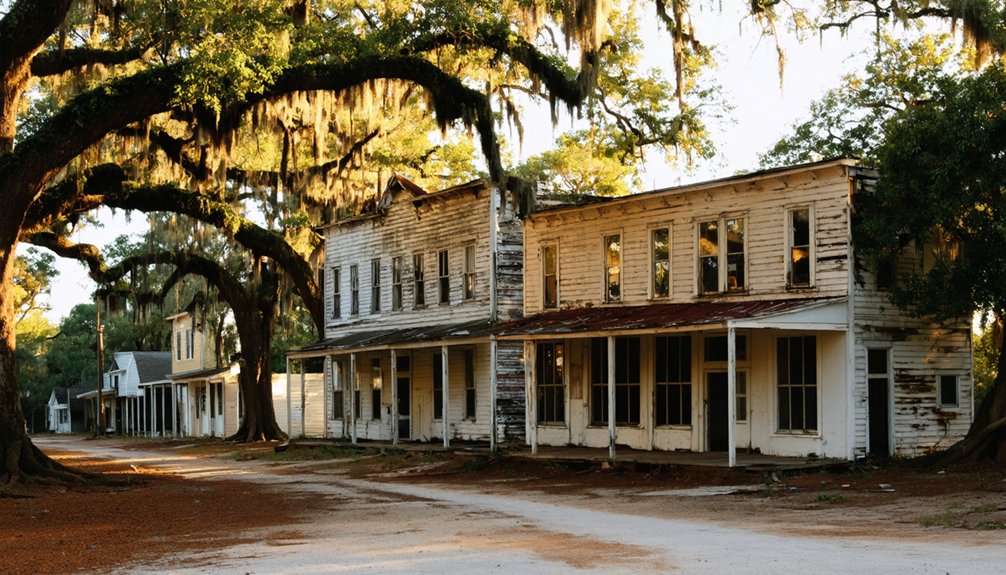
Tucked within the restricted boundaries of the Savannah River Site, Dunbarton’s skeletal remains offer regional television producers an authentic ghost town that requires no set construction. You’ll find streets, sidewalks, and driveways still marking where 1,500 residents lived before the 1951 federal land acquisition displaced them.
The town’s local history—from its 1899 railroad boom to its sudden evacuation for atomic energy work—provides compelling narrative depth for period productions.
Filming logistics demand coordination with federal authorities controlling the 300-square-mile restricted zone, but the payoff is substantial: untouched abandonment spanning seven decades.
Production teams gain access to genuine post-evacuation landscapes without the sanitized feel of reconstructed sets, while Barnwell County’s virtual museum archives supply historical accuracy for costume designers and location scouts seeking Depression-era authenticity.
Frequently Asked Questions
Can Visitors Legally Explore These Abandoned Deep South Filming Locations?
Like forgotten stage sets awaiting new actors, you’ll find most sites accessible—Elkmont and Auraria welcome explorers freely. However, you must respect historical preservation guidelines and verify private property boundaries at Cahawba and Vicksburg before investigating.
What Permits Are Required to Film in Ghost Towns?
You’ll need owner permission for private ghost towns, plus BLM permits if you’re causing environmental impact on public lands. Historical preservation concerns may trigger additional requirements. Contact local property managers—Golden and Waldo require Josephine County approval.
Are Guided Tours Available at These Former Filming Sites?
You’ll find these atmospheric ruins lack formal guided tours. Preservation efforts at Cahawba Archaeological Park permit self-guided exploration through haunted legends daily. Spectre, Henry River Mill Village, Babcock Building, and Byrnes Lake remain accessible only for independent urban exploration adventures.
How Do Production Companies Ensure Safety in Abandoned Buildings?
You’ll find production companies hire structural assessment experts and industrial hygienists before filming. They’ll balance historical preservation requirements with safety protocols, implementing hazard mitigation like debris removal, PPE mandates, and daily site inspections throughout shooting schedules.
Do Ghost Town Owners Charge Fees for Film Production Access?
You’ll find ghost town owners typically charge location fees based on property ownership rights, though rates vary. Historical preservation costs often influence pricing, with private owners in Deep South locations negotiating custom agreements with production companies seeking authentic backdrops.
References
- https://www.businessinsider.com/abandoned-places-used-in-movies-tv-shows-2020-9
- https://en.wikipedia.org/wiki/Haunted_Towns
- https://www.losethemap.com/scariest-ghost-towns-in-the-world/
- https://www.youtube.com/watch?v=KQOA3Q1z0Nc
- https://www.youtube.com/watch?v=IOSyq5PrgbM
- https://www.youtube.com/watch?v=5zVcMi_UFPM
- https://www.geotab.com/ghost-towns/
- https://en.wikipedia.org/wiki/Henry_River_Mill_Village
- https://roadtrippers.com/magazine/henry-mill-river-hunger-games-district-12/
- https://henryrivermillvillage.com/history/