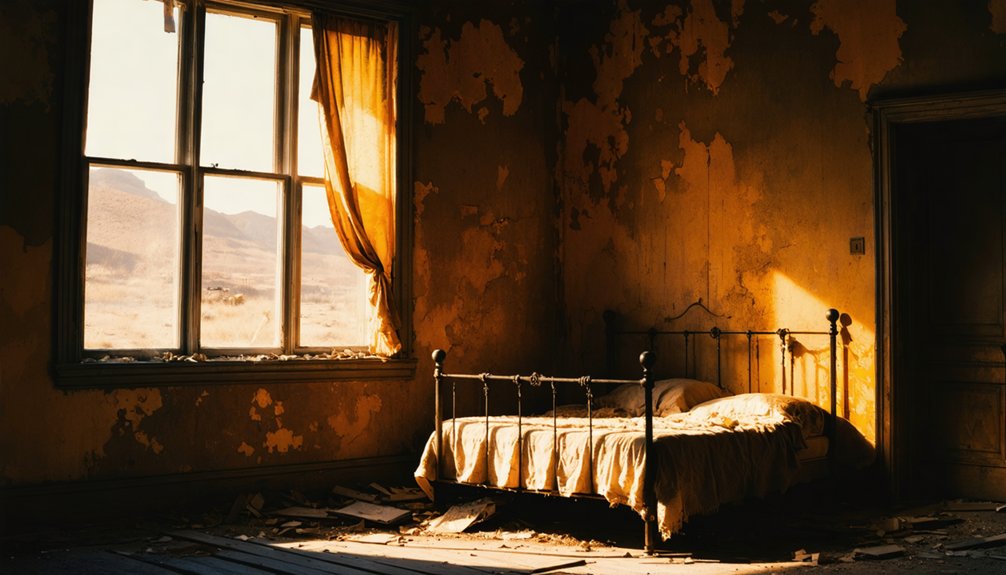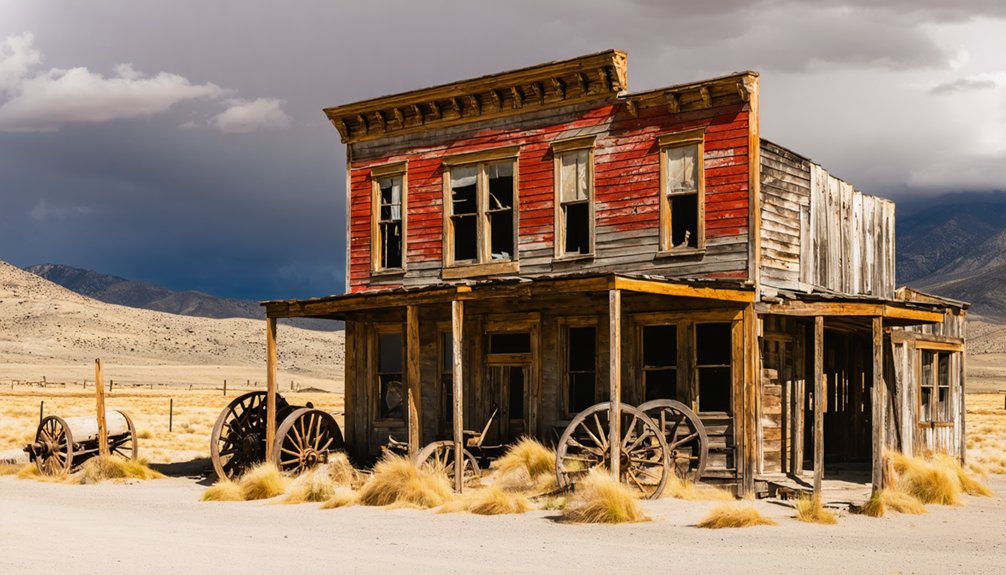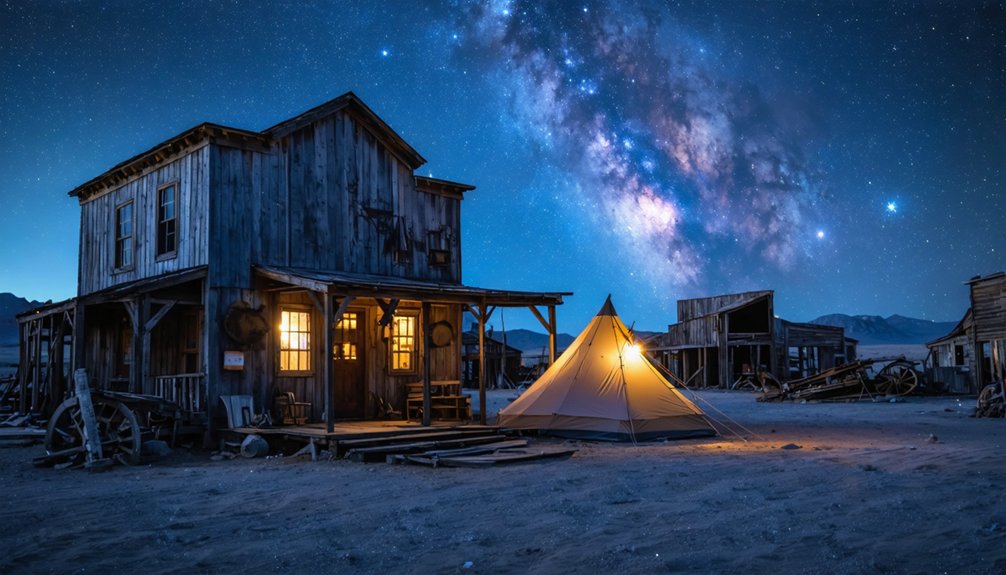
You’ll find exceptional overnight camping at Bannack State Park in Montana, where 60 historic buildings surround your campsite among gold rush relics. St. Elmo, Colorado offers a nearby campground at 9,961 feet elevation, while Terlingua, Texas lets you camp freely amid adobe ruins along Terlingua Creek. Garnet Ghost Town provides authentic wilderness camping with fire pits between weathered saloons. For developed amenities, Calico Ghost Town features established sites where you can explore mine tunnels by day and hear ghost stories echo through silver-mining ruins after dark—each location revealing its own shadowed history.
Key Takeaways
- Bannack State Park, Montana offers campgrounds with basic amenities and overnight rental tipis ranging from $30-$42 at this historic ghost town.
- Terlingua, Texas allows free camping amid mercury mining ruins with unrestricted exploration of adobe structures and historic sites.
- Garnet Ghost Town, Montana provides authentic camping among well-preserved 1880s buildings like Kelly’s Bar with fire pits and wilderness surroundings.
- Animas Forks, Colorado features dispersed camping along Engineer Pass at 11,200 feet elevation near weathered cabins and mining relics.
- Cerro Gordo, California offers rentals of historic houses at 8,500 feet, though remote access requires serious preparation and planning.
Bodie State Historic Park, California
Perched at 8,375 feet in California’s remote eastern Sierra Nevada, Bodie State Historic Park preserves one of the American West’s most authentic ghost towns—frozen in a state of “arrested decay” where weathered buildings still contain their original contents.
While you can’t camp within the park itself, nearby BLM lands offer dispersed camping where you’ll wake to views of ghost town architecture silhouetted against sunrise. The historic preservation approach here means wandering streets where miners once brawled, peering through dusty windows at forgotten furnishings and rusted tools.
You’ll find proper campgrounds at Bridgeport Reservoir (18 miles) or Twin Lakes (38 miles), but adventurous souls gravitate toward Bodie Bowl’s dispersed sites. If you bring your dog, keep them on a maximum 6-ft leash at all times and note they cannot enter the historic buildings. Given the dry, high-altitude conditions, strict fire regulations are enforced throughout the area.
Visit May through October when daytime temps hit the 70s—winter transforms access into a snowshoe expedition.
Terlingua, Texas
From California’s high-altitude preservation to Texas’s living ghost town, Terlingua sprawls across the Chihuahuan Desert like a sunbaked monument to boom-and-bust fortune.
Terlingua stands as a weathered testament to fortune’s fleeting grip on the unforgiving Chihuahuan Desert landscape.
You’ll wander through mercury mining ruins where 1,000 souls once extracted cinnabar, now reduced to crumbling adobe and rusted machinery.
The 1906 Howard Perry mansion looms over Boot Hill Cemetery, where local ghost stories whisper through mesquite branches during Day of the Dead campfires.
Historic preservation efforts saved these structures from bulldozers in the 1960s, transforming abandonment into opportunity.
You can pitch your tent amid the decay, exploring freely while Big Bend’s starfields blaze overhead.
The settlement originated along Terlingua Creek, possibly named for “three tongues” referencing the languages spoken or the creek’s forks before cinnabar discoveries transformed it into a mining district.
The annual chili cook-off draws 10,000 visitors to this off-grid community of 78 residents who’ve claimed the ruins as home, proving ghost towns needn’t stay dead.
Between explorations, you can browse local artwork at Earth and Fire Gallery, where paintings, pottery, and metalwork capture the desert’s stark beauty.
Calico Ghost Town, California
Where silver fever once pulled thousands into the Mojave’s rust-colored hills, Calico Ghost Town now beckons with the same promise—minus the backbreaking labor.
You’ll pitch your tent among buildings that once housed 1,200 fortune-seekers who extracted $20 million in silver between 1881 and the mid-1890s.
Walter Knott’s historical preservation transformed this authentic mining camp into California’s official Silver Rush Ghost Town.
You’ll explore the restored false-front saloons and general stores, venture into mine tunnels where prospectors once swung pickaxes, and watch gunfight reenactments under desert stars. The town features 500 historic mines that once produced the region’s silver wealth, with some accessible for modern exploration.
The visitor experiences here go beyond typical tourism—you’re sleeping where miners slept, walking their dusty streets, breathing freedom into a place that embodied the ultimate American gamble.
Between sundown and sunrise, you might encounter the legendary spirits of Lucy Lane or Tumbleweed Harris wandering the weathered boardwalks.
It’s ghost town immersion without the cholera.
St. Elmo, Colorado
At 9,961 feet in Colorado’s Sawatch Range, St. Elmo pulls you into 1880s mining history through its preserved architecture. You’ll wander past the general store, telegraph office, and schoolhouse that survived when 2,000 residents fled on the last train in 1922.
This National Historic District lets you pitch your tent at adjacent Iron City Campground, then explore 150+ mine claims on foot or ATV while chipmunks outnumber visitors.
County Road 162 brings you here year-round, sixteen miles west from Nathrop.
Haunting stories echo through structures that withstood decades of abandonment, though fire claimed six buildings in 2002. The Mary Murphy Mine, once shipping 50-75 tons of ore daily, stood as the area’s largest operation before depletion triggered the town’s decline.
You’re free to fish Chalk Creek’s waters and ride former mining roads turned trails, experiencing authentic Western isolation without sacrificing access. The town’s name comes from Saint Elmo, a popular 1866 novel that inspired numerous place names across America during the era.
Bannack State Park, Montana
Montana’s first territorial capital rises from the sagebrush plains at 5,837 feet, where 60 weathered structures stand along Grasshopper Creek as silent witnesses to the 1862 gold rush that birthed this boomtown.
You’ll find authentic freedom here, camping among preservation efforts that keep history tangible. Two campgrounds—Vigilante and Road Agent—offer 24-28 sites beneath cottonwood shade, plus a hike-in option along the creek.
Campground amenities include vault toilets, drinking water, and fire rings, though you’ll trade modern hookups for star-filled skies and coyote serenades. For a unique stay, rent one of the available tipis at $30 for Montana residents or $42 for non-residents.
Half the sites operate first-come, first-served, rewarding spontaneous adventurers. The park welcomes RVs up to 45 feet in select campsites, though electrical hookups remain unavailable.
Between exploring abandoned saloons and the territorial jail, you’ll sleep where prospectors once dreamed of striking it rich, their ghosts whispering through the sagebrush wind.
Panamint Valley, California
You’ll find Panamint Valley’s ghost towns scattered across a landscape scarred by silver and gold fever. Crumbling brick smokestacks and abandoned mine shafts tell stories of boom-and-bust desperation.
The remote Ballarat settlement offers free boondocking among weathered ruins and rusted machinery.
Meanwhile, the more ambitious can backpack overnight into Panamint City, perched at 6,500 feet in Surprise Canyon.
Beyond these primary sites, the valley’s endless BLM lands welcome dispersed camping. This gives you access to dozens of forgotten mining camps accessible only by washboard roads and hiking trails.
Mining History and Remnants
Silver ore glinting in the December sun changed everything when prospectors discovered it at the head of Surprise Canyon in 1872.
You’ll find remnants of the Wyoming Mine’s 2,600-foot aerial tramway, once hauling ore worth $600 per ton down steep canyon walls.
Historic landmarks include the 20-stamp mill site where ore averaged $80-$100 per ton during the 1875 boom.
Mining equipment still rusts along the trails—cable systems, ore carts, and weathered timbers from the Lewis Tunnel blasted in the 1920s.
The canyon walls bear witness to boom and bust: 2,000 souls worked claims worth millions before exhausted veins and an 1876 flash flood reclaimed this mile-high outpost.
Freedom-seekers’ll appreciate exploring without guardrails or gift shops.
Camping at Fayette Park
Tucked against Death Valley’s western edge at mile marker 10 on Highway 190, Panamint Springs Resort breaks the monotony of desert emptiness with 54 camping options spread across the scrubby valley floor. You’ll find everything from $15 tent sites to $75 canvas cabins, each positioned where miners once worked claims that left historical artifacts scattered through surrounding canyons.
The hookup sites run on diesel generators—fitting tribute to this mechanized ghost town clinging to existence.
Your mornings start with Father Crowley Vista‘s scenic viewpoints overlooking the valley’s northern reaches, while Darwin Falls beckons with rare desert water.
Night transforms the camp into an astronomical theater; darkness so complete you’ll understand why prospectors saw fortunes in these hills.
The resort’s services—showers, WiFi, cold beer—feel almost defiant against the surrounding wilderness.
Accessing the Dirt Road
Getting to Panamint Valley’s historic dirt roads demands more planning than throwing coordinates into your GPS and trusting the route. Navigation apps have already stranded travelers on primitive backcountry roads, leaving them with flat tires miles from help.
Your off road preparation starts with checking road condition updates—Lower Wildrose Road remains closed until Summer 2027 due to a 9-foot cut. Additionally, September’s floods damaged countless routes.
State Route 190 opens access to the western park, connecting to Panamint Valley Road, which evolves from pavement to graded gravel near 36.141N / 117.296W. You’ll need 31-inch tires minimum for technical sections, with proper ground clearance for rocky terrain.
Stock SUVs won’t cut it on these shelf roads and canyon passages where sharp rocks puncture unprepared vehicles.
Garnet Ghost Town, Montana
Deep in the Garnet Mountains of west central Montana, where winter snows pile six feet high and summer breezes carry whispers of forgotten fortunes, Garnet Ghost Town stands as Montana’s best-preserved relic of the gold rush era.
You’ll walk through authentic preserved structures that haven’t been sanitized for tourists—Kelly’s Bar, Dahl’s Saloon, and the J.R. Wells Hotel sit exactly where miners left them.
The ghost town architecture tells raw stories of nearly 1,000 residents who once supported 13 saloons and extracted millions in gold from surrounding peaks.
Sitting at 6,000 feet elevation, you’ll find freedom most tourists never experience: the chance to camp among genuine history, explore buildings on your own terms, and feel the weight of silence that settled here after the 1912 fire.
Grafton Ghost Town, Utah
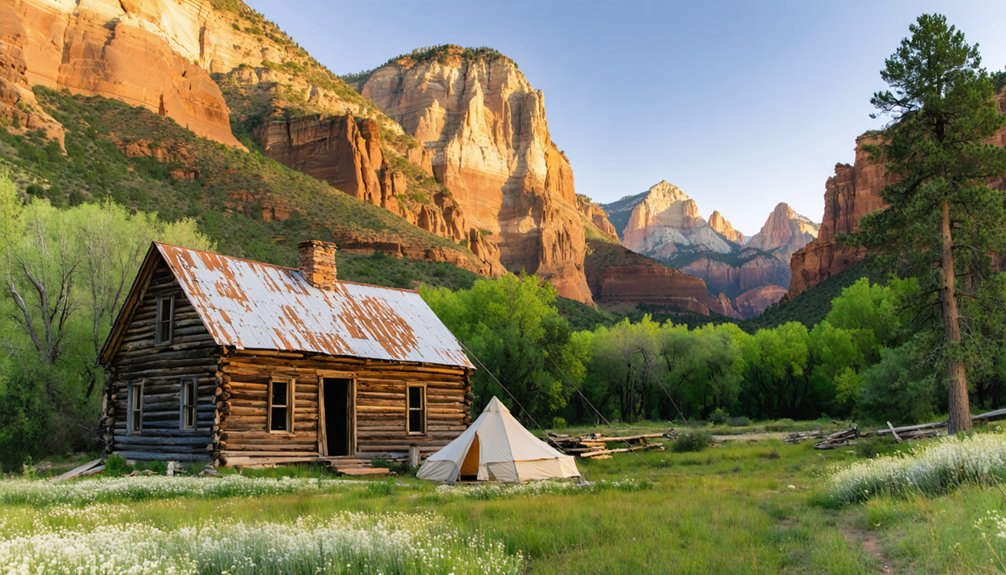
Where the Virgin River carves through red rock canyons just nine miles from Zion National Park‘s entrance, Grafton Ghost Town emerges from the cottonwoods like a sepia photograph come to life.
Founded in 1859 by Mormon pioneers, this settlement battled relentless floods and conflicts before its last residents departed in 1945.
You’ll wander among authentic pioneer architecture—the 1886 adobe schoolhouse, John Wood’s 1877 home, and a weathered cemetery enclosed by berry fencing.
While Grafton doesn’t offer designated camping within its boundaries, its commitment to historical preservation makes it the West’s most photographed ghost town.
The Grafton Heritage Partnership maintains this rare unrestored village where descendants still gather annually, and you’re free to explore the same dusty paths Butch Cassidy once rode.
Cerro Gordo, California
Perched 8,500 feet in the stark Inyo Mountains above Owens Lake, Cerro Gordo clings to the mountainside like a proof to silver-fueled ambition.
You’ll walk through thirty miles of tunnels where miners once extracted $500 million worth of ore using 1860s mining techniques—no modern conveniences, just determination and dynamite.
Today, you can rent the 1868 Belshaw House or 1904 Bunkhouse on this 337-acre private property, sleeping where prospectors once dreamed of striking it rich.
Water preservation remains critical here, just as it was when scarcity helped doom the town by 1938.
The general store-turned-museum and aerial tram remnants tell stories of 4,000 souls who once thrived here.
It’s raw, remote, and requires serious preparation to reach.
Animas Forks, Colorado
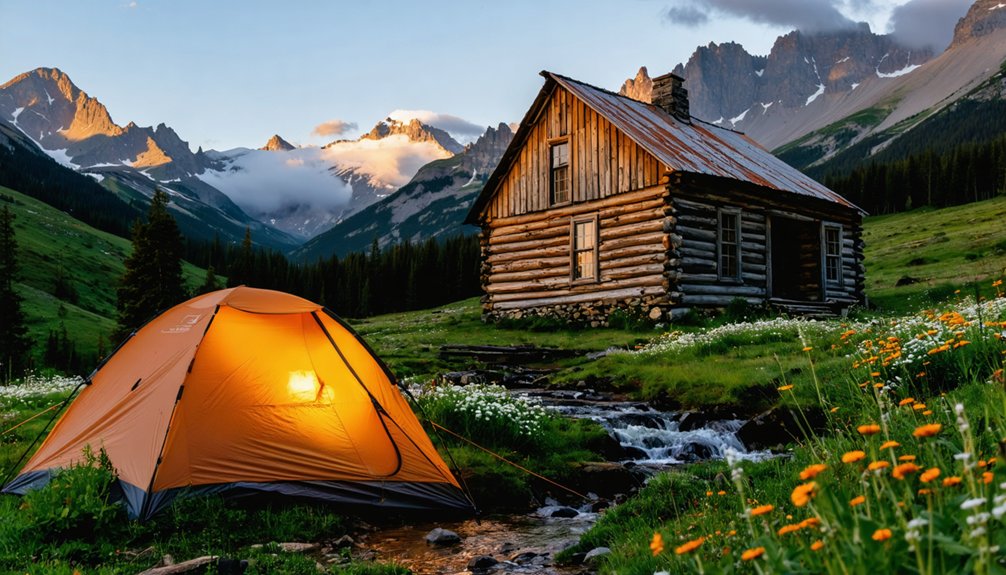
At 11,200 feet in Colorado’s San Juan Mountains, Animas Forks once thrived as a silver mining hub where 450 residents endured winters with snowdrifts reaching 25 feet.
You’ll find weathered cabins and the distinctive hip-roofed boarding house still standing among the ruins, preserved by the Bureau of Land Management as a tribute to the boom-and-bust era that ended in the 1920s.
The surrounding BLM lands welcome dispersed camping, letting you pitch your tent in the shadows of these high-altitude remnants accessible only by rugged 4WD roads.
High-Altitude Mining History
Among Colorado’s most dramatic ghost towns, Animas Forks clings to a mountainside at 11,200 feet above sea level, where snow can fall any month of the year and the wind cuts through valleys like a knife.
You’ll discover mining relics scattered across this remote terrain, where 400 souls once carved out existence among peaks reaching 14,000 feet.
What Made This Place Legendary:
- The Gold Prince Mill – A $500,000 behemoth built with Colorado’s first structural steel framework, standing as demonstration to silver boom ambition
- Eight Major Mines – Operations like Black Cross and Red Cloud extracted over 2 million ounces of gold from these unforgiving mountains
- High altitude camping among authentic structures including Duncan House and the original jail
Nature ultimately reclaimed what miners couldn’t hold, creating your perfect backcountry escape.
Nearby Camping Options
Your basecamp options radiate outward from Animas Forks like spokes on a wagon wheel, each offering distinct advantages for exploring this 11,200-foot ghost town.
Dispersed sites dot Engineer Pass’s upper reaches, where you’ll pitch your tent without neighbors or restrictions—just raw mountain solitude punctuated by wildlife encounters at dawn.
The Lower Engineer section provides additional free camping along Mineral Creek’s rush.
For creature comforts after ghost-hunting, developed campgrounds near Durango deliver hot showers and fire pits beneath ponderosa pines.
Local legends whisper through these mountains after dark, whether you’re sleeping rough on public land or settled into Cascade Wagon Road‘s amenities.
Weekend spots fill fast during peak season, so arrive early or reserve ahead at established sites.
Frequently Asked Questions
What Safety Precautions Should I Take When Camping Near Ghost Towns?
You’ll need to respect historical preservation while avoiding unstable structures and ghost town relics. Check your vehicle thoroughly, secure your campsite away from wildlife paths, maintain proper fire distance, and keep emergency communications ready for remote exploration.
Are Ghost Town Campsites Accessible for RVS and Large Vehicles?
Where there’s a will, there’s a way—many ghost town campsites welcome your RV despite accessibility challenges from rough terrain. Historical preservation efforts sometimes limit modifications, but destinations like Calico accommodate big rigs beautifully with full hookups awaiting.
Do I Need Permits or Reservations for Overnight Camping Near Ghost Towns?
You’ll need permits for National Park ghost towns and reservations for groups at Calico, but BLM dispersed camping stays wonderfully free. Camping regulations balance historical preservation with your independence—just respect stay limits and fire restrictions during your adventure.
What Wildlife Should I Watch for When Camping in These Areas?
Oatman’s 50 free-roaming burros will approach your camp seeking handouts. You’ll need wildlife photography equipment ready while maintaining animal safety distance from territorial burros, curious otters, and nocturnal scavengers exploring ghost town ruins after dark.
Are Campfires Allowed at Ghost Town Camping Locations?
Campfire regulations vary by location and current fire restrictions. You’ll need designated fire rings or elevated containers, following fire safety tips like maintaining clearance and never leaving flames unattended. Check local restrictions before striking that match.
References
- https://www.hipcamp.com/journal/camping/ghost-town-camping/
- https://www.truckcampermagazine.com/expeditions/united-states/exploring-ghost-towns-with-a-camper/
- https://www.ecoflow.com/us/blog/haunted-outdoor-ghost-towns-spooky-campsites
- https://www.youtube.com/watch?v=FbfBnySs2gQ
- https://woodallscm.com/2020-campcalnow-guide-focuses-on-ghost-towns/
- https://www.gorving.com/tips-inspiration/travel-guides/go-rving-these-western-ghost-towns
- https://www.mensjournal.com/travel/13-ghost-town-campsites
- https://www.nps.gov/deva/learn/historyculture/death-valley-ghost-towns.htm
- https://www.campscanner.com/parks/california/bodie-state-historic-park-in-ca
- https://www.parks.ca.gov/?page_id=31352