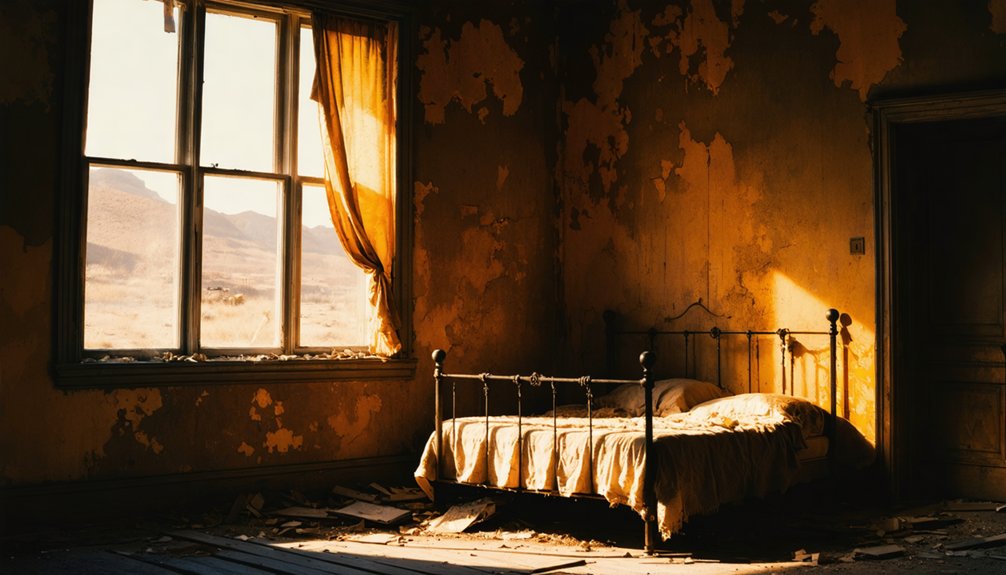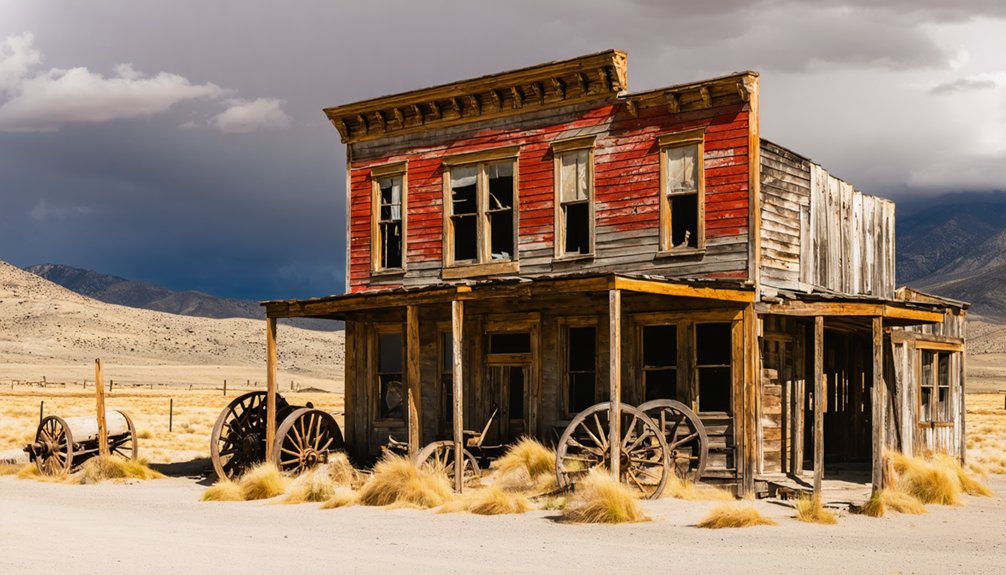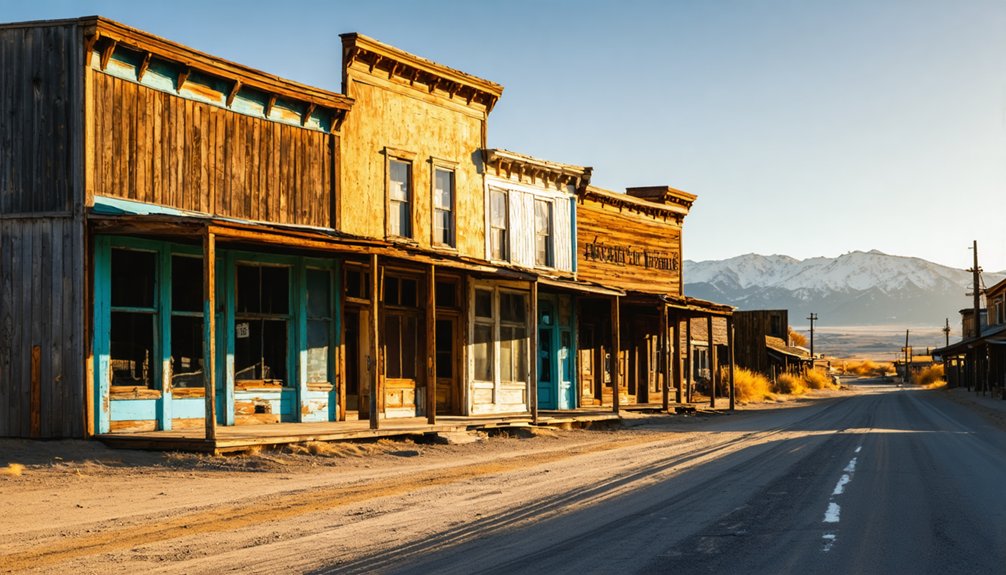
You’ll find America’s best-preserved ghost towns at Bodie, California, where 170 structures remain untouched since 1942 in “arrested decay,” and Virginia City, Nevada, home to the six-story 1877 International Hotel with its original elevator. St. Elmo, Colorado maintains 43 authentic 1880s wood-frame buildings at 10,000 feet elevation, while Bannack, Montana preserves its original frontier architecture as Montana’s first territorial capital. Each site offers architecturally intact buildings frozen at their moment of abandonment, revealing the precise details of 19th-century mining life that await your exploration.
Key Takeaways
- Bodie, California preserves over 2,000 buildings in arrested decay, maintained exactly as residents left them in 1942.
- Virginia City, Nevada features intact 1860s-1870s structures including the six-story International Hotel with Nevada’s first elevator.
- St. Elmo, Colorado contains 43 original wood-frame structures from the 1880s-1890s within a National Register Historic District.
- Bannack, Montana maintains original frontier architecture as Montana’s first territorial capital within a state park setting.
- Preservation techniques focus on arrested decay and maintaining authenticity rather than reconstruction, keeping structures frozen in time.
Bodie, California: A Frozen Snapshot of the Gold Rush Era
When Waterman S. Body discovered gold in 1859 north of Mono Lake, he couldn’t have imagined his mining town would become California’s most authentically preserved ghost settlement. You’ll find Bodie perched at 8,379 feet in the Sierra Nevada, where over 100 original structures stand in “arrested decay”—neither restored nor reconstructed.
Gold discovery transformed this remote outpost into a bustling community of nearly 10,000 residents by the late 1870s, supporting 2,000 buildings and 65 saloons. The town earned such a violent reputation that a bad man from Bodie became a common phrase throughout the American West.
Mining towns typically vanish completely, but Bodie’s isolation proved its salvation. The 1879 Boone Store still displays miners’ supplies on original shelves, while the 1882 Methodist Church awaits congregants who’ll never return. The Miners Union Hall, built in 1878, served as the social heart of the community, hosting everything from dances to religious services.
You’re witnessing history exactly as residents abandoned it in 1942.
St. Elmo, Colorado: Rocky Mountain Mining Heritage Preserved
You’ll find 43 original wood-frame structures from the 1880s-1890s standing in St. Elmo’s Chalk Creek Canyon, forming a National Register Historic District since 1979.
This Colorado mining town reached 2,000 residents during its 1880-1920s silver boom, leaving behind the 1885 Home Comfort Hotel, 1892 Miners Exchange Building, and a fully preserved schoolhouse.
The town’s elevation at 10,000 feet creates dramatic photographic contrasts between weathered pine facades and the surrounding Rocky Mountain peaks.
The Mary Murphy Mine, the area’s largest operation, shipped 50-75 tons of ore daily to smelters during the boom years.
The Stark family purchased and preserved many of St. Elmo’s Victorian-era buildings, with descendants later donating them to Historic St. Elmo, Inc for restoration.
Original Structures Stand Intact
Along Main Street in St. Elmo, you’ll find 43 original wood-frame structures standing exactly where miners built them in the 1880s-1890s. You’re free to walk through the general store, blacksmith, livery, American House Hotel, undertaker’s parlor, and schoolhouse—each maintaining its Victorian-era architecture and preserved interiors.
Preservation techniques employed by Historic St. Elmo, Inc. focus on authentic representation rather than reconstruction. The 2002 fire that destroyed the town hall tested these efforts, yet original buildings survived through proper restoration challenges management.
Despite common timber-structure fire risks, key landmarks like the Home Comfort Hotel and Heyle Cottage (1881) remain intact. The town sits at an elevation of 9,961 feet in the Sawatch Range, accessible via Highway 162 west of Nathrop. The St. Elmo General Store operates seasonally from May to September, offering souvenirs, antiques, and refreshments to visitors. Your contributions through on-site tubes or online donations directly fund ongoing preservation work at this National Register site.
Peak Mining Era History
After prospectors Abner Wright and John Royal discovered silver in Chalk Creek Canyon’s Mary Murphy Mine site in 1875, the settlement they called Forest City transformed into St. Elmo when Griffith Evans renamed it in 1880.
You’ll find this town peaked dramatically after the Denver, South Park & Pacific Railroad arrived in 1881, swelling the population to 2,000.
The Mary Murphy Mine’s mining technology advanced rapidly, extracting 70-100 tons daily with stamp mills and water flumes, employing over 250 men.
Five restaurants, three hotels, and two sawmills served the booming community.
Despite devastating fires in 1898-1899 and the Alpine Tunnel’s 1910 closure, town revitalization efforts emerged when miners struck a 25-foot ore body in 1912, sparking renewed activity until final closure in 1926.
The town’s scenic mountain location attracted tourists since the 1880s, with visitors enjoying hot springs and sleigh rides that helped sustain St. Elmo beyond its mining era.
The mine’s unique placement on a mountaintop 2,000 feet above the railroad required specialized transportation systems to move ore down to the valley for processing at Alpine smelters.
Photographer’s Mountain Paradise
Nestled 20 miles southwest of Buena Vista in Colorado’s Sawatch Range, St. Elmo delivers unparalleled photographic opportunities you won’t find elsewhere. The 43 National Register buildings from the 1880s-1890s create authentic backdrops for mountain sunrise photography, when golden light transforms weathered timber facades into visual masterpieces.
Your camera captures three distinct preservation achievements:
- Home Comfort Hotel (1885) – Original Victorian architecture frames wildflower migration patterns each July.
- Minor Exchange Building (1892) – Former bank’s deteriorated facade contrasts dramatically with Colorado’s alpine peaks.
- Pat Hurley’s Hall (1892) – Authentic dancehall structure provides period-accurate mining camp context.
You’ll access this photographer’s paradise via improved roads requiring no special permits or restrictions. The town’s origins trace back to prospectors Abner Ellis Wright and John Royal, who discovered a silver vein near Chalk Creek in 1875, transforming the location initially called Forest City into the thriving mining settlement now preserved for documentation. During its peak, St. Elmo supported 150 patented mine claims that fueled the community’s prosperity. The privately-owned structures maintain historical integrity while you’re free to explore, document, and interpret Colorado’s mining heritage independently.
Virginia City, Nevada: The Comstock Lode’s Living Legacy
You’ll find Virginia City stands as one of the West’s most architecturally intact boomtowns, with its 1860s-1870s buildings surviving the catastrophic 1875 fire that destroyed 75% of the settlement.
The town’s six-story International Hotel, featuring the region’s first “rising room” elevator, exemplifies the sophisticated urban infrastructure that emerged from the Comstock Lode’s $230 million silver output.
Today, you can walk past 110 saloon sites, 20 theater locations, and operational sections of the 1873 Marlette Lake Water System—once the world’s highest-pressure municipal water supply.
Historic Architecture and Structures
Virginia City’s designation as a National Historic Landmark in 1961 recognizes what remains the American West’s most complete silver boomtown. Over two million visitors annually walk streets lined with structures that have stood since the 1860s and 1870s. After the 1875 fire left 8,000 homeless, restoration techniques enabled reconstruction within twelve months, preserving the town’s architectural detailing through the rebuilt six-story International Hotel featuring Nevada’s first elevator.
The preserved landscape showcases:
- Commercial infrastructure – Assay offices, banks, livery stables, and over 100 saloons maintained their original 1864 street grid
- Civic monuments – Opera houses, churches like St. Paul’s, hospitals, and schools funded by $400 million in silver extraction
- Engineering marvels – Hermann Schussler’s 1873 Marlette Lake water system, still operational with its original wrought iron pipes spanning twelve miles
Mining Heritage and Museums
Beyond the architectural streetscapes, Virginia City’s mining heritage materializes through preserved underground workings and operational museums that document the Comstock Lode’s transformation from June 1859 surface diggings into industrialized extraction networks.
You’ll explore authentic mining techniques at Chollar Mine Tours, where tunnels reveal methods that extracted $17 million over eight decades.
The Comstock Gold Mill demonstrates complete ore processing sequences through its functioning 1860s stamp mill, operating May through October with narrated demonstrations showing ore-to-gold conversion.
These preservation sites contextualize the district’s $400 million output across two decades, when over 200 mills processed high-grade ore assaying $3,876 per ton.
Underground access and mechanical demonstrations provide unmediated encounters with extraction systems that powered Virginia City’s twenty-year boom from 1859 through peak production years.
Active Tourist Destination Today
Despite its designation as a ghost town, Virginia City operates as Nevada’s most actively visited 19th-century settlement, where 1.5 million annual tourists engage with preserved infrastructure through operating railways, underground mine access, and functional historic venues.
Modern preservation efforts maintain authentic experiences you’ll discover freely:
- Virginia & Truckee Railroad runs 35-minute excursions through Tunnel 4, connecting visitors to operational 1870s engineering while narrating Comstock history past bonanza mine ruins.
- Chollar and Ponderosa Mines provide underground access at 400-foot and 300-foot levels, showcasing original square-set timbering and 300+ antique equipment pieces from working extraction operations.
- Piper’s Opera House (built 1885) continues hosting performances after 150 years, demonstrating sustained functionality rather than static museum preservation.
Tourist engagement extends through International Camel Races, World Championship Outhouse Races, and ten operational saloons maintaining their original 19th-century purposes.
Calico, California: Restored Desert Silver Town
When silver prospectors discovered rich ore deposits in the Mojave Desert hills in 1881, they sparked California’s largest silver strike and established what would become Calico.
You’ll find a town that extracted over $20 million in silver from 500 mines before its 1890s abandonment.
Walter Knott’s 1950s acquisition initiated meticulous historical preservation, restoring structures to their 1880s appearance across these stark desert landscapes.
Five original buildings survive: Lane’s General Store, Lil’s Saloon, the Zenda Mining Company museum, and Calico Park Office.
Reconstructions include the distinctive Bottle House, built from thousands of glass bottles, and the two-story Cosmopolitan Hotel.
Since its 1966 donation to San Bernardino County, you’re free to explore this State Historical Landmark 782, experiencing authentic frontier architecture without modern restrictions.
Bannack, Montana: The West’s Most Notorious Gold Camp
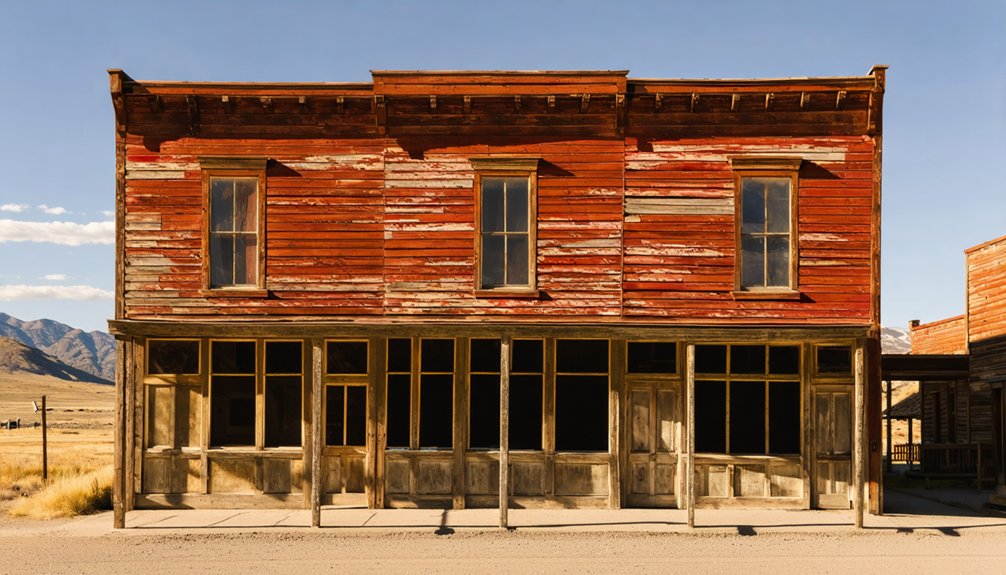
On July 28, 1862, John White and his party of Pikes Peakers extracted extraordinarily pure gold—measuring 99 to 99.5% versus the typical 95%—from Grasshopper Creek, triggering what contemporaries called “the greatest rush to the West” since California’s 1849 strike.
Bannack’s population exploded from 400 to 5,000 within months, establishing Montana Territory’s first capital in December 1864.
Gold mining’s rapid progression through Bannack:
- 1862-1863: Miners erected tents, dugouts, and shanties overnight, earning $8 daily from placer deposits
- 1864-1870: Easy diggings exhausted; territorial capital relocated to Virginia City by 1865
- 1895-1940s: Dredge boats worked 40-foot depths until final residents departed
Montana’s ghost town preservation efforts since the 1960s maintain Bannack State Park‘s original structures, offering you unobstructed views into authentic frontier architecture.
Batsto Village, New Jersey: Colonial Iron Industry Relic
While Western gold camps dominated the 1860s frontier narrative, Colonial America’s industrial heartland was already producing iron essential to the nation’s birth. You’ll find Batsto Village’s 1766 origins preserved through forty structures demonstrating bog iron smelting technology.
Batsto Village stands as testament to Colonial iron production that forged America’s industrial independence decades before Western expansion captured public imagination.
The site’s industrial relics include the original furnace, worker cottages, and Joseph Wharton’s 36-room Italianate mansion with tower. Revolutionary War-era operations utilized Batsto River water power and Pine Barrens charcoal.
New Jersey’s 1954-1955 acquisition implemented preservation techniques maintaining blacksmith shops, gristmill, and general store exactly as residents left them in 1989. The Richards manor survived an 1874 fire, now anchoring this National Register site.
You can explore self-sustaining operations spanning wheelwright facilities to Lake Batsto’s sunken ore boat—250 years of American independence frozen in architectural detail.
What Makes These Ghost Towns Stand Out Among Abandoned Settlements
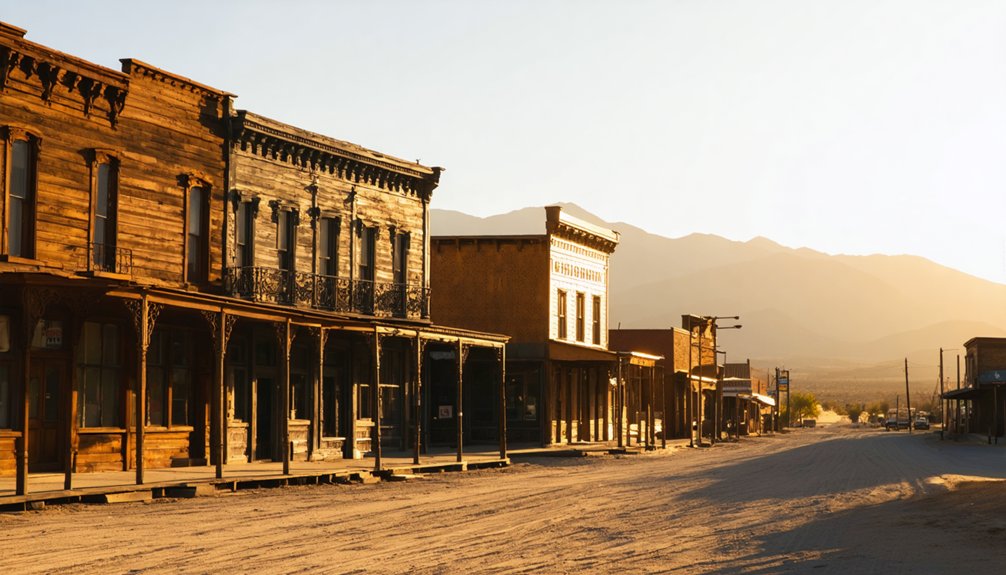
Authentic preservation distinguishes America’s premier ghost towns from deteriorated ruins through rigorous “arrested decay” protocols that maintain structural integrity without modern restoration. You’ll find structures frozen in time—kitchen tables set for meals never eaten, mine equipment abandoned mid-shift in 1942, and original storefronts untouched since the 1880s.
Modern preservation techniques protect these sites while refusing artificial reconstruction that’d compromise their cultural significance.
What Sets These Towns Apart:
- Unaltered interiors where you peer through windows at genuine 19th-century possessions exactly where miners left them
- State park protection preventing commercial development while maintaining free public access to authentic frontier architecture
- Documented histories of violence, prosperity, and sudden abandonment that you’ll experience through preserved physical evidence rather than reconstructed attractions
Planning Your Visit to America’s Best-Preserved Ghost Towns
Before you pack your camera and hiking boots, strategic planning transforms ghost town visits from disappointing detours into immersive historical experiences.
Spring and fall offer ideal conditions when mild temperatures let you explore without weather constraints. You’ll need sturdy footwear for uneven terrain, plus water and sun protection since shade remains scarce at most sites.
Pack essentials for exposed terrain: durable boots handle unstable ground while ample water and sun protection combat the relentless elements.
Bodie’s 110 structures showcase preservation challenges—interiors frozen since the 1910s mining collapse require careful maintenance against urban decay.
Summer brings 50-minute ranger tours and extended ghost tours, while Grafton provides year-round access with unrestricted walking paths.
St. Elmo’s Rocky Mountain location peaks during summer months, and Virginia City operates as a living museum where you’ll access mines, wooden sidewalks, and saloons without guided restrictions limiting your exploration.
Frequently Asked Questions
Can Visitors Stay Overnight in Any of These Ghost Towns?
You’ll find overnight accommodations at St. Elmo’s 2007-built guest house, Gold Point’s restored 1860s miner cabins, and Calico’s campground. These tourist amenities let you experience authentic ghost town history while supporting preservation efforts through your stay.
Are the Preserved Buildings Protected From Weather Damage and Deterioration?
Like ancient Sumerian builders, you’ll find modern caretakers employ weatherproofing techniques including foundation sealing and compatible materials. Restoration policies mandate regular maintenance, ember-resistant vents, and non-combustible zones, ensuring these abandoned structures withstand nature’s relentless assault.
Which Ghost Town Has the Most Documented Paranormal Activity?
Bannack Ghost Town holds the most documented paranormal activity, with historical legends spanning from 1862. You’ll find paranormal sightings including Dorothy’s apparition, executed outlaws’ spirits, and infant ghosts from epidemic eras—all meticulously recorded throughout its preserved structures.
Many visitors are drawn to historic cemeteries in ghost towns, where the stories of those who once lived there intertwine with the haunting atmosphere. These burial grounds often reflect the cultural and historical significance of their surroundings, providing a unique glimpse into the past. It’s not uncommon for explorers to report eerie sensations and glimpses of the past as they wander through these silent witnesses to history.
Do Any Ghost Towns Charge Entrance Fees or Require Reservations?
Yes, you’ll find varied ticket policies among preserved ghost towns. Vulture City charges $18 general admission, while Bodie’s $8 entrance uses self-pay envelopes. Reservation systems apply for specialized tours—Goldfield’s Ghost Walks require advance booking through BodieFoundation.org.
What Photography Equipment Works Best for Capturing Ghost Town Structures?
Masterful mirrorless cameras like Sony a7R III excel in historical photography of deteriorating structures. You’ll capture chronologically precise architectural details using wide-angle lenses (16-35mm f/2.8), sturdy tripods for low-light preservation documentation, and equipment recommendations emphasizing full-frame sensors for unrestricted exploration.
References
- https://www.christywanders.com/2024/08/top-ghost-towns-for-history-buffs.html
- https://www.visittheusa.com/experience/5-us-ghost-towns-you-must-see
- https://www.geotab.com/ghost-towns/
- https://www.atlasobscura.com/lists/americas-best-preserved-ghost-towns
- https://www.youtube.com/shorts/4RfA-O8xteE
- https://www.youtube.com/watch?v=2Foz-2R_mH8
- https://www.nps.gov/places/bodie-historic-district.htm
- https://www.exploratography.com/blog-cal/dxan8zo55mm3dq325qd8yhi7s0e0qi
- https://www.snowcreekresort.com/blog/bone-chilling-history-bodie-ghost-town/
- https://www.parks.ca.gov/?page_id=26330