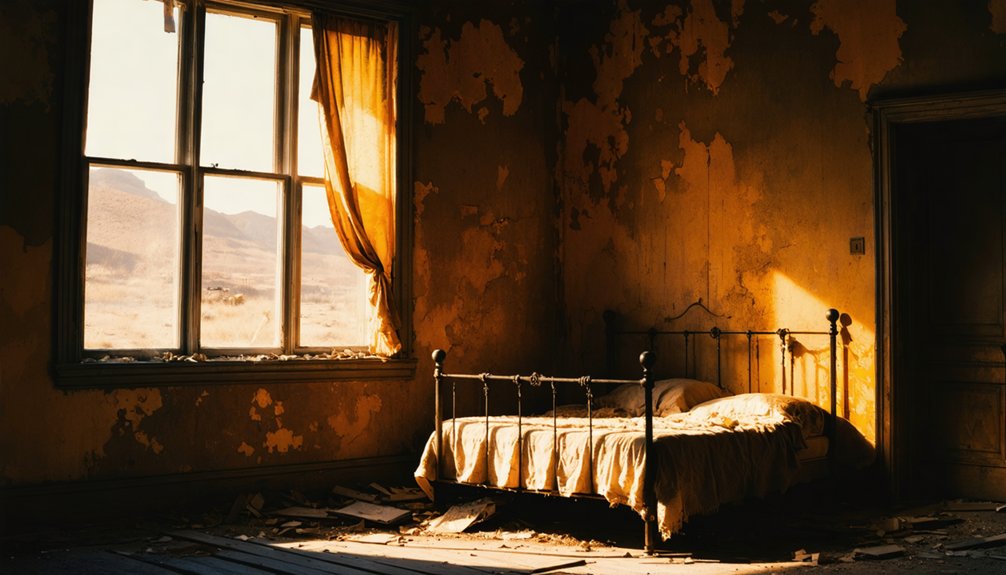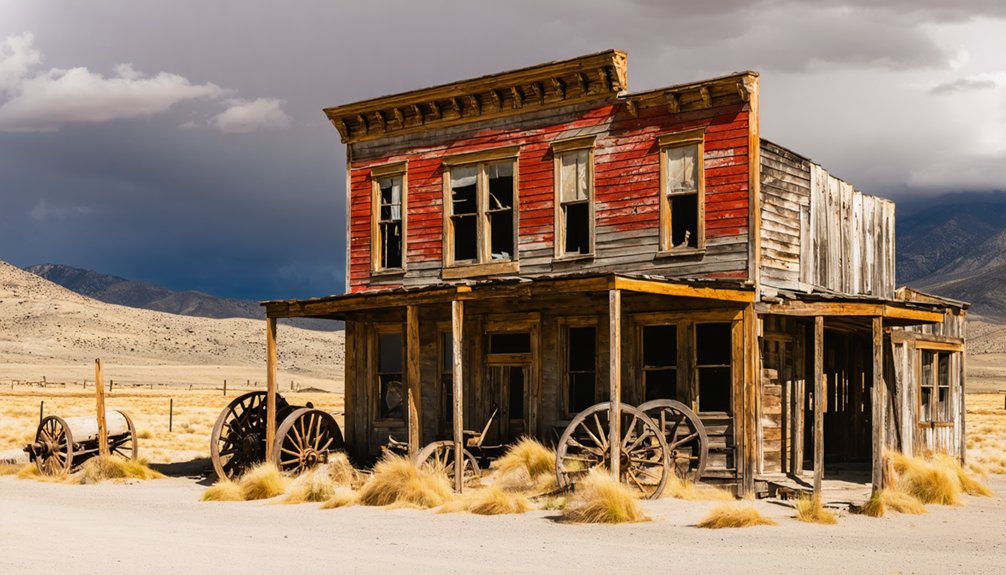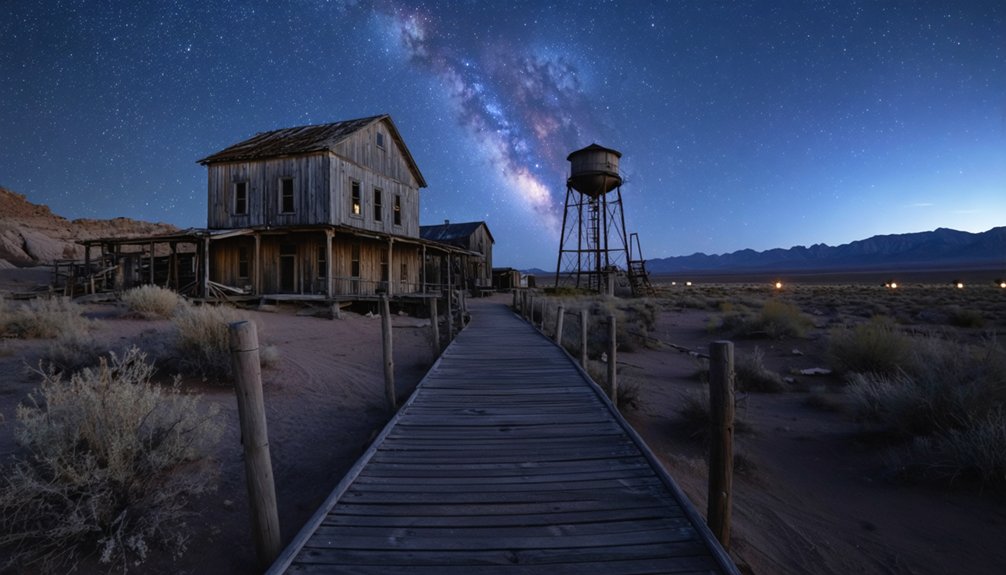
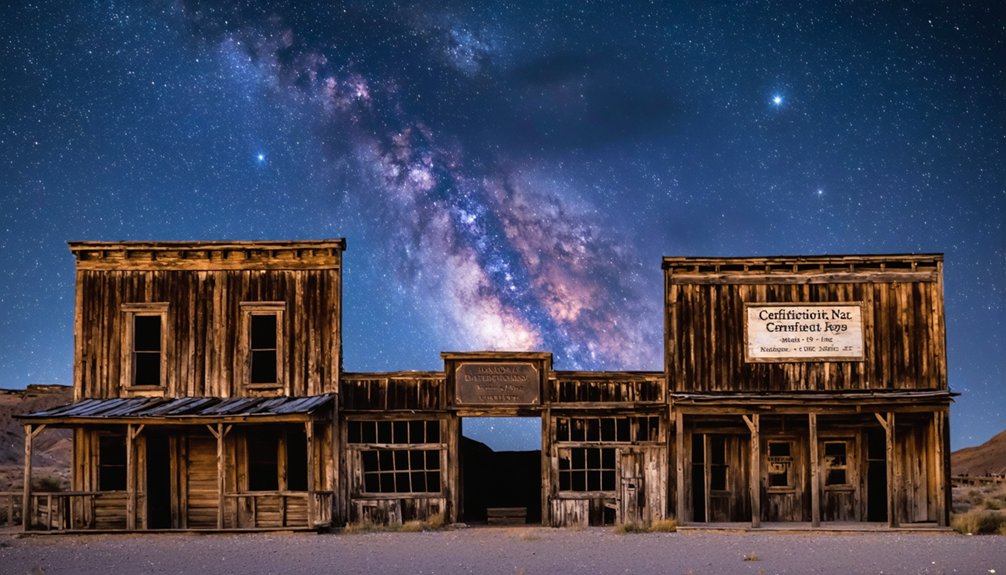
You’ll discover exceptional stargazing at Nevada’s Belmont Ghost Town near Massacre Rim Dark Sky Sanctuary, where 101,000 protected acres offer Bortle Class 1 darkness with zero light pollution. Berlin-Ichthyosaur State Park combines preserved 1911-era mining structures with pristine night skies at 6,840-7,880 feet elevation. South Dakota’s Black Hills-Badlands corridor features Spokane Ghost Town alongside Bortle Class 2 conditions, while California’s Leadfield and Nevada’s Rhyolite provide early 20th-century mining relics beneath certified dark sky zones. These locations meet International Dark-Sky Association standards of ≤20 magnitudes per arcsecond² sky brightness, with extensive details on access routes, camping options, and certification criteria available below.
Key Takeaways
- Belmont Ghost Town, a former Nevada mining town established in 1865, sits near Massacre Rim Dark Sky Sanctuary’s pristine darkness.
- Berlin-Ichthyosaur State Park preserves Nevada’s only arrested-decay ghost town alongside excellent stargazing opportunities in remote settings.
- Rhyolite, Nevada and Leadfield, California are early 20th-century mining towns located near dark sky areas ideal for astrophotography.
- South Dakota’s Spokane Ghost Town near Custer offers 1890s mining history with Bortle Class 2 dark sky conditions.
- Badlands National Park combines historical structures like saloons and churches with exceptional night sky visibility for astronomical observation.
Belmont Ghost Town and Massacre Rim Dark Sky Sanctuary, Nevada
When prospectors discovered silver ore in 1865 within the surrounding hills, they catalyzed Belmont’s transformation from a tent-based mining camp into a structured municipality that would serve as Nye County seat from 1867 to 1905.
You’ll find the 1876 courthouse and Monitor-Belmont Mill remnants preserving mining history among stone structures that’ve withstood 150+ years.
The town peaked at 2,000 residents during the 1870s before mines depleted by 1887.
Indigenous peoples had utilized this landscape for seasonal travel and resource gathering long before mining altered the terrain.
Belmont is completely off the grid, with no nearby electricity, gas stations, or food services available to visitors.
Today, you’re positioned near Massacre Rim Dark Sky Sanctuary, where minimal light pollution creates ideal stargazing conditions.
Following stargazing tips, you’ll explore the preserved ruins during daylight, then observe astronomical phenomena after dark.
This remote desert location offers unrestricted access to both cultural heritage sites and pristine nocturnal skies—combining historical exploration with astronomical observation autonomously.
Berlin-Ichthyosaur State Park: Where Prehistoric Meets Pioneer History
At Berlin-Ichthyosaur State Park, you’ll encounter Nevada’s only ghost town preserved through arrested decay—a conservation method maintaining structures in their exact state of deterioration since abandonment in 1911.
The adjacent Fossil House protects approximately 40 Shonisaurus popularis specimens, marine reptiles measuring up to 50 feet that inhabited warm Triassic oceans 225 million years ago.
This National Natural Landmark grants you direct access to North America’s most abundant concentration of the largest-known ichthyosaur remains, displayed in situ within a climate-controlled barn constructed specifically for fossil preservation.
The park’s 1,540 acres span elevations from 6,840 to 7,880 feet, where hillsides covered with big sagebrush transition to pinyon pine and Utah juniper at higher altitudes. Shonisaurus popularis became Nevada’s state fossil in 1977, cementing the park’s significance in paleontological history.
Arrested Decay Preservation Method
Since 1955, Berlin-Ichthyosaur State Park has pioneered the arrested decay preservation philosophy, maintaining both prehistoric fossils and pioneer-era structures in their found condition rather than removing them to museums or allowing natural deterioration.
You’ll find ichthyosaur skeletons exposed in situ under protective barn structures, while Berlin’s 1890s buildings stand with original interiors viewable through windows or controlled access points.
The fossil excavation process employs sandblasting to remove limestone deposits without damaging bone integrity.
Preservation techniques include sealing specimens with vinac—polyester resin dissolved in acetone—protecting against environmental degradation.
Modern documentation utilizes laser scanning, LiDAR, and photogrammetry for research accuracy.
The site houses nearly 40 ichthyosaurs in a 217-million-year-old fossil bed first discovered in 1928.
Berlin’s ore mill, blacksmith shop, and mine headworks remain accessible, though you’re prohibited from disturbing any features.
The park offers guided mine tours that cover approximately 500 feet into a tunnel connected to the Berlin Mine during non-winter months.
This federal-state partnership preserves your freedom to experience authentic historical and paleontological resources simultaneously.
Ichthyosaur Fossils and Access
Beneath the protective Fossil House structure, you’ll encounter North America’s most concentrated assemblage of Shonisaurus popularis remains—nearly 40 specimens ranging from 2 to 50 feet in length. These fossils are preserved in situ on exposed Triassic bedrock dating back to 225 million years ago.
This fossil preservation site, designated Nevada’s state fossil in 1977, requires no permits for visitation.
Access Routes to Berlin-Ichthyosaur:
- From Fallon: Highway 50 to SR 361 south, then SR 844 east
- From Hawthorne (75 miles): Highway 95 to Luning, SR 361 north, then SR 844
- Final approach: Well-maintained dirt road suitable for standard vehicles
- Park status: Open 24/7/365; guided tours non-winter months
While dinosaur footprints capture terrestrial Mesozoic life, these marine reptiles document ancient ocean ecosystems. The fossils originated within the Luning Formation, a geological unit that preserves marine environments from approximately 217 million years ago. These carnivorous marine reptiles hunted mollusks with their distinctive toothed snouts, exhibiting highly specialized adaptations for aquatic life.
Collection requires permits; report discoveries to park staff.
Understanding Dark Sky Sanctuary Designations and Global Standards
When you visit ghost towns near dark sky preserves, you’re experiencing sites protected under three distinct International Dark-Sky Association designations that cover varying land sizes and management structures.
Exploring the remnants of ghost towns across the United States offers a unique glimpse into the past, showcasing the stories and histories left behind. Each site reveals the challenges faced by former residents, from economic downturns to natural disasters, leaving behind a haunting beauty in the landscape. As you wander these forgotten places, the starry skies above provide a breathtaking backdrop, enhancing the experience of stepping back in time.
Sanctuary status protects fragile or remote nocturnal environments without minimum area requirements, while Reserve designation demands at least 700 square kilometers with 80% peripheral zone participation in light pollution mitigation.
Currently, 22 Reserves exist worldwide (15 in Europe), compared to 127 Parks globally (89 in the USA, 25 in Europe), each maintaining sky brightness standards measured at 20 magnitudes per square arcsecond or darker.
These designations serve as recognition awards modeled after UNESCO World Heritage Sites and Biosphere Reserves, providing international acknowledgment of exceptional night sky protection efforts.
Communities surrounding these dark sky areas must adopt strong outdoor lighting ordinances that mandate full shielding and warm color temperature limits to maintain designation standards.
Global Certification Requirements Explained
DarkSky International administers five distinct certification categories that recognize exceptional nighttime environments through measurable standards and management criteria.
You’ll find each designation targets specific landscapes—from remote wilderness Sanctuaries requiring 21.5 magnitude zenith readings to Parks maintaining 20 magnitudes per square arc second.
The certification process demands concrete commitments to sky quality through enforceable lighting regulations.
Your path to certification involves four critical benchmarks:
- Sky Quality Measurements: Document darkness levels meeting category-specific thresholds through regular monitoring protocols.
- Lighting Management Plan: Achieve 90% fixture compliance within five years using fully shielded, warm-toned (≤3000K) sources.
- Legal Protection: Secure permanent conservation status for scientific, natural, or public enjoyment purposes.
- Annual Reporting: Submit ongoing data on monitoring results, outreach initiatives, and compliance metrics to maintain certification status.
Protected Land Coverage Statistics
As dark sky certifications expand across continents, protected land coverage reveals distinct patterns in how nations preserve nighttime environments. You’ll find 201 certified Dark Sky Places globally as of January 2023, encompassing 115 Parks, 20 Reserves, 38 Communities, 16 Sanctuaries, 6 Urban Night Sky Places, and 6 Developments of Distinction.
Sky preservation varies dramatically by designation—from Goosenecks’ compact 40 hectares to Katahdin Woods’ expansive 35,400 hectares. Utah demonstrates concentrated land protection, hosting six Parks totaling approximately 63,882 hectares.
Parks exceeding 50,000 hectares can designate portions for certification, maximizing protected zones. Reserve core areas meet minimum criteria while peripheral zones buffer against encroaching light pollution.
This tiered approach lets you safeguard darkness across diverse landscapes, from isolated Sanctuaries to urban interfaces.
What Makes Massacre Rim One of Earth’s Darkest Places
Rising 1,200 feet above Long Valley in northern Washoe County, Massacre Rim stands as one of the darkest locations on Earth—a distinction verified by its 2019 designation as an International Dark Sky Sanctuary.
You’ll experience unparalleled darkness resulting from:
- Zero surrounding light interference across 101,000 protected acres
- Stars casting visible shadows on moonless nights
- Clear high desert air at elevations reaching 6,800 feet
- Remote positioning 150+ miles from major urban centers
This pristine nocturnal environment enables advanced astrophotography techniques without light pollution filters while supporting essential nocturnal wildlife observations. Scientists have discovered previously unknown Milky Way structures here.
You’ll find complete freedom to explore the cosmos from this wilderness study area, where thousands of acres of surrounding sagebrush buffer against encroaching development.
Ghost Towns Beyond Nevada: South Dakota and Death Valley Destinations
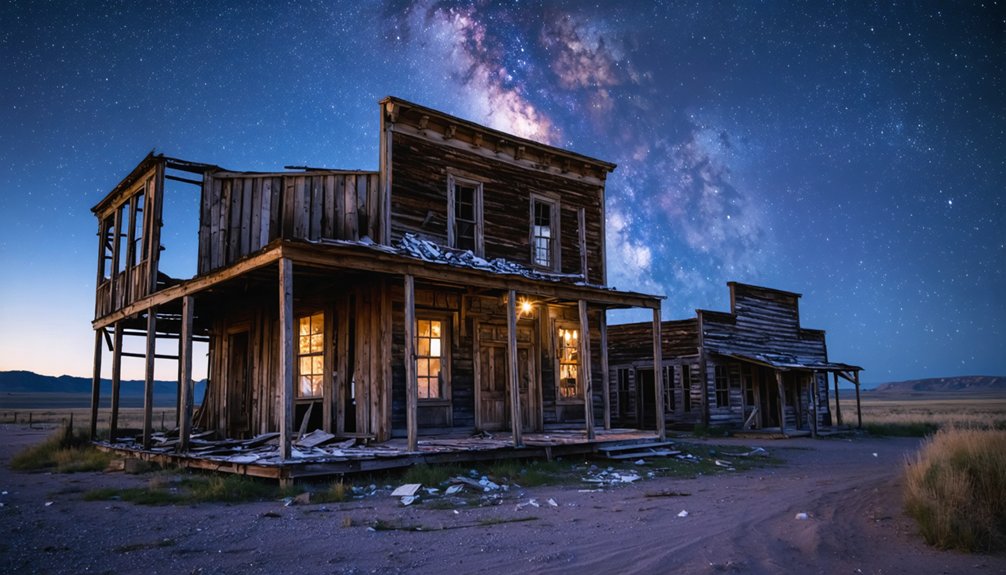
Beyond Nevada’s celebrated dark sky territories, two remarkable regions combine abandoned settlements with world-class astronomical viewing: South Dakota’s Black Hills-Badlands corridor and California’s Death Valley National Park.
You’ll find Spokane Ghost Town near Custer, where mining history traces gold, silver, mica, and zinc extraction from the 1890s. Access it via Spokane Creek Campground or Forest Service Road 330.
Scenic Ghost Town sits near Badlands National Park (Bortle Class 2), featuring a Longhorn Saloon and a combination church-jail structure.
Death Valley hosts Rhyolite, which peaked at 5,000 residents in 1907, plus remote Leadfield from the 1920s zinc boom. Both regions offer Bortle Class 1-2 conditions—Black Hills National Forest and Death Valley maintain International Dark Sky Park status, protecting ancient artifacts and ruins under pristine celestial canopies.
Planning Your Visit: Access, Camping, and Equipment Requirements
Once you’ve selected your ghost town-dark sky destination, securing access and appropriate gear determines observation success.
Most locations require minimal equipment—Cherry Springs’ Bortle Class 1 skies reveal 10,000 stars to your naked eye, while Canyon of the Ancients‘ Star Tower eliminates telescope setups entirely for Milky Way viewing.
No telescopes needed—these pristine dark sky zones showcase thousands of stars and the Milky Way with nothing but your eyes.
Critical Planning Elements:
- Access Routes: Navigate Bucktail Scenic Byway to Cherry Springs or traverse mesas reaching Cortez’s Canyon of the Ancients Guest Ranch.
- Camping Options: Reserve Summit at Big Bend’s domes on 1,000 private acres or pitch tents at Cape Lookout National Seashore’s sand.
- Seasonal Timing: Coordinate meteor showers with Rush ghost town’s three trail system accessibility.
- Temperature Preparation: Pack layers for Linville Caverns’ constant 52°F and Thorny Mountain Fire Tower’s exposed elevation.
The Growth of Dark Sky Conservation and How Communities Earn Certification
Since 2001, the International Dark-Sky Association’s certification program has transformed nighttime conservation from grassroots activism into systematic policy implementation across 200+ designated sites worldwide.
You’ll find five certification tiers—Parks, Sanctuaries, Reserves, Communities, and Urban Night Sky Places—each requiring sky brightness measurements exceeding 20 magnitudes per square arc second.
The application process demands documented community engagement through three rigorous phases: initial inquiry, formal proposal development, and Dark Sky Places Committee review spanning 90-150 days.
You’re looking at specific lighting regulations requiring 90% compliance within five years and complete adherence within ten years post-designation.
Annual monitoring reports, ongoing outreach documentation, and lighting inventory updates maintain certification status.
Non-compliance triggers revocation, ensuring designated sites preserve genuine darkness rather than symbolic recognition.
Frequently Asked Questions
What Permits or Fees Are Required to Visit Ghost Towns Near Dark Sky Areas?
You’ll find permit requirements vary by location and historical preservation status. Most ghost towns don’t require fees, but nearby dark sky preserves may charge entrance costs. Always check local land management agencies for current regulations before you visit.
Can You Photograph the Milky Way With Just a Smartphone Camera?
Yes, you can capture the Milky Way with smartphones—80% of astrophotographers now use mobile devices. You’ll need low light settings (ISO 800-3200, 15-30s exposure) and avoid star trail photography by limiting shutter speed to preserve crisp stellar details.
Are Ghost Town Structures Safe to Enter or Only Viewable From Outside?
Ghost town abandoned buildings lack structural integrity and aren’t safe to enter. You’ll find decades of decay, unstable foundations, and collapse risks make interior exploration dangerous. View these historic sites from outside to protect yourself and preserve them.
What Wildlife Might I Encounter When Camping at Remote Dark Sky Sites?
Like shadows coming alive, wildlife encounters at dark sky sites include nocturnal creatures such as kangaroo rats, burrowing owls, and caracaras. You’ll observe 190+ bird species and mammals adapted to light-sensitive foraging patterns across protected habitats.
How Do Moon Phases Affect Stargazing Quality at Dark Sky Sanctuaries?
Moon phases dramatically impact your stargazing freedom—full moons create severe moonlight interference matching urban skyglow, while new moons enable pristine observations. Lunar eclipse effects temporarily restore darkness. You’ll maximize astronomical independence during moonless periods.
References
- https://roadtrippers.com/magazine/dark-skies-and-ghost-towns-stops-on-a-spooky-nevada-road-trip/
- https://myxoadventures.com/the-ghost-town-of-spokane-south-dakota/
- https://darksky.org/what-we-do/international-dark-sky-places/
- https://www.youtube.com/watch?v=-vPPooDMJ5U
- https://www.nps.gov/deva/learn/historyculture/death-valley-ghost-towns.htm
- https://darksky.org/what-we-do/international-dark-sky-places/all-places/
- https://offroad.vegas/belmont-nevada-ghost-town/
- https://travelnevada.com/ghost-town/belmont-ghost-town/
- https://www.youtube.com/watch?v=Bp2IcEQsWEM
- https://nevadamining.org/get-to-know-a-nevada-ghost-town-belmont/