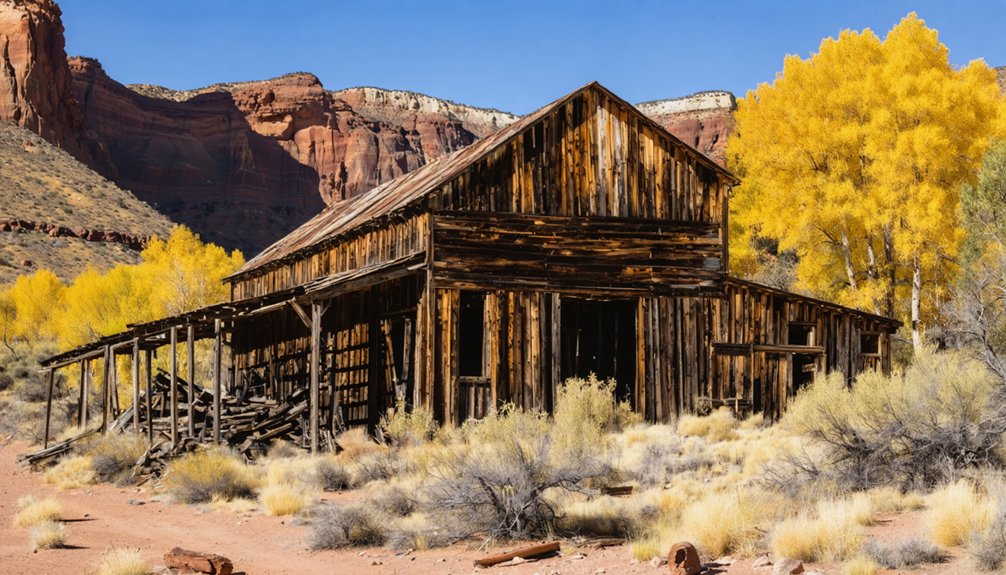
You’ll discover Arizona’s most mesmerizing ghost towns where mining history meets autumn splendor in Jerome, perched at 5,000 feet with Victorian buildings framing October’s golden aspens, and Chloride, where weathered storefronts stand against Cerbat Mountain slopes ablaze in rust and amber. Goldfield Ghost Town rests beneath the Superstition Mountains’ bronze-toned peaks, while higher elevations near these historic settlements showcase brilliant fall colors from late September through November. The perfect convergence of Wild West architecture and seasonal transformation awaits your exploration through Arizona’s mountain-desert borderlands.
Key Takeaways
- Jerome, a copper mining ghost town at 5,000 ft, offers Victorian architecture and Douglas Mansion panoramic fall vistas in October.
- Chloride features 150-year-old frontier buildings surrounded by Hualapai Mountains with brilliant aspens and red maples peaking late September-October.
- Goldfield Ghost Town sits beneath Superstition Mountains, showcasing golden, bronze, and russet desert tones throughout October and November.
- Higher elevations above 6,000 ft in Hualapai and Cerbat Mountains display the most vibrant fall colors during mid-to-late October.
- Mid-October to early November provides optimal viewing conditions with temperatures around 70-85°F for exploring ghost towns and fall foliage.
Jerome: Copper Mining Town Amid Colorful Canyon Country
Perched precariously on the slopes of Cleopatra Hill at 5,000 feet elevation, Jerome clings to the mountainside like a copper-stained memory of Arizona’s wildest boom-and-bust era. You’ll find a town that literally slid downhill—underground blasting moved entire buildings hundreds of feet, including the famous “Sliding Jail.”
During its peak, 15,000 souls from over 30 nationalities chased copper dreams here, extracting $800 million in ore by 1953.
The town’s mining history pulses through Victorian buildings and abandoned mine shafts. When Phelps Dodge closed operations in 1953, the town’s decline was swift—population crashed to just 222 residents. The Verde Valley Railroad, built in 1911, once transported copper to Drake and today operates as a scenic route through fall foliage.
Today, artists and free spirits have reclaimed this vertical ghost town, where autumn cottonwoods splash gold against red rock canyons below. The Douglas Mansion, built in 1916 atop a hill above the Little Daisy Mine, became a state park in 1965 and now offers sweeping views of the fall landscape.
Chloride: Historic Desert Settlement Near Mountain Foliage
You’ll find Chloride’s weathered wooden storefronts and tin-roofed buildings frozen in time along dusty streets where miners once walked. It is Arizona’s oldest continuously inhabited mining town since 1862. The desert settlement itself sits at a modest elevation.
The nearby Cerbat Mountains rise dramatically to over 7,000 feet, their slopes erupting in golden aspens and rust-colored oaks each autumn. Drive the rugged 1.3-mile road past abandoned mine shafts to reach Roy Purcell’s sprawling murals.
There, you’ll catch glimpses of mountain foliage framing the vibrant reds and yellows painted across 2,000 square feet of rock face. Along the town’s streets, all 20 occupied houses display eccentric junk art installations, from flamingos crafted from gas tanks to bottle trees adorned with colorful glass. Weekly Saturday gunfight reenactments at noon bring Old West history to life for visitors exploring this desert outpost.
Old West Town Character
Tucked against the rugged Cerbat Mountains seventy miles northeast of Kingman, Chloride wears its 150-year history in weathered wood and sun-bleached stone. You’ll walk dusty streets past original settler houses, weathered jails, and buildings that survived the late 1920s fire that nearly erased this silver mining camp.
Historical preservation here isn’t about polished museums—it’s lived-in authenticity, where twenty residents blend quirky art installations with frontier remnants. Gas tank flamingos stand beside century-old structures, while bottle trees catch desert light near abandoned mines.
A town map from the local restaurant guides you to marked historic sites, but the real discovery happens wandering freely. Roy Purcell’s massive cliff murals wait beyond the mines, accessible only by rugged four-wheel-drive roads that reward adventurous spirits. The higher elevation terrain supports desert Joshua trees and scattered mountain vegetation that adds seasonal color to the landscape. The town takes its name from silver chloride deposits that drew prospectors to these mountains in the 1860s, establishing one of Arizona’s oldest continuously inhabited mining camps.
Nearby High-Elevation Color Viewing
While Chloride’s desert streets preserve silver boom history at 4,000 feet, the Hualapai Mountains rising just beyond transform into Arizona’s unexpected autumn showcase.
You’ll reach Hualapai Mountain Park within thirty minutes, where aspens blaze yellow and maples ignite red against evergreen backdrops from late September through October. Trails wind through color gradients as elevation climbs past 6,000 feet—peak viewing hits mid-to-late October when oaks add burnt orange to the palette.
Local wildlife including mule deer and hawks become more visible against bare branches, perfect subjects for autumn photography. The park’s mountain roads deliver overlook after overlook where riparian sycamores and cottonwoods paint canyon bottoms gold. As chlorophyll production stops during longer, colder nights, the hidden yellows and reds emerge in the mountain’s deciduous trees. For an elevated perspective, scenic chairlift rides at nearby mountain resorts offer sweeping views of the autumn canopy below.
You’re combining ghost town exploration with legitimate fall color—no crowds, just elevation and freedom to roam Arizona’s hidden seasonal display.
Goldfield Ghost Town and Superstition Mountain Scenery
You’ll find Goldfield Ghost Town perched at the base of the Superstition Mountains, where the reconstructed 1890s mining camp sits at an elevation sweet spot that catches Arizona’s subtle autumn transformation.
The surrounding peaks rise dramatically from the desert floor to nearly 6,000 feet, creating microclimates where cottonwoods and sycamores shift to gold while lower desert vegetation takes on bronze and russet tones.
As you wander the wooden boardwalks past the Mammoth Saloon and mining tunnel entrance, the mountain backdrop transforms through October and November into a layered palette that echoes the town’s own golden legacy. The town itself was established in 1893 following the discovery of gold ore in what was then the Arizona Territory. Located just 30 minutes east of Phoenix, this accessible destination requires no parking or entry fees, allowing you to focus your budget on activities like mine tours, gold panning, or a meal at the saloon.
Reconstructed 1890s Mining Camp
Against the rugged backdrop of the Superstition Mountains, Goldfield Ghost Town rises from the desert floor as a meticulously reconstructed proof to Arizona’s 1890s mining boom. Bob and Lou Ann Schoose transformed a five-acre mill site starting in 1984, rebuilding structures that fire destroyed in 1943.
You’ll walk dirt streets past authentic buildings—the Mammoth Saloon, General Store, and Blue Nugget photo shop—each anchoring this historical restoration to its territorial camp origins.
The town’s outdoor activities pull you deeper into mining heritage. You can descend into the Mammoth Gold Mine’s underground tunnels, pan for gold, or catch Old West gunfights performed by Goldfield Gunfighters.
A narrow gauge train winds through the property while ziplines streak overhead, blending adventure with history beneath the Superstitions’ timeless gaze.
Superstition Mountains Elevation Changes
Rising from desert bajadas at 2,602 feet, the Superstition Mountains vault skyward in a dramatic 3,664-foot ascent that culminates at Mound Mountain’s 6,266-foot summit in the range’s eastern reaches.
You’ll witness how elevation impact transforms the landscape—thousands of spires and hoodoos pierce the sky, born from ancient caldera eruptions and volcanic upheaval.
The mountain rock formations reveal nature’s raw architecture: tuff cliffs, dacite pinnacles, and decomposed granite fans spreading from resurgent domes.
Superstition Peak stands at 5,057 feet with commanding 1,837-foot prominence, while trails gain between 3,193 and 4,372 feet depending on your chosen route.
These mountains rise just east of Phoenix’s suburban sprawl, offering accessible wilderness where fall colors accent volcanic ridgelines and Class 2-5 climbing challenges await.
Desert Flora Seasonal Transitions
Where ancient volcanic peaks meet Sonoran Desert floor, Goldfield Ghost Town stands as a living museum where century-old saguaros dwarf weathered boardwalks and mine shaft entrances. Desert blooms don’t follow traditional autumn schedules here—instead, you’ll witness subtle cactus coloring as seasons shift.
Those 500-year-old giants near Superstition Mountain display weathered textures that shift from vibrant green to dusty sage throughout fall’s shoulder season.
Seasonal Desert Characteristics:
- Arm-branched saguaros exceeding 10 feet mark century-old survivors of harsh desert winters
- Low season visits reveal wildlife like bunnies steering through cactus patches without summer crowds
- Snake-like branches create natural sculptures against mountain backdrops
- Train rides traverse 1.5 miles showcasing flora variations across elevation changes
Winter and shoulder seasons offer prime exploration when heat retreats and desert landscape reveals its timeless transformation patterns.
Oatman’s Route 66 Charm With Seasonal Mountain Backdrops
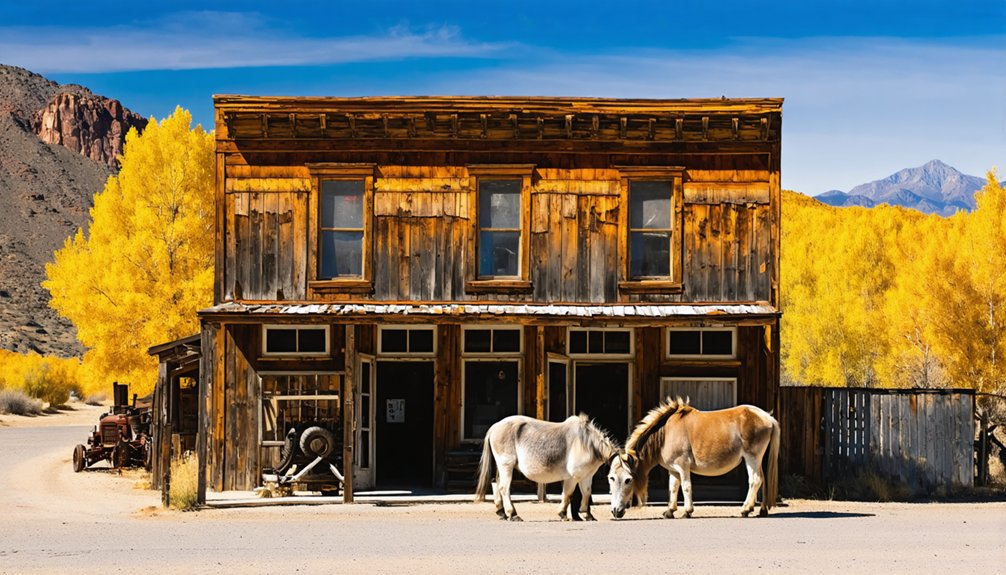
Wooden storefronts line the 0.4-mile stretch of Route 66 that cuts straight through Oatman’s heart as Main Street. Their weathered planks and hand-painted signs tell stories from the Gold Rush era. You’ll find wild burros—descendants of mining pack animals—wandering freely between the Oatman Drug Company and Glory Hole Soda Fountain, creating perfect wildlife photography moments against rustic backdrops.
The Black Mountains frame this scene with dramatic seasonal color, especially from Sitgreaves Pass at 3,595 feet where panoramic views reveal autumn’s desert palette.
Local folklore centers on the historic Durlin Hotel, where “Oatie” supposedly still roams. Daily gunfight reenactments bring Wild West authenticity.
When you navigate the hairpin curves of Gold Hill Grade, you’ll understand why this remote outpost embodies true freedom—unchanged, unpolished, unforgettable.
Bisbee’s Victorian Architecture During Autumn Months
From the dusty flats of Oatman, the road climbs southeast into Mule Mountains country where Bisbee clings to canyon walls at 5,300 feet—a vertical mining town that preserved Arizona’s densest collection of Victorian architecture through sheer economic accident. When Phelps Dodge shuttered operations, the 1890-1915 streetscape froze intact—Italianate facades, Gothic Revival spires, and Art Deco geometry rising through terraced neighborhoods.
October brings something unexpected: autumn colors framing brick hotels and the 1931 Courthouse on Quality Hill.
You’ll discover:
- 1,000 steps connecting Victorian-era mining cottages perched on impossible grades
- Castle Rock Hotel’s three-sided veranda overlooking canyon maples turning gold
- St. Patrick’s original stained glass catching afternoon light through yellow-leafed cottonwoods
- Central School’s Renaissance Revival bulk anchored by stone retaining walls built by hard-rock miners
Ruby Ghost Town in the Coronado National Forest
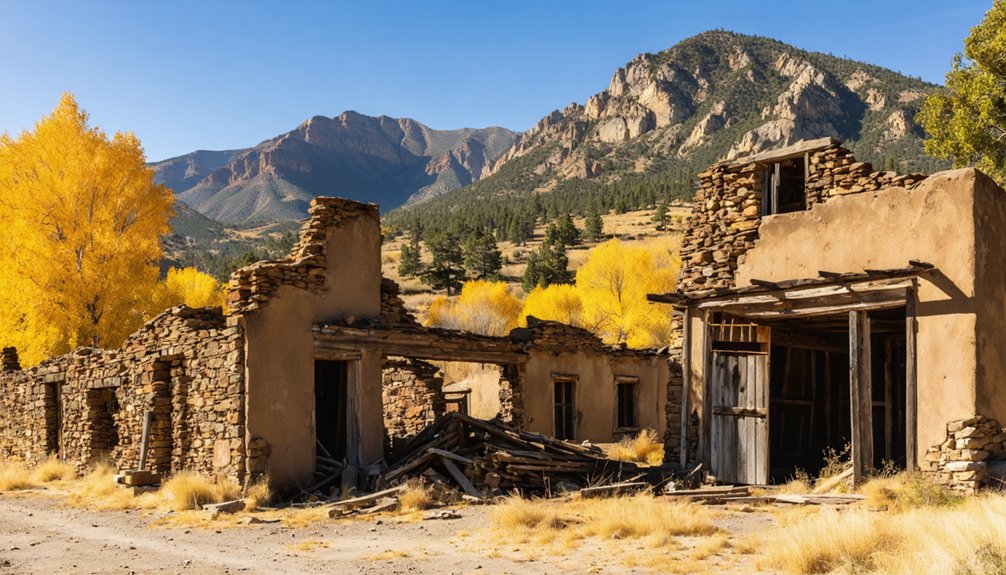
Beyond the tourist-trampled corridors of Tombstone and Jerome, Ruby slumbers in a high desert valley where the Pajarito Mountains buckle against the Mexican border—a 362-acre time capsule so authentic you’ll find rusted bedframes still positioned beside schoolhouse windows and machinery frozen mid-operation in the Montana Mine’s sorting sheds.
You’ll need permission to enter this privately-owned sanctuary, but that exclusivity preserves what vandals destroyed elsewhere.
October transforms surrounding Coronado National Forest into copper-and-gold tapestries that complement Ruby’s weathered adobe walls.
Native wildlife thrives here—190,000 Mexican free-tailed bats occupy mine shafts while bass patrol stocked lakes.
Historical excavations reveal the violent frontier legacy: three double murders between 1920-1922 sparked Arizona’s first aerial manhunt, evidence of lawlessness still whispered through jail cell bars.
Planning Your Ghost Town and Fall Colors Road Trip
Because Arizona’s ghost towns and fall foliage hotspots sprawl across 113,000 square miles of wildly varied terrain, you’ll need strategic route planning to capture both weathered history and autumn color within a single expedition.
Time your journey for mid-October through early November when Oak Creek Canyon and Strawberry-Pine areas blaze with color. Loop from Phoenix to Jerome’s steep galleries, then north to Chloride’s silver-mining ruins via US 93. Detour through Oak Creek’s 6.5-mile West Fork Trail before sunset.
Essential considerations for your autonomous adventure:
- Night photography opportunities flourish at Goldfield Ghost Town, where weathered structures frame star-filled Superstition skies
- Local cuisine in Jerome and Bisbee fuels exploration between haunted mine tours
- Higher elevations like Mount Baldy demand early-morning starts for aspen captures
- Route 66 ghost towns along Oatman-Hackberry stretch offer limitless wandering freedom
Best Times to Visit Arizona’s Mining Towns in Autumn
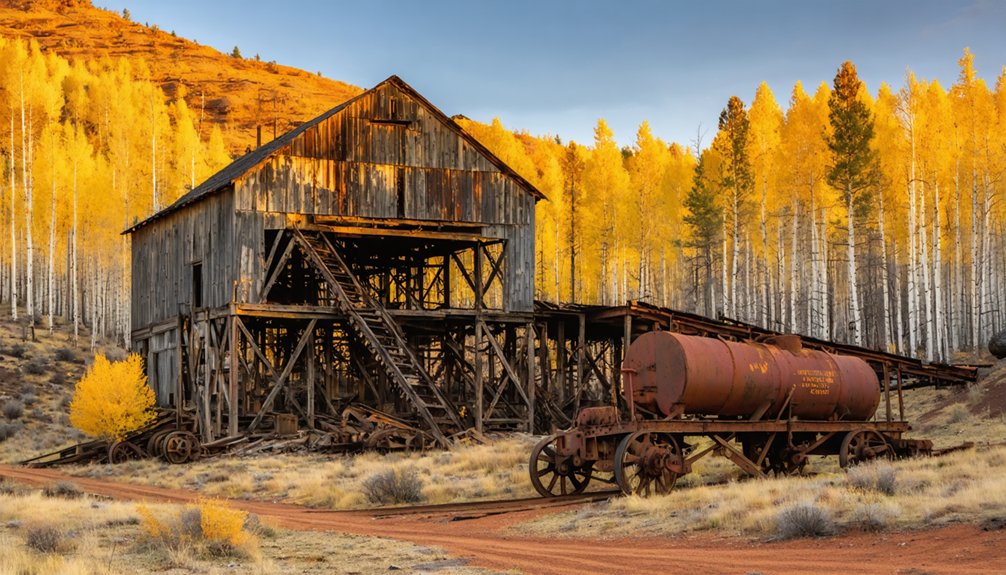
Your carefully mapped route means little if you arrive when autumn has already surrendered to winter’s grip or before the first golden leaves appear. Target mid-to-late October when temperatures hover between 70-85°F during daylight hours, perfect for exploring mineral deposits that built these forgotten settlements.
Timing your visit matters—arrive mid-to-late October when autumn peaks and temperatures ideal for ghost town exploration align perfectly.
Higher elevations near Patagonia show colors from early October, while lower desert sites like Courtland peak later in the month. You’ll find clear skies 80% of autumn days, with minimal rainfall keeping trails accessible.
Visit mining museums on weekday mornings when crowds thin and golden hour light transforms crumbling adobe walls into photographers’ dreams.
November offers solitude among shaded canyon remnants, though shortened daylight demands earlier departures from remote locations like Harshaw.
Frequently Asked Questions
Are There Any Ghost Towns at Higher Elevations With Aspens?
Alto’s high-elevation hikes promise aspen sightings among abandoned ruins, though desert-bound ghost towns dominate Arizona’s landscape. You’ll find freedom exploring White Mountains’ unverified settlements where golden aspens might whisper through weathered cabins above 8,000 feet.
Which Ghost Towns Are Closest to Oak Creek Canyon?
Jerome’s your closest ghost town, perched 40 miles northwest via SR 89A, offering hidden history through clifftop copper mines. You’ll find tourism opportunities at Gold King Mine, while Perkinsville’s ranching relics await your exploration deeper in Verde Valley’s freedom-filled landscape.
Do Any Southern Arizona Ghost Towns Have Fall Foliage?
You’ll find fall foliage at higher-elevation southern Arizona ghost towns like Ruby and Harshaw, where oaks, sycamores, and cottonwoods frame the ghost town history. These Patagonia-area sites blend autumn colors with crumbling adobe ruins beautifully.
Can You Camp Overnight Near Ghost Towns With Foliage?
You’ll find overnight camping near Jerome’s Potato Patch Campground and Ruby’s on-site stays, perfect for foliage photography sessions. Prioritize camping safety—these remote locations offer solitude but require self-sufficiency. Pack accordingly for high-elevation autumn temperatures and wildlife encounters.
Are Ghost Town Roads Accessible in Autumn Weather Conditions?
You’ll find seasonal road access pleasantly “adventurous” during autumn weather challenges—paved routes to Jerome and Hackberry remain reliable, though unpaved forest roads become temperamental with rain. Higher elevations demand respect, but freedom seekers rarely turn back.
References
- https://justsimplywander.com/fall-leaves-in-arizona/
- https://www.visittucson.org/blog/post/8-ghost-towns-of-southern-arizona/
- https://takingthekids.com/the-remote-arizona-ghost-towns-that-will-take-you-back-in-time/
- https://www.atlasobscura.com/itineraries/these-8-arizona-ghost-towns-will-transport-you-to-the-wild-west
- https://www.youtube.com/watch?v=_yKiDvD0LSk
- https://www.tripadvisor.com/Attractions-g28924-Activities-c47-t14-Arizona.html
- https://www.hipcamp.com/journal/camping/arizona-ghost-towns/
- https://fillyourplate.org/visit-the-ghost-towns-of-arizona/
- https://westernmininghistory.com/towns/arizona/jerome/
- https://www.legendsofamerica.com/az-jerome/