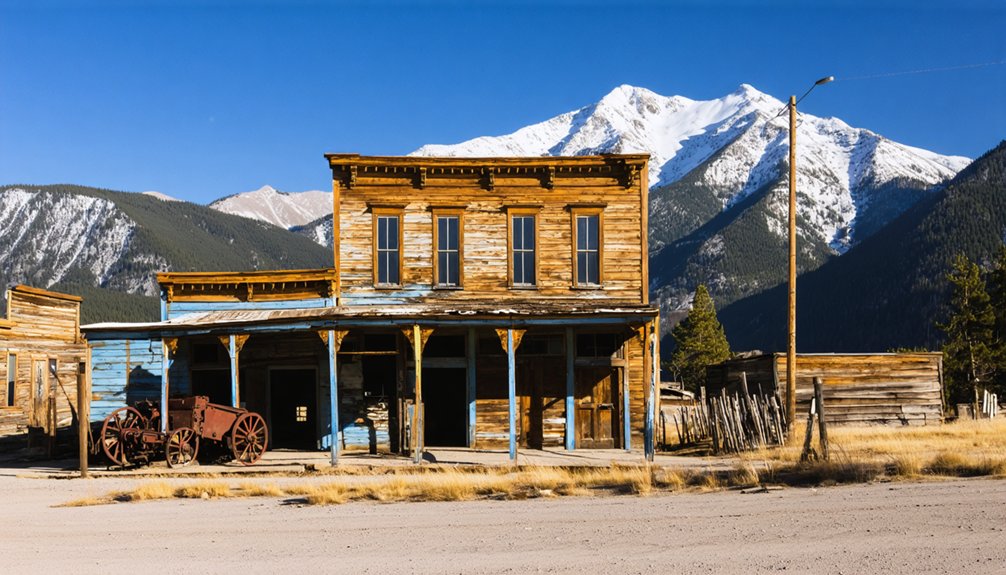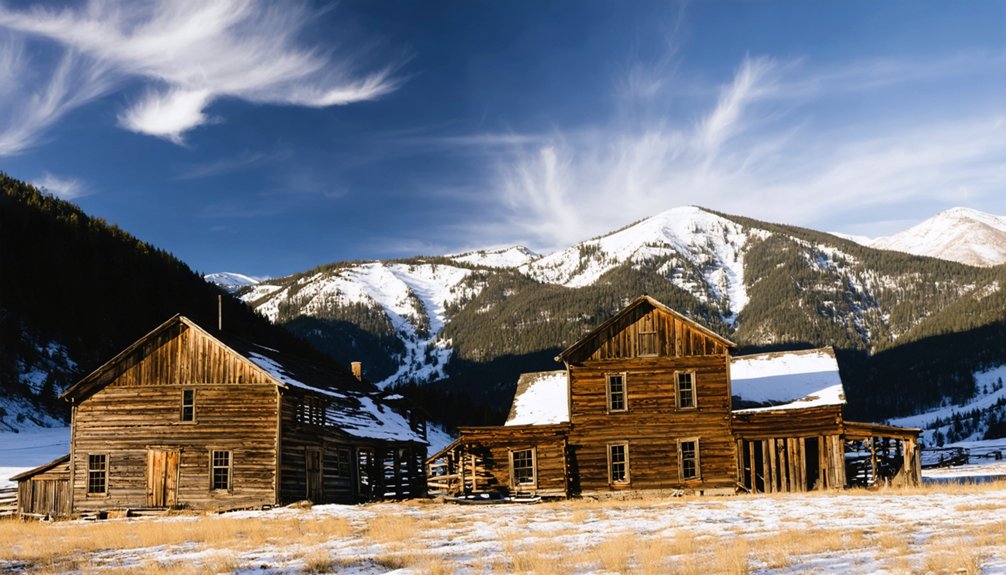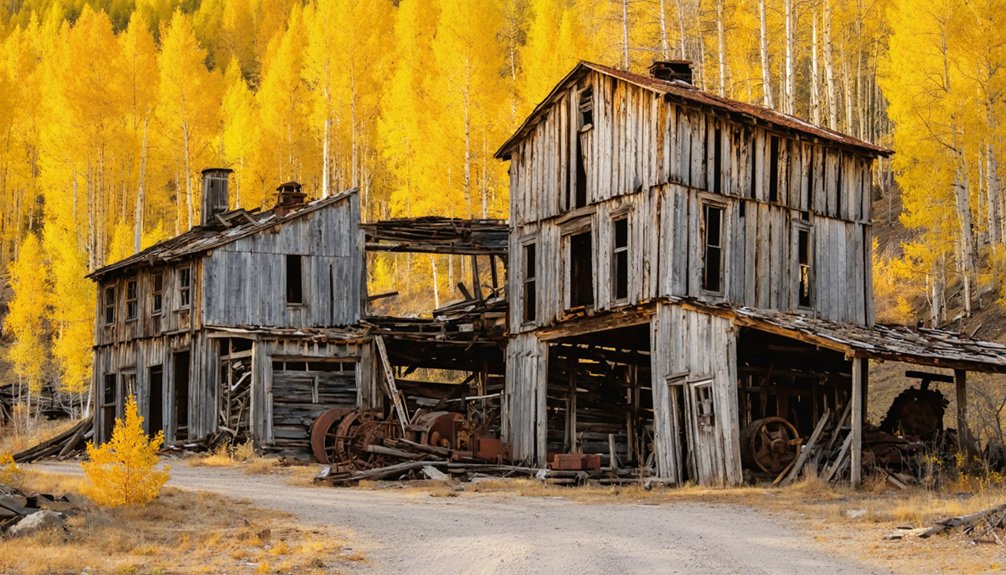
You’ll find Colorado’s most spectacular ghost town views from mid-September through early October, when golden aspens frame St. Elmo’s 43 weathered structures and century-old poplars glow along Vicksburg’s abandoned main street. At 11,200 feet, Animas Forks offers the state’s highest elevation ruins, while Gothic’s 80 silver-era buildings nestle beneath Elk Mountain peaks ablaze with fall color. Pack layers and waterproof boots—these mountain towns demand preparation, but the collision of mining history with autumn’s most vivid display rewards every rutted mile you’ll travel.
Key Takeaways
- St. Elmo, at 10,000 feet, features 43 preserved structures surrounded by golden aspens along Chalk Creek.
- Vicksburg showcases century-old balsam poplars lining its main street with 40 protected historic buildings.
- Animas Forks sits at 11,200 feet, Colorado’s highest ghost town, with weathered structures accessible via 4WD roads.
- Gothic offers 80 silver-era buildings at 9,514 feet, now housing the Rocky Mountain Biological Laboratory.
- Peak foliage occurs mid-September through early October; roads above 11,000 feet close by mid-October.
St. Elmo: Colorado’s Most Haunted and Best-Preserved Ghost Town
Perched at nearly 10,000 feet in the Sawatch Range, St. Elmo beckons you with 43 weathered structures lining its dusty Main Street. You’ll wander through Colorado’s best-preserved ghost town, where golden aspens frame weathered storefronts each autumn.
Step into Colorado’s mountain silence where 43 weathered buildings stand frozen in time at 10,000 feet above yesterday.
The Stark family’s preservation efforts kept this 1880s mining hub alive—they bought abandoned buildings at tax sales and welcomed tourists while legends grew around them.
Urban legends swirl through the crisp mountain air, claiming Annabelle Stark’s spirit still slams doors and drops temperatures twenty degrees. You’ll feel it exploring the old general store and hotel she tended for decades.
The railroad’s 1922 departure sealed St. Elmo’s fate, but you’re free to roam its remnants now, fishing Chalk Creek or tackling nearby off-road trails beneath fiery fall colors. The town once boomed with over 2,000 residents during its mining heyday, fueled by the Mary Murphy Mine’s daily shipments of gold and silver ore. The town shares its name with Delta Phi fraternity, known by the St. Elmo nickname at Yale University.
Dearfield: A Unique Chapter in Black Settlement History
You’ll find Dearfield rising from the prairie grass along Route 85, where golden cottonwoods now frame the weathered remains of Colorado’s largest Black agricultural colony. Founded in 1910 by Oliver Toussaint Jackson, this self-sufficient community once bustled with 700 residents who danced on Saturday nights and harvested watermelons from land that white landowners had refused to sell them.
The Depression and Dust Bowl emptied these streets by 1948, leaving behind Jackson’s home and a powerful symbol to Black homesteaders who claimed their independence in Colorado’s remote eastern plains. The colony’s farmers focused on dryland farming techniques, cultivating wheat, corn, and sugar beets across more than 19,000 acres of prairie without supplemental irrigation. Today, Dearfield stands as a testament to unequal access faced by Black Americans seeking to establish communities on western lands.
Early 1900s Black Community
While most Colorado ghost towns tell stories of gold rushes and mining booms, Dearfield stands apart as a powerful evidence to Black resilience and self-determination in the early twentieth century. You’ll discover where Oliver Toussaint Jackson, inspired by Booker T. Washington’s vision, established a thriving agricultural colony in 1910.
Here, 700 settlers from 37 states carved independence from sandy Weld County soil twenty-five miles east of Greeley.
Settlement challenges tested every family. Without affordable irrigation rights, these pioneers mastered dry farming techniques on land others dismissed. They coaxed watermelons and cantaloupes from desert earth, built forty-four wooden cabins, operated businesses, and fielded baseball teams. The community’s social fabric included dances, baseball games, and gatherings at facilities like the dance pavilion and restaurant that fostered cohesion among residents. The settlement featured churches and a post office, essential infrastructure that supported the self-sustaining community.
This African American history reveals three hundred residents at peak, cultivating self-sufficiency through sheer determination—proving freedom means controlling your own destiny.
Depression Era Decline
By the mid-1920s, the same determined hands that had coaxed melons from sandy earth now gripped crumbling soil that slipped through their fingers like ash. Crop prices collapsed while drought strangled the plains. Economic setbacks mounted when settlers discovered their 320 acres couldn’t sustain farming without irrigation—and the South Platte flowed tantalizingly close, yet water rights remained beyond their financial reach.
Then came the Dust Bowl’s fury, flipping soil and obliterating dreams. Environmental disasters crushed what economic hardship hadn’t already destroyed. The Great Depression delivered the final blow.
Of 700 residents who’d built 44 cabins and forged a community, nearly all retreated by the 1940s. By 1940, the population had dwindled to 12, a stark contrast to the hundreds who had called Dearfield home during its prosperous years. Only founder Oliver Jackson and his niece remained,守持着 ghosts of prosperity until his death in 1948 left Dearfield silent.
Scenic Northern Colorado Route
As you drive the sun-bleached stretch of U.S. Highway 34 eastward from Greeley, amber grasslands unfold beneath Colorado’s vast autumn sky. Twenty-five miles into this journey through the Platte River Valley’s sand hills, you’ll discover Dearfield—where freedom-seeking African American homesteaders carved out independence on 320 acres beginning in 1910.
Unlike other ghost towns with haunted legends of miners and outlaws, Dearfield whispers stories of resilience: Oliver Toussaint Jackson’s vision, 300 residents cultivating watermelons against impossible odds, concrete dreams rising from prairie soil.
Today’s preservation efforts safeguard the colony’s standing wooden cabins—Colorado’s only intact Black homesteading site. The Black American West Museum‘s land negotiations guarantee these weathered structures endure.
As cottonwoods flame gold around crumbling walls, you’re witnessing history that mainstream narratives buried.
Gothic: Where Mining History Meets Alpine Research
High in the Elk Mountains at 9,514 feet, Gothic’s weathered wooden structures stand as silent witnesses to a silver rush that blazed and died within a single decade. You’ll wander past eighty substantial business houses that once lined the main street, their mining heritage etched in every sun-bleached plank.
Gothic’s weathered structures stand at 9,514 feet as silent witnesses to a decade-long silver rush now frozen in time.
The town architecture tells of 1879’s frenzied optimism—400 buildings sprouting from virgin ground after wire-silver’s discovery.
What sets Gothic apart isn’t just abandonment. Scientists have claimed this ghost town, transforming it into the Rocky Mountain Biological Laboratory. You can explore freely during summer, taking guided tours past President Grant’s 1880 walking route. Students conduct summer research on ecosystems and evolution amid the historical remnants. The route to Gothic follows Gothic Road north from Crested Butte for just over 7 miles, accessible to standard 2WD vehicles year-round.
When silver crashed, Gothic emptied overnight. Now it thrives again—not with prospectors seeking fortune, but researchers chasing knowledge through alpine meadows where saloons once stood.
Vicksburg: Autumn Poplars and Mining Camp Tales
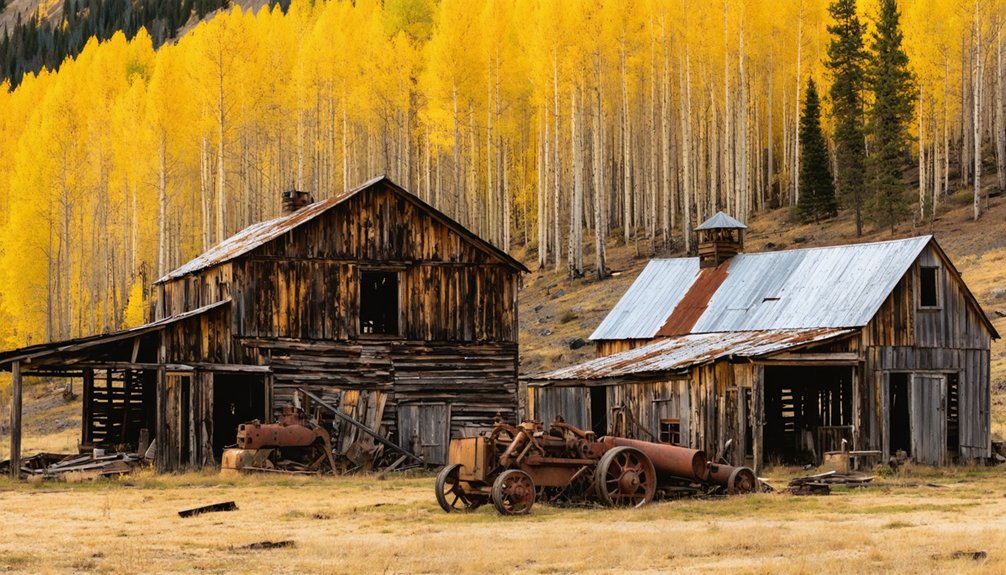
You’ll find Vicksburg’s main street lined with towering balsam poplars that miners hauled in on burros over a century ago. Their golden leaves now blaze against weathered cabin walls. The trees still drink from the original creek ditches. Their autumn display transforms this well-preserved camp into a living postcard.
Where forty historic buildings tell stories through peeling paint and sagging doorframes. A historical society established in 1971 now protects and preserves these structures.
As you wander past the two-story schoolhouse and Vick Keller’s old general store, you’re walking the same rutted path where 700 miners once chased silver dreams through these high-altitude forests.
Golden Poplars Line Streets
When autumn transforms Colorado’s high country, Vicksburg’s main street becomes a tunnel of gold—a living demonstration to miners who hauled balsam poplar saplings on burro-back up Clear Creek Canyon in the 1870s. Those forty-plus poplar trees still stand, their yellow leaves catching afternoon light between weathered cabins and abandoned storefronts.
You’ll discover wooden irrigation boxes beside the ditches that once kept these trees alive at 10,000 feet—practical engineering that doubled as coolers for perishable goods.
The same water that nurtured these unlikely sentinels protected against fires that claimed so many mining camps.
Walk beneath their canopy past mining relics and skeletal buildings. These poplars outlasted the boom, the bust, and generations of treasure-seekers who planted them, creating Colorado’s most unlikely arboreal monument.
Audio-Guided Mining History
Those golden poplars whisper stories if you know how to listen. A YouTube narration brings Vicksburg’s 1867 founding to life—lost burros stumbling upon gold, silver booms, and the slow fade after 1893’s market crash. You’ll hear about Eastern investors funding shafts that once employed 700 souls, their mining artifacts still scattered through buildings where craftsmen shaped destiny.
The Chaffee County Historical Society operates two museums here, preserving what freedom-seekers built with their hands. Walk past billiard halls and assay offices while the audio guide explains how ore wagons rumbled these streets until 1918. Ghost town preservation feels tangible when you’re standing where blacksmiths hammered and prospectors gambled everything.
The narration transforms rust-covered tools into testaments of hard-won independence—each artifact a declaration of rebellion against ordinary existence.
Winfield: Four Historic Log Buildings in Clear Creek Canyon
The weathered logs of Winfield’s four remaining buildings stand like sentinels in Clear Creek Canyon, their hand-hewn timbers still defying 140 years of Colorado winters. You’ll find authentic ghost town architecture here—no Disney-fied recreations, just raw history preserved by the Clear Creek Historical Society.
Two structures serve as summer museums: the old schoolhouse displays original furnishings from Winfield’s 1890 heyday, while the Ball cabin showcases mining-era tools and photographs. The other buildings remain privately owned, occasionally occupied by folks seeking solitude among the aspens.
These preservation efforts matter because most of the original town has surrendered to forest reclamation. Walking between these survivors, you’ll sense the 1,500 souls who once thrived here before the 1893 silver crash scattered them like autumn leaves.
Animas Forks: Colorado’s Highest Elevation Ghost Town
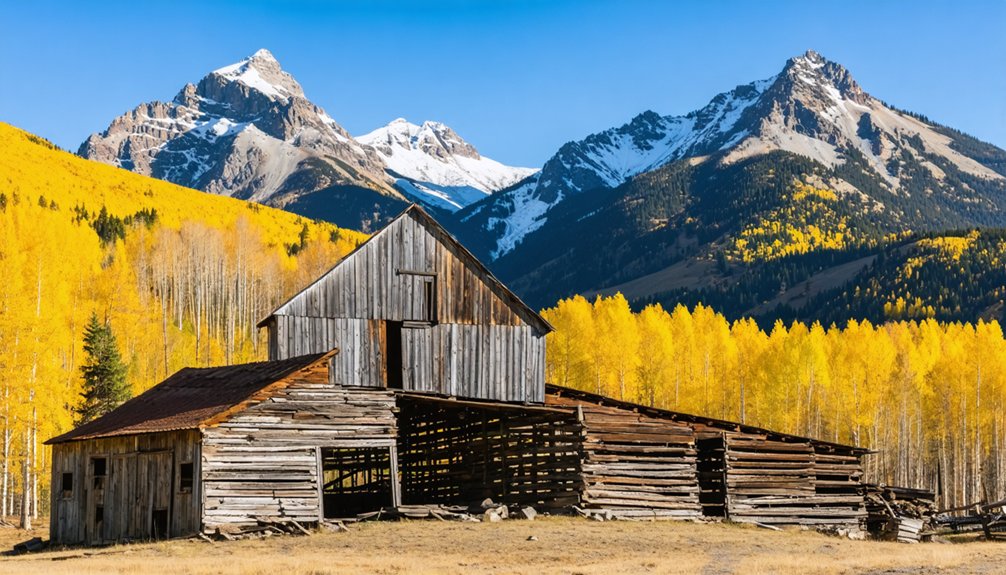
While Winfield’s four buildings whisper their stories in relative obscurity, Animas Forks shouts from 11,200 feet—Colorado’s highest elevation ghost town. It draws over 100,000 visitors annually to its collection of weathered structures perched impossibly high in the San Juan Mountains.
You’ll navigate unimproved dirt roads requiring high-clearance 4WD, tracing the 65-mile Alpine Loop where prospectors struck gold in 1873. Walk unrestricted through general stores, saloons, and boarding houses—authentic art preservation without velvet ropes constraining your exploration.
Recent surges to 250,000 visitors create environmental impact concerns as ATVs increasingly threaten these fragile remnants. The Bureau of Land Management balances access with protection, letting you experience the 1884 blizzard’s 25-foot snowfall legacy and fire-scarred foundations from 1891.
Golden aspens frame your photography against weathered timber—freedom earned through rugged approach.
Best Times to Visit Colorado Ghost Towns for Fall Colors
Timing your ghost town expedition to Colorado’s high country transforms a historical trek into a sensory spectacle.
Strategic timing elevates your Colorado ghost town journey from simple sightseeing into an unforgettable fusion of history and autumn’s brilliant natural display.
When golden aspens ignite against weathered timber and rusted metal, you’ll understand why photographers wait all year for this fleeting window.
Prime Viewing Schedule:
- Mid-September: Chaffee County destinations like St. Elmo and Vicksburg showcase poplar canopies, while wildlife habitats bustle with pre-winter activity.
- Late September: Gothic Road’s dirt ribbon winds through peak aspen brilliance at 9,500+ feet, where historical preservation meets natural artistry.
- Early October: San Juan Skyway’s 235-mile loop delivers reds and yellows around Carson before snowfall locks gates.
You’ve got roughly three weeks between mid-September and early October to catch this convergence.
High-elevation sites above 11,000 feet close by mid-October, making late September your sweet spot for accessible roads and explosive color.
What to Bring When Exploring Colorado’s Abandoned Mining Towns
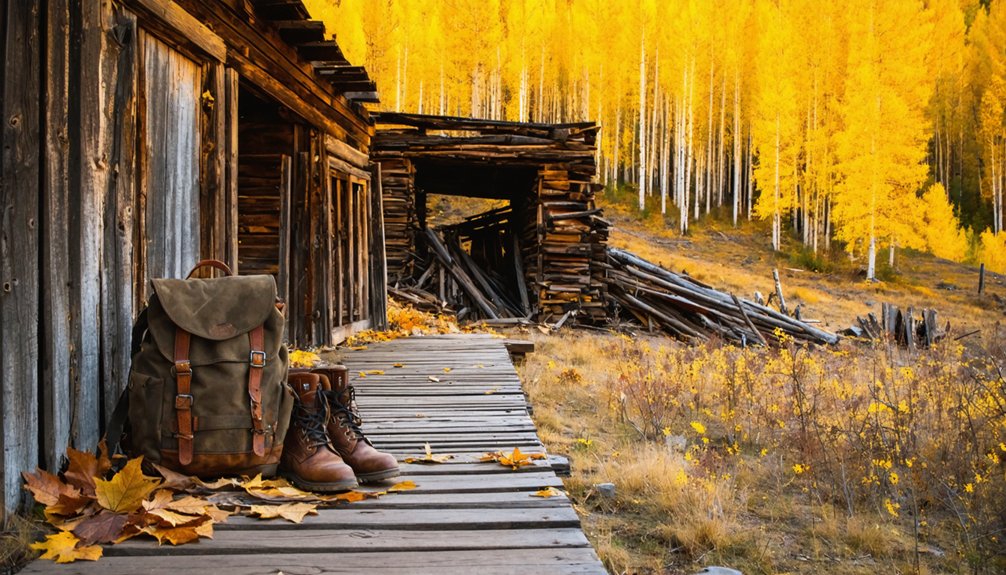
Frozen mornings at 10,000 feet will punish your cotton T-shirt with hypothermia-inducing sweat, then scorch your exposed neck by noon—I learned this the hard way during my first trip to Animas Forks when September’s deceptive blue skies masked brutal alpine conditions.
You’ll need moisture-wicking layers and a puffy jacket for dawn explorations of ghost town architecture, waterproof boots for creek crossings near collapsed stamp mills, and high-SPF sunscreen against relentless UV rays bouncing off weathered clapboard facades.
Pack a headlamp for peering into dark mine shafts where local legends whisper of lost fortunes, bear spray for moose encounters in willow thickets, and offline GPS maps—cell service vanishes faster than the miners who abandoned these peaks.
Bring traction mats and a spare tire; muddy September roads don’t care about your schedule.
Planning Your Colorado Ghost Town Road Trip Route
Because Colorado’s ghost towns scatter across 400 miles of mountain passes and high-altitude valleys, your route demands strategy beyond “drive until something looks abandoned.” I once spent three hours backtracking from Animas Forks when thunderclouds turned Cinnamon Pass into a slick clay nightmare—a mistake that taught me to anchor my itinerary around a single base camp rather than ambitious point-to-point marathons.
Three proven base camp strategies:
- Crested Butte hub opens Gothic Road’s easy dirt access through aspen groves, with ghost town architecture framed by gold canopies perfect for fall foliage photography.
- Lake City anchor positions you four miles from Henson and within striking distance of Capitol City via Alpine Loop.
- Buena Vista center delivers Vicksburg’s poplar-lined streets and St. Elmo’s preserved structures within single-tank range.
Choose elevation over distance.
Frequently Asked Questions
Are Dogs Allowed at Colorado Ghost Towns?
Though remote access might worry you, most Colorado ghost towns welcome leashed dogs on dog-friendly trails. You’ll treasure exploring crumbling cabins together, but remember pet safety tips: watch for wildlife, pack water, and respect private property boundaries.
Do Any Ghost Towns Charge Admission Fees?
Yes, some charge admission. You’ll find Ghost Town Museum requires $8.50 for adults, supporting historical preservation of authentic artifacts. It’s worth it—you’ll discover incredible photography opportunities among century-old buildings where freedom-seeking pioneers once carved their destinies from wilderness.
Can You Camp Overnight Near These Ghost Towns?
Golden aspens frame your tent as you’ll find dispersed camping near Gothic, St. Elmo, and Vicksburg on surrounding federal lands. Historical preservation limits overnight stays within town sites, but nearby spots offer incredible photography opportunities under starlit skies.
Are Restrooms Available at Ghost Town Sites?
Restroom facilities aren’t available at most ghost town sites—you’ll find yourself embracing true frontier conditions. Occasionally portable toilets appear near popular spots, but you’re better off planning bathroom breaks in nearby base towns before venturing out.
Which Ghost Towns Are Wheelchair Accessible?
Looking for barrier-free exploration? St. Elmo and Ashcroft offer wheelchair-accessible trails with boardwalks winding through historic streets. You’ll find freedom roaming weathered storefronts independently, though wheelchair rentals aren’t available onsite—bring your own for autumn adventures.
References
- https://www.milehighmamas.com/blog/2020/08/19/guide-to-colorados-best-fall-colors-scenic-drives-ghost-towns-and-farm-experiences/
- https://www.youtube.com/watch?v=zX27iwQ6P6w
- https://www.uncovercolorado.com/ghost-towns/
- https://www.colorado.com/articles/colorado-ghost-towns
- https://leadville.com/the-ghost-towns-of-leadville-and-beyond/
- https://www.durango.com/colorado-ghost-towns/
- https://www.legendsofamerica.com/co-stelmo/
- https://en.wikipedia.org/wiki/Saint_Elmo
- https://www.islands.com/1828318/saint-st-elmo-colorado-abandoned-town-american-west-best-preserved-enchanting-gem/
- https://www.youtube.com/watch?v=zX4MV4IegJc