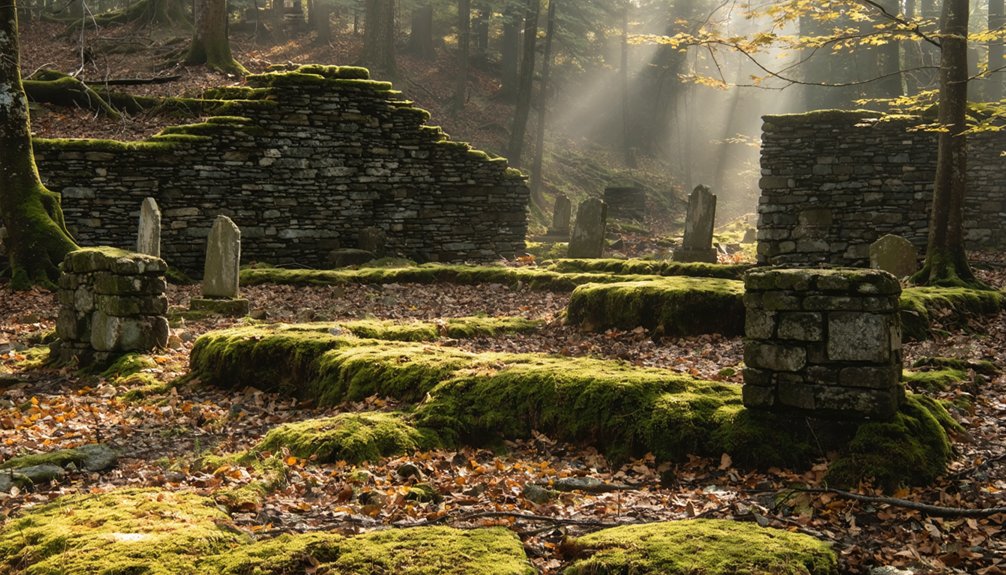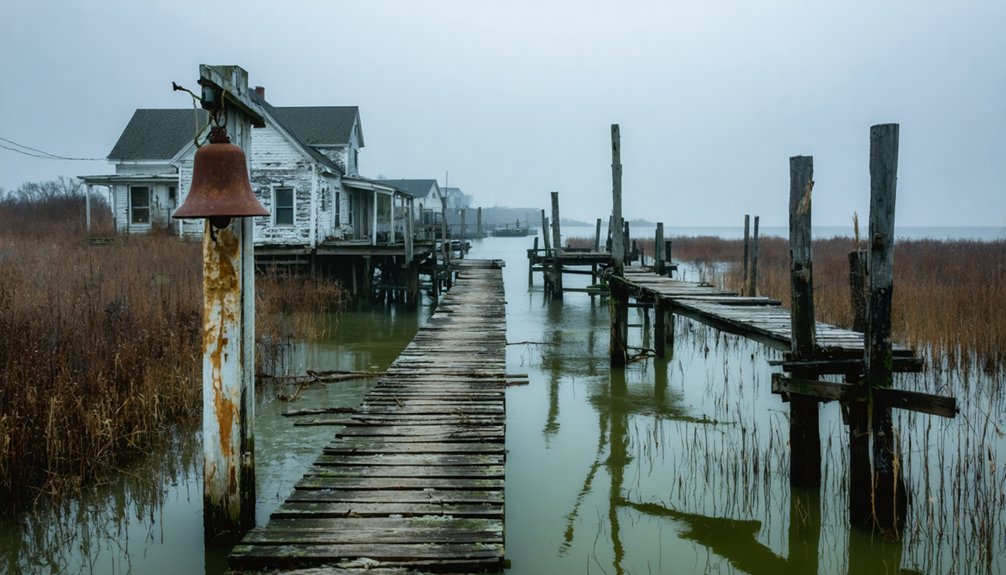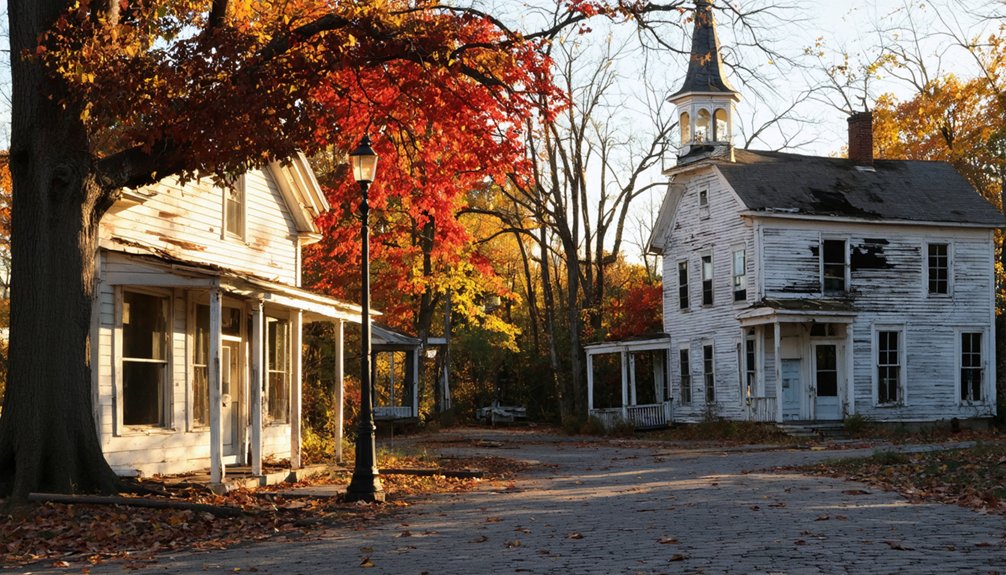
You’ll find Connecticut’s most atmospheric ghost towns cloaked in spectacular fall foliage between mid-October and late November. Dudleytown’s moss-covered cellar holes hide among crimson maples in Litchfield Hills, while Bara-Hack’s Welsh settler ruins emerge from golden oak groves in Pomfret’s dense woods. Johnsonville Village‘s Victorian mill buildings stand frozen along the Moodus River, framed by vibrant autumn colors. The highest elevations peak earliest—October 3-23—creating layered woodland aesthetics perfect for photography. Access restrictions apply to most sites, though nearby trails and scenic corridors reveal these haunting landscapes where nature reclaims history.
Key Takeaways
- Dudleytown in Litchfield Hills features moss-covered foundations amid crimson autumn foliage, though public exploration is prohibited by Dark Entry Forest.
- Bara-Hack in Pomfret showcases Welsh settler ruins, weathered headstones, and vibrant fall colors; private land requires permits or guided tours.
- Johnsonville Village offers Victorian buildings and Neptune Mill ruins along the Moodus River, framed by maples and oaks in October.
- Peak foliage viewing occurs October 15-25, with higher elevations like Dudleytown peaking earlier than central locations like Johnsonville.
- Fall colors enhance abandoned sites with red maples, golden oaks, and millpond reflections creating photogenic backdrops for historic ruins.
Dudleytown: Dark Entry Forest’s Most Notorious Abandoned Settlement
Deep in Connecticut’s Litchfield Hills, where three mountains converge to create a perpetual twilight, the remnants of Dudleytown slumber beneath a canopy of blazing autumn color. You’ll find only moss-covered cellar holes and crumbling stone foundations where 26 families once struggled against isolation and rocky soil over 1,500 feet above sea level.
Though folklore legends blame a Dudley family curse for the settlement’s demise, reality tells a harsher story: brutal winters, failed crops, and economic migration westward emptied this Cornwall hollow by the early 1900s. The mountains surrounding the settlement limited sunlight exposure, contributing to the agricultural challenges that ultimately doomed the community. The name Dudleytown itself refers to multiple locations, though this Connecticut site remains the most notorious among them.
Today, Dark Entry Forest Incorporated maintains the site for historic preservation and wildlife conservation. You can’t legally explore these shadowed woods—they’re closed to wanderers—but the mystery endures, whispering through October’s crimson leaves.
Bara-Hack: Windham County’s Hidden Historical Ruins
You’ll need to respect the “No Trespassing” signs that now guard Bara-Hack’s crumbling stone foundations, as persistent ghost hunters forced the landowners to close this slice of 1778 history to the public.
Through the chain-link barriers in October, you can still glimpse moss-covered cellar holes emerging from carpets of crimson and gold leaves, where Nightingale Brook once powered the Higinbothams’ spinning wheel mill.
The autumn forest has reclaimed the pastures where sheep grazed until the Civil War, transforming this Welsh settlers’ “breaking of bread” into a tantalizing forbidden landscape you can only admire from the roadside.
Johnathan Randall Esq. and Obediah Higinbotham founded the settlement after fleeing British forces during the Battle of Rhode Island, establishing their farms on land Randall had purchased two years earlier.
Among the visible remnants, an old graveyard marks the final resting place of the community’s earliest families, its weathered headstones standing sentinel beneath the changing leaves.
Accessing the Abandoned Settlement
Tucked away in Pomfret’s dense woodlands at coordinates 41°52′48″N 72°00′40″W, Bara-Hack’s crumbling stone foundations rest on private property that’s now strictly off-limits to casual visitors.
You’ll need a special permit or guided tour to tread the lengthy trail winding through these overgrown ruins. Ghost hunters and paranormal enthusiasts forced the closure after their relentless intrusions threatened the site’s historical preservation.
The property owner occasionally grants permission, but don’t count on wandering freely among the stone walls and intact cemetery where Randalls, Higginbothams, and their slaves lie buried. Those nine marked graves and weathered foundations hold archaeological significance beyond spectral speculation. The settlement earned its Welsh name “Bara-Hack” from the breaking of bread tradition practiced by the families who migrated from Rhode Island before 1780. The site also includes a small mill foundation among its remaining structures.
If you’re determined to explore this Welsh-named settlement where forests reclaimed nineteenth-century dreams, respect the boundaries—or risk trespassing charges that’ll definitely haunt you.
Autumn Scenery and Ruins
Where the Shetucket River curves through Windham County’s forgotten valleys, autumn transforms Bara-Hack’s ruins into something almost otherworldly. You’ll find crumbling stone walls threading through blazing red maples and golden oaks—nature reclaiming what 19th-century farmers left behind.
The Barber-Brooks Cemetery sits beneath a canopy so vivid it feels surreal, especially when October light filters through the leaves onto weathered headstones. The gravestones remain surprisingly legible despite decades of abandonment, their inscriptions still telling stories from centuries past.
For foliage photography, you can’t beat the contrast between human remnants and wild resurgence. Old foundation stones emerge from carpets of rust-colored leaves, while abandoned road traces vanish into scarlet hillsides. Sites like the Chester-Hudson Quarry demonstrate how preserved ruins can maintain their industrial ambiance while allowing natural overgrowth to enhance rather than obscure their historical character.
Historical preservation efforts here remain minimal—frankly, that’s part of the appeal. You’re experiencing these ruins as they authentically exist: untamed, unmanicured, and utterly free from tourist infrastructure.
Just you, history, and October’s brilliant chaos.
Gay City State Park: Where History Meets Accessible Autumn Beauty
Deep in the forests of Hebron and Bolton, stone foundations emerge from carpets of crimson and gold leaves like ghosts reaching through time. You’ll discover Gay City State Park’s 1,569 acres through ten miles of trails that wind past abandoned cellars and weathered tombstones—remnants of the mill town that thrived here until the 1880s.
Stone foundations rise through autumn leaves like monuments to vanished lives, where mill town dreams dissolved into forest silence.
Historical preservation efforts maintain these ruins while letting nature reclaim its territory, creating an atmospheric blend you won’t find in manicured historic sites.
The park’s visitor amenities make exploration effortless: accessible trails from Route 85 lead you to the millpond and burial ground where founding families rest. The trails extend beyond the park boundaries, connecting through Meshomasic State Forest all the way to the Case Mountain trail system for those seeking longer autumn adventures.
You can swim, hike, or simply wander among the stone walls as autumn transforms the forest canopy overhead into a blazing celebration of freedom and impermanence. The settlement was named after founder John Gay, with most residents sharing his family lineage in this close-knit 18th-century community.
Johnsonville Village: Middlesex County’s Woodland Ghost Town
You’ll find Johnsonville Village tucked along the Moodus River’s edge, where nineteenth-century mill buildings and Victorian structures stand frozen in time since their 1994 closure.
The crumbling Neptune Mill—once bustling with twine production until a 1972 lightning strike—overlooks the fifteen-acre millpond through a canopy of maples and oaks that blaze crimson and gold each October.
Though the property remains off-limits, you can catch glimpses of the ghost town’s weathered steeples and porches from Johnsonville Road.
The surrounding woodland trails offer legal access to witness autumn’s transformation of this industrial relic.
Abandoned Mill Town History
Through the canopy of autumn maples, the weathered steeple of Neptune Mill once pierced the sky like a church tower, its bell calling workers across the Moodus River valley each dawn.
You’re walking through what five generations of Johnsons built—a twine empire that armed fishermen on both coasts and supplied rope for two World Wars.
The 1832 Neptune Mill hummed with river-powered looms until lightning struck in 1972, forcing families into the night as flames consumed their history.
Raymond Schmitt rescued the remaining bones in 1965, dragging vintage buildings across hillsides to craft his Victorian dreamscape.
But industrial decline claimed another victim when zoning battles shuttered his gates in 1994, leaving historical preservation to autumn winds and curious wanderers.
Woodland Trail Access Routes
The flames that ended Neptune Mill’s century-long hum didn’t just consume rope and twine—they erased the well-worn paths workers’ boots had carved through these 62 acres. Today, you’ll find historical property boundaries marked more by absence than access.
Since Iglesia ni Cristo’s 2017 purchase, restoration access restrictions have transformed once-public corridors into administrative questions.
What remains navigable depends on current permission:
- Moodus River corridors where mill workers once hauled timber still cut through dense woodland
- Johnson homestead approaches (built 1842) provide reference points through overgrown terrain
- Millpond perimeter routes trace Triton Mill’s 1846 waterways near Salmon River Cove
- Victorian building clusters create waypoints among transplanted structures
Contact property administrators before exploring—your freedom to wander here requires their blessing.
Peak Autumn Viewing Times
When mid-October sunlight filters through Johnsonville’s sugar maples, the abandoned village transforms into something Raymond Moore couldn’t have imagined when he purchased these 64 acres in 1964.
You’ll find the ideal viewing window between October 15-25, when crimson leaves frame the Neptune Mill’s charred skeleton and Victorian facades glow against amber canopies.
The mill pond becomes your perfect mirror for seasonal photography—still waters doubling the riot of oranges and reds surrounding Emory Johnson’s original homestead.
You’ve got seven to ten days when the maples, oaks, and birches peak simultaneously, their overlapping hues creating layered depth through the woodland trails.
Historical preservation efforts by Iglesia ni Cristo maintain clear sightlines to the chapel and schoolhouse, where autumn vines climb weather-worn walls in defiant beauty.
Timing Your Visit: Peak Foliage Season for Ghost Town Exploration
As crimson maples ignite against weathered foundations and golden oak leaves drift through empty doorways, Connecticut’s ghost towns transform into something magical between late September and early November.
You’ll want to time your escape carefully, as seasonal foliage peaks shift dramatically across the state’s varied terrain.
Timing is everything—Connecticut’s ghost towns reveal their most haunting beauty when you match elevation to foliage peaks.
Your ghost town foliage calendar:
- Northern sites (Dudleytown, Bara-Hack) – Hit these early-to-mid October when higher elevations explode with color
- Central locations (Johnsonville Village) – Plan for mid-to-late October as valleys reach peak intensity
- Coastal areas (Gay City State Park) – Explore through late October into November for extended viewing
- Weather impact strategy – Monitor weekly reports; warm autumns delay peaks while cold snaps accelerate them
Skip crowded weekends.
Dawn light through abandoned windows reveals colors you’ll never forget.
Litchfield Hills: Connecticut’s Premier Fall Color Region
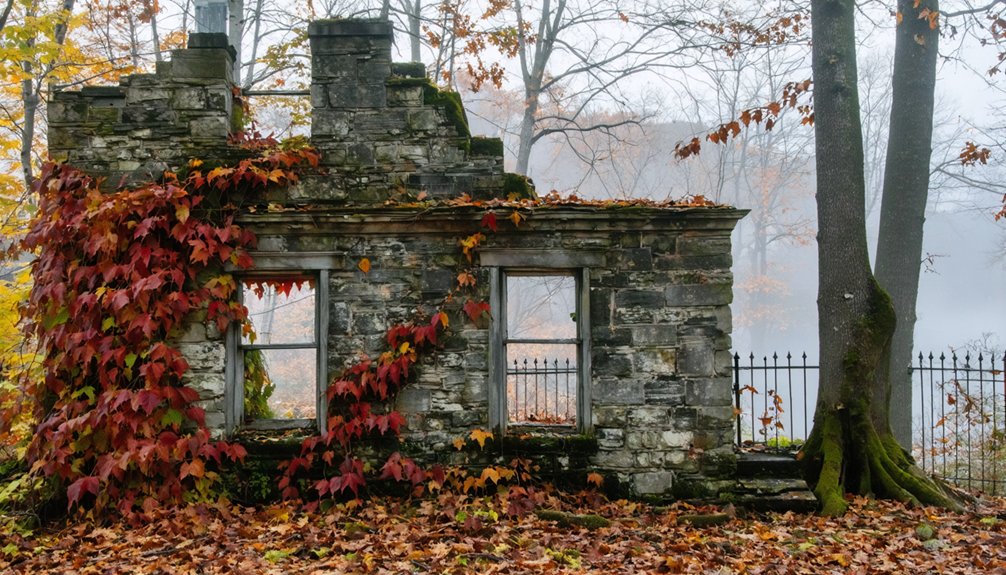
Northwest Connecticut’s Litchfield Hills erupt in scarlet and gold weeks before the rest of the state, transforming this already haunting landscape into Connecticut’s undisputed autumn spectacle. You’ll witness maples blazing crimson against abandoned homesteads while birches glow golden along forgotten roads—aerial photography captures this phenomenon as a band-like wave sweeping southward from mid-October.
DEEP confirms what locals know: higher elevations here show Connecticut’s first color bursts. Historical preservation efforts have protected viewing corridors along Route 7, where sparse development lets you absorb uninterrupted vistas.
Climb Mt. Tom’s tower for 360-degree panoramas, or stand at Apple Hill’s platform overlooking Bantam Lake.
Crisp Canadian air triggers the transformation, painting valleys and ridges in oranges and reds that peak October 3-23, creating perfect conditions for exploring ghost towns cloaked in autumn’s glory.
Best Trails and Backroads for Combining Ghost Towns and Foliage Views
4. Pilfershire’s Unmarked Routes – Fog-shrouded forest paths demand navigation skills and reward bold wanderers.
Frequently Asked Questions
Are Ghost Town Sites Wheelchair Accessible for Visitors With Mobility Limitations?
You’ll find limited accessible pathways at Connecticut’s ghost towns, but you can reserve all-terrain mobility aids at five state parks. Dinosaur State Park near Rocky Hill’s abandoned village offers free wheelchair access after quick video training.
What Photography Equipment Works Best for Capturing Ghost Towns in Autumn?
Want to freeze autumn’s ghostly magic? You’ll need a mirrorless camera with versatile zoom lenses and circular polarizers for vibrant colors. Camera settings favoring sharp detail matter, but tripod essentials guarantee stability when shadows lengthen across abandoned, leaf-strewn pathways.
Can Visitors Camp Overnight Near Connecticut’s Ghost Town Locations?
You can’t camp at the ghost towns themselves due to preservation efforts, but you’ll find designated sites nearby. Gay City offers 27 spots where you’ll experience historical interpretations while respecting these fragile ruins under autumn’s crimson canopy.
Are Guided Tours Available for Exploring Connecticut’s Abandoned Settlements?
You’re barking up the wrong tree—no guided tours exist for Connecticut’s ghost towns. You’ll discover historical preservation through self-exploration, creating your own storytelling opportunities while wandering crumbling foundations where autumn leaves crunch beneath your boots, completely untethered.
What Safety Precautions Should Visitors Take When Exploring Ghost Town Ruins?
You’ll want sturdy boots and stay on marked trails—historical preservation matters here. Pack flashlights, first-aid supplies, and bright clothing. These visitor safety tips guarantee you’re respecting fragile ruins while protecting yourself from crumbling structures and wildlife.
References
- https://heleneinbetween.com/2025/03/best-places-to-see-fall-foliage-in-new-england-towns-farms-leaves-festivals-and-more.html
- https://newenglandwanderlust.com/fall-in-connecticut/
- https://www.getawaymavens.com/connecticut-fall-foliage/
- https://kristynewengland.com/5-favorite-fall-connecticut-towns-to-visit/
- https://earlybirdonthetrail.com/haunted-hikes-in-connecticut/
- https://ctvisit.com/articles/ultimate-connecticut-fall-foliage-road-trip-guide
- https://www.atlasobscura.com/things-to-do/connecticut/ghost-towns
- https://www.youtube.com/watch?v=PKr-5HrudiI
- https://en.wikipedia.org/wiki/List_of_ghost_towns_in_Connecticut
- https://www.oreateai.com/blog/dudleytown-ct-the-haunting-legacy-of-an-abandoned-village/b6c65dcad13be8ccbb4426ae02f376ea