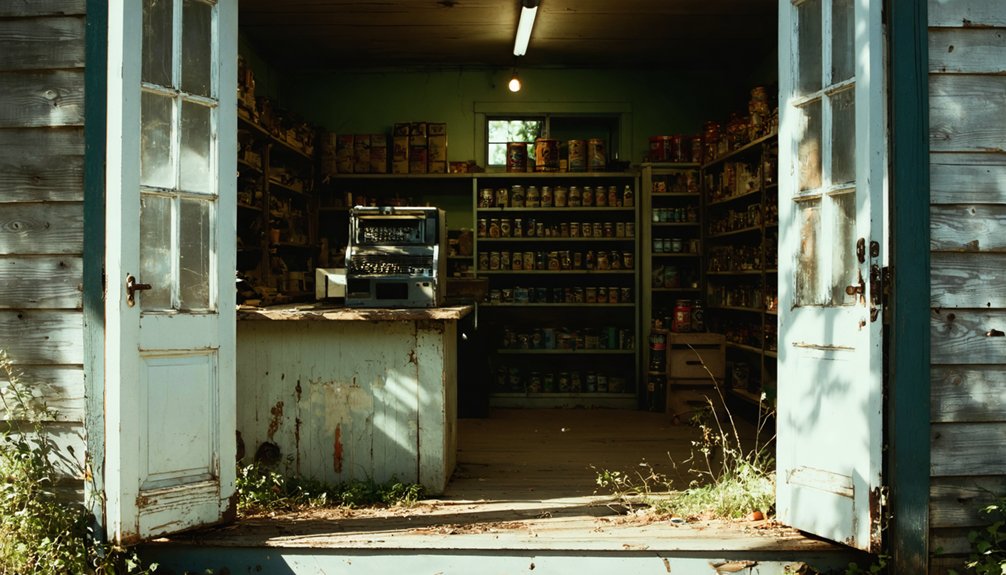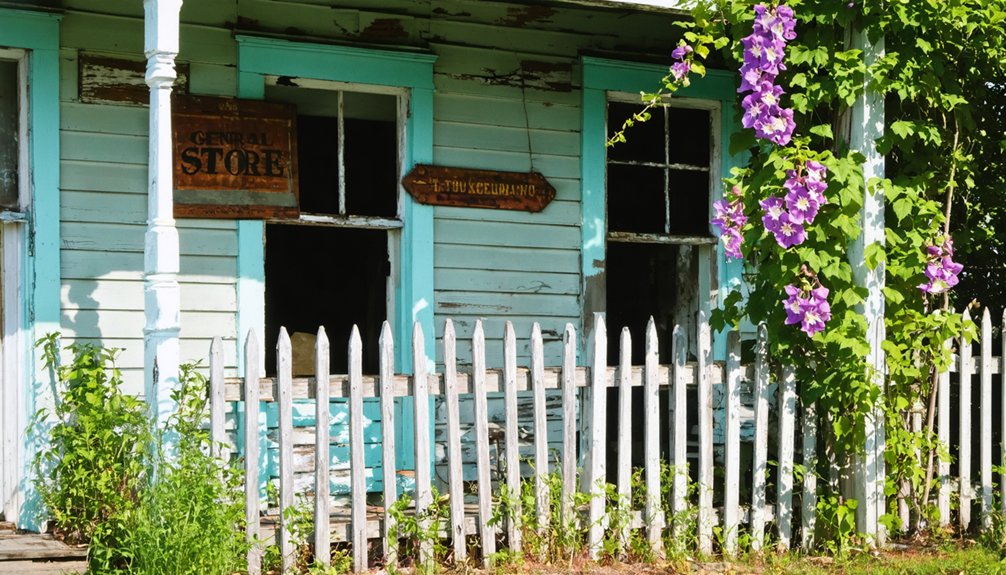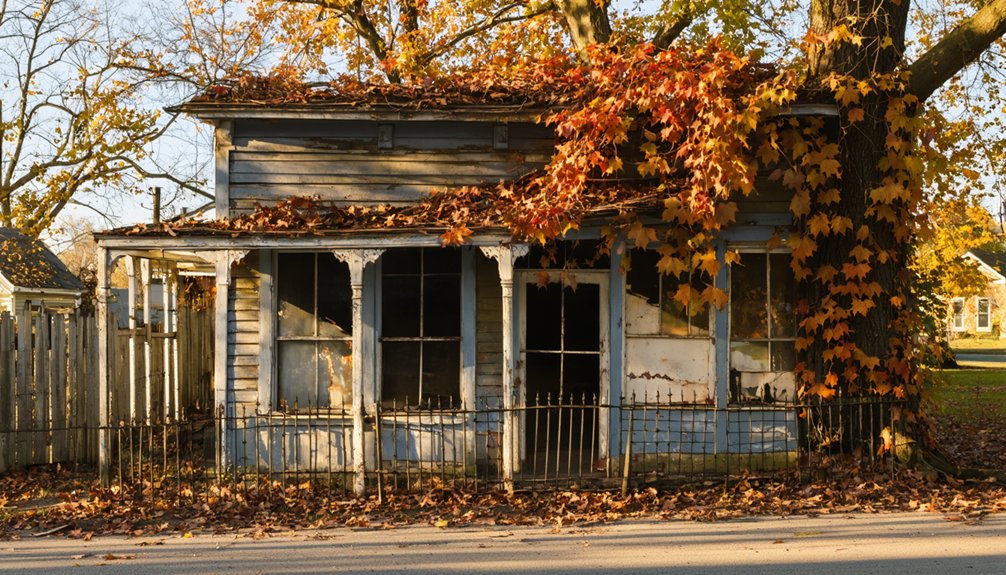
You’ll find Delaware’s ghost towns dramatically framed by fall foliage, from Glenville’s modern ruins along Red Clay Creek to Sussex County’s abandoned settlements like Zwaanendael and Bethel. Woodland Beach offers coastal ghost town exploration with peak October colors, while Trap Pond’s cypress swamp displays vibrant autumn hues alongside late 1700s logging remnants. Rockwood Park combines Gothic Revival architecture with haunted trails through crimson maples, and Winterthur’s 1,000 acres showcase russet oaks near forgotten communities. These preservation sites reveal how Delaware’s seasonal landscapes enhance its abandoned heritage throughout the state’s most atmospheric months.
Key Takeaways
- Glenville ghost town on Red Clay Creek offers modern ruins amid seasonal foliage after 2003 tropical storm destruction and state buyout.
- Sussex County features abandoned settlements like Zwaanendael and Saint Johnstown with archaeological remnants visible beneath autumn leaves.
- Woodland Beach’s coastal ruins display haunting structures and erosion remnants framed by scenic fall landscapes along Delaware Bay.
- Trap Pond State Park combines cypress swamp fall colors with visible remnants of 1700s logging operations and mill sites.
- Rockwood Park’s 72-acre historic grounds feature October haunted walks through vibrant autumn foliage and Victorian gardens.
Glenville: A Modern Ghost Town Near Northern Delaware’s Autumn Landscapes
Glenville sits quietly along Red Clay Creek in New Castle County, a settlement that met its end not through the passage of centuries but through the forces of nature in the early 2000s.
You’ll find this modern ghost town twenty feet above sea level on Bread and Cheese Island’s floodplain, where Tropical Storm Henri delivered its devastating blow in September 2003. The environmental impact proved catastrophic—homes destroyed, families displaced, and a community erased.
State buyout programs facilitated resident relocation by 2004, while demolition crews systematically dismantled remaining structures throughout 2005.
Unlike Delaware’s historic ghost towns abandoned through violence or economic collapse, Glenville stands as a testament to climate vulnerability. The town had deep historical roots dating to 1679, giving it centuries of existence before natural disasters sealed its fate.
Historical preservation here exists only through photographs and Red Cross archives documenting this bittersweet modern abandonment. Red Cross disaster relief workers photographed the destruction in August 2003, capturing the aftermath of devastated homes before subsequent storms struck the area.
Sussex County’s Forgotten Settlements and Trap Pond’s Cypress Swamp Colors
You’ll discover Sussex County holds Delaware’s densest concentration of abandoned settlements, including Banning, Saint Johnstown, and the 1631 Dutch colony of Zwaanendael near present-day Lewes.
These forgotten towns once thrived on agriculture and manufacturing before fading into the surrounding woodlands that now blaze with autumn color. Banning, also known as Glenville, never recovered from Tropical Storm Henri in 2003 and was abandoned by 2004.
The historic village of Bethel, established in the 1700s, remains a rural crossroads with few houses remaining, a church, and a historic cemetery that preserve this early American settlement’s cultural heritage.
Five miles northeast of where SH 46 crosses Deep Creek, Trap Pond State Park‘s 185-acre cypress swamp transforms into a golden-orange spectacle each October, creating Delaware’s most distinctive fall foliage display where abandoned settlements meet preserved wilderness.
Abandoned Sussex County Towns
When Dutch settlers established Zwaanendael in 1631 near Delaware Bay, they envisioned a thriving whaling enterprise under the Dutch West India Company’s charter. Led by Gillis Hossitt, the colony met disaster within months when cultural misunderstandings with the Siconese sparked violence. Captain David Pieterson DeVries arrived December 1632 to find complete annihilation.
Sussex County’s historical preservation efforts now document these vanished communities:
- Bethel Crossroads Village declined from its 1700s agricultural boom to scattered houses and a cemetery.
- Saint Johnstown faded after resource-based industry collapse.
- Woodland disappeared beneath forests and development.
- Owens Station left only foundation traces in plowed fields.
These local legends represent Delaware’s pattern of resource-driven settlements rising and falling, their stories preserved through archaeological remnants and cemetery markers surviving beneath autumn’s colorful canopy. The Dutch refortified the former Swanendael area in 1659, calling it Hoerenkill and later Whorekill, though this settlement too would fade from prominence. Rural settlements like Robinsonville still dot the landscape at scattered rural dwellings visible in aerial surveys near Lewes.
Trap Pond Autumn Spectacle
Beyond the documented ghost towns of Sussex County, Trap Pond State Park preserves layers of industrial archaeology beneath its celebrated autumn canopy. You’ll find remnants of historical logging operations dating to the late 1700s, when up to 20 mill ponds supported timber extraction for charcoal production.
The 1931 flood destroyed the original dam, draining the pond until New Deal-era dam restoration by the Civilian Conservation Corps in 1936-1937.
Today’s 3,653-acre landscape showcases fall’s transformation through Mid-Atlantic Mesic Mixed Hardwood Forest and Southern Red Maple-Blackgum Swamp communities. The cypress wetland—now honored as Cypress Point—displays amber hues against dark waters, marking where Nanticoke ancestral lands met industrial enterprise. Originally designated as Jason Beach, this area served as a vital gathering spot for African Americans from the 1930s into the early 1970s before being renamed Cypress Point in the late 1960s. The area’s ironworks bellows once fueled furnaces that processed bog ore, leaving slag fragments still visible at sites like Old Forge.
These preserved acres reveal Delaware’s layered past through seasonal woodland progression.
Winterthur Museum’s Fall Splendor and Nearby Abandoned Communities
Nestled among the Brandywine Valley‘s rolling hills, Winterthur Museum, Garden & Library transforms into a tapestry of autumn brilliance across its 1,000-acre estate each fall. Your leaf peeping excursions begin mid-September when dogwoods and maples ignite the woodland trails, intensifying through early November as hickories and tulip-poplars blaze golden overhead.
Fall Foliage Timeline:
- Mid-September: Dogwood, maple, and katsura display initial hues
- Early October: Hickories, ashes, and black gum add golden-red layers
- Late October: Peak vibrancy with tulip-poplars and intensified russet oaks
- November: Japanese maples at Magnolia Bend provide finale displays
Art installations throughout sixty manicured garden acres complement nature’s palette.
While exploring hilly meadows where spicebush and wildflowers mirror overhead canopies, you’ll discover freedom in wandering these historically preserved grounds. White flower clusters of White Wood Aster emerge along woodland edges throughout September, adding delicate contrast to the warming autumn palette. The enchanted woods offer children interactive discovery stations where young visitors can explore nature’s seasonal transformations.
Woodland Beach in Kent County: Coastal Ghost Town Meets Seasonal Trails
Along Delaware Bay’s eroding shoreline, Woodland Beach stands as Kent County’s most poignant coastal ruin—a once-thriving 1880s resort town where steamboats delivered thousands of visitors to its hotel, pavilion, and boardwalk before catastrophic storms erased nearly everything. The 1878 hurricane and 1914 nor’easter reduced this vibrant destination to a fishing village frozen in time.
You’ll discover hidden histories here, including “Colored Peoples Day” events (1884-1906) and the devastating 1903 smallpox outbreak that killed a third of the population.
Spectral sightings pepper local lore—Maggie’s decapitated ghost near the bridge, Jacob’s apparition at Woodland Ferry, and moonlit figures where the boardwalk once stood.
Today’s seasonal trails wind through this forgotten landscape, offering photographers and history seekers unfiltered access to Delaware’s coastal past.
Nemours Estate and Mt. Cuba Center: Gilded Age Gardens Near Haunted History
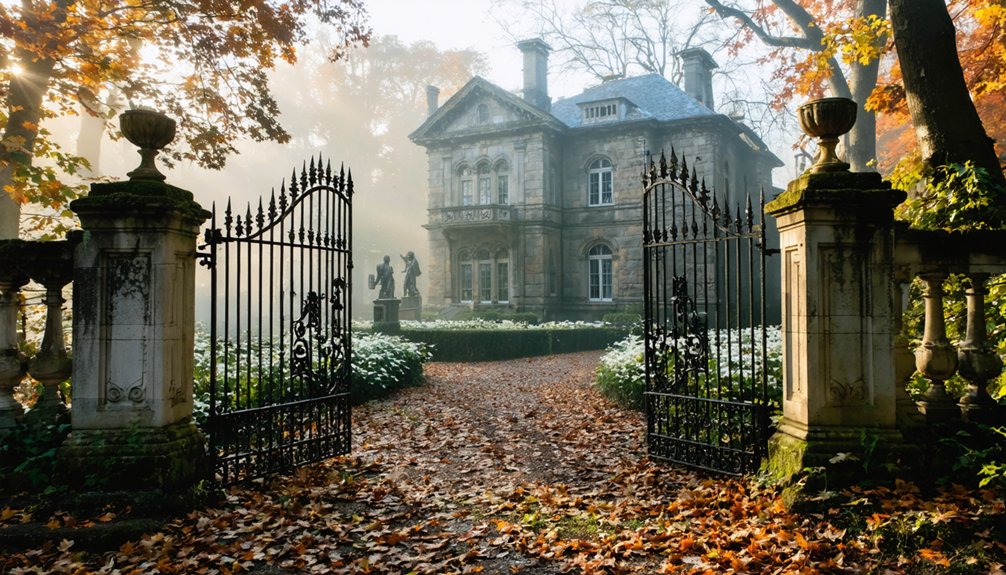
Where Brandywine Valley wealth transformed wilderness into Europe-inspired showplaces, Alfred I. du Pont’s Nemours Estate emerges as Delaware’s most ambitious Gilded Age monument—a 47,000-square-foot Louis XVI château completed in just 18 months (1909-1910) following his scandalous divorce and remarriage to Alicia.
Historic architecture meets haunted legends across 300 acres of Versailles-inspired gardens, where fall foliage transforms North America’s largest jardin à la française into burnished gold.
You’ll discover technological marvels beneath period opulence:
- Central vacuum system and generator powering 77 rooms
- Ice-making facilities with basement chutes serving the kitchen
- Temple of Love overlooking a ⅓-mile formal axis
- Reflecting pool spanning one acre with 157 fountains
Tours run May through December, revealing both du Pont dynasty innovations and whispered tales of restless spirits wandering manicured paths where industrial fortunes built European fantasies.
October Activities at Rockwood Park’s Haunted Trails and Historic Grounds
You’ll find Rockwood Park’s Haunted Trails transform the 72-acre English-style estate into Delaware’s spookiest evening destination throughout October.
With free self-guided walks available nightly from 7-10pm.
The historic grounds, listed on the National Register of Historic Places since 1976, serve as an atmospheric backdrop where spooky light displays illuminate the Gothic Revival mansion‘s surroundings by moonlight.
October’s fall foliage enhances the walking paths across this former Bringhurst family estate.
Though the terrain requires proper footwear for traversing the illuminated trails.
Free Evening Haunted Walks
Throughout October, Rockwood Park transforms its historic grounds into Delaware’s premier free haunted walking experience, welcoming visitors nightly from 7–10pm without requiring tickets or reservations.
You’ll navigate moonlit paths enhanced by spooky lights at 4651 Washington Street Extension, discovering haunted history through seasonal explorations of Delaware’s spookiest terrain.
Essential considerations for your visit:
- Footwear matters: Uneven historic terrain demands sturdy, weather-resistant shoes
- Weather preparation: Dress appropriately for outdoor October conditions
- Timing strategy: Arrive early to maximize your self-guided experience
- No actors involved: Pure atmospheric exploration without theatrical elements
This family-friendly trail operates independently of Rockwood’s paid events like The Revisionists’ lamplight tours ($30) and paranormal investigations.
The self-guided format grants you complete freedom to explore at your own pace, supporting the Rockwood Park Preservation Society’s mission.
October Spooky Light Displays
The spooky light displays at Rockwood Park represent October’s most photographed nighttime feature, casting an ethereal glow across 72 acres of documented Victorian estate grounds from 1851.
You’ll find nighttime illumination strategically placed along self-guided trails, creating ghostly atmospheres enhanced by moonlight throughout the month.
These free displays operate nightly from 7–10pm at 4651 Washington Street Extension, requiring no tickets or reservations—you’re free to explore at your own pace.
The lighting design emphasizes atmospheric effects over structured scares, letting you wander historic paths where Delaware’s autumn foliage meets Victorian architecture.
Wear sturdy shoes for uneven terrain.
The displays complement deeper paranormal programming, including investigation reveals and equipment-based mansion experiences that sell out quickly, supporting the estate’s preservation through visitor engagement.
Fall Foliage Playground Setting
When autumn transforms Rockwood Park’s 162 acres into a natural amphitheater of color, the Gothic Revival mansion’s 1851 stonework emerges as a focal point against Delaware’s seasonal palette—crimson maples and golden oaks framing Joseph Shipley’s architectural vision exactly as period landscape design intended.
Your autumn adventures unfold across historically authentic grounds where foliage photography captures the same vistas documented in 1850s pleasure garden plans. The restored 72-acre landscape provides uncrowded pathways through peak October colors.
- Free nightly access (7-10pm) throughout October on trails designed for moonlit exploration
- National Register site since 1976 with documented horticultural heritage
- Miles of curving paths through lawns and wooded borders
- Grand Garden Tour (October 4) contextualizes 170 years of landscape evolution
Self-guided walks require only proper footwear and appreciation for preservation-minded seasonal access.
Frequently Asked Questions
Are Pets Allowed on Trails at Delaware Ghost Town Locations?
Pet policy information for Delaware’s ghost town trails isn’t thoroughly documented. You’ll need to contact individual property managers directly to verify current trail rules, as restrictions vary greatly between state-managed sites and privately-owned historical properties.
What Is the Best Time of Day to Photograph Fall Foliage?
Timing perfect photography during Golden Hour—half-hours after sunrise or before sunset—you’ll capture Delaware’s ghost town foliage under ideal lighting conditions. Morning’s sharp angles make colors pop vibrantly, while evening’s warm glow provides softer, historically authentic documentation opportunities.
Do Any Ghost Towns Offer Overnight Camping During October?
You’ll find overnight camping at Fort Delaware during October, where haunted legends permeate abandoned structures from the 1860s. While not technically a ghost town, it’s Delaware’s most authentically preserved paranormal site offering three-hour investigations and genuine historical atmosphere.
Exploring ghost towns in Delaware’s history reveals even more intriguing stories of forgotten communities, lost to time and economic shifts. Each site holds remnants of a vibrant past, drawing curiosity from history buffs and paranormal enthusiasts alike. With their empty streets and crumbling buildings, these locations serve as a haunting reminder of what once was.
Are the Ghost Town Sites Wheelchair Accessible for Visitors?
Wheelchair accessibility information isn’t documented for Delaware’s ghost town sites. You’ll need to contact historical preservation offices directly about visitor amenities before planning your trip, as these abandoned locations typically lack modern accessibility features or standardized accommodations.
Which Ghost Towns Have Parking Facilities Available for Tourists?
Like scattered waypoints on an explorer’s map, you’ll find parking at Fort Delaware’s ferry lots, Allee House’s roadside spaces near Dutch Neck Road, and Robinsonville’s junction pull-offs—all preserving access to historical ruins amid autumn scenery awaiting your discovery.
References
- https://bigfamilytrips.com/the-best-places-to-see-fall-colors-in-delaware/
- https://schellbrothers.com/blog/2017/09/21/delaware-in-the-fall/
- https://www.visitwilmingtonde.com/blog/stories/post/fall-at-rockwood-park-museum-art-atmosphere-and-after-dark-haunted-adventures/
- https://en.wikipedia.org/wiki/List_of_ghost_towns_in_Delaware
- https://www.youtube.com/watch?v=ex8Hld_imPU
- https://www.farmweddingde.com/wedding-blog/haunted-history-in-delaware-city-tourism-in-the-first-state
- https://www.narratively.com/p/the-park-built-on-forgotten-ghost-towns
- https://www.visitkeweenaw.com/listing/delaware-the-ghost-town/515/
- https://kids.kiddle.co/Glenville
- https://commons.wikimedia.org/wiki/File:Abandoned_house_in_Glenville_Delaware.jpg