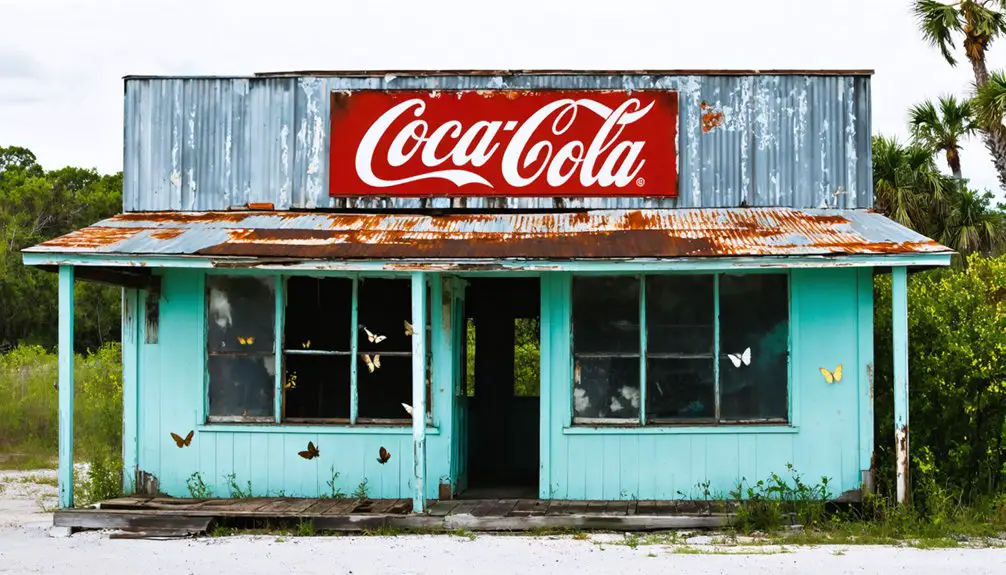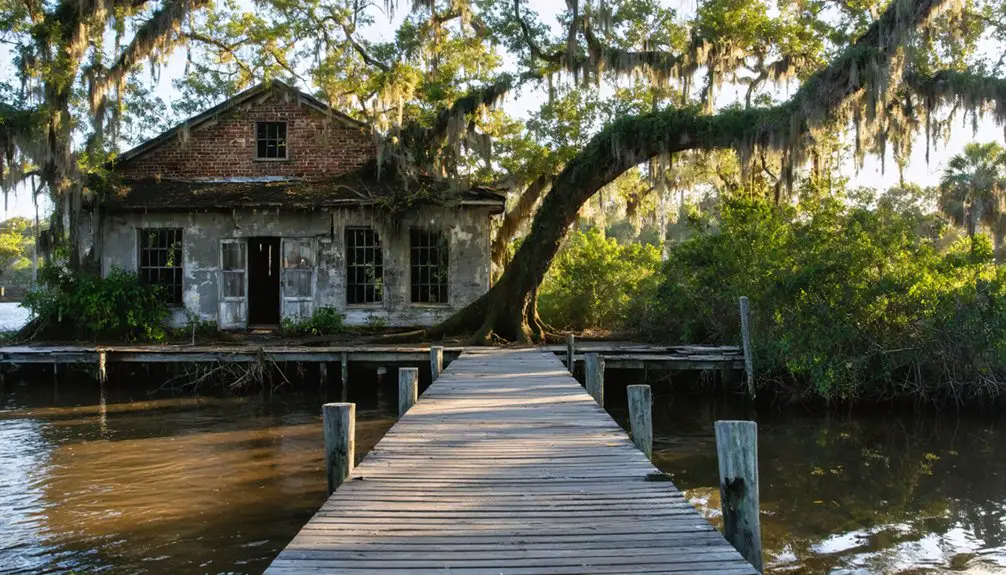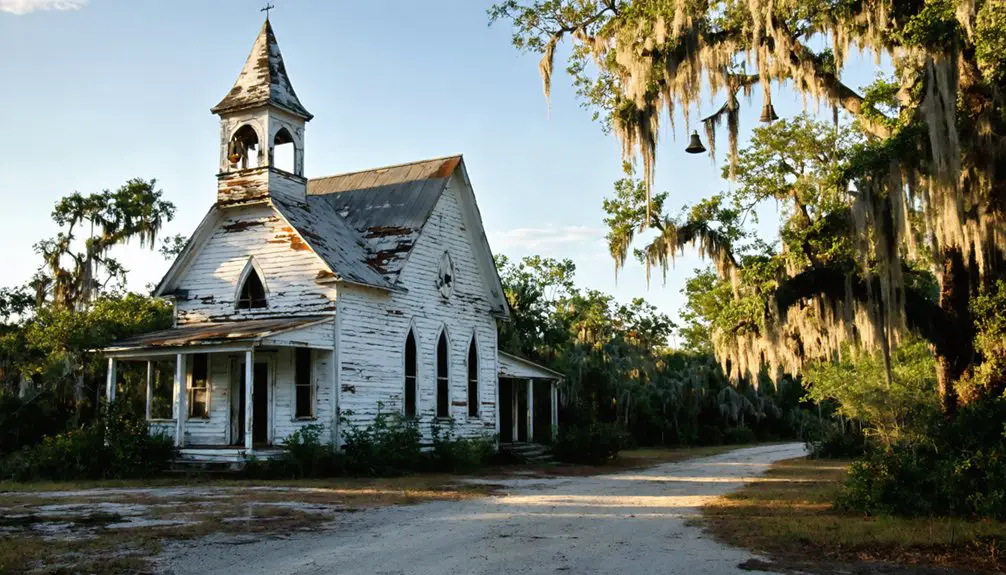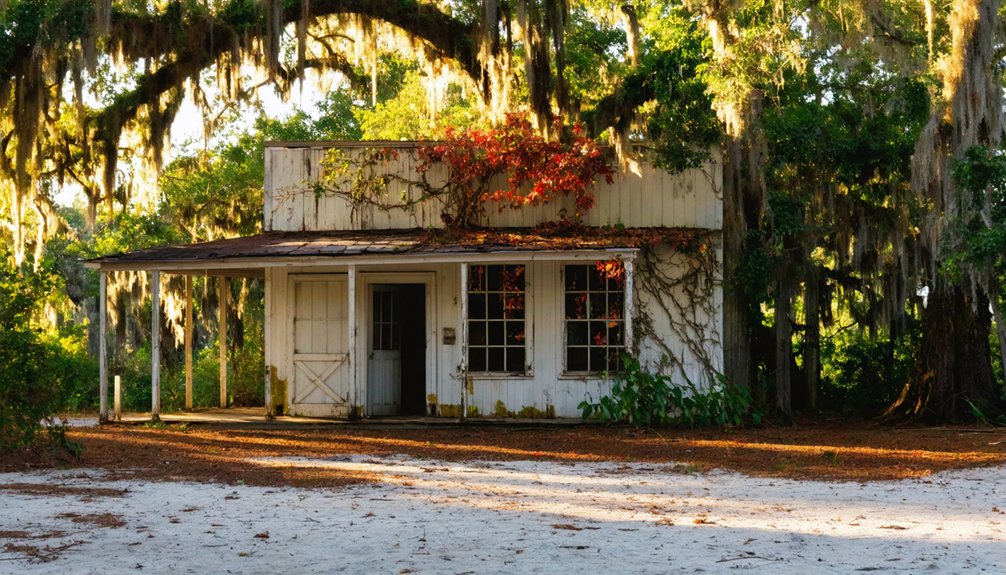
You’ll discover Florida’s ghost towns transform each autumn as sweetgum and hickory trees paint forgotten streets in amber and crimson. Wander through Micanopy’s 1890s storefronts beneath golden canopies, or explore Linden’s phosphate ruins where fall foliage overtakes rusted machinery near Ocala National Forest’s 72-mile trail. In Archer, Victorian mansions from the phosphate boom glow against October sunlight, while Two Egg’s Depression-era legacy stands framed by seasonal colors. These nine atmospheric sites reveal how Florida’s abandoned settlements blend southern Gothic architecture with unexpected autumn beauty.
Key Takeaways
- Two Egg, a Great Depression-era ghost town, offers timber heritage and rural history near Marianna in the Florida Panhandle.
- Linden’s decaying phosphate settlement borders Ocala National Forest, featuring 72-mile trails with fall foliage best viewed April through February.
- Micanopy, Florida’s oldest inland town, hosts 39 historic sites with brick storefronts and antique shops amid autumn scenery.
- St. Joseph’s coastal ruins preserve 1838 structures and cemeteries, surrounded by modern Port St. Joe with historical preservation efforts.
- Archer showcases phosphate-era Victorian mansions and industrial architecture like Maddox Foundry, highlighted by October foliage and wraparound porches.
Two Egg and the Jackson County Timber Heritage
Deep in the Florida Panhandle, where Jackson County’s pine forests meet red clay roads, you’ll find a weathered sign marking one of America’s most peculiarly named communities: Two Egg.
This unincorporated crossroads earned its nickname during the Great Depression when desperate locals bartered eggs for sugar at Lawrence Grocery.
You’re standing where timber heritage built fortunes—7,000-acre plantations once sprawled here when it was called Allison.
Today’s ghost legends haunt these woods: Elizabeth Bellamy’s burning spirit wanders Bellamy Bridge searching for her lost husband, while the pale-skinned “Stump Jumper” stalks swamplands on two legs.
Though census records still list Two Egg, you’ll discover mostly memories here—a historical monument honoring the Williams family stands as a demonstration of rural resilience against economic collapse.
The name gained official recognition when it appeared on state highway maps by 1941, cementing this community’s unique identity in public record.
The community sits at the intersection of State Road 69 and 69A, where Marianna lies just eleven miles distant.
Micanopy’s Historic District and Annual Fall Festival
Where Cholokka Boulevard’s moss-draped oaks cast shadows across weathered brick storefronts, you’ve discovered Florida’s oldest inland town—a 470-acre treasure designated historic in 1983. Named after Seminole Chief Micanopy, this 1821 trading post settlement holds thirty-nine National Register sites within its boundaries.
You’ll find authentic historic preservation here, not manufactured nostalgia. The 1890s Thrasher Warehouse stands sentinel among buildings marked with plaques telling their own stories. Ancient oaks shelter brick-and-mortar antique shops lining the main street. The Herlong Mansion stands as one of the district’s most notable historic structures, representing the architectural heritage preserved since the town’s founding in 1776. Greek revival mansions with Corinthian columns showcase the architectural grandeur that defined the town’s prosperous era.
Come autumn, the fall festival transforms this quiet sanctuary into a bustling gathering of 30,000 visitors exploring artisan wares and supporting twelve local nonprofits. But venture here on any ordinary Tuesday—when tourists scatter—and you’ll experience Micanopy’s true character: unhurried, unpolished, and unapologetically independent.
Brooksville’s May-Stringer House Among Autumn Landscapes
North of Micanopy’s antique shops, Brooksville’s May-Stringer House rises from a hilltop at 601 Museum Court—a painted-lady Victorian with seven gables and gingerbread trim that’s witnessed 160 years of Florida history.
You’ll find preservation efforts have transformed Dr. Stringer’s former medical practice into the Hernando Heritage Museum, where 10,000 artifacts fill themed rooms from Victorian dining spaces to an 1880s doctor’s office.
The haunted folklore runs deep here. Museum volunteers report shadows drifting through empty corridors, cold spots materializing without warning, and children’s cries echoing from the graves of Marena May and her daughter Jessie Mae, who’ve rested on the grounds since 1869. Sightings of mists have been reported over the years, adding to the home’s supernatural mystique. The attic presence remains the most unsettling aspect of paranormal encounters, according to ghost folklore passed down through generations.
Over 80 ghost-hunting groups have investigated this hilltop mansion, making it Florida’s most documented paranormal site where autumn brings both falling leaves and restless spirits.
Linden and the Ocala National Forest Seasonal Trails
Beyond the May-Stringer House‘s Victorian haunts, Florida’s forgotten phosphate settlement of Linden crumbles into the earth at the edge of Ocala National Forest—600 square miles of America’s oldest woodland east of the Mississippi. You’ll find rusted processing equipment strangled by sand pines turning bronze, company house foundations swallowed by sweetgum and red maple flashing October gold.
The forest’s 72-mile Florida Trail delivers seasonal trail highlights best explored January through February when swamps dry enough for boot passage. You’ll trace the Juniper Prairie Wilderness segment past fall foliage varieties—sourwood’s crimson, shortleaf pine’s amber needles carpeting forgotten paths. Watch for gopher tortoises shuffling across the path and pitcher plants lining the wetland edges. Pack rose-colored glasses to intensify the perception of autumn hues along these remote stretches.
Alexander Springs erupts Olympic-pool volumes every fourteen minutes while you navigate by compass through scrub where black bears shuffle beneath yellowing hardwoods, free from crowds and Florida’s eternal green monotony.
St. Joseph’s Panhandle Coastal Ruins
Florida’s most spectacular vanishing act played out along St. Joseph’s Bay, where the state’s largest town once thrived before nature struck back. You’ll find the old cemetery standing guard over stories of the 1841 yellow fever epidemic and that legendary 1844 hurricane—folklore legends whisper of survivors clinging desperately to tombstones as waves crashed overhead.
The brick tombs and weathered markers represent essential historical preservation efforts in the Panhandle, though most grand homes were barged away to Apalachicola long ago. Captain George L. Kupfer’s whistling ghost supposedly still roams here, while Confederate specters guard phantom gold.
Modern Port St. Joe surrounds these coastal ruins now, but autumn’s cooler winds carry echoes of constitutional conventions and cotton fortunes lost to storms and fever. The 1838 convention hall once hosted Florida’s first state constitutional gathering, before the city’s ambitions to become the state capital were dashed by successive catastrophes. Far to the south, another St. Joseph’s plantation met a similar fate when Seminoles burned it in February 1836 during the Second Seminole War, erasing Joseph M. Hernandez’s sugar works that once produced hundreds of hogsheads annually.
Cedar Key’s Weathered Waterfront Relics
You’ll find Cedar Key’s waterfront scattered with relics from its 1840s heyday as one of Florida’s largest ports—weathered dock pilings jutting from turquoise shallows, crumbling stone cisterns on abandoned Atsena Otie Key, and the lonely 1850s lighthouse still standing watch over Seahorse Key.
Walk the U-shaped dock where the Cross Florida Railroad once terminated, and you’ll sense phantom merchants hauling cedar, turpentine, and cotton onto ships bound for northern factories.
The salt-weathered ruins whisper stories of Civil War raids, catastrophic hurricanes that drowned entire communities, and the stubborn waterfront buildings that have survived 180 years of Gulf fury—until Hurricane Helene’s 2024 surge finally swept wood-frame homes into the sea.
Historic Buildings and Docks
When you step onto Dock Street in Cedar Key, salt-weathered clapboard buildings rise on stilts above the tide like sentinels from another century. These wood-frame structures with wide porches and tin roofs have survived hurricanes since the 1850s, their faded facades telling stories of fishing boats and railroad glory.
You’ll find the Island Hotel, standing since before the Civil War, where Pearl Buck and Jimmy Buffett once stayed. The 1870 Lutterloh residence now houses historical exhibits, while waterfront restaurants occupy buildings that once served Florida’s western railroad terminus.
Historic preservation efforts saved these architectural survivors—a $500,000 grant renovated one vacant structure into a museum. Despite storm damage, waterfront restoration continues, maintaining this rare glimpse of untamed Old Florida.
Ghostly Waterfront Encounters
Along Cedar Key’s misty shoreline, where weathered docks creak beneath your feet and salt air hangs thick with maritime history, the spirits of Florida’s pirate past refuse to rest.
You’ll hear tales of Pierre LeBlanc’s headless horseman thundering across Seahorse Key’s beaches, his detached head tucked beneath one arm while guarding Jean LaFitte’s buried treasure.
Near the Suwannee River’s Gulf entrance, Annie Simpson manifests as floating white light alongside her spectral wolfhound—both murdered by pirates centuries ago.
Cemetery apparitions aren’t confined to graveyards here; lighthouse keeper William Wilson’s whispers still echo through stairwells, and ghostly shipwrecks punctuate the coastline.
At forest edges, a beckoning girl in Victorian dress dissolves into vapor, her giant hound standing sentinel over waterfront secrets.
Archer’s Phosphate-Era Architecture
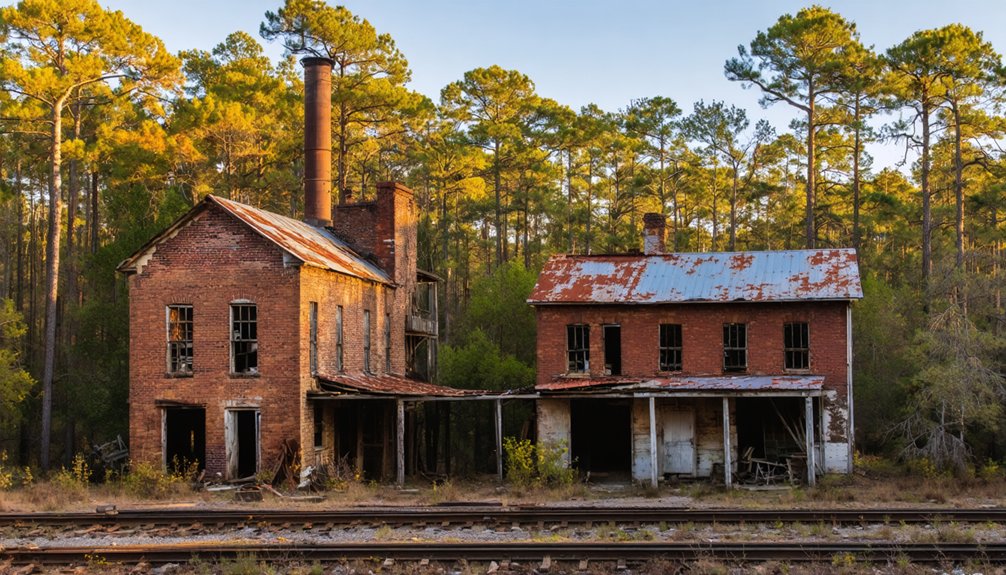
You’ll find Archer’s Victorian mansions rising from quiet streets where phosphate barons built their fortunes in the 1890s. Their wraparound porches and twin gazebos still command attention beneath canopies of rust-colored sweetgum leaves.
The Neal-Wood House and the grand Herlong mansion—with its dark walnut paneling and inlaid floors—stand as monuments to an era when railroad tracks intersected here and mining money flowed through town like the phosphate-laden waters nearby.
Walk past the old Maddox Foundry on Mechanic Street, and you’re tracing the bones of an industrial boom that once employed a hundred workers producing everything from mine equipment to wartime mortar shells.
Historic Late 1800s Structures
Meanwhile, the Herlong House tells its own evolution story. What started as a humble 1875 frame dwelling morphed into a Colonial Revival masterpiece by 1915.
It is complete with walnut and oak paneling that glows in autumn light. Run your fingers along those inlaid floors—they’re affirmation to an era when phosphate money flowed freely and architectural ambition knew no bounds.
Phosphate Industry Foundation
You can still trace the boom through structures that fed off mining wealth:
- Maddox Foundry’s original machine shop, where equipment was forged for Peace River operations
- Victorian-era storefronts that catered to flush mine executives
- Worker housing clusters near the rail depot
- Warehouses that stockpiled machinery parts bound for Bowling Green’s operations
Walk these streets in October, and you’re stepping through rooms built by steam-powered dreams—before the deposits ran dry and prosperity shifted north to Mulberry.
Autumn Landscape Surroundings
When October light slants through Archer’s live oak canopy, it illuminates a phosphate fortune frozen in architectural amber. You’ll find the Neal-Wood House’s twin gazebos catching golden afternoon rays, while the Herlong House’s Colonial Revival columns stand sentinel over streets where mining magnates once walked. The 1890s railroad depot—built when phosphate money flowed freely—frames autumn scenery that transforms these historical ghost towns into living museums.
At 100 Mechanic Street, Maddox Foundry’s brick walls still echo with industrial ambition. Cottonwood Plantation’s bronze marker gleams beneath turning leaves, marking where Confederate gold met David Yulee’s cotton empire. These structures weren’t built for tourists—they served phosphate operations that hauled fortune from Florida earth, leaving behind Victorian mansions and machine shops as evidence to boom-time audacity.
Pittman and the Legacy of the Big Freeze
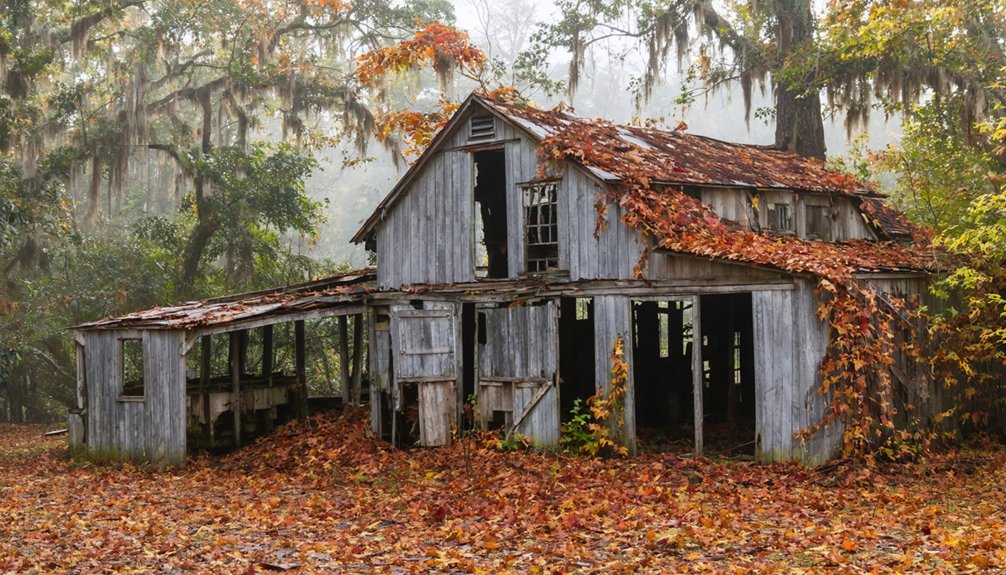
The Great Freeze didn’t arrive with warning—it descended on Central Florida like a guillotine on December 29, 1894, plunging Orlando’s thermometers to 18 degrees and splitting citrus bark with sounds like gunshots echoing through the groves.
A second wave hit February 7, 1895, driving temperatures to 7 degrees near Frostproof.
Pittman’s collapse tells the story:
- Production crashed from 6 million boxes to 100,000
- 21,737 acres yielded nothing
- Trees died to their roots
- Town center relocated as farms failed
You’ll find ceramic relics near Mills Lake Pond where the original settlement stood. Residents walked to work—no cars meant proximity mattered. When the groves died, so did Pittman. Ghost stories now haunt these abandoned acres where fortune froze overnight.
Ruby’s Abandoned Clay Mining Settlement
While citrus groves froze to death in Central Florida, another industry was literally digging its fortune from Florida’s earth. Clay extraction operations carved deep into the terrain, transforming landscapes and birthing temporary communities that vanished as quickly as they appeared.
You’ll find scattered settlement ruins throughout Clay County, where workers once hauled raw material from the ground. The Florida Solite facility stands silent now, its abandoned structures proof to boom-and-bust economics.
These sites offer unexpected autumn beauty—sweet gums and maples paint burnt orange against weathered mining equipment. You’re free to explore these forgotten industrial landscapes, where fall colors frame rusting machinery and crumbling foundations, creating an eerie juxtaposition of nature’s seasonal triumph over man’s temporary dominance.
Frequently Asked Questions
What Is the Best Time to Visit Florida Ghost Towns for Fall Foliage?
You’ll catch the best seasonal colors from late October through November near Bristol and Lake City. These photography hotspots offer amber-hued trails and abandoned ruins where crisp autumn air meets Florida’s wild, untamed landscapes—perfect for your adventurous spirit.
Are There Guided Tours Available for Florida’s Abandoned Ghost Town Sites?
You’ll find guided tours at several sites, revealing hidden history through ranger-led walks at Torreya State Park and kayaking expeditions to Atsena Otie. These guides know prime photography locations where crumbling structures meet autumn-tinged landscapes perfectly.
Can You Camp Overnight Near Ghost Towns in Ocala National Forest?
Like finding hidden treasure in autumn woods, you’ll discover ghost town camping throughout Ocala National Forest. Salt Springs campground puts you closest to St. Francis Trail’s remnants, where crackling campfires illuminate your wild, unrestricted evening explorations.
Which Ghost Towns Are Safe to Explore With Children During Fall?
Centralia and St. Joseph offer the safest family adventures. You’ll discover historic landmarks without hazardous structures, while kids explore abandoned buildings through open trails. The coastal breeze and wilderness paths create perfect freedom for young explorers this fall.
Do Any Florida Ghost Towns Have Accessibility Accommodations for Visitors?
You’ll find limited accessibility features at Florida’s ghost towns. Suwannee River State Park near Ellaville offers marked trails and picnic areas, though wheelchair-friendly paths aren’t guaranteed. Most sites remain wild and unimproved, letting nature reclaim its territory freely.
References
- https://en.wikipedia.org/wiki/List_of_ghost_towns_in_Florida
- https://www.visitflorida.com/travel-ideas/articles/marianna-rural-florida-two-egg/
- https://www.worldatlas.com/cities/9-timeless-towns-in-florida-51426.html
- https://fdc.com/blog/ghost-towns-in-florida/
- https://www.youtube.com/watch?v=ZQf3AqatGD4
- https://www.ocalastyle.com/ghost-towns-of-lake-sumter/
- https://yanitzaninett.com/blog/2019/9/10/everglades-city-spending-1-hour-in-ghost-village
- https://www.onlyinyourstate.com/trip-ideas/florida/creepy-day-trip-spookiest-places-fall-fl
- https://floridatrailblazer.com/category/ghost-towns/
- https://www.florida-backroads-travel.com/two-egg-florida.html