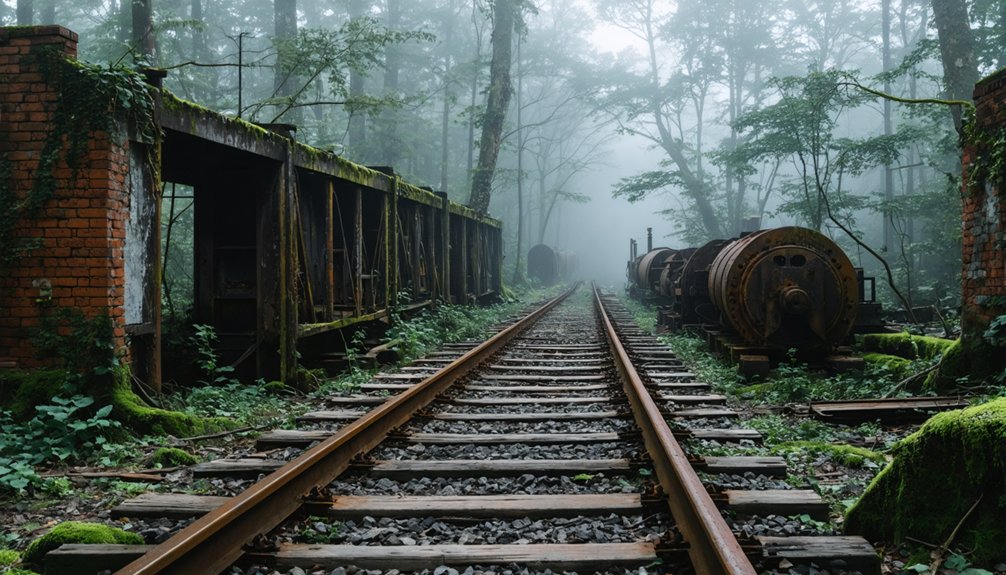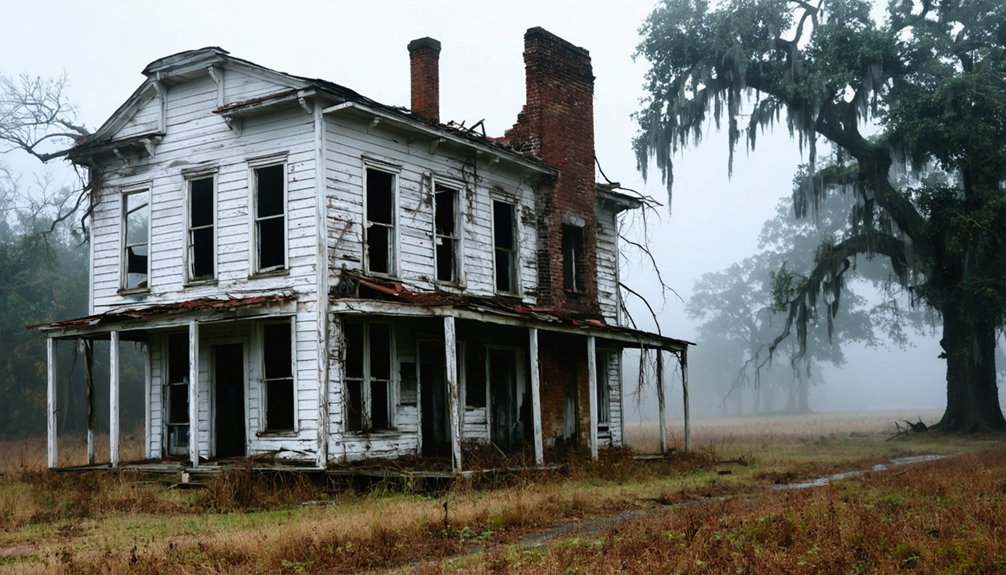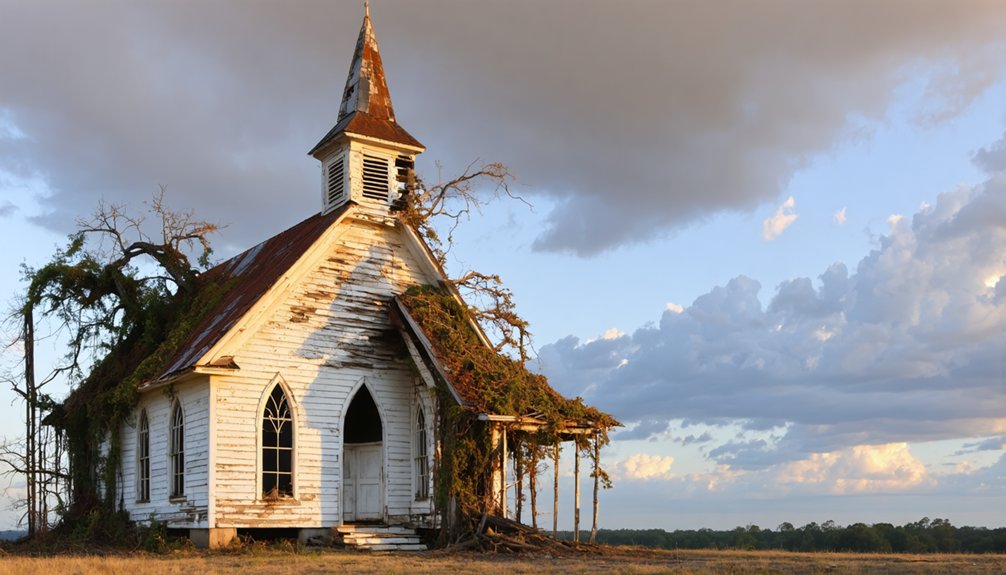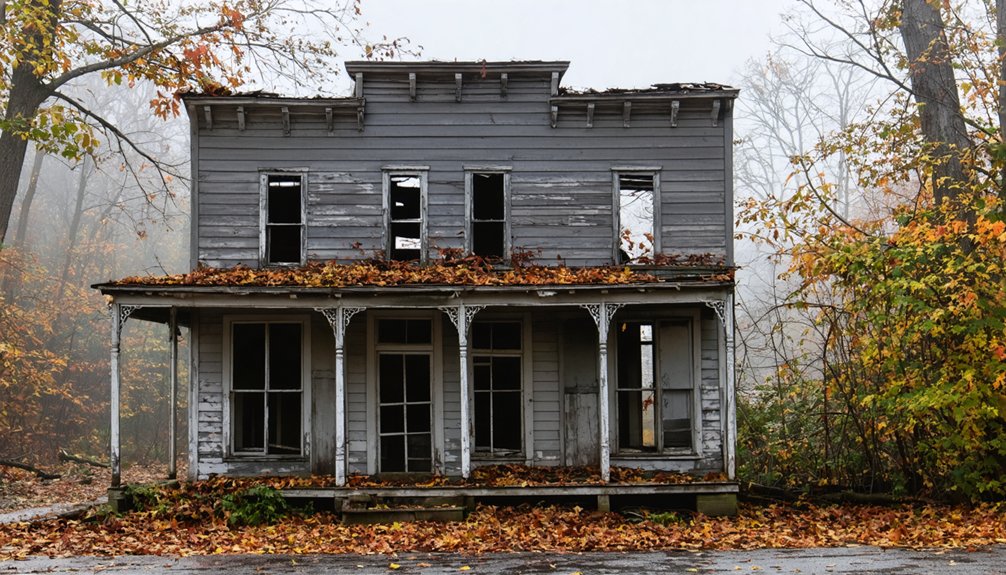
You’ll find Georgia’s ghost towns most haunting during late September through early November, when crimson maples frame kudzu-strangled ruins at Scull Shoals’ 1811 paper mill and High Falls’ moss-covered textile foundations. Sunbury’s Revolutionary War cemetery glows amber atop coastal bluffs, while Oakville’s abandoned farmsteads disappear beneath golden vines. Morning frosts crystallize on crumbling brick walls as fog drifts through cypress swamps at Jacksonboro. Each site pairs 19th-century industrial decay with nature’s seasonal transformation, creating photographer-friendly landscapes where cultural heritage meets autumn’s vibrant reclamation—and there’s strategic timing to maximize your ghost town exploration.
Key Takeaways
- High Falls features a 135-foot waterfall, 1890 granite dam ruins, and moss-covered textile mill remains framed by vibrant fall foliage.
- Scull Shoals displays 19th-century paper mill ruins and warehouse walls surrounded by crimson and gold autumn hardwood colors.
- Oakville’s abandoned farmsteads are draped in kudzu vines that turn botanical amber during Georgia’s peak fall season.
- Sunbury’s colonial port cemetery and Revolutionary War headstones are enhanced by seasonal maples and oaks in vivid autumn hues.
- Visit late September through early November for optimal fall colors; October 15–25 offers peak foliage with fewer crowds.
Scull Shoals: Millstone Ruins Along the Oconee River
For 10,000 years, the fertile shoals along the Oconee River drew people to their banks—first Native American hunter-gatherers who left behind pottery sherds and arrowheads. Then Mississippian farmers cultivated corn and built ceremonial mounds to honor their priest-chiefs.
You’ll find Georgia’s first paper mill here, built in 1811, which once anchored a thriving industrial village employing 500 workers. The archaeological significance of this site extends from prehistoric mounds dating to 1250 A.D. through frontier fortifications against Creek raids. Fort Clark, constructed in 1793 by Michael Cupp, protected early settlers from Creek Indians across the river.
Today, crumbling warehouse walls from 1846 stand as testimony to historical preservation efforts within Oconee National Forest’s 2,200 experimental acres. The wooden covered bridge spanning the Oconee River remains one of the few intact structures from the village’s industrial heyday. The 1887 flood, which sent the final residents fleeing, left behind ruins that autumn leaves now blanket in gold and crimson each fall.
High Falls: Waterfall Echoes of a Textile Mill Town
You’ll find the skeletal remains of High Falls’ nineteenth-century textile mill perched beside the thundering cascade that once powered its operations.
Where autumn maples and sweetgums now blaze orange and crimson against crumbling brick foundations. The waterfall’s constant roar echoes through hollowed structures—a ghostly rhythm that once synchronized with spinning looms and the footsteps of mill workers steering between production halls.
Hiking trails wind past moss-covered entrance gates and fragmented walls, leading you through a landscape where industrial ambition surrendered to kudzu vines and the persistent reclamation of Georgia’s piedmont forest. Similar ruins survive at Roswell Mill, where Roswell Gray fabric was produced for Confederate uniforms before Union forces seized the complex in 1864. Georgia’s textile heritage extends to other mill villages like Silvertown, where curvilinear streets and green spaces were carefully designed by landscape architect Earl Draper to integrate with natural topography.
Mill Ruins by Falls
The brick ruins of New Manchester Manufacturing Company rise from the forest floor like skeletal monuments to Georgia’s industrial past, their red walls now draped in kudzu and framed by the amber canopy of autumn hardwoods. You’ll discover five-story fragments where Confederate uniforms once rolled from looms powered by Sweetwater Creek‘s relentless flow.
Sherman’s troops torched this profitable operation in 1864, scattering its 100 workers and ending the self-contained village that thrived here. Union forces accused the mill workers of treason and deported the women northward to prevent them from continuing textile production for the Confederacy.
Recent historical preservation efforts have stabilized these crumbling walls with steel supports and protective caps, allowing you to explore freely through industrial archaeology that speaks of ambition and destruction. The mill village model would later expand across Georgia, with company-owned housing becoming standard practice as Northern textile manufacturers established operations throughout the post-war South.
Walk among blackberry-covered foundations where company stores and housing once stood, now reclaimed by wilderness—a testament to industry’s impermanence.
Autumn Colors Meet Cascade
North of Sweetwater Creek’s industrial ghosts, another mill town met its demise not through Sherman’s flames but through the subtler betrayal of progress—when the railroad chose a route that left High Falls stranded in economic isolation.
Today, you’ll find autumn’s crimson and gold framing Georgia’s middle region’s largest waterfall—a 135-foot cascade amplified by an 1890 granite dam that once powered thriving mills. The industrial archaeology here tells stories through crumbling powerhouse walls, now canvas for graffiti, and grist mill foundations reclaimed by forest.
Ghost town preservation transformed this abandoned landscape into a state park where you can trace Historic Trail past textile-era echoes. Before the mills rose, Creek Indians inhabited these grounds, following trails that would evolve into the Old Alabama Road. The 1994 flood that destroyed the Old Alabama Road bridge added another layer to High Falls’ narrative of resilience and decay.
The park’s 650-acre lake provides a striking contrast to the historic ruins, offering recreational opportunities amid the autumn foliage and cascading waters. Dickey Betts of The Allman Brothers Band immortalized the location in a 14½-minute instrumental composition titled “High Falls” in 1975, connecting the park’s scenic beauty to Southern music heritage.
Sunbury: Coastal Cemetery Bluffs on the Medway
Perched on windswept bluffs where the Medway River curves toward the Atlantic, Sunbury Cemetery stands as the last visible whisper of Georgia’s second-busiest colonial port. You’ll find weathered headstones dating from 1788 to 1911, marking Revolutionary War soldiers and early pioneers who shaped Georgia’s untamed coast.
The cemetery’s historical preservation tells stories of a thriving pre-Revolutionary hub that British forces targeted in 1778, triggering its eventual abandonment.
Salt-tinged breezes rustle through Spanish moss as you wander Church Square’s southwest corner, where cemetery conservation efforts protect this haunting remnant. Among the notable burials, you’ll discover Reverend William McWhir, the Presbyterian founder who died in 1851 at age 92, alongside prominent coastal families like the Laws and Delegals.
Below these bluffs, the port that once rivaled Savannah has vanished entirely, leaving only burial grounds to commemorate the freedmen, ministers, and merchants who built—and lost—their Atlantic dreams here. The site now serves as part of the Georgia Coast Atlas, a comprehensive digital resource that documents and preserves the region’s cultural heritage for researchers and visitors exploring coastal history.
Jacksonboro: Courthouse Shadows in the Cypress Swamp
Where cypress knees puncture the dark swamp water and Spanish moss drapes like funeral shrouds, Jacksonboro’s courthouse square has surrendered entirely to Georgia’s untamed wetlands.
You’ll find only the 1815 Goodall House standing—only witness to when this thriving county seat hosted Methodist pioneers and rowdy frontiersmen.
Historical legends swirl around preacher Lorenzo Dow’s 1820 curse, pronounced after townspeople pelted him with eggs and tomatoes. He damned everything except Seaborn Goodall’s sanctuary.
Whether supernatural or not, courthouse and jail vanished into mysterious fires and floods after losing county seat status in 1847.
Preservation challenges mean you’re essentially visiting absence itself—a ghost town consumed by swamp, where autumn’s gold reflections shimmer across waters reclaiming civilization’s footprint.
Oakville: Kudzu-Draped Farmstead Frozen in Time
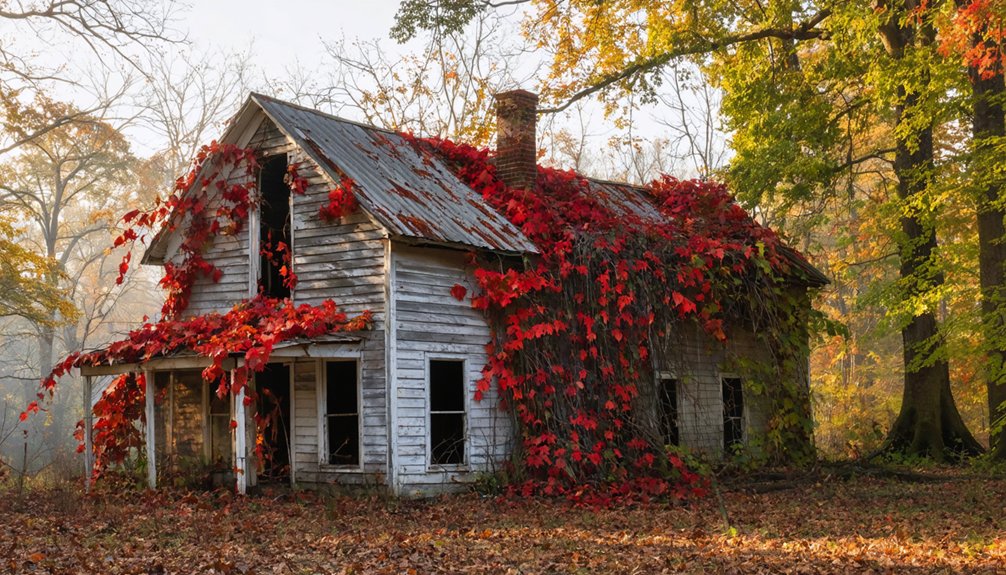
You’ll find Oakville’s forgotten farmsteads strangled beneath cascading walls of kudzu, where the invasive vine has spent decades swallowing barns, fences, and the geometric traces of cultivation that once defined this rural crossroads.
In autumn, the kudzu’s green curtain transforms into rust and burgundy, creating an eerie fusion where fall foliage mingles with the tendrils that’ve frozen this landscape in botanical amber.
The vines shape ghostly mounds—each concealing a collapsed structure or rusted implement—forming a surreal topography where nature’s reclamation becomes its own haunting spectacle.
Kudzu Conceals Abandoned Structures
You’ll discover nature’s reclamation through:
- Kudzu invasion draping porches and cinching rooflines into green silhouettes
- Saddlebag house profile barely identifiable under strangling vines
- Enamelware scattered beneath leaves, marking everyday life abandoned
- Field edges retaining straight lines amid advancing saplings
Mottled light filters through the vines, creating hushed spaces where crickets fill the silence.
The Collier family still holds the property, with relatives deer hunting these woods as recently as 2015, keeping watch over a farmstead that GPS screens won’t acknowledge.
Lost Farmstead Rural Geometry
Beyond the kudzu curtains, Oakville’s geometry reveals itself in careful increments—the deliberate right angles of a fieldstone foundation, the parallel lines of hand-hewn floor joists, the symmetrical placement of cedars that once framed a working homestead.
You’ll trace the architectural logic through square nails driven before 1880, through pine stumps anchoring corners where families shifted from enslavement to ownership.
The weathered barn stands sentinel beside a hidden garden where Spanish moss now claims what cultivation abandoned.
That wraparound second-story porch calculated southern summer survival—screened against mosquitoes, angled for cross-ventilation.
Inside, four-post beds and barrel tables maintain their mathematical relationships to doorways and windows, a domestic calculus that sustained generations until the 1980s, when the last calendar marked time’s final equation.
Fall Foliage Meets Vines
The kudzu arrives at Oakville like a slow-motion tsunami, transforming what geometry built into organic sculpture. This abandoned farmstead showcases nature’s reclamation project where vine dominance creates an unexpected autumn spectacle.
The kudzu invasion that federal agents once championed now mingles with Georgia’s native fall colors, producing bronze-and-crimson tapestries across forsaken structures.
You’ll witness seasonal transformation through:
- Kudzu leaves turning golden-yellow against weathered farmhouse boards
- Native hardwoods bleeding scarlet through vine-draped canopies
- Morning frost crystallizing on both invasive and indigenous foliage
- Abandoned fields creating layered autumn textures unlike manicured landscapes
The 2010 photographs captured this vulnerability—a farmstead surrendering to vegetative conquest.
What government programs planted in desperation during the Dust Bowl era now creates haunting beauty, proving abandonment sometimes births unexpected artistry when human control vanishes.
Brasstown Bald: Mountain Peak Legends and Autumn Vistas
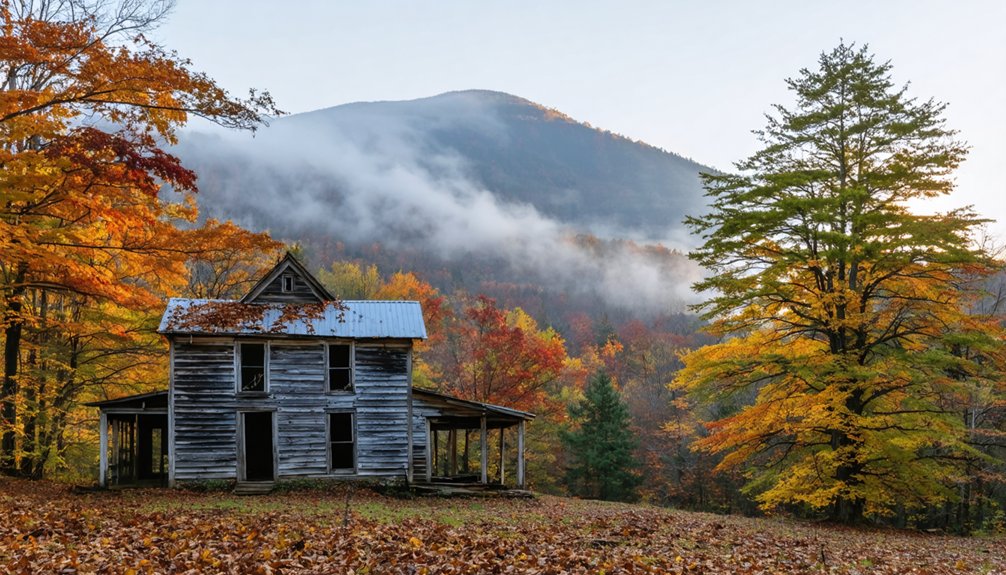
Rising 4,784 feet above sea level, Brasstown Bald commands the Georgia skyline as the state’s highest peak, where Cherokee legends whisper through mountain laurels and autumn paints the slopes in blazing color. The name stems from ltse’yi—”a place of fresh green”—though settlers mistakenly called it “brass.”
You’ll climb a steep half-mile trail to reach the observation tower, where mountain vistas stretch across four states on clear days. The elevation triggers early fall colors, transforming rhododendron-lined slopes into crimson tapestries weeks before lowland forests turn.
Summit temperatures drop ten degrees cooler than the base, sharpening your senses as you stand atop this ancient Cherokee gathering place. Three trails branch from the parking area, beckoning you deeper into wilderness.
Best Times to Visit Georgia’s Ghost Towns in Fall
Timing your journey to Georgia’s abandoned settlements means matching nature’s calendar to crumbling chimneys and forgotten millstones. You’ll find mid-October delivers peak conditions when crimson maples frame weathered brick ruins at sites like Scull Shoals, where historical preservation meets autumn’s wild palette.
Peak foliage transforms forgotten Georgia ruins into photographic gold—crimson leaves against crumbling brick create unforgettable October compositions.
Optimal visiting windows:
- Late September weekdays – escape crowds while 60-75°F temps keep trails comfortable and kudzu hasn’t yet obscured structural details
- October 15-25 – witness fiery oranges and yellows intensify around ghost town ruins at 2,000+ feet elevations
- Early November mornings – capture fog-shrouded cemeteries before leaf drop, when wildlife habitats grow visible through thinning canopies
- Avoid Columbus Day weekend – secure solitude at remote homesteads when foliage hunters flock elsewhere
September through November offers dry paths, flowing waterfalls, and temperatures that won’t drain your water reserves during backcountry exploration.
Planning Your Autumn Ghost Town Road Trip
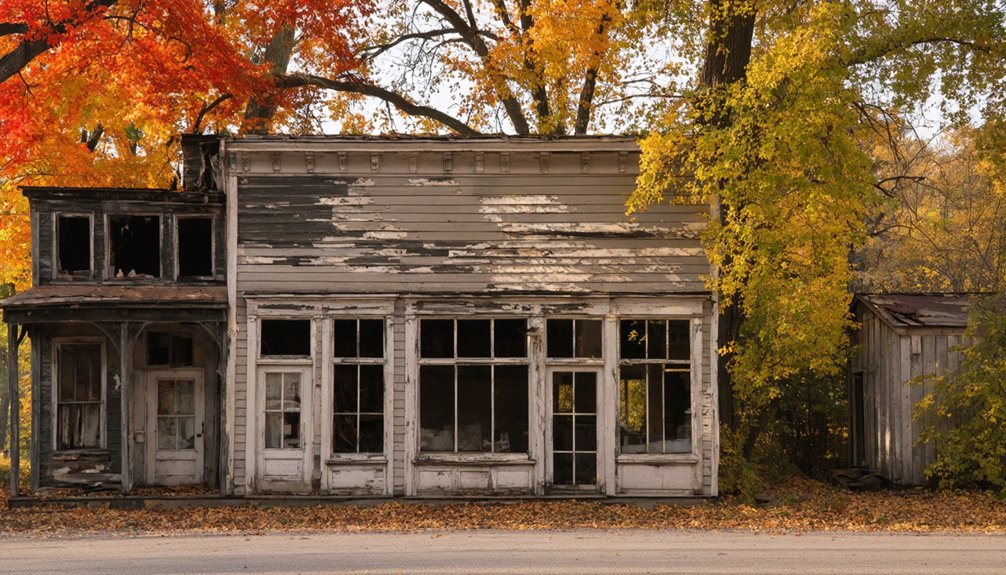
When autumn’s palette transforms Georgia’s forgotten settlements into living history paintings, your road trip demands more than a full gas tank and good intentions.
Map your route through North Georgia’s US-76 corridor, connecting Brasstown Bald’s misty peaks to Hiawassee’s haunted structures.
Pack sturdy boots for Scull Shoals’ moss-covered foundations and Oakville’s kudzu-draped farmsteads.
Your camera captures autumn wildlife—deer threading through Oconee Woods’ sycamores, hawks circling High Falls’ abandoned mill town.
Check Oconee River levels before approaching flood-cursed sites.
Download offline maps for Princeton’s vanished roads and Cleola’s railroad beds.
Balance exploration with Helen’s Bavarian local cuisine and Ellijay’s orchard trails.
Bring flashlights for dusk investigations at Fort Mountain’s mysterious stone wall.
Water, insect repellent, and caution complete your kit for Georgia’s ghostly autumn canvas.
Frequently Asked Questions
Are Any Ghost Towns in Georgia Pet-Friendly for Autumn Visits?
You’ll find Instagram-worthy haunted legends await at pet-friendly ruins like Scull Shoals and High Falls, where leashed dogs explore historic landmarks freely. Autumn transforms crumbling mills into sensory adventures—crunching leaves, misty waterfall spray, moss-covered foundations beneath fiery foliage.
Do Any Sites Require Entrance Fees or Advance Permits?
You’ll encounter minimal entrance fee policies at Georgia’s ghost towns—most charge $5 for state park parking, while national forest ruins remain free. Permit requirements are rare; only Cumberland Island’s Dungeness demands advance ferry reservations at $40 roundtrip.
What Photography Equipment Works Best in Low Light Ruins?
You’ll need a full-frame camera like Sony A7SIII paired with fast wide lenses (f/1.8-f/2.8) for low light ruins. A sturdy tripod enables long exposure shots capturing ghostly interiors where autumn light filters through broken rafters and crumbling doorways.
Are Guided Ghost Town Tours Available During Fall Season?
You’ll find guided ghost tours exploring haunted legends in historic Savannah and Eatonton during fall, but authentic ghost towns lack organized tours. Instead, you’re free to wander atmospheric ruins yourself, discovering historical preservation sites amid autumn’s golden embrace.
Which Locations Have Nearby Camping for Overnight Ghost Town Exploration?
You’ll kill two birds with one stone at Fort Mountain, High Falls, and Scull Shoals—all offering campgrounds where historical preservation meets haunted legend exploration. You can pitch your tent, then roam crumbling ruins under starlit Georgia skies.
References
- https://fernwehrahee.com/fall-in-georgia/
- https://www.visittownscounty.com/whispers-of-the-past-ghostly-tales-from-towns-county-georgia/
- https://everafterinthewoods.com/georgia-ghost-town-landscapes-where-nature-and-history-share-the-same-ground/
- https://flagpole.com/news/news-features/2013/10/23/exploring-georgias-ghost-towns/
- https://exploregeorgia.org/georgia-fall-trip-guide
- https://www.youtube.com/watch?v=n_YB4s0R4Tg
- https://dlg.usg.edu/record/g-hi_g-hiia_collectionsofgeo04jone
- https://vanishinggeorgia.com/2015/11/18/scull-shoals-greene-county-2/
- https://www.youtube.com/watch?v=hpcGWfFwR9Y
- https://www.scullshoals.net/history