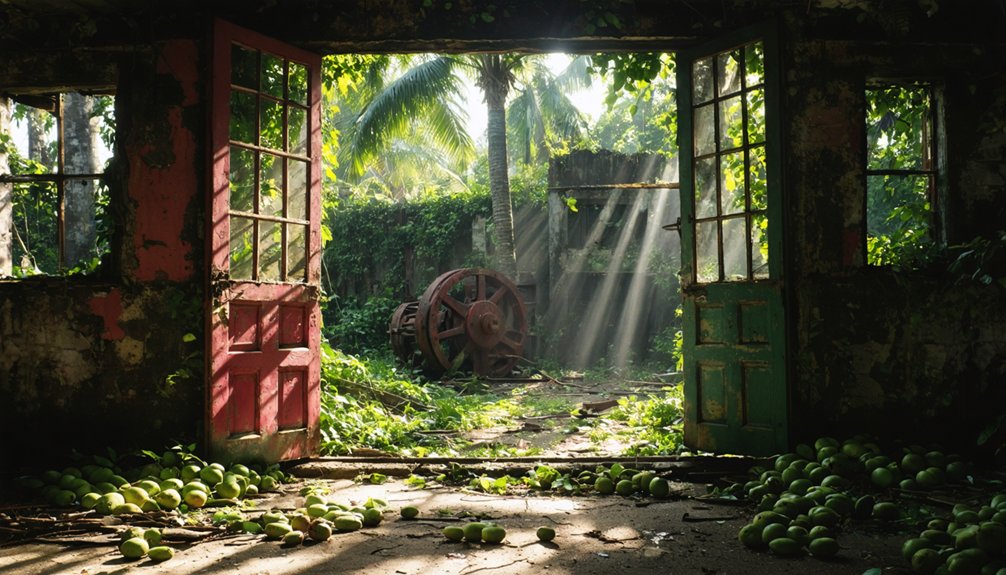
You won’t find traditional fall foliage in Hawaii’s ghost towns, but you’ll discover something more striking: Kaimu’s lava-buried village where crimson ʻōhiʻa lehua blooms erupt from 80-foot-deep flows, Keomuku’s cursed sugar mill ruins framed by golden kiawe, and Hanapēpē’s abandoned WWII buildings draped in explosive orange bougainvillea. Visit May through November when vibrant tropical blooms create Hawaii’s version of autumn colors—native heliconia, ginger, and hibiscus transforming plantation ghost towns into living museums where volcanic history meets resilient rainforest regeneration across Kauai, Maui, and the Big Island’s remote valleys.
Key Takeaways
- Kaimu, buried by 1990 lava flows, features ʻōhiʻa lehua trees growing from hardened volcanic rock with seasonal Puna District foliage.
- Keomuku on Lānaʻi displays abandoned sugar mill ruins surrounded by seasonal kiawe blooms and cultural legends from its 1901 collapse.
- Hanapēpē’s revitalized downtown preserves 1924 massacre history with galleries amid autumn-flavored flora and Friday Art Night events.
- Kohala’s abandoned plantation towns like Hawi feature overgrown foundations and rusted machinery framed by fall-like scenery since 1975 closures.
- Hawaii’s “autumn” occurs May through November, showcasing orange bougainvillea, crimson hibiscus, and native plants over historic ghost town ruins.
Kaimu and Volcano Village: Lava-Buried History Meets Rainforest Colors
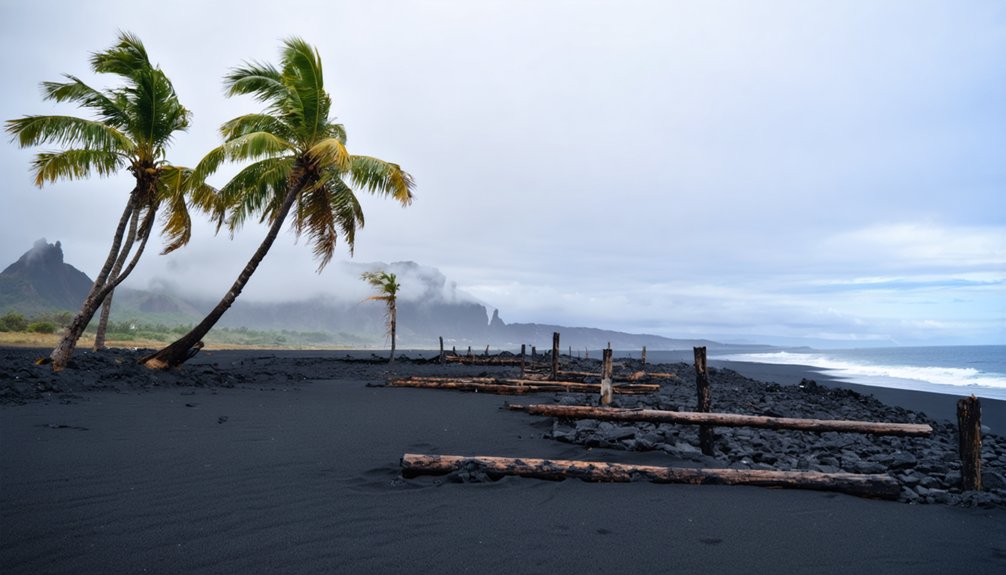
When Kīlauea’s Puʻu ʻŌʻō-Kupaianaha eruption consumed Kaimu in 1990, the slow-moving lava buried an entire village—100 homes, a church, stores, and the iconic black sand beach formed centuries earlier by steam explosions.
Flows from Kūpaianaha vent extended the shoreline 1,000 feet beyond its original edge, creating hardened fields where surf once rolled. Today’s landscape speaks to lava resurgence—a new black sand beach formed where molten rock met ocean, cooling into fragments ground by waves. Visitors must navigate a 10-15 minute walk across exposed lava fields from Highway 130’s terminus to reach this evolving shoreline.
Nearby Volcano Village offers stark contrast through rainforest transformation.
While Kaimu’s fractured roads dead-end at solid volcanic walls, ʻōhiʻa lehua trees sprout from 1990 flows, their fall colors blending with resilient greenery. The lava buried the village up to 80 feet deep, erasing streets and landmarks beneath multiple layers of hardened basalt.
You’ll witness nature’s defiant cycle: burial and rebirth, lava monuments juxtaposed against seasonal foliage in Hawaii’s Puna District.
Keomuku’s Cursed Remains Among Lanai’s Seasonal Blooms
Though barely two years of grinding sugar cane defined its industrial life, Keomuku’s ghost echoes across Lāna’i’s windward shore where 800 workers once labored under plantation dreams. You’ll discover why locals blame the 1901 collapse on desecrated heiau stones—railroad construction disturbed sacred sites, and legend claims the gods turned drinking water brackish. An epidemic followed, claiming half the population.
Today you’ll navigate rutted roads past Ka Lanakila o Ka Malamalama Church, the sole standing structure among rusted locomotives and crumbling ovens.
Cultural legends warn against angering spiritual forces, yet autumn’s golden kiawe blooms soften these cautionary tales. The Buddhist shrine honors Japanese workers who never returned home, while ancient fishponds remind you that Hawaiian families thrived here centuries before industrial ambitions arrived.
Hanapēpē Town: Kauai’s Abandoned Military Past and Autumn-Like Flora
As World War I sailors crowded Port Allen’s docks, Hanapēpē transformed from a quiet immigrant settlement into Kauai’s rowdiest boomtown—a reputation that persisted through the 1950s when the US Navy finally departed.
You’ll find Old West-style buildings over a century old lining streets where prostitutes once served naval personnel. The 1924 massacre battleground—where sixteen Filipino strikers and four officers died demanding fair wages—now receives over $1 million for cultural preservation.
When sugar’s decline left downtown abandoned just decades ago, artists reclaimed these weathered structures. Today’s community revitalization fills former brothels and gambling halls with galleries and studios.
The USO Club stands transformed, marked with historical plaques. Every Friday from 6-9 PM, Art Night opens these renovated spaces to visitors browsing local artists’ work.
A 2006 commemorative plaque in Hanapēpē Town Park marks where strikers were held in a schoolhouse before the deadly confrontation with police. Meanwhile, autumn-hued flora frames the haunted “Traveling Bones” cliff, where legends claim cruel ali’i met their fate.
Kahakuloa and Halawa: Remote Valleys Where Nature Reclaims the Past
Beyond the guardrails and paved highways, Kahakuloa Valley clings to Maui’s windswept north coast like a fragment of ancient Hawaii preserved in amber. You’ll navigate a treacherous one-lane road to reach this village of 70 Native Hawaiians who maintain taro patches where their ancestors farmed for centuries.
Traditional legends echo through the valley—Hina birthing the island at Puʻu Koaʻe, King Kahekili’s daring cliff leaps, and the puhi eel’s underwater cave. Seven ancient heiau mark this ahupuaʻa’s sacred significance. In similar valleys like Kualoa, passing vessels would lower their sails in respect to the land’s spiritual power, a practice even Kamehameha I acknowledged.
Across the channel, Molokaʻi’s Halawa Valley mirrors this isolation, where nature reclaims abandoned loʻi and jungle swallows what civilization briefly touched. On Kaua’i’s Nāpali Coast, Kalalau Valley reveals stone walls and terraced gardens built by Polynesian settlers a thousand years ago, now surrendered to invasive species and the weight of time. Both valleys stand as *testament* to cultural preservation, their remoteness protecting what development couldn’t destroy.
Kohala’s Deserted Plantation Towns in Fall-Like Landscapes
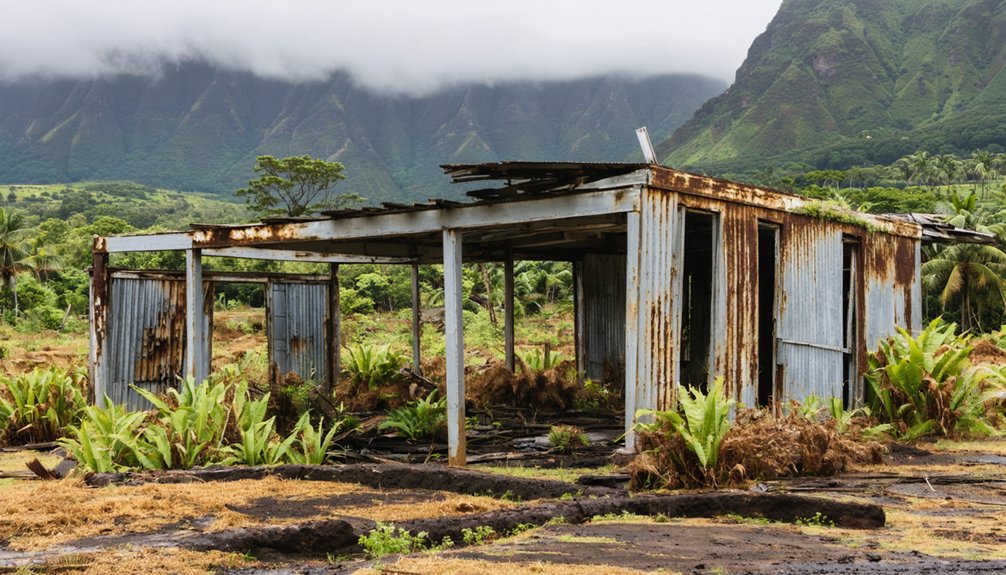
Where Kohala’s volcanic slopes descend toward the Pacific, abandoned sugar towns tell stories written in rusted machinery and overgrown foundations.
You’ll find Hawi and Kapaau near the Akoni Pule Highway’s terminus, where 5,000 workers once harvested cane until the last plantation closed in 1975. Within a decade, half the island’s mills vanished.
Yet this region’s agricultural heritage runs deeper than sugar. The Kohala Field System‘s 15,000 acres of ancient walls once fed 30,000 people, and cultural preservation efforts secured 390 acres along the coast between 2010-2017.
At Lapakahi State Historical Park, you’ll trace a 600-year-old fishing village’s foundations, while the Bond Historic District‘s 1855 Kalāhikiolā Church stands symbol to missionary influence that shaped these mountains long before plantation whistles echoed through valleys.
Planning Your Ghost Town Foliage Tour: Best Times and Access Tips
You’ll find the best conditions for exploring Hawaii’s ghost towns between September and November, when cooler temperatures bring out golden hues in native grasses while tourist crowds thin considerably.
Access requires careful preparation—treacherous one-lane roads like the route to Kahakuloa demand confident driving skills, while winter rainfall can render remote plantation sites completely impassable.
Plan your route to combine the visual drama of abandoned structures with Hawaii’s unique seasonal shifts. Remember that some locations like Hālawa Valley remain under the guardianship of native Hawaiian families who’ve maintained ancestral connections for generations.
Optimal Seasonal Travel Windows
While Hawaii’s tropical climate defies traditional autumn expectations, the September-to-November window transforms the islands’ abandoned sites into uniquely accessible destinations. You’ll escape summer’s heat extremes while avoiding winter road closures that restrict remote exploration.
Fall’s reduced rainfall in key areas means clearer access to plantation ruins and coastal ghost towns, though Big Island’s Hilo region maintains its signature moisture, intensifying waterfall displays.
You’ll find fewer tourists competing for trail space compared to peak seasons dominated by beach activities and local festivals. The cooler air enhances comfort during extended hikes through valley ruins, while late September through mid-November delivers peak tropical foliage—golden bamboo, vibrant taro fields, and kaleidoscopic forest hues.
Layer your clothing for variable conditions, and you’ll discover Hawaii’s abandoned corners at their most inviting.
Hawaii’s ghost towns demand careful route planning that respects both cultural boundaries and formidable terrain. Kahakuloa’s one-lane road requires high-clearance vehicles and reverence for the 70 Native Hawaiians still farming taro along its sharp curves.
You’ll find hidden ruins at Maunaloa via 4WD trails threading through overgrown plantation structures.
While Kalaupapa’s mule trail plunges 1,600 feet down cliffs—closed when mountain streams swell during storms.
Kaimu demands foot navigation across unstable lava fields where GPS fails from magnetic interference.
Kapoho lies buried under 80 feet of solidified lava, accessible only through permitted viewpoints.
Pack emergency supplies, respect restricted areas, and download offline maps.
These aren’t tourist loops—they’re expeditions into landscapes where nature and history collide without compromise.
Combining Foliage With History
When planning your ghost town foliage tour, target the changeover months between May and November to catch Hawaii’s interpretation of autumn—not golden maples, but explosive orange bougainvillea cascading over Kohala’s rusting sugar mill walls and crimson hibiscus framing Keomuku’s crumbling church foundation.
You’ll discover stories urban development left behind: Kalaupapa’s isolation preserving native flora around century-old cottages, or Volcano Village’s rainforest reclaiming plantation sites. These spots exist outside modern tourism’s reach, offering unfiltered encounters with abandoned structures wrapped in heliconia and ginger.
Combine your visits with Volcanoes National Park or Pu’uhonua o Honaunau for accessible history-foliage pairings.
Check permit requirements for remote villages beforehand, but prioritize public historic sites where you’re free to wander among blooms and weathered stone without restrictions.
Frequently Asked Questions
Are Hawaii’s Ghost Towns Safe to Explore Without a Guide?
Most aren’t safe without guidance—you’ll face treacherous roads, wildlife encounters, and cultural boundaries requiring respect. Historical preservation efforts and ancestral guardians protect these sacred sites. You’re risking spiritual consequences and physical danger exploring independently.
Can You Visit Lahaina’s Wildfire-Affected Areas as Tourists?
You can visit Lahaina’s reopened zones respectfully, honoring historical preservation efforts and the community’s recovery. Areas remain sensitive; wildlife conservation continues alongside rebuilding. Approach with cultural respect—this isn’t just tourism, it’s witnessing resilience and supporting Maui’s healing journey.
What Precautions Are Needed When Visiting Active Lava Flow Zones?
You’ll need protective gear like sturdy boots and long pants for lava safety. Stay on marked trails, respect park closures, monitor volcanic gas warnings, and keep distance from fountains—your freedom depends on respecting nature’s power.
Do Night Marchers Pose Actual Danger to Ghost Town Visitors?
Night marchers aren’t physically dangerous—they’re cultural phenomena. Local beliefs about ghostly apparitions emphasize showing respect: lie down, avert your eyes. Superstitions surrounding night marchers reflect Hawaiian values about sacred spaces, not actual threats to modern visitors exploring responsibly.
Which Ghost Towns Require Four-Wheel Drive Vehicles for Access?
Hawaii’s remote ghost town sites don’t require four-wheel drive access. However, you’ll need proper vehicle preparation and off-road navigation skills for Lanai’s backcountry routes, where rental restrictions and rugged terrain challenge your adventure-seeking spirit.
References
- https://www.worldatlas.com/cities/7-least-crowded-towns-in-hawaii-to-catch-fall-foliage.html
- https://www.revealedtravelguides.com/blog/haunted-places-to-visit-in-hawaii-this-halloween/
- https://nvtami.com/2023/04/26/big-island-hawaii-ghost-towns/
- https://ghost-towns.close-to-me.com/states/hawaii/
- https://www.youtube.com/watch?v=3tGSM9Xl-4M
- https://www.ghosttowns.com/states/hi/hi.html
- https://en.wikipedia.org/wiki/List_of_ghost_towns_in_Hawaii
- https://www.onlyinyourstate.com/trip-ideas/hawaii/haunted-road-trip-hi
- https://www.enjoytravel.com/us/travel-news/famous-for/7-of-the-most-haunted-places-in-hawaii
- https://arnottslodge.com/kaimu-black-sand-beach/