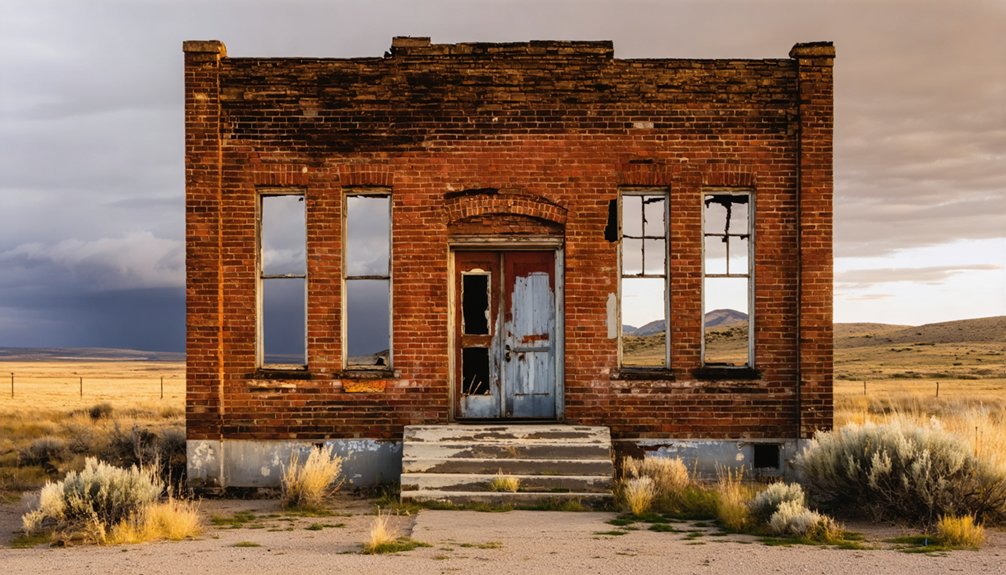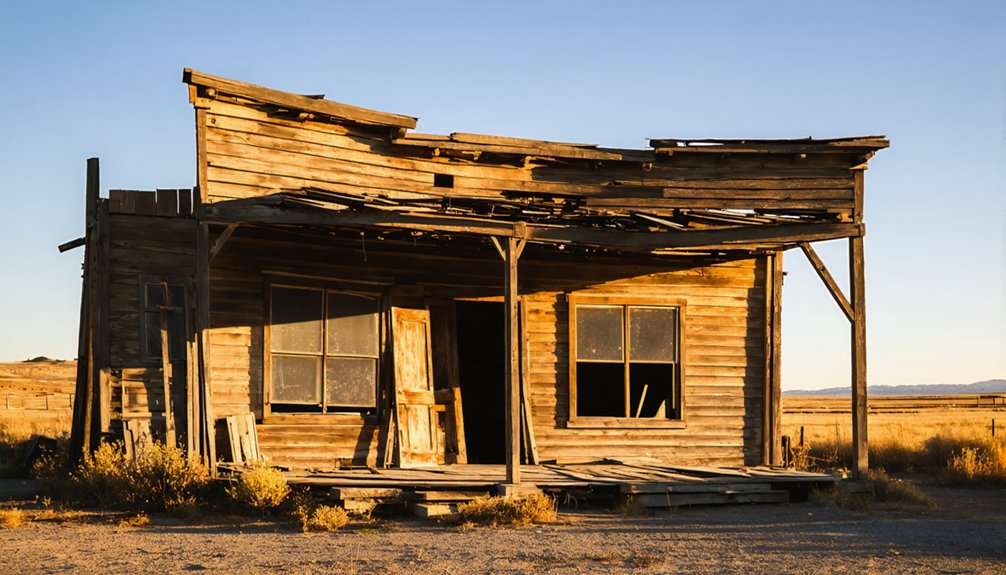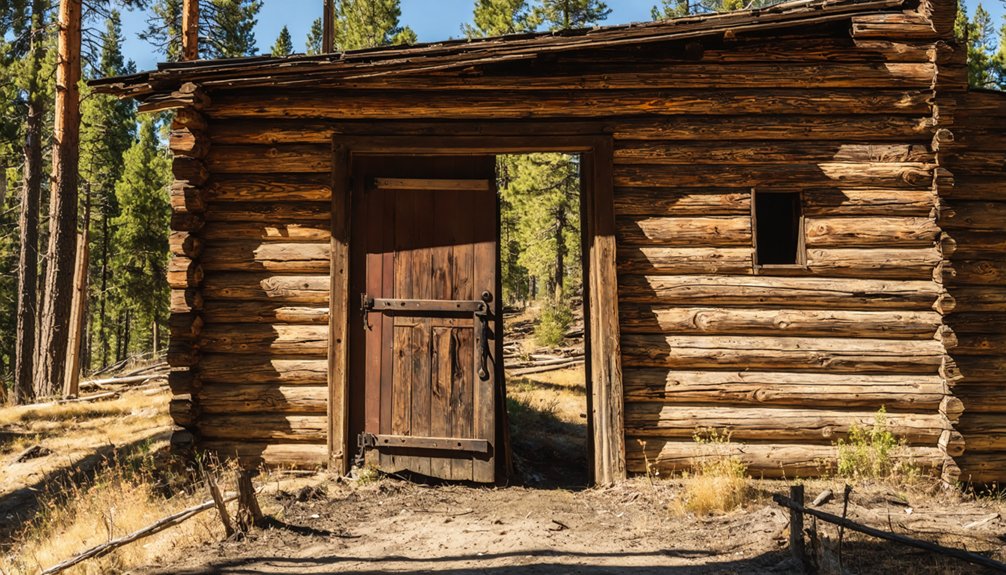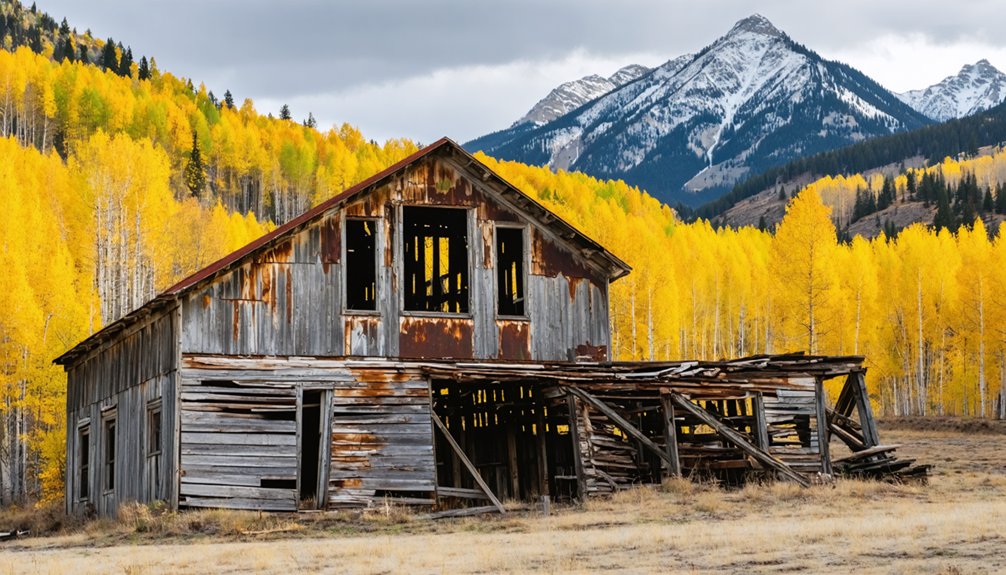
You’ll find Idaho’s most photogenic ghost towns transformed by autumn in the Lemhi Mountains, where Bayhorse’s 1870s stone kilns stand against golden aspens, and along the Yankee Fork, where Bonanza’s weathered structures overlook colorful valleys. Silver City retains 75 original buildings at 6,200 feet amid fall brilliance, while remote Wickahoney’s lava rock ruins rise from high desert sage. September through early October offers peak colors, accessible roads, and that perfect golden light casting long shadows across abandoned bunkhouses and cemeteries—timing and preparation make all the difference.
Key Takeaways
- Bayhorse features golden aspens and 1870s structures including stone kilns within Land of Yankee Fork State Park.
- Silver City preserves 75 original buildings at 6,200 feet elevation amid fall mountain colors in the Owyhees.
- Bonanza offers the Yankee Fork Gold Dredge and cemeteries overlooking colorful valleys during peak autumn season.
- Visit mid-September through October for optimal foliage; mountain passes close after mid-October limiting access.
- Ponderosa Pine Scenic Byway provides 131-mile route through Boise National Forest connecting multiple ghost town sites.
Bayhorse: Mining Heritage Meets Autumn Splendor in the Lemhi Mountains
When autumn arrives in the Lemhi Mountains, Bayhorse transforms into something extraordinary—a place where weathered timbers and crumbling stone kilns stand against hillsides ablaze with golden aspens.
You’ll walk among structures that witnessed hard-rock mining techniques from the 1870s, when 200 men extracted silver and lead from these peaks. The stamp mill’s skeleton still looms over Bayhorse Creek, while beehive kilns mark where charcoal fueled the smelter’s fires. The town’s origins trace back to 1864, when prospectors first discovered small gold veins in what would become the Yankee Mining District.
Where 200 miners once forged their fortunes, weathered structures now stand as silent witnesses to the silver boom that shaped these peaks.
Since becoming part of Land of Yankee Fork State Park in 2009, preservation challenges have been met with building stabilization and interpretive signage. The Wells Fargo building, constructed from native rock, stands as one of the better-preserved structures and may have served as bullion storage during the town’s peak years.
You’re free to explore this $10 million producing district at your own pace, discovering artifacts scattered among autumn’s copper and gold—nature reclaiming what miners left behind.
Silver City: A Well-Preserved Window Into Idaho’s 19th-Century Past
High in the Owyhee Mountains at 6,200 feet, Silver City clings to War Eagle Mountain’s slopes like a monument to ambition frozen in time.
You’ll wander past 75 original structures where 2,500 souls once carved fortunes from rock—300 homes, eight saloons, and the bloodstains of underground mine battles still echo in the tunnels.
Historical preservation here isn’t sterile—it’s raw. The 1869 Masonic Lodge stands sentinel while mining artifacts scatter across the 17-mile Skyline Mine Tour like breadcrumbs through autumn gold.
Idaho’s old county seat refused to die completely; a handful of rebels remain year-round, keeping three seasonal businesses alive.
Walk the dozen streets where telegraph wires once hummed with silver prices, and you’ll taste what independence really cost. Over 250 mines tore $60 million in silver and gold from these mountains between 1863 and 1865 alone, before inflation made those numbers quaint.
The Idaho Hotel, which opened in 1866 and shuttered during World War II, now serves guests again as both lodging and restaurant after its 1972 resurrection.
Bonanza: Silver Boom Remnants Against a Backdrop of Mountain Colors
Where Charles Franklin staked his claim along the Yankee Fork of the Salmon River in 1877, Bonanza exploded into existence on William Norton’s $20,000 hand-dug strike—the kind of fortune that turned whispers into stampedes. You’ll discover mining history etched into every weathered timber and rusted ore cart, where thousands once chased silver through these mountains.
The town peaked during the 1880s boom before gold depletion emptied it by 1911.
Today’s scenic vistas frame what remains:
- The Yankee Fork Gold Dredge, silent since 1949
- Restored structures within Land of the Yankee Fork State Park
- Historic cemeteries overlooking autumn-painted valleys
- Mill remnants standing against flame-colored aspens
September transforms this ghost town into something transcendent—silver boom architecture silhouetted against mountains ablaze with fall color, offering you unfettered exploration through Idaho’s untamed past. Neighboring Custer thrived simultaneously during the same gold and silver rush era, its own collection of abandoned buildings adding depth to this concentrated pocket of mining history. The Sunbeam Dam stands as another testament to the area’s mining heritage, complementing Bonanza’s silver legacy with its own piece of industrial history.
Placerville: Boise Basin’s Haunting Cemetery and Historic Structures
Gold fever gripped the Boise Basin in late 1862, and Placerville erupted from nothing into one of Idaho’s premier mining settlements—a town built literally on top of some of the richest placer ground ever discovered in the territory.
Placerville sprang from Idaho’s richest earth—a town literally built atop the gold that created it.
You’ll find remnants of its 3,254-person boom days scattered around an unusual town square, where the Boise Basin Mercantile still stands as Idaho’s earliest chain store experiment.
Mining techniques evolved here as water scarcity forced seasonal operations, while settlement architecture adapted from tent camps to ninety permanent structures within months.
Today, you can wander through weathered cemeteries where Irish, English, and Chinese miners rest beneath autumn-gold aspens, their stories preserved in the Historical Society’s museums.
The Pioneer Mill site at Granite Creek whispers of ten-stamp operations that once thundered through these mountains.
The 1899 fire devastated much of the town, yet residents rebuilt with larger, more substantial structures in the early twentieth century, transforming disaster into an opportunity for architectural renewal.
Perched at an elevation of 4,324 feet, the town experiences brilliant fall colors as aspens and cottonwoods blaze against the mountain backdrop each September and October.
Wickahoney: Eerie Ruins Along Southwestern Idaho’s Remote Routes
You’ll find Wickahoney’s haunting lava rock structures rising from Owyhee County’s high desert, where Dow Dunning’s 1890s stagecoach station still stands after more than a century of abandonment. The black basalt walls of the one-and-a-half story house, its attached barn, and stone corrals remain remarkably intact. Their cement mortar is eroded by decades of desert winds, while iron relics rust beside a complete hearth oven. The original shingled roof with seven gables has long since disappeared, leaving the stone walls exposed to the elements.
Reaching this isolated ghost town requires traversing a treacherous 10-mile dirt trail through Jacks Creek Wilderness, where jagged lava rock exposures guard these eerie remnants of Idaho’s failed frontier dreams. The town’s significance earned it a place on the National Register of Historic Places, preserving its legacy as a crucial supply point for Nevada’s mining operations.
Stagecoach Shop Remnants
Rising from southwestern Idaho’s high desert like a mirage of blackened stone, Wickahoney’s lava rock ruins command the sagebrush plateau with an austere grandeur that belies their humble origins. You’ll discover walls built from basalt chunks, their cement mortar long eroded yet standing defiant against time’s relentless march.
The historical architecture speaks of Dow Dunning’s ambitions—a one-and-a-half story house with attached barn, where Margaret once ran the stagecoach stop from 1895 to 1911.
What remains tells the story:
- Stone corrals connecting to the main barn structure
- Complete hearth oven still intact among scattered iron relics
- Board-and-batten outbuilding weathered but recognizable
- Pretentious construction revealing commercial dreams that never materialized
Preservation challenges multiply here—isolation protects while nature reclaims its territory.
Remote Owyhee County Setting
Beyond the last whisper of civilization, Wickahoney slumbers in Owyhee County’s vast expanse where sagebrush-covered plateaus roll toward distant mountain silhouettes and the horizon stretches endless in every direction.
You’ll navigate ten miles of jagged lava rock and barbed wire gates, each obstacle testing your resolve to reach these stone ruins near Jacks Creek Wilderness.
The isolation that’s kept vandals away has also preserved this fragment of 1890s frontier life—basalt walls standing defiant against time’s erosion.
Wildlife encounters are your only company here: hawks circling overhead, antelope ghosting through sage.
There’s no fuel for hundreds of miles, no safety net.
Preserving historic landmarks like Wickahoney means embracing the rawness that makes them authentic, the remoteness that keeps them real.
DeLamar: Joseph R. DeLamar’s Legacy in the Owyhee Backcountry
Deep in the Owyhee Mountains of southwest Idaho, where autumn gold spills across canyon walls and abandoned mine shafts pierce the hillsides, the ghost town of DeLamar clings to steep slopes above Jordan Creek.
Where autumn gold meets forgotten silver dreams, DeLamar’s ghost town clings to canyon walls above Jordan Creek.
You’ll discover Captain Joseph R. DeLamar’s 1888 vision still etched into this landscape—a silver mining empire that once produced $8 million in precious ore.
The British-owned operation built this backcountry metropolis complete with:
- A red brick schoolhouse anchoring the upper town
- Fifty-room bunkhouse for underground workers
- “Tough Town” district with saloons and Jennie Mitchell’s notorious establishment
- The “Uget” newspaper chronicling boom-era dreams
Mining archaeology reveals preservation challenges here—only four structures survive on private property. Yet DeLamar’s 1,600-acre historic district whispers stories of frontier ambition where fall colors now paint forgotten dreams.
Planning Your Ghost Town Road Trip During Peak Foliage Season
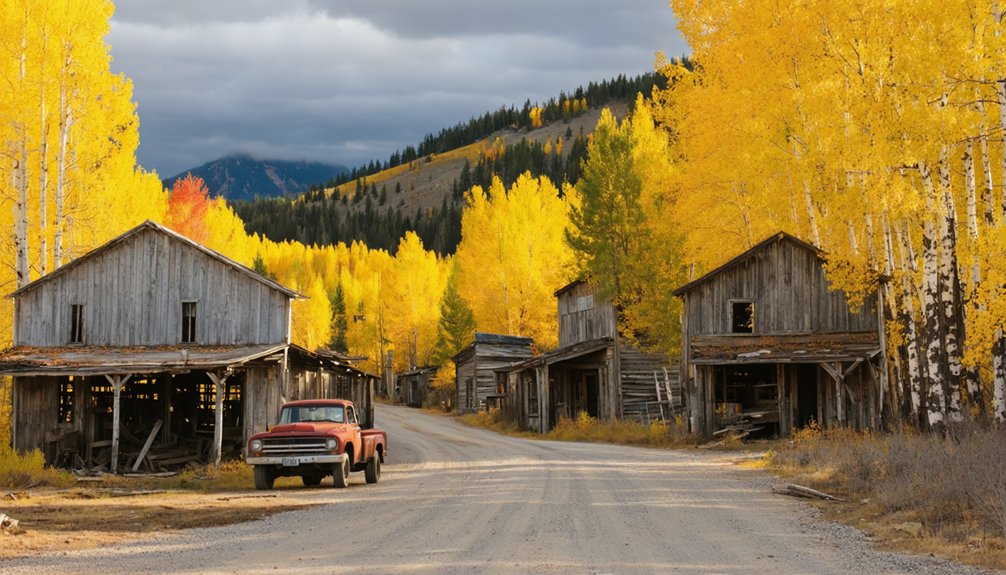
The abandoned streets of DeLamar fade in your rearview mirror as you plot your next discovery, and timing becomes everything. September through October delivers Idaho’s most spectacular show—aspens blazing gold against weathered cabins, mountain peaks framing Silver City’s preserved storefronts.
Summer offers reliable gravel road access, but you’ll miss the magic. Pack detailed maps and sturdy boots for Bonanza’s alpine trails, where barely-standing Wickahoney awaits beyond the next ridge.
The Ponderosa Pine Scenic Byway winds 131 miles through Boise National Forest, connecting ghost towns with hot springs and pioneer cemeteries.
Base yourself in Stanley or Lowman for post-visit accommodation among the Sawtooths.
Local dining options remain sparse—bring provisions.
Winter’s arrival closes mountain passes, so chase autumn’s colors before November’s first snow.
Essential Gear and Safety Tips for Exploring Remote Mining Sites
Before you duck beneath Silver City’s sagging mine timbers or peer into Bonanza’s vertical shafts, understand that Idaho’s abandoned claims hide dangers far deadlier than collapsed dreams. Mining safety demands respect—these tunnels don’t forgive carelessness.
Your protective gear arsenal should include:
- FFP3 respirator or N95 mask for black mold and asbestos-laden dust
- Steel-toed boots with puncture-resistant soles protecting against rusted nails and jagged metal
- Three independent light sources (headlamp plus backup flashlights)
- Hard hat and heavy-duty gloves for unstable ceilings and contaminated debris
I’ve watched experienced explorers test every stair tread, stepping near wall-mounted edges rather than rotted centers. They move deliberately through powder-coated spaces, avoiding the airborne toxins you’ll kick up rushing.
Research each site’s history beforehand—knowing whether mercury amalgamation or cyanide processing occurred might save your lungs.
Photography Opportunities: Capturing Historic Structures and Fall Colors
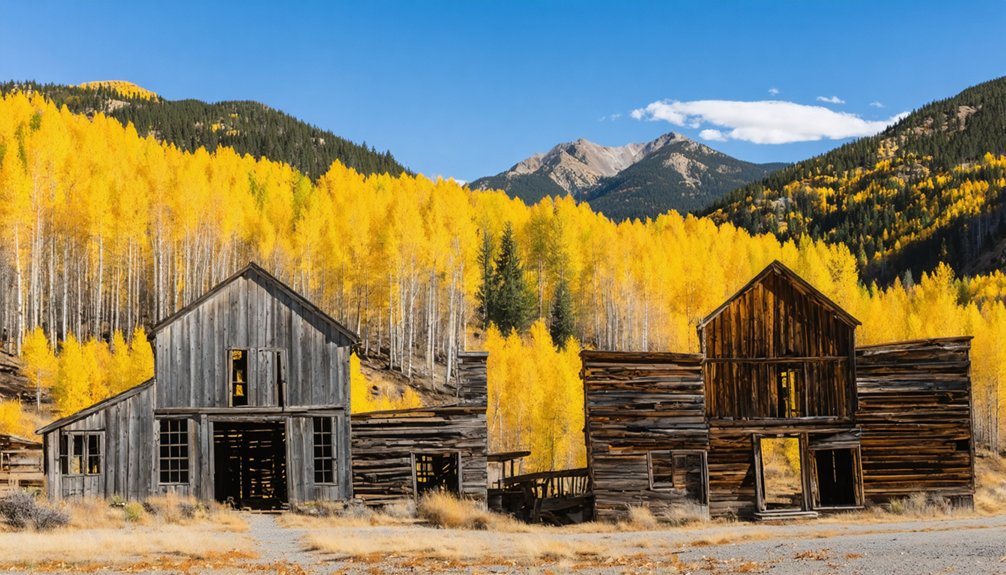
You’ll find your best shots materialize during golden hour, when amber light streams through abandoned windowpanes and sets weathered wood ablaze alongside the yellowing aspens that reclaim these forgotten streets.
Position yourself to layer crumbling structures in your foreground against slopes of russet and gold, letting the ruins’ sharp angles contrast with autumn’s soft palette.
I’ve learned that cloudy days actually enhance these compositions—the diffused light saturates the fall colors while preventing harsh shadows that can swallow the delicate textures of century-old timber and stone.
Best Lighting and Timing
When autumn transforms Idaho’s ghost towns into painterly scenes, timing your photography becomes as crucial as the composition itself.
You’ll find golden hour delivers magic along the Payette River Scenic Byway, where abandoned mining structures glow against amber mountainsides. Fall weather brings crisp mornings perfect for capturing filtered light through aspens at Banner Creek Summit’s scenic viewpoints.
Optimal shooting conditions:
- Early morning light reveals delicate textures on weathered wood structures before crowds arrive.
- Cloudy days eliminate harsh shadows on building details while intensifying golden cottonwood tones.
- Late afternoon bathes ghost towns in warm hues, especially along the 131-mile Ponderosa Pine Scenic Byway.
- Mid-September through early October offers peak color timing near historic mining sites.
The Payette River corridor’s recovery forests create layered depth—new growth against century-old ruins, all framed by fall’s fleeting brilliance.
Composition Tips for Ruins
As weathered timber frames dissolve into Idaho’s autumn landscape, your camera becomes a tool for preserving the conversation between decay and renewal. Position foreground ruins against distant fall ridges—you’ll create depth that pulls viewers into Silver City’s abandoned streets.
Low angles on collapsed cabins emphasize towering golden aspens overhead, while doorways framed with vibrant leaves provide natural leading lines toward forgotten interiors.
Color harmony emerges when you pair rusty metal against yellow aspens or weathered wood against red maples. Balance those muted gray foundations with bright foliage tones during golden hour.
Your perspective techniques matter: use the rule of thirds to position historic buildings off-center, then follow leaning storefronts toward horizon mountains.
Isolate single structures against expansive autumn hillsides—there’s something profound about loneliness framed by nature’s relentless return.
Best Times to Visit Idaho’s Ghost Towns for Optimal Autumn Views
The aspen leaves shimmer like gold coins against weathered timber frames, transforming Idaho’s abandoned mining camps into galleries where nature reclaims human ambition. You’ll find peak colors mid-September through early November, though wildflower blooms fade as autumn arrives.
Weathered ghost towns frame autumn’s golden aspens—nature’s slow reclamation of human dreams painted in September’s brilliant light.
I’ve discovered timing varies dramatically by elevation—Sawtooth heights blaze golden by mid-September while Lemhi Valley’s Salmon-area ruins peak in late October.
Strategic Timing by Region:
- Custer County’s Bonanza and Bayhorse: mid-September to mid-October
- Silver City’s southern slopes: late September ideal
- Ponderosa Pine Scenic Byway towns: early fall
- Stanley area sites: early to mid-autumn
River crossings become trickier after October rains, and mountain passes close post-mid-October.
Plan September visits for clear skies, accessible gravel roads, and solitary exploration before winter locks these forgotten places away.
Frequently Asked Questions
Are Pets Allowed When Visiting Idaho’s Ghost Towns?
You’ll find pet policies generally welcoming at Idaho’s ghost towns, though animal restrictions apply inside historic buildings. Keep your furry companion leashed on trails where autumn leaves crunch underfoot, and you’ll both experience these haunting landscapes freely together.
Do Any Ghost Towns Charge Entrance or Parking Fees?
You’ll encounter modest contributions supporting historical preservation at some sites—Garnet asks $10, while Land of Yankee Fork requires $7 for vehicles. However, local community involvement keeps Bonanza and Custer entirely free for your exploration.
Can I Camp Overnight Near These Ghost Town Sites?
You’ll find primitive camping near most sites on Forest Service lands, where wildlife encounters await among historical preservation efforts. Pack responsibly—these remote locations demand self-reliance, but reward you with starlit solitude beside Idaho’s weathered remnants.
Are These Ghost Towns Accessible for Visitors With Mobility Limitations?
You’ll find wheelchair accessibility and paved pathways absent here. These ghost towns demand rugged exploration—gravel roads wind through wilderness, uneven terrain challenges every step, and freedom means embracing adventure’s raw, untamed spirit over convenient access.
Is Cell Phone Service Available at Remote Ghost Town Locations?
Cell service remains unpredictable across these remote Idaho ghost towns. You’ll find minimal connectivity options in Silver City, Bonanza, and Placerville’s wilderness. Ashcroft’s proximity to Aspen offers your best chance for signal, though mountains still interfere with coverage.
References
- https://idaho-forged.com/idahos-ghost-towns-eerie-yet-approachable/
- https://www.youtube.com/watch?v=RNCaxrY62ZI
- https://visitidaho.org/fall-for-idaho/
- https://www.onlyinyourstate.com/trip-ideas/idaho/haunting-road-trip-id
- https://visitidaho.org/things-to-do/ghost-towns-mining-history/
- https://en.wikipedia.org/wiki/List_of_ghost_towns_in_Idaho
- https://www.legendsofamerica.com/id-bayhorse/
- https://westernmininghistory.com/towns/idaho/bayhorse/
- https://history.idaho.gov/wp-content/uploads/2018/09/Bayhorse_76000671.pdf
- https://rvertv.tv/blogs/news/bayhorse-ghost-town-a-journey-into-idaho-s-historical-past