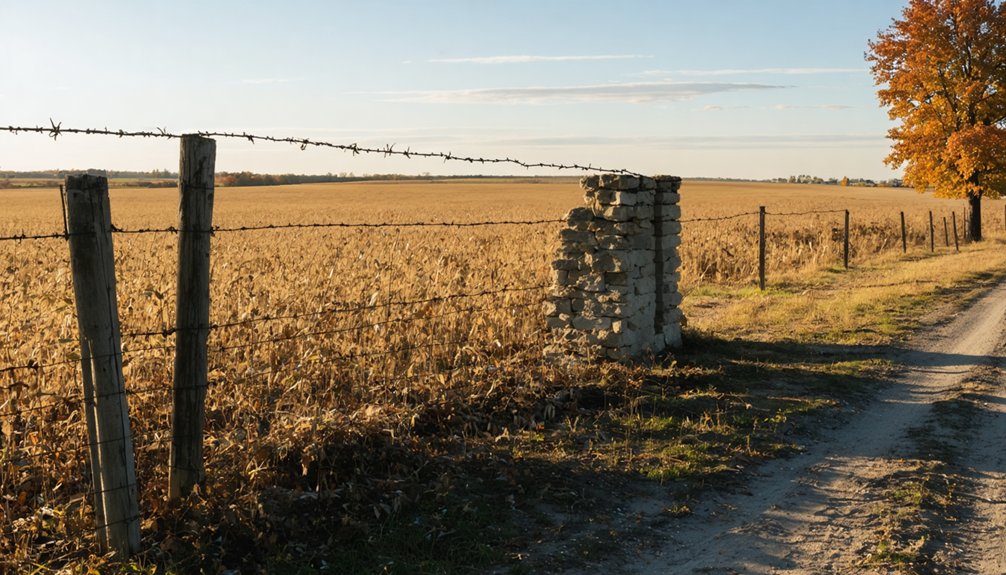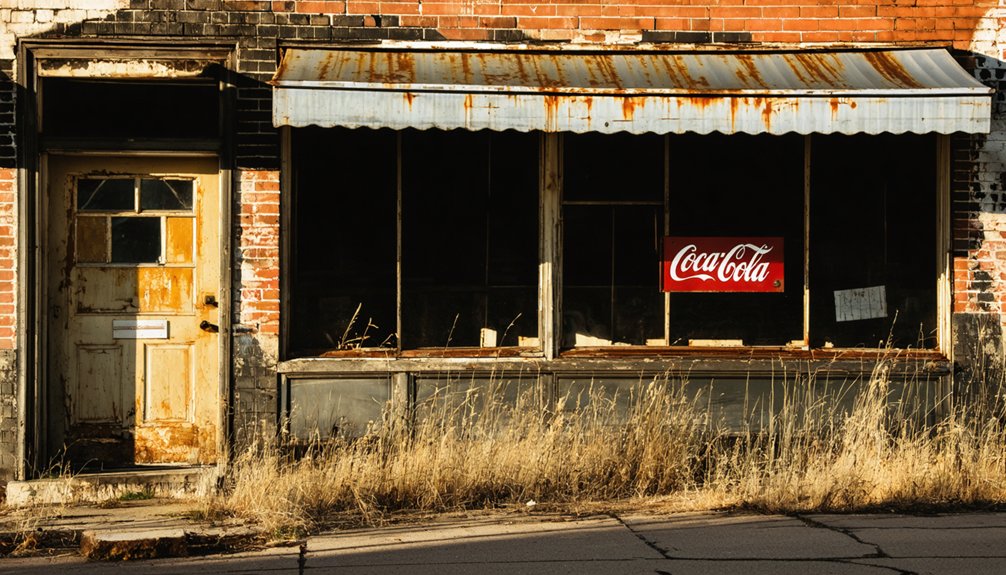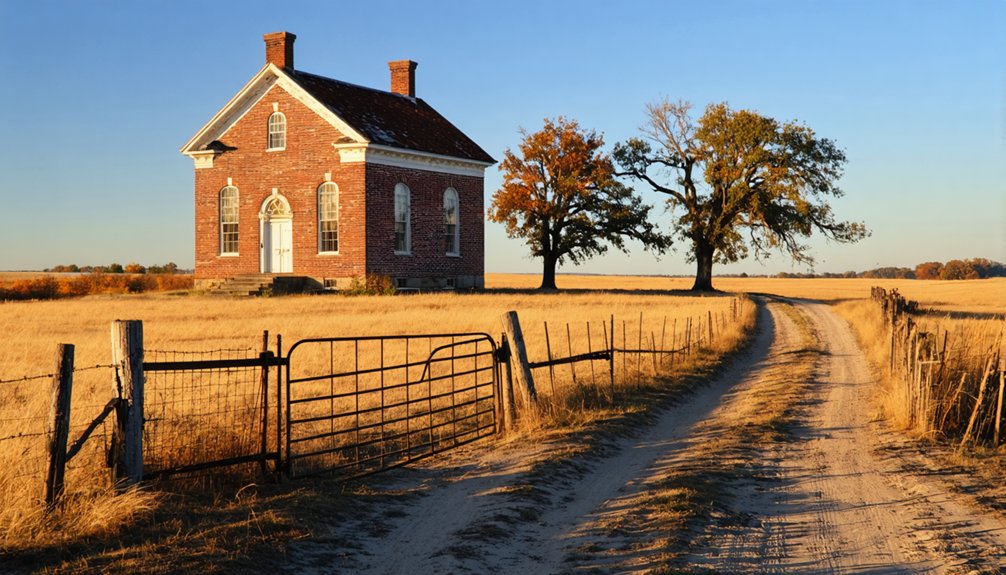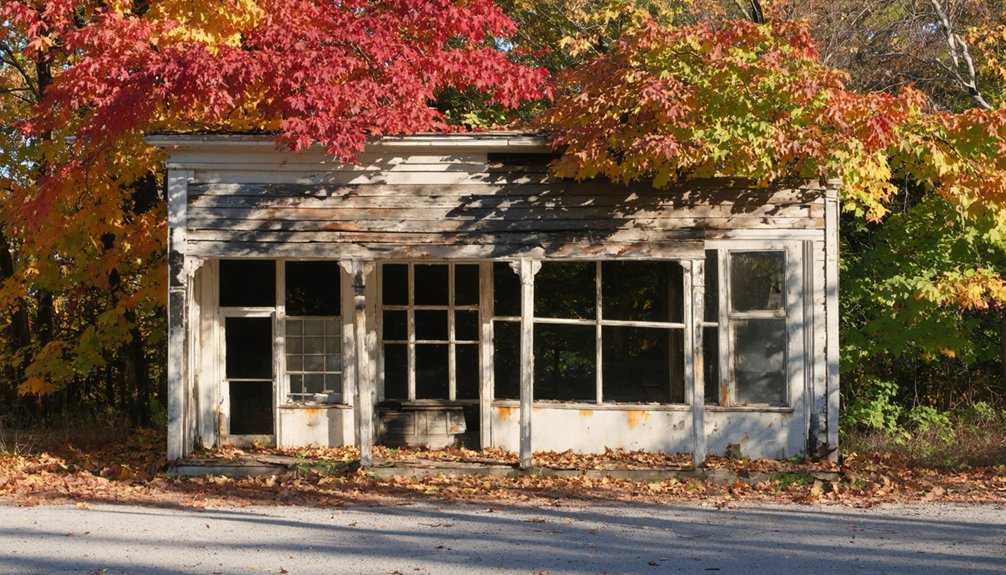
You’ll find Illinois’s most atmospheric ghost towns where autumn’s crimson and gold frame weathered limestone ruins and abandoned railway depots. Vishnu Springs’ collapsed Capitol Hotel sits beneath copper maples in Post Wildlife Sanctuary, while Providence’s leaning tombstones glow in October light among Bernadotte Township’s vanished settlements. Along Copperas Creek, moss-draped warehouse walls emerge from river mist, and Bryant’s skeletal railway depot stands sentinel over prairie grass reclaiming forgotten coal camps. The backroads reveal dozens more locations where nature’s vibrant rebellion makes history tangible.
Key Takeaways
- Vishnu Springs offers secluded valley ruins with golden maples and crimson vines, attracting visitors to wildlife-reclaimed healing water sites along LaMoine River.
- Providence’s weathered church stones and cemetery markers emerge through October maples in Bernadotte Township, showcasing autumn-lit historical remnants.
- Griggsville Landing’s lime kiln ruins feature weathered limestone overgrown by nature, providing authentic ghost town exploration amid fall landscapes.
- Copperas Creek’s abandoned warehouses and 1876 steamboat docks stand sentinel, framed by autumn marshlands and moss-draped stones accessible by boat.
- New Philadelphia’s national park site preserves pioneer settlement archaeology beneath fall grasses, marking Underground Railroad history with seasonal beauty.
Fulton County’s Forgotten Settlements Along the Spoon River Valley
The Spoon River Valley cuts through Fulton County like a vein of history, and along its banks, autumn’s copper and gold palette now drapes over settlements that time forgot. You’ll find Spoon River Village, laid out in 1838 but never prospering beyond Hiram Wentworth’s modest holdings.
Where autumn gilded banks meet forgotten ambitions, Spoon River Village stands as testament to dreams that withered before they bloomed.
Vienna became Astoria when bureaucrats demanded the change—its original identity erased from maps but not from the land itself.
Vanopolis dreamed of railroad riches in 1840, yet stood vacant within four years when the timber trade and promised tracks bypassed it entirely. Leaman peaked as a coal mining hamlet between Seville and Mariette, housing 45 residents and the Marietta Stone Coal Company until the 1893 panic gutted its economy.
Providence persists as church stones and cemetery markers among October maples. Near Havana, Dickson Mounds burial site rises over 90 feet above the Illinois River, where generations of villagers from around A.D. 1250 were laid to rest before becoming a museum of archaeological study. These aren’t sanitized historical markers—they’re raw evidence that ambitious settlements crumbled when commerce chose different paths, leaving only foundations beneath crimson leaves.
Bernadotte Township’s Historic Prairie Communities and Cemeteries
Just beyond the Spoon River’s immediate banks, Bernadotte Township spreads across prairie swells where grasses once reached a rider’s stirrups and now October’s burnt orange sedges whisper against cemetery gates.
You’ll find Tuscumbia’s story written in Wade Hampton’s 1837 plat—54 lots honoring Tashka Ambi’s Cherokee heritage through its name, where Isaac Howard taught behind greased paper windows before 1855’s abandonment.
Providence’s weathered church still stands in section 23, its tombstones leaning like crooked teeth against autumn’s copper light.
Bennington vanished entirely after its 1835 post office closure, leaving only prairie landscapes reclaimed by big bluestem.
At Cameron Grove, three miles upriver, picnic grounds disappeared beneath wild grapevines that now blaze crimson each fall—nature’s own memorial to communities that couldn’t outlast the prairie’s relentless horizon. Like Benjaminville’s Friends Meeting House, which survived its town’s post-1870 railroad bypass to become a relic on the National Register of Historic Places, these prairie settlements left architectural traces that now frame autumn’s copper and gold displays. Nearby Civer’s cemetery was relocated when coal mining plans forced the removal of bodies to Shields Chapel Cemetery in Buckheart Township, erasing even the dead from this railroad community that once boasted a depot three miles west of Canton.
Farmington Township’s Vanished Railroad-Era Towns
Where prairie grass surrenders to gravel ballast, Farmington Township’s ghost towns trace their rise and fall to the iron rails that stitched these bottomlands together after 1880. You’ll find railroad heritage embedded in North Street’s pavement—actual rails protruding through blacktop like skeletal reminders of prosperity lost.
The Iowa Central brought coal-camp settlements: Middle Grove, Trivoli, Bryant. Walk these abandoned tracks and you’ll sense autumn wind whistling through empty right-of-ways where the Fulton County Narrow Gauge once hauled freight. The Fulton County Interurban Railway depot still stands beside the current BNSF line at Bryant, a weathered sentinel marking where passengers once boarded electric cars bound for vanished mining communities.
At its peak in the late 1920s, the electric line transported 75,000 tons of freight annually, connecting rural industries to distant markets before the Great Depression severed these vital arteries of commerce.
Vishnu Springs: Where Nature Reclaims Abandoned Grounds
You’ll find Vishnu Springs nestled in a secluded valley where the Western Illinois University Foundation now maintains the Post Wildlife Sanctuary, letting nature slowly devour what ambition built.
The crumbling Capitol Hotel stands as the sole survivor among brush-covered foundations and weed-choked springs, its broken windows framing autumn’s crimson and gold like portraits of decay. The resort once drew several thousand visitors annually during its peak in the late 1800s, when people flocked to these grounds seeking the spring’s legendary healing powers.
Each October, you can watch sugar maples and red oaks blaze against weathered clapboards, their fallen leaves carpeting the paths where thousands once walked seeking miraculous cures. The 26 by 40 feet hotel was built with locally quarried stone, its first-class accommodations once commanding approximately $2,500 in construction costs.
Natural Preserve and Sanctuary
When autumn arrives at Vishnu Springs, the ghosts seem to step aside for something more powerful—nature itself, quietly erasing a century of human ambition.
The 140-acre sanctuary sprawls along the LaMoine River valley, where bedrock springs that once promised miracle cures now feed wildlife habitats undisturbed by commercial exploitation.
You’ll find Western Illinois University researchers monitoring groundwater chemistry and cataloging flora diversity that’s flourished since the 1920s collapse.
The pond near the crumbling Capitol Hotel hosts seasonal aquatic surveys, revealing how ecosystems recover when human interference fades.
This isn’t manicured preservation—it’s raw reclamation.
Crimson maples and golden oaks frame limestone ruins while deer paths replace guest walkways.
The property’s transformation began when Olga Kay Kennedy donated the land to Western Illinois University in 2003, formally ending over a century of private ownership.
In its prime, the resort attracted 3,000 visitors annually, drawn by the promise of healing waters and social gatherings.
The Ira and Reatha T. Post Wildlife Sanctuary proves that sometimes the best thing we can do is simply walk away.
Autumn Colors Among Ruins
The Capitol Hotel’s skeletal frame rises through a canopy of amber and rust each October, its three stories of peeling paint and shattered windows creating eerie juxtapositions against the brilliant foliage.
You’ll discover autumn landscapes transformed into nature’s rebellion against human ambition—golden maples swallowing collapsed homes, crimson sumac reclaiming forgotten streets.
The weed-choked springs reflect copper leaves where health-seekers once gathered.
Walking through this secluded valley, you’ll hear wind whistling through broken hotel corridors while crimson vines strangle remnants of Darius Hicks’s failed empire.
Haunting stories of Maud’s tragic death and carousel accidents feel tangible here, especially when shadows lengthen through orange foliage.
It’s unpatrolled freedom—nature’s masterpiece painted over scandal and decay, where you’re truly alone with history’s ghosts.
River Landings That Time Forgot: Illinois and Mississippi Waterways
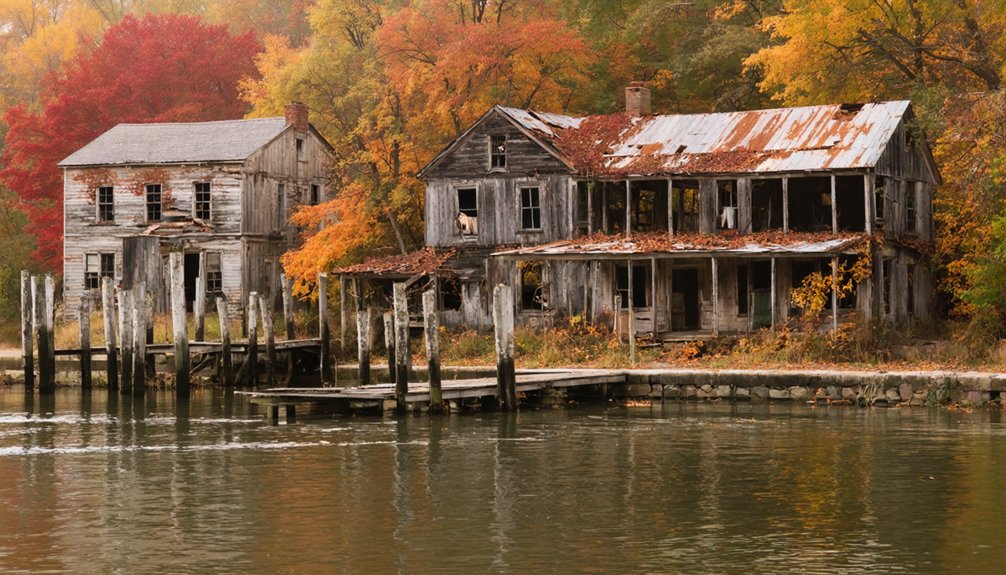
You’ll find Copperas Creek’s weathered warehouses standing sentinel along forgotten docks, their timber frames silvered by decades of river mist and autumn rain. The empty loading platforms still jut into the water where steamboats once queued, now watched only by herons fishing in the shallows beneath rust-streaked metal roofs.
At Griggsville Landing, relocated structures tell a different story—whole buildings hoisted onto wagons and rolled inland when the river proved too fickle, leaving only foundation stones and overgrown pathways where maples now scatter their crimson leaves.
Copperas Creek’s Abandoned Warehouses
Where Copperas Creek surrenders to the Illinois River, crumbling lock walls rise from muddy banks like ancient sentinels guarding memories of a commerce that never quite materialized.
You’ll find industrial ruins where Mill’s Point and Commerce existed only on paper—phantom towns that promised prosperity in the 1840s but delivered only weathered warehouses and a lonely landing.
The 1876 lock raised waters five feet for sixty miles, transforming this stretch into a navigation corridor until 1933’s modernization rendered it obsolete.
Today, you’re free to explore these river remnants by boat, scanning moss-draped stones for shorebirds and eagles.
The wild’s reclaimed what ambition abandoned.
Autumn paints surrounding marshlands in copper and gold, framing 133-year-old stonework that refuses to completely surrender.
Griggsville Landing’s Relocated Structures
Along Illinois River’s eastern bank, Griggsville Landing’s lime kiln stands as the sole survivor of a settlement that thrived when steamboats ruled commerce.
You won’t find relocated structures here—no salvaged ferry office or reconstructed hotel gracing modern museums. The town simply vanished when railroads and Army Corps levees reshaped the landscape in the 1870s.
What remains speaks volumes: that nine-foot ledge where workers once pulled quicklime from the kiln’s mouth, stone rubble marking where craftsman William Hobson mixed mortar for Pike County’s bridges.
Without preservation efforts, autumn’s gold and crimson leaves frame crumbling wing walls and weathered limestone.
This ghost town offers raw authenticity—no sanitized historical village, just nature reclaiming what commerce abandoned.
New Philadelphia: Pike County’s Lost Pioneer Settlement
Though prairie winds now sweep across empty fields where streets once bustled with commerce, New Philadelphia stands as one of America’s most remarkable forgotten communities. You’ll discover Free Frank McWorter‘s revolutionary vision—the first town platted by an African American before the Civil War.
He transformed 160 acres into an integrated settlement where Black and white families shared schools, businesses, and hope along the Underground Railroad.
Historical preservation efforts culminated in 2022 when New Philadelphia became America’s 424th national park. You can walk those vanished streets today, where archaeological findings reveal pottery fragments and gravel pathways beneath autumn grasses.
McWorter’s defiance against Illinois’s Black Codes created something extraordinary: a biracial frontier community that proved freedom wasn’t just an ideal—it was a neighborhood where everyone belonged.
Exploring Hidden Cemeteries and Burial Grounds in Autumn
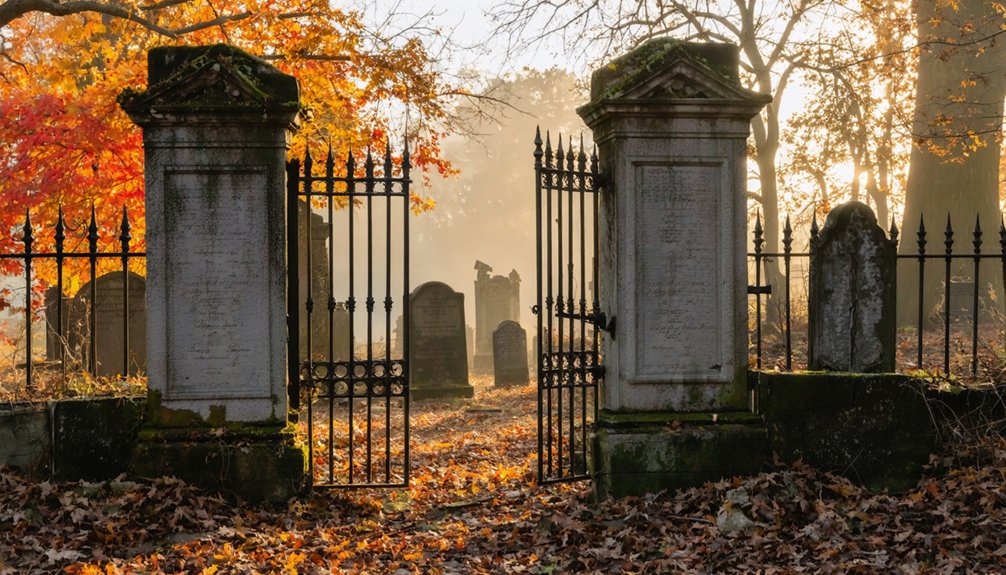
Illinois’s ghost towns guard secrets beneath their soil, where crumbling headstones emerge from carpets of crimson and gold leaves each October. You’ll find Reddick Hollow Cemetery hidden within Shawnee National Forest’s abandoned settlements. Its markers are nearly swallowed by autumn undergrowth.
Crimson leaves blanket forgotten graves where Illinois’s ghost town cemeteries surrender their weathered stones to October’s creeping wilderness.
Ridge Cemetery crowns Williamsburg Hill at 800 feet, where gnarled trees cast shadows across illegible stones while haunted legends speak of phantom crowds and mysterious lights piercing the fall mist.
St. Omer’s ghost town harbors the notorious Witch Grave, marked with an impossible death date that feeds spooky legends among the scattered leaves.
These forgotten burial grounds offer unrestricted exploration through Illinois’s backroads, where you’re free to discover stories etched in weathered granite beneath October’s vibrant canopy.
Planning Your Fall Ghost Town Adventure Across Illinois
Before you pack your camera and hiking boots, consider that autumn’s six-week window transforms Illinois’s forgotten settlements into accessible time capsules where you’ll crunch through copper-colored leaves covering century-old foundations.
Start at Tunnel Hill State Trail‘s 45-mile corridor, where five ghost towns await discovery between weathered railroad ties and limestone bluffs. You’ll find historical preservation efforts minimal here—nature’s reclaiming what commerce abandoned, leaving you free to explore without ropes or guided tours.
Head to Garden of the Gods for scenic viewpoints where morning mist rises through scarlet canopies above vanished settlements.
River to River Trail delivers Progress ghost town near Crab Orchard’s wilderness.
Bring topographic maps; many sites lack markers. The archaeological remnants speak loudest when October’s slanted light reveals building outlines beneath rustling leaves.
Frequently Asked Questions
What Photography Equipment Works Best for Capturing Ghost Town Ruins in Fall?
You’ll need camera gear essentials like a DSLR or mirrorless body with tripod for those eerie, abandoned corridors. Ideal lens choices include wide-angle glass (16-35mm) for architecture and telephoto zooms (70-200mm) isolating rust-colored leaves against crumbling walls—total Instagram gold.
Are Ghost Town Sites Accessible for Visitors With Mobility Limitations?
Most ghost town sites present significant mobility challenges with overgrown trails, uneven terrain, and crumbling structures. You’ll find accessible pathways rare—Cahokia Mounds offers paved routes, but forgotten cemeteries and river landings demand sturdy boots and adventurous spirit.
Which Ghost Towns Allow Metal Detecting or Artifact Collection?
You’ll find metal detecting isn’t allowed at Illinois ghost towns without permits due to legal regulations protecting historical preservation. Private sites like Vishnu Springs require landowner permission, while state locations demand official authorization before you’re free to explore.
What Safety Precautions Should Visitors Take When Exploring Abandoned Structures?
Crumbling walls whisper danger—you’ll need sturdy boots, flashlights, and first aid kits as survival gear. Check legal considerations first; trespassing charges aren’t worth it. Travel with friends, wear protective clothing, and keep your phone charged for true exploring freedom.
Can I Camp Overnight Near Illinois Ghost Town Locations?
You’ll need permits for most Illinois ghost town camping, as historical preservation rules restrict overnight stays. Seek landowner permission near private sites—I’ve found locals often share *fascinating* local folklore around crackling campfires when you respect their boundaries.
References
- http://cantontornado36.blogspot.com/2017/04/ghost-towns-of-fulton-county-illinois.html
- https://www.youtube.com/watch?v=93k0qtvzkn4&vl=en-US
- https://www.enjoyillinois.com/plan-your-trip/seasonal-adventures/fall-in-illinois/
- https://www.freakyfoottours.com/us/illinois/
- https://en.wikipedia.org/wiki/List_of_ghost_towns_in_Illinois
- https://www.jameskrohejr.com/spoon-river-dead-lfi
- https://lit.newcity.com/2011/07/27/spoon-river-anthropology-tracking-the-ghosts-of-edgar-lee-masters/
- https://www.neh.gov/humanities/2015/novemberdecember/statement/how-the-once-banned-spoon-river-anthology-made-comeback-i
- https://fultoncountyil.gov/wp-content/uploads/2022/11/FultonCountyVisitorsGuide.pdf
- https://savvytraveler.publicradio.org/show/features/2000/20001103/spoon.shtml