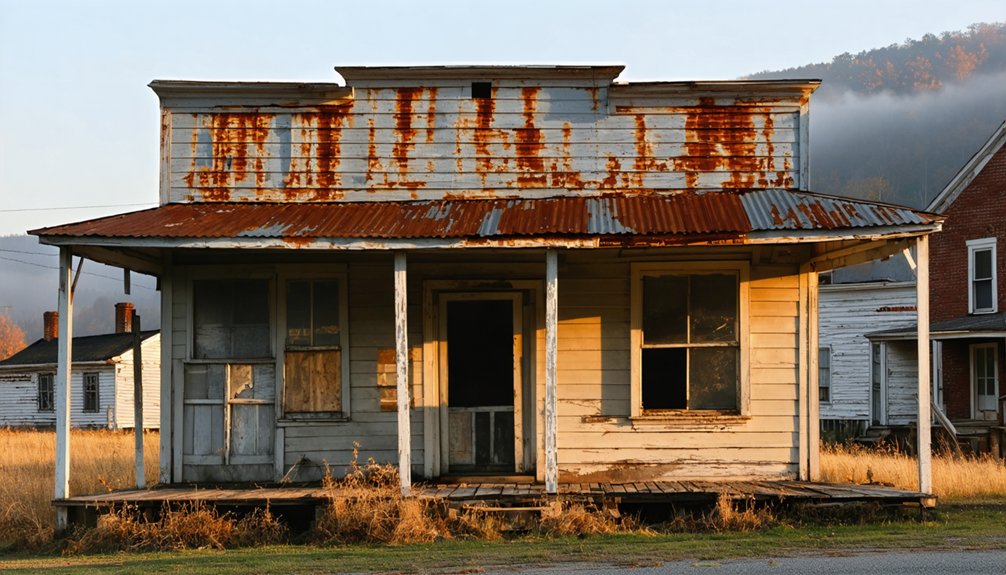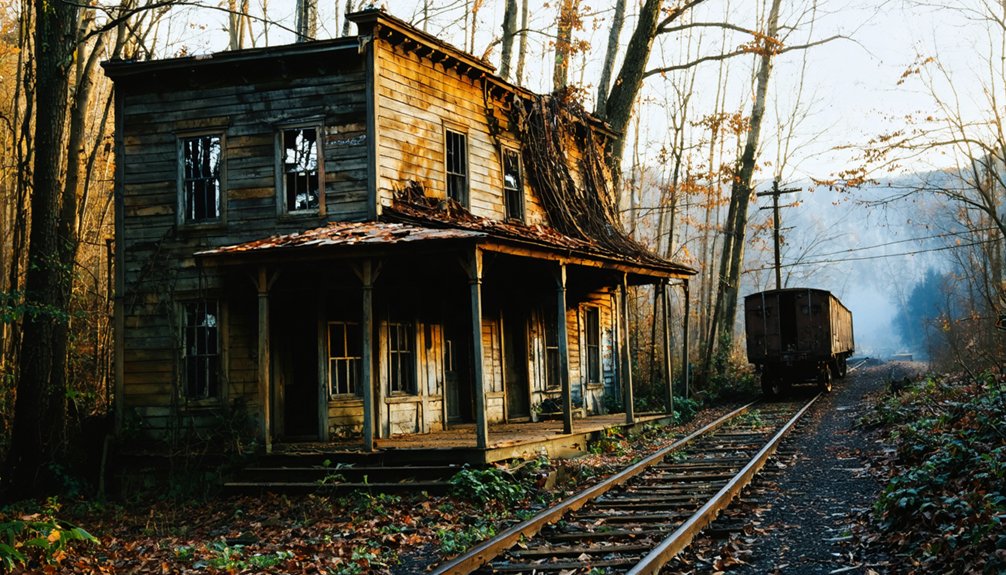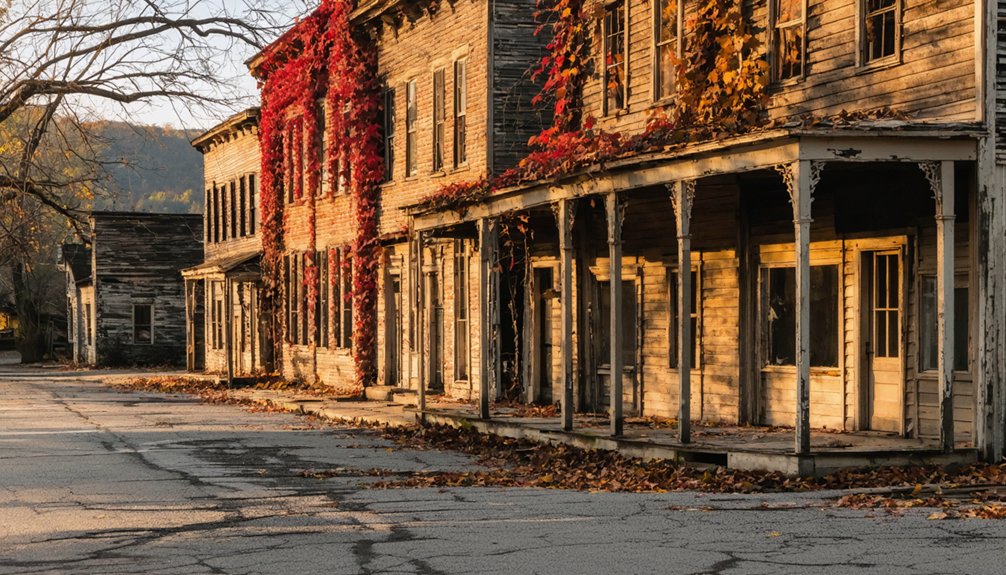
Kentucky’s abandoned coal towns become ethereal landscapes each fall, where steel frameworks at Blue Heron pierce through crimson canopies and Barthell’s weathered miners’ homes stand against golden ridges. You’ll find Paradise’s lonely cemetery overlooking forests ablaze with seasonal color, while Golden Pond’s memorial overlook frames Kentucky Lake through autumn’s fire. Bells Mines hides 186-year-old industrial ruins beneath native hardwoods turning amber and rust. These haunting sites reveal deeper stories of displacement, industry, and Appalachian heritage waiting beyond their scenic facades.
Key Takeaways
- Blue Heron features steel frameworks of former miners’ homes from 1937-1962, creating industrial ghosts amid Big South Fork’s fall colors.
- Barthell Coal Camp, Kentucky’s oldest mining settlement from 1902, displays reconstructed homes framed by autumn’s vibrant landscape near Big South Fork.
- Paradise Cemetery overlooks Kentucky ridges with weathered 1750s gravestones, where autumn leaves highlight the strip-mined ghost town’s remnants.
- Golden Pond heritage overlook marks the TVA-obliterated town site with glass panels, while fall foliage underscores 788 displaced families’ sacrifice.
- Bells Mines, operating from 1836-2022, shows Kentucky’s oldest coal industry ruins reclaimed by native flora amid fall woodland scenery.
Blue Heron: Steel Structures and Steam Engine History Amid Autumn Colors
When autumn transforms the Big South Fork gorge into a tapestry of rust and gold, Blue Heron’s skeletal steel structures emerge from the hillside like memories frozen in metal.
Blue Heron’s steel frameworks rise from the autumn gorge like industrial ghosts, preserving memories in metal against a backdrop of fall colors.
You’ll walk through open frameworks where miners’ homes once stood, each metal shell positioned exactly where families lived from 1937 to 1962.
This heritage preservation approach honors a community that was never meant to be permanent—the original buildings designed for relocation once the coal ran out.
Cross the bridge near the full-scale coal tipple replica, where recorded voices of actual Mine 18 residents echo through the frames.
The rustic architecture allows you to explore freely, stepping into the mine entrance itself while fall leaves crunch underfoot and interpretive photographs reveal what these steel skeletons once contained.
Press buttons at informational signs to hear stories from former residents, bringing personal narratives to life as you stand where these coal mining families once gathered.
The site serves as a navigational aid connecting visitors to the broader history of Appalachian coal mining communities that shared similar names throughout the region.
Barthell Coal Camp: Preserved Mining Town in Fall-Draped Appalachian Foothills
As autumn’s palette sweeps across the Cumberland Plateau, Barthell Coal Camp stands as Kentucky’s oldest coal mining settlement, its weathered structures bearing witness to over a century of Appalachian history.
Founded in 1902, this mining preservation project invites you to wander freely through reconstructed miners’ homes where 350 souls once carved their lives from McCreary County’s coal-rich earth.
You’ll discover authentic buildings restored through old photographs and oral histories, each telling stories of families who thrived here until the 1950s.
The Appalachian history comes alive as fall’s crimson and gold frame the weathered wood and tin roofs.
Located near Big South Fork’s scenic landscapes, you’ll find this open-air museum offers unscripted exploration through grounds where nature reclaims industry, creating haunting beauty beneath autumn’s fiery canopy.
The Koger family purchased the site in 1984, launching an ambitious reconstruction effort to preserve the mining community’s way of life for future generations.
Paradise: Vanished Community Cemetery Overlooking Seasonal Hardwood Display
Where Muhlenberg County’s autumn hardwoods once sheltered a thriving community, only weathered gravestones now pierce the landscape—silent sentinels overlooking barren craters and the distant stacks of TVA’s Paradise Fossil Plant.
You’ll find Paradise’s Smith Family Cemetery on restricted property, its stones dating to the 1750s marking Revolutionary War settlers who claimed this land through blood and warrant.
Strip mining erased everything else—homes, roads, memories—leaving historical preservation to volunteers who breach closed gates for occasional cleanups.
The cemetery’s elevated position reveals autumn’s defiant blaze across surrounding ridges, hardwoods igniting gold and crimson where land reclamation slowly heals mining scars.
Kentucky law protects burial grounds, yet wind-borne dust and neglect threaten stones broken by fallen limbs.
William Smith’s marker stands upright against a tree, salvaged from collapse while other monuments lie shattered on the ground.
Local veterans’ groups assist with cleanup, honoring Civil War soldiers whose faded markers rest among the earliest Kentucky pioneers.
This ghost town whispers loudest through October leaves.
Golden Pond: TVA-Relocated Settlement in Lakeside Fall Forest
Beneath the canopy of October maples and hickories along Kentucky Lake’s northern shoreline, Highway 68 now carves through terrain where Golden Pond’s main street once bustled with 120 years of commerce and community—until President Kennedy’s signature condemned it to oblivion.
Between 1964 and 1970, TVA bulldozers erased 788 families from existence, demolishing every structure as residents watched their heritage vanish. Families like Bill Miller’s, whose grandfather had settled the land, formed perimeters around their homes in desperate attempts to prevent TVA entry.
You’ll find no town restoration here—only a heritage overlook with maps reconstructing what federal authority destroyed. The October 22, 2016 dedication ceremony featured etched glass panels depicting Golden Pond’s history as both memorial and warning. The historical documentation TVA meticulously compiled before demolition now serves as cemetery headstones for a community sacrificed to bureaucratic vision.
Autumn’s brilliant display illuminates this truth: freedom’s most dangerous enemy isn’t tyranny’s sword but progress’s paperwork, signed by smiling politicians.
Bells Mines: Historic Coal Operations Hidden in Western Kentucky Autumn Woodlands
Orange and amber light filters through October’s canopy along Bells Mines Road, where remnants of Kentucky’s oldest coal operation lie scattered beneath hickories and sweet gums that’ve reclaimed what 186 years of industry once dominated.
Nature reclaims what industry abandoned—186 years of coal extraction now surrendered to hickories and the slow patience of October.
You’ll find this ghost town two miles south of Sturgis, founded when Tennessee politician John Bell purchased 31 acres in 1836 for coal extraction near Tradewater River.
History preservation comes alive through crumbling foundations where European immigrants once labored, extracting what was reputed as Kentucky’s finest coal.
The 1864 Civil War skirmish—46 Union soldiers against 300 Confederate guerrillas—adds violent punctuation to this industrial heritage site. Bell himself rarely visited the mines, instead relying on paid managers like W.C. Carvell to oversee daily operations while he pursued his political ambitions in Washington.
Alcoa’s 1950s land grab ended the community, though autumn’s transformation now softens the ruins. A 500-horsepower power plant once powered the mining machinery and provided electric lighting throughout the operation during its early 20th century revival.
You’re free to explore this wooded sanctuary where capitalism’s rise and fall play out in rust and leaves.
Frequently Asked Questions
What Are the Best Months to Visit Kentucky Ghost Towns for Fall Foliage?
You’ll find peak autumn photography opportunities from mid-October through early November when vibrant foliage frames your historical exploration. Visit after October 18th for the most dramatic colors, capturing Kentucky’s abandoned sites wrapped in nature’s fiery transformation.
Are Overnight Accommodations Available Near These Ghost Town Locations?
You’ll find local lodging at restored miners’ cabins in Barthell and state park lodges near ghost towns. Campground options include primitive sites at Daniel Boone National Forest, letting you wake surrounded by autumn’s golden embrace.
Do Visitors Need Permits to Access Ghost Towns on Public Lands?
You won’t need permits for Kentucky’s ghost towns on public lands—just watch for private land restrictions around certain sites. Some federal recreation areas require parking permit requirements, but most historic locations remain freely accessible for exploration.
Which Ghost Towns Offer Guided Tours During Autumn Season?
You’ll discover guided autumn tours at Blue Heron Mining Community, La Grange, Cynthiana, and Lawrenceburg. Each offers haunted legends woven through candlelit streets and abandoned coal towns, providing extraordinary photography opportunities against Kentucky’s blazing fall foliage backdrop.
Are the Trails and Roads to Ghost Towns Wheelchair Accessible?
Unfortunately, accessibility concerns dominate these rugged sites—none offer wheelchair-friendly routes. You’ll encounter overgrown paths, steep terrain, and boulder-strewn trails instead of paved access. These wild, untamed landscapes prioritize preservation over accommodation, demanding physical navigation through forested ghost town remnants.
References
- https://www.hannaheliseschultz.com/blog/waterfalls-amp-ghost-towns-eagle-falls-trail-in-cumberland-falls-state-park-corbin-ky
- https://www.wanderingaroundtheus.com/3-best-locations-to-view-stunning-fall-foliage-in-kentucky/
- https://everafterinthewoods.com/abandoned-ghost-towns-in-kentucky-that-still-hold-echoes-of-the-past/
- https://en.wikipedia.org/wiki/List_of_ghost_towns_in_Kentucky
- https://www.kentuckybb.com/Blog/Get-Haunted-and-Go-Ghost-Hunting-in-Kentucky.html
- https://thedecorologist.com/ghost-town-cave-city-kentucky/
- https://www.youtube.com/watch?v=D9gOmfCuKLs
- https://www.youtube.com/watch?v=KJN0Fl1MafQ
- https://en.wikipedia.org/wiki/Blue_Heron
- https://npshistory.com/publications/biso/brochures/blue-heron-community-2.pdf