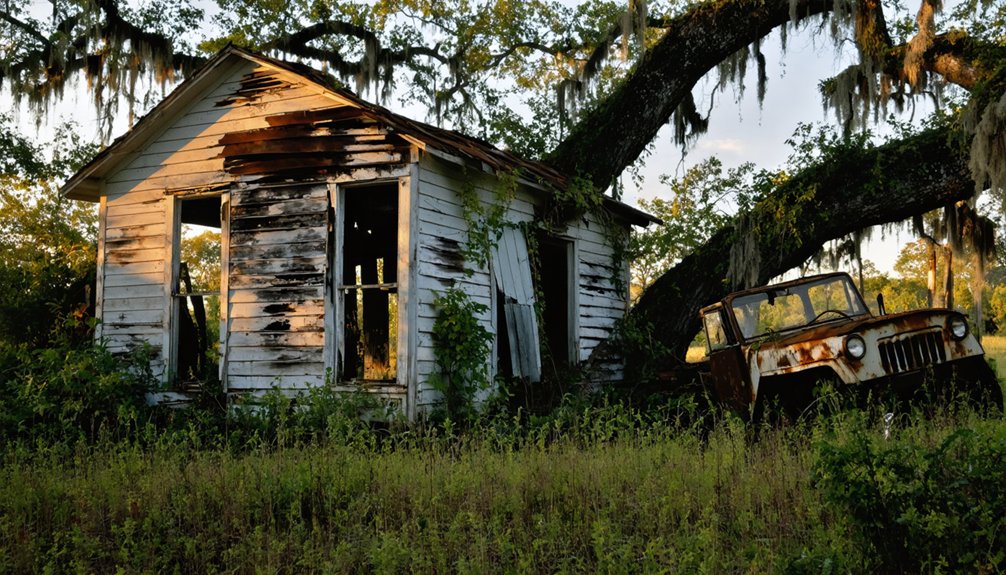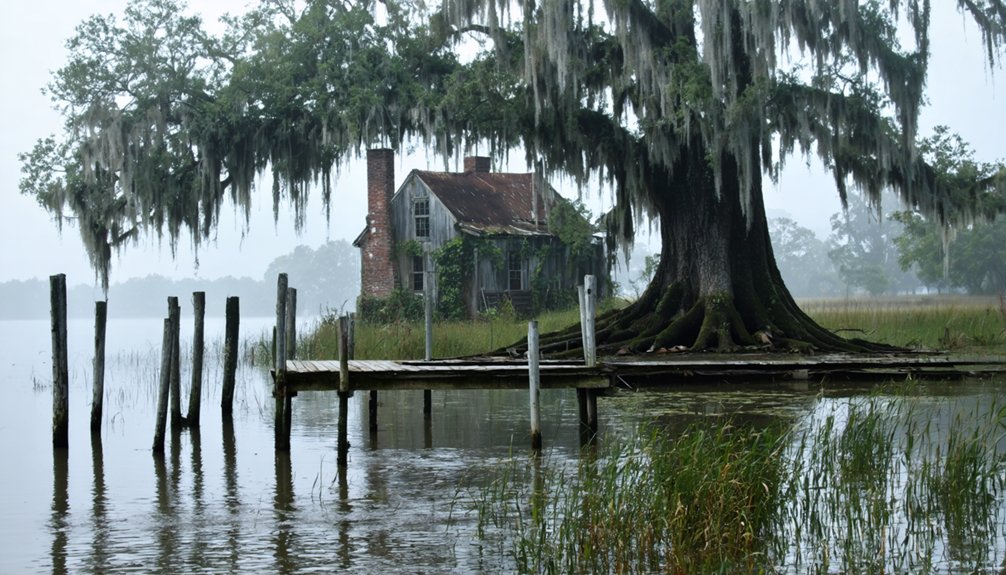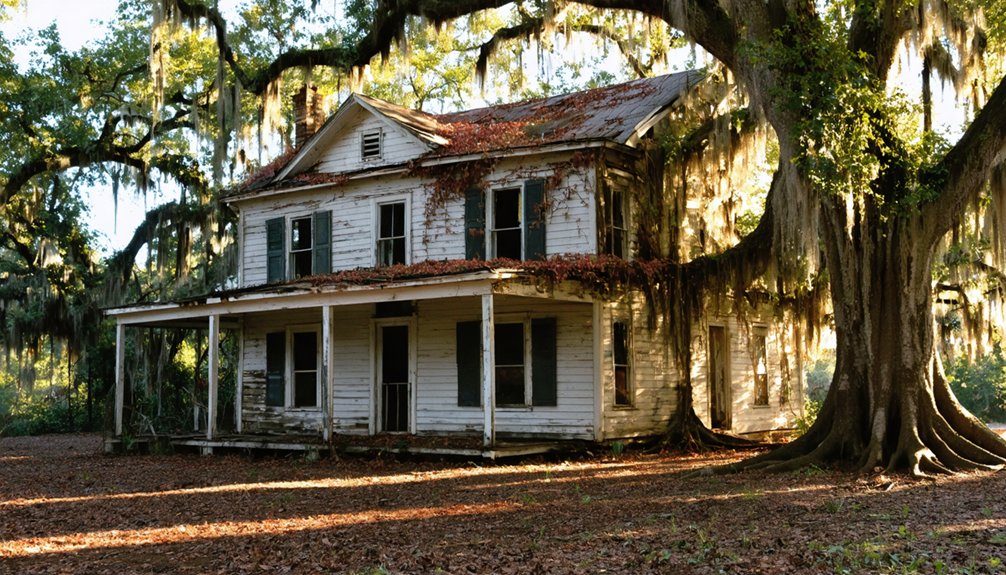
You’ll find Louisiana’s most atmospheric ghost towns amid the Kisatchie National Forest, where abandoned sawmill communities like Fisher and Fullerton emerge from forests ablaze with sugar maple burgundy and oak orange each November. The Longleaf Trail Byway winds through these timber-era ruins—concrete foundations, opera houses, and commissary buildings—framed by vibrant fall colors that peak at midday. Fisher’s preserved structures and Kurthwood’s forest-reclaimed sites offer haunting tableaus where industrial heritage meets seasonal transformation, while Oil City’s weathered derricks stand sentinel among golden hardwoods that’ve overtaken extraction sites generations past.
Key Takeaways
- Kisatchie forests and Longleaf Trail Byway feature ghost towns amid vibrant fall colors from maples, oaks, and swamp red maples peaking in November.
- Fullerton Mill Trail explores a former 5,000-resident timber town with concrete ruins surrounded by autumn foliage, abandoned after 1927.
- Fisher, Louisiana’s best-preserved sawmill ghost town near Toledo Bend Lake, displays historic structures enhanced by seasonal colors.
- Oil City’s industrial ruins, including warehouses and operational oil rigs, stand amid forest regrowth and vibrant fall landscapes.
- Ancient Panis settlements along Red River show archaeological remnants and trading post foundations now surrounded by brilliant autumn foliage.
North Louisiana’s Prime Leaf-Peeping Territory
While Louisiana’s coastal cypress swamps steal most of the autumn spotlight, the state’s northern parishes harbor a secret: the rolling woodlands above Alexandria explode with scarlet and gold each November, transforming into a leaf-peeper’s paradise that rivals destinations hundreds of miles north.
You’ll find this wildlife habitat concentrated around Lake Claiborne, Lake Bistineau, and Toledo Bend—ancient upland forests where sweetgum, hickory, and oak ignite in crimson waves. These state parks function as accidental historical preservation zones, protecting landscapes that once witnessed timber booms and settlement rushes.
Drive the winding roads circling Caney Lake or Chemin-A-Haut’s cypress-studded bluffs, where colors peak through mid-November. The region’s uncrowded trails offer freedom to explore genuine wilderness, far from scripted tourist corridors. Kisatchie National Forest, located about 1.5 hours north of Lafayette, provides scenic fall foliage across nearly untouched land for those seeking a quiet escape. For the most dramatic displays, plan your visit between November 2nd through 11th, when the Farmer’s Almanac identifies peak viewing conditions across the region.
Kisatchie National Forest and Longleaf Trail Byway
The Longleaf Trail Scenic Byway unfurls seventeen miles of rolling buttes and broadleaf pine forests off Interstate 49.
Sweetgums ignite in crimson and cypress glow golden from late October through mid-November.
As you navigate this historic corridor through Kisatchie National Forest’s 604,000 acres, the roadway passes within striking distance of abandoned sawmill settlements—ghostly remnants of Louisiana’s timber boom era when longleaf pine harvesting fueled entire communities.
These forsaken mill towns, now reclaimed by the same forests that once sustained them, stand cloaked in autumn’s warm palette of hickories and black tupelo against the evergreen backdrop.
Oaks contribute warm orange shades to the seasonal display, enriching the tapestry of color along these forgotten settlements.
Sandstone outcrops punctuate the landscape, adding geological drama to the forested terrain.
Panoramic Views Along Byway
Rising along Forest Road 59’s high ridge route, Longleaf Trail Byway reveals Louisiana’s most unexpected terrain—a rugged landscape of sandstone mesas, steep rocky bluffs, and geological formations that earned the area its nickname, “Little Grand Canyon.”
The 17-mile scenic corridor climbs from 80 feet to 400 feet above sea level, positioning travelers at strategic vantage points where the Kisatchie Hills Wilderness Area unfolds across 8,700 acres on three sides.
Multiple scenic outlooks punctuate the route, offering unobstructed panoramas where sandstone outcroppings thrust through longleaf pine forests.
You’ll discover small fossils and petrified wood at turnout sites, while wildlife photography opportunities abound with over 100 bird species inhabiting the canopy. The Longleaf Visitor Center provides detailed information on local hiking trails and offers educational exhibits about the Cathoula sandstone bed that defines the region’s distinctive topography. The byway crosses Kisatchie Bayou, a scenic stream that flows into Old River, adding riparian diversity to the upland forest landscape.
This elevated passage contrasts sharply with Louisiana’s lowland forests, delivering the visual freedom of western expanses without leaving the state.
Nearby Sawmill Ghost Towns
Just eight miles north of the Longleaf Trail Byway, the Fullerton Mill Trail winds through Louisiana’s most significant timber ghost town—a once-thriving community of 5,000 residents that vanished within decades of its founding.
When S.H. Fullerton built the region’s largest sawmill in 1907, he created a modern town complete with electricity, hospitals, and theaters.
Twenty years later, after harvesting 97,000 acres of virgin longleaf pine, the timber ran out.
The final tree cut occurred on May 6, 1927, triggering the town’s rapid decline as the mill shut down and workers departed.
You’ll discover concrete foundations marking where buildings once stood before WWII bombing exercises obliterated remaining structures.
While urban decay typically preserves architectural remnants, military demolition left only pilings and mill ruins.
The trail network extends to campsites and fishing areas that now occupy what was once the heart of this industrial community.
Today’s historic preservation efforts manifest through the Forest Service’s reconstructed pavilion and interpretive trails, allowing you to explore remnants of Louisiana’s timber boom alongside autumn-colored forests.
Fisher: A Sawmill Town Turned Autumn Destination
Just six miles south of Many on Highway 171, you’ll discover Fisher, the last surviving sawmill town from Louisiana’s timber boom that began in 1889 under Captain John Barber White’s Louisiana Longleaf Lumber Company.
Unlike typical shanty settlements, this remarkably preserved company town features substantial structures—from the Old Commissary to the Opera House—that earned it National Register status in 1979. The historic district is situated at Toledo Bend Lake, where visitors can explore both the town’s heritage and the surrounding recreational landscape.
When autumn transforms the surrounding Sabine Parish woodlands, Fisher’s historic buildings take on an especially haunting beauty. Their weathered facades are framed by the same longleaf pine forests that once fueled the town’s prosperity. The town celebrates its lumber heritage each year during Fisher Sawmill Days Festival, held the third weekend in May.
Fisher’s Sawmill Heritage
When Louisiana Longleaf Lumber Company erected its massive sawmill in Fisher in 1889, the operation transformed Sabine Parish from piney backwoods into an industrial powerhouse. You’ll discover the timber industry‘s legacy throughout this remarkable village, where operations kicked off July 15, 1899, establishing the region’s largest mill.
Workers labored “can to can’t” six days weekly, with mule teams dragging massive logs through dense forests.
The company built everything—homes, churches, an opera house, commissary—creating a self-contained world that defined community heritage until the 1960s closure.
Today, you’re free to explore authentic structures reflecting the lumber era’s craftsmanship. Listed on the National Register since 1979, Fisher’s preserved buildings stand as demonstration to the timber barons who shaped Louisiana’s economic independence through sweat and sawdust.
Autumn Colors in Sabine
As October’s cool fronts sweep across Sabine Parish, Fisher’s abandoned sawmill grounds transform into an unexpected autumn canvas where sweetgums ignite in burgundy and purple while cypress trees glow golden along former logging routes.
You’ll discover peak fall foliage extending through November, when southern sugar maples display yellow and burgundy alongside oaks that add warm oranges across the uplands.
The seasonal landscapes here deliver moderate to high color intensity within Kisatchie’s forests, where swamp red maples contribute additional yellow, red, and orange shades.
Fisher’s heavily-wooded terrain enhances these subtle southern displays, offering accessible viewing along rural roads that twist through hilly country.
Midday sun highlights the foliage changes best, while Louisiana’s mild climate supports an extended season rare in ghost town settings throughout the Deep South.
Exploring Fisher’s Remnants
Six miles south of Many along Highway 171, Fisher stands as Louisiana’s most architecturally intact sawmill town.
The Louisiana Longleaf Lumber Company’s 1889 vision for a planned industrial village outlasted the very forests it consumed. You’ll discover historical architecture that showcases the lumber industry’s finest craftsmanship—the commissary, Opera House, Baptist Church, and original company homes that avoided the clapboard shantytown fate of lesser mill settlements.
Listed on the National Register of Historic Places since its 1971 incorporation, Fisher offers fall photography opportunities among structures framed by seasonal color.
The Fisher Heritage Foundation maintains this preserved village, where you can wander freely through a working-class monument to Louisiana’s timber boom, experiencing authentic turn-of-the-century industrial planning without tourist embellishment.
Longleaf and the Southern Forest Heritage Museum
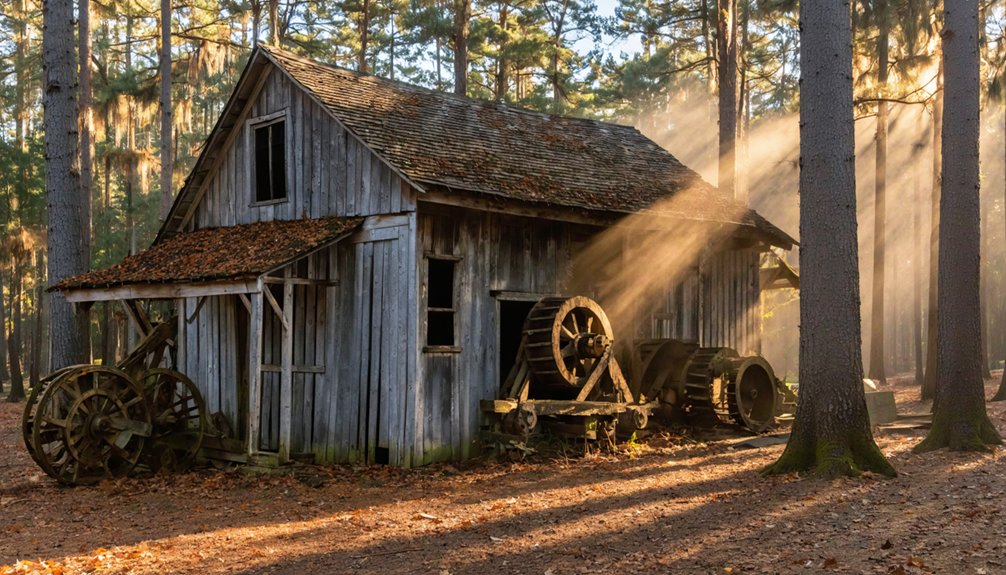
Though the whine of circular saws fell silent over half a century ago, the Long Leaf sawmill complex rises from Louisiana’s piney woods like a perfectly preserved window into the timber baron era. You’ll find the nation’s most complete sawmill operation at this 57-acre site three miles south of Forest Hill, where the Crowell family’s lumber industry empire ran from 1894 to 1969.
The Southern Forest Heritage Museum’s historic preservation earned National Register status, showcasing steam locomotives, McGiffert log loaders, and belt-driven machinery still operational in the original roundhouse.
You can ride the M-4 Railbus along two miles of track threading through autumn-touched pines, exploring freely where company towns once thrived and longleaf timber fueled America’s war effort—including every Higgins boat that stormed Normandy’s beaches.
Kurthwood’s Abandoned Mill Among the Pines
You’ll find few industrial relics today—Kurth sold workers’ houses for $100 each and dismantled everything.
Along Highway 465, forest regeneration has reclaimed the overgrown mill sites.
Only the founder’s house survived this “cut-out-get-out” policy, documenting a sawmill town that somehow “refused to die” despite losing everything else.
Oil City’s Haunting Ruins in Fall Colors
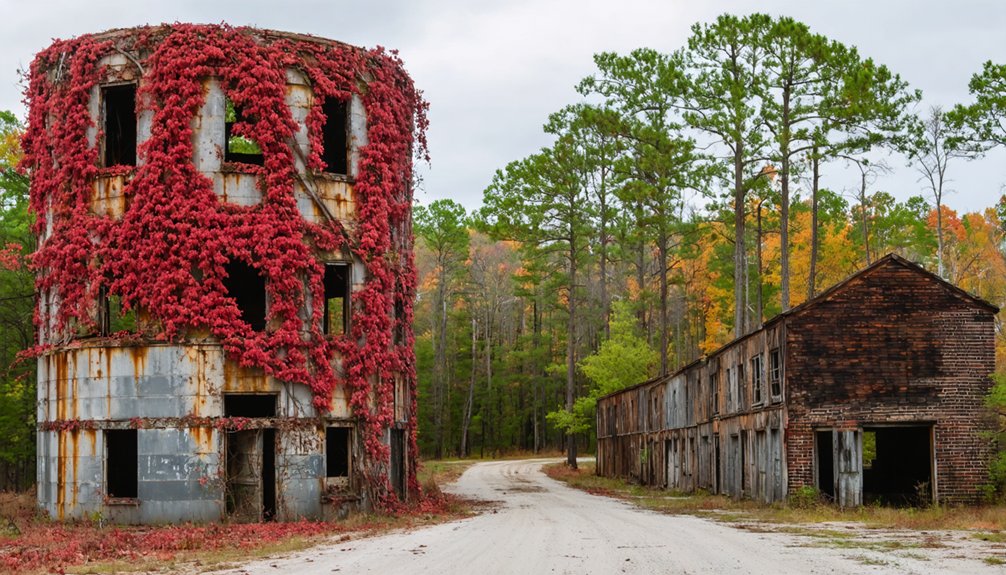
When Howard Hughes, Sr. convinced the Kansas City Southern Railway to rename a humble rail stop called Ananias on November 13, 1907, he couldn’t have foreseen how perfectly “Oil City” would capture both the town’s meteoric rise and its haunting decline.
You’ll discover hidden ghost stories among:
- Reno Hill’s foundations where 40-50 women worked in five houses of ill-repute until 1917
- An operational downtown oil rig pumping beside abandoned structures
- Rusting equipment graveyards creating eerie autumn trail photography opportunities
- Oil City United Methodist Church standing sentinel over crumbling neighbors
- The lone central tree once used for restraining drunks, now framed by fall colors
This town of 900 souls—down from 1,400—offers unfiltered exploration through warehouses, hotels, and railroad-side gambling houses where Producers Well No. 3‘s 80-foot flames once lit northwestern Louisiana’s sky.
Scenic Northern Routes Through Ghost Town Country
Beyond Oil City’s weathered storefronts, Louisiana’s northern backroads thread through a landscape where ghost towns emerge like faded photographs between stands of sweetgum and sassafras ablaze with October color. You’ll navigate Highways 1077 and 40 through dense pine forests where weather-beaten churches mark settlements that time forgot.
Morning fog clings to collapsing barns and family cemeteries hidden among hickory stands along the Longleaf Trail Byway. While nearby communities host farm fresh festivals and festive crafts celebrating harvest season, these forgotten routes offer something rawer—crumbling plantations beside rusty-hued oak groves, abandoned schoolhouses framed by golden hickories.
Poverty Point’s ancient mounds rise through autumn woods, connecting you to indigenous pathways older than any ghost town’s memory, where freedom means exploring beyond marked trails.
Pawnee and Ward: Forgotten Settlements in Autumn
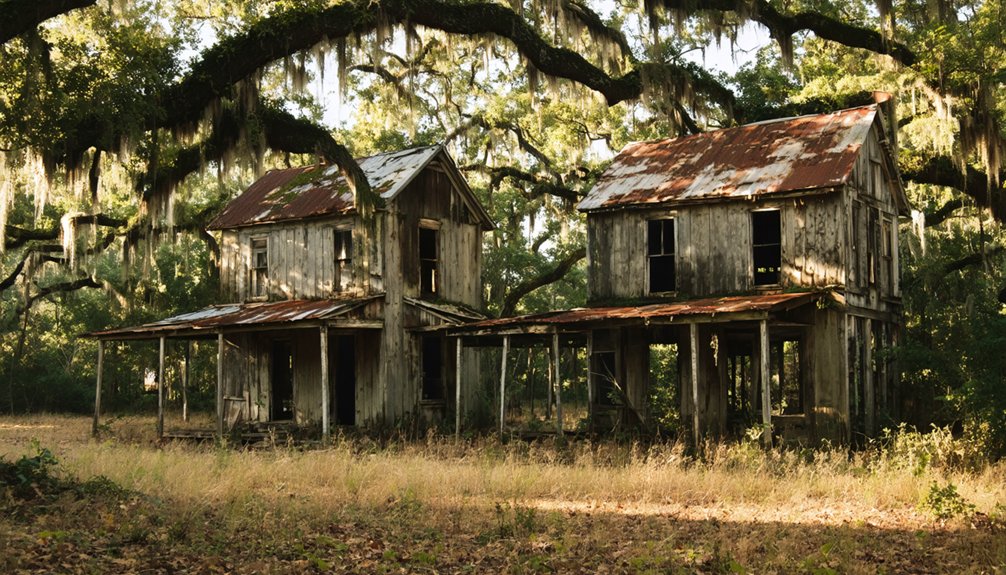
Along Louisiana’s Red River bottomlands, the spectral remains of Panis settlements haunt autumn’s russet landscape—places where captured Apache women and French traders created communities that dissolved like morning mist by the 1830s.
These riverside communities—born of exploitation and erasure—vanished as silently as the captives who built them.
You’ll discover these forgotten villages where abandoned trading posts became human trafficking hubs.
George Catlin documented their locations before they vanished completely, leaving only archaeological whispers beneath fall’s golden canopy.
What remains at these haunting sites:
- Sacred earth lodges with western altars holding buffalo skulls and family bundles
- Scalp-decorated lodge poles streaming red-painted fragments in autumn winds
- Trading post foundations where Lipan Apache captives were sold to French settlements
- Ghost Dance ceremonial grounds from 1891 revival movements
- Henry Glass’s 1806 meteorite theft location near Panis encampments
These settlements represent freedom denied—communities built on captivity that history reclaimed.
Alco’s Remote Sawmill Remains
Deep in Vernon Parish’s cutover forestland, where Louisiana Highway 465 threads between Kurthwood and Simpson, a weathered sign reading “Alco Community” marks what once housed over 1,000 souls in a company town that vanished as swiftly as the virgin pines it devoured.
You’ll find the Alco remains on the highway’s south side—overgrown timber reclaiming what Alexandria Lumber Company built in 1922 after relocating machinery from Pineville.
The “cut out and get out” operation exhausted surrounding timberlands by 1945, when the mill stopped and residents scattered to other lumber camps.
Among autumn’s regenerated forest, ghost town artifacts whisper of Methodist and Baptist congregations, locomotive repair shops, and a Red River and Gulf Railroad spur that once connected this remote settlement to Alexandria, fifty miles south.
Frequently Asked Questions
What Safety Precautions Should Visitors Take When Exploring Abandoned Ghost Towns?
You’ll need sturdy boots for maneuvering crumbling abandoned buildings, permission slips to avoid trespassing risks on private property, and emergency supplies since cell service fails. Pack tetanus shots, snake guards, and satellite communicators for these lawless ruins.
Are There Guided Tours Available for Louisiana’s Ghost Town Locations?
Yes, you’ll find guided tours at Frenier ruins via Lake Pontchartrain boats and plantation sites like Myrtles and Oak Alley, offering historical preservation insights and exceptional photography opportunities among moss-draped oaks and crumbling antebellum structures.
When Is Peak Fall Foliage Season in North Louisiana Forests?
Timing is everything—you’ll catch peak autumn photography in mid-to-late November when cold fronts ignite sweetgums and maples into crimson glory. These leaf peeping spots blaze brightest then, offering you untamed beauty across northern Louisiana’s historic forests.
Can Visitors Camp Overnight Near These Ghost Town Sites?
Camping near Louisiana’s ghost towns isn’t guaranteed. You’ll need landowner permission on private property respecting historical preservation efforts. Public lands like Kisatchie National Forest offer alternatives, though they’re protecting wildlife habitats rather than providing ghost town-adjacent facilities.
Which Ghost Towns Are Accessible Without Four-Wheel Drive Vehicles?
Standard roads reveal history’s doors at Longleaf, Lecompte, and Hollybrook—you’ll find paved highways leading to historical preservation sites with exceptional photography opportunities. These accessible ghost towns let you explore Louisiana’s forgotten past without off-road vehicles required.
References
- https://www.explorelouisiana.com/articles/louisiana-gorgeous-fall-attractions
- https://www.ezhomesearch.com/blog/ghost-towns-in-louisiana/
- https://thebayouinsider.substack.com/p/ghost-towns-and-forgotten-roads-louisianas
- https://www.enjoytravel.com/us/travel-news/famous-for/7-of-the-most-haunted-places-in-louisiana
- https://en.wikipedia.org/wiki/List_of_ghost_towns_in_Louisiana
- https://710keel.com/discover-70-ghost-towns-from-across-louisiana/
- https://www.youtube.com/watch?v=EU0bCGNF13k
- https://www.youtube.com/watch?v=e9N4ENaiTRI
- https://www.getyourguide.com/explorer/louisiana-ttd583/fall-in-louisiana/
- https://710keel.com/louisiana-best-fall-foliage/