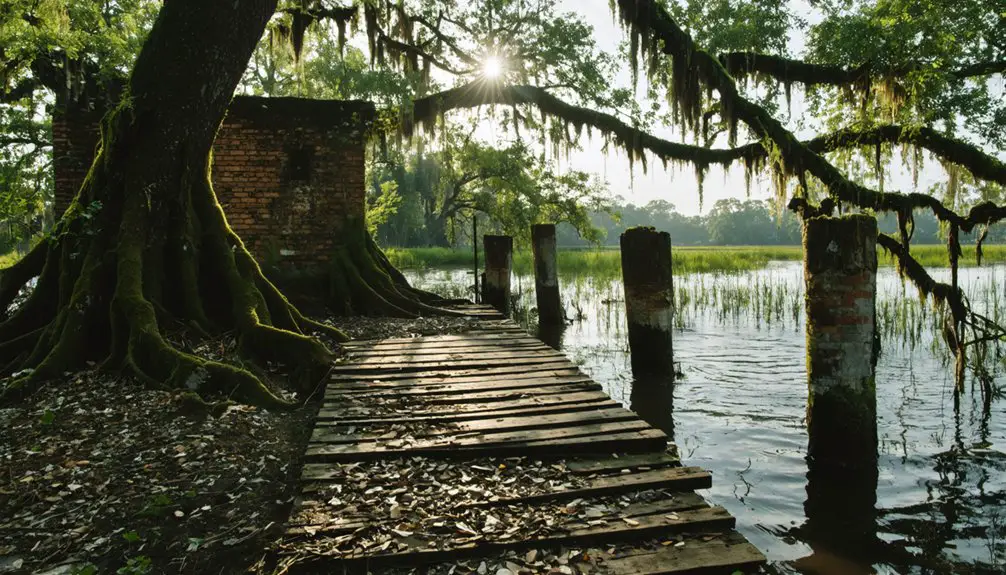
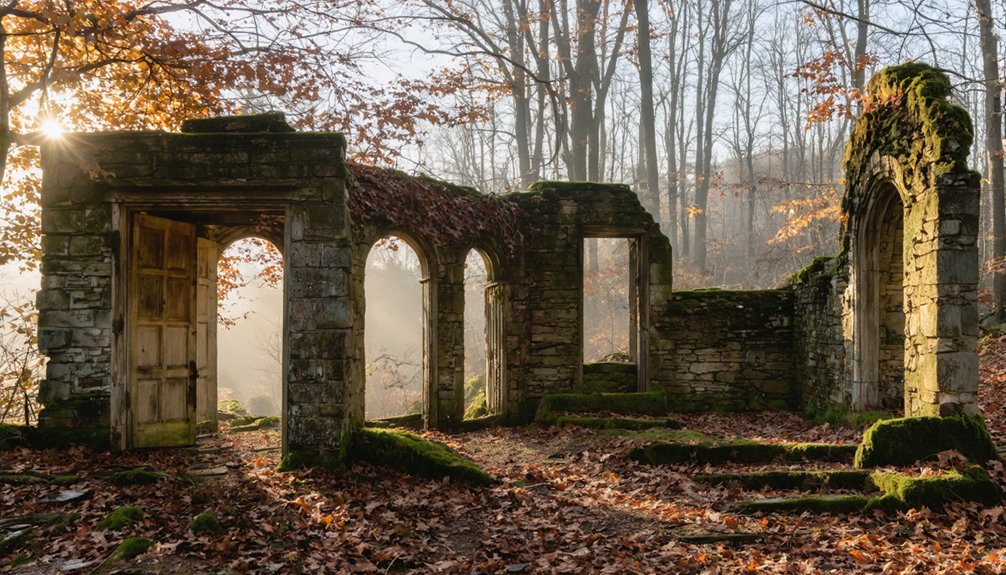
You’ll find Daniels Ghost Town along the Patapsco River transformed by October’s golden and crimson foliage, where gothic stone arches from the 1879 Saint Stanislaus Kostka Church rise through tangled vines. The overgrown cemetery’s weathered headstones dating to 1911 lean at odd angles beneath rust-colored leaves, while crumbling mill foundations and rusting 1950s cars create haunting contrasts against vibrant autumn colors. Late October through early November offers peak viewing when swirling leaves accentuate the decay, and our thorough guide reveals the best trails, timing, and hidden corners of this atmospheric ruin.
Key Takeaways
- Daniels Ghost Town along the Patapsco River features crumbling textile mill ruins, abandoned churches, and overgrown cemeteries best visited in October.
- Saint Stanislaus Kostka Church’s stone skeleton from 1879 stands amid fall foliage, its walls surviving fire and flood devastation.
- Late October to early November offers optimal viewing when golden and crimson leaves frame decaying structures and weathered tombstones.
- Access via Alberton Road trailhead includes a three-mile trek past rusted cars, graffiti-marked foundations, and the Daniels Dam ruins.
- Catoctin Mountains provide additional fall scenery with hiking trails like Chimney Rock offering mountain vistas alongside Maryland’s haunting historic sites.
Daniels Ghost Town: A Historic Mill Town Frozen in Time
Tucked into a serpentine bend of the Patapsco River, Daniels emerges from the autumn mist like a faded photograph come to life. You’ll discover foundations where 90 families once thrived in this company town, their lives intertwined with the textile mill’s rhythm for 150 years.
The industrial decay tells stories of sudden abandonment—279 residents forced out in 1968, their bowling alley and general store left behind. Tropical Storm Agnes finished what economics started, washing away most structures in 1972.
Yet preservation efforts saved fragments: Gary Memorial Church still stands resolute, and the mill’s listing on the National Register ensures its memory endures. Behind the Catholic church ruins lies an overgrown cemetery with headstones dating to 1919, documenting over 57 graves of former mill workers and their families. The B&O Railroad arrived in 1831, driven by the thriving mill industry that transformed this cotton mill town into a bustling community with churches, homes, and businesses.
Wander these grounds freely, where amber leaves now carpet streets that once bustled with mill workers’ footsteps.
Exploring the Ruins and Cemetery of Daniels
Your boots crunch through scattered leaves as you climb the uphill path past rusting 1950s cars, their chrome catching autumn light before gothic stone arches emerge through crimson maples.
The cemetery sprawls ahead in overgrown chaos—toppled gravestones lean at odd angles beneath golden canopy, some dating back to 1911, others bearing incomplete inscriptions that end abruptly in 1969. Among the ruins stands Saint Stanislaus Kostka Catholic Church, its fire-scarred walls a remnant of the 1927 blaze that consumed both the structure and its irreplaceable records. October’s peak foliage transforms these abandoned structures into something almost beautiful, the fire-scarred church walls framed by orange and amber branches that soften what storms and floods left behind. Hurricane Agnes in 1972 demolished the town’s 1833 main mill building, reducing the once-thriving industrial centerpiece to scattered rubble along the riverbank.
Church Structures and Foundations
The stone skeleton of St. Stanislaus Kostka Roman Catholic Church rises through tangled vegetation like a monument to abandonment. You’ll find these Gothic ruins along the fire access path, their 1879 stonework outlasting everything else the mill companies built.
September 1926’s flames gutted the tower that once guided workers home, yet the walls endure.
Half a mile beyond, the Pentecostal Holiness Church crumbles where Hurricane Agnes flooded it in 1972. Church preservation never materialized despite the Smithsonian’s interest.
Now ruins exploration means pushing through weeds to trace foundations marked by graffiti and time. Across the Patapsco, St. Alban’s Episcopal shell watches silently.
The five churches served a population not exceeding 800, testimony to the town’s deep religious character during its industrial heyday.
Gary Memorial Church alone survived operational—freedom from corporate ownership saved it. The church’s graveyard remains visible beside the ruins, a final testament to the community that once thrived here.
Cemetery Remnants and Trails
Behind Saint Stanislaus Kostka’s fire-scarred walls, tombstones lean at drunken angles through waist-high weeds that weren’t there when mourners last gathered.
You’ll find this graveyard predating 1800, its stones knocked flat by time and indifference. Vines snake around what remains standing—reminders that these historical ghost towns reclaim themselves when nobody’s watching.
Access the northern ruins via Alberton Road’s trailhead at 8106, though the lot fills fast during autumn leaf exploration season.
Your three-mile trek winds along the Patapsco River, passing rotting cars from 1972’s floods and graffiti-marked foundations. The path ends at Daniels Dam, where you’ll spot mill workers’ homes reduced to low stone walls. The settlement itself appears on multiple reference pages due to various historical and geographical associations with the name.
It’s quiet here—just woods breathing through broken windows, patient and untamed.
Best Autumn Viewing Times
When autumn’s chill strips away summer’s concealing curtain, Daniels reveals itself most honestly—late October through early November offering that sweet spot where foliage blazes against crumbling stone and you can actually *see* what you came for. September’s too early; you’ll fight lingering overgrowth.
December works if you’ve missed the window, though the color show’s faded. Those blustery October Sundays? Perfect. Wind rattles through empty church frames while rust-orange leaves swirl around Agnes-drowned cars still rotting where floodwaters left them.
The forest reclaims everything here, but autumn slows that conquest just enough for foliage photography that captures both beauty and decay. Behind the old Saint Stanislaus Kosta Catholic Church, an ancient cemetery holds tombstones dating from the early 1900s, their weathered inscriptions barely visible through the fall leaves. Haunted legends feel more plausible when stone arches emerge from the dying undergrowth, their shadows lengthening across forgotten foundations.
Catoctin Mountains: Western Maryland’s Autumn Showcase
Rising from Maryland’s piedmont, Catoctin Mountain Park transforms into a painter’s palette each October, though nature’s canvas looked somewhat muted during my mid-October visit in 2025.
Drought-stressed oaks browned without their typical scarlet fanfare, while black walnuts and red maples delivered scattered brilliance at medium elevations. Thurmont Vista rewarded you with fantastic oranges and yellows against persistent green—colors echoing the haunted legends whispered along these ridges.
The 82°F heat felt surreal, like summer refusing surrender.
You’ll find folklore stories interwoven with hiking trails like Chimney Rock, where valley vistas stretch beyond changing canopies. Recent rains triggered premature leaf drop, yet moisture preserved remaining color. A family-friendly Cryptid Hike at Cedarville State Forest on October 18 explores Maryland’s mysterious creatures and folklore.
Ridge tops thinned early, their skeletal branches stark against crystalline skies, beckoning freedom-seekers toward wilderness solitude. The signature hike covers approximately 3.8 miles, including a trip to Chimney Rock and Thurmont Vista Overlook along stone pathways.
Frederick Municipal Forest and Scenic Ridge Trails
Just south of the mountain vistas, Frederick Municipal Forest sprawls across ridgelines where civilization’s edges blur into wilderness. You’ll navigate the 4-mile loop where pine-scented air mingles with October’s crimson canopy. Your boots crossing streams that mark both journey’s beginning and end.
Trail safety demands attention on rocky grades averaging 6 degrees—especially when autumn rains slick the soil beneath fallen leaves.
Wildlife observation rewards your patience here. White-tailed deer emerge at dusk near colonial charcoal hearths, while red-tailed hawks circle above abandoned settlements swallowed by forest.
The waterfall near trail’s end tumbles past foundations where ghost communities once thrived. You’re walking paths the Civilian Conservation Corps carved through 1930s wilderness, connecting Frederick’s threshold to Catoctin’s 26.6-mile ridge—freedom measured in footsteps through forgotten places.
Elk Neck State Park: Woodland Paths to a Historic Lighthouse
You’ll find yourself descending through a canopy of amber and crimson as the mile-long trail winds down a hundred-foot bluff toward Turkey Point Light.
Where autumn transforms the woodland path into a tunnel of gold each October.
The remote location that once isolated keepers like Fannie Mae Salter—14 miles from the nearest store—now offers you the rare gift of witnessing peak foliage undisturbed by crowds, with only the occasional white-tailed deer emerging from the underbrush.
As you navigate the steep, root-crossed trail, watch for the moment when the trees suddenly part and the 1833 lighthouse appears, its white stucco tower stark against the blazing reds of the surrounding maples.
Trail Features and Accessibility
Winding through 2,188 acres of forest, Elk Neck’s 12 miles of trails reveal a landscape where autumn transforms the canopy into copper and gold.
You’ll find the Pete Bond Trail offering an easy stroll to scenic overlooks, though trail accessibility doesn’t meet ADA standards—some visitors with disabilities can still navigate it.
White Banks Trail challenges you with steep climbs, rewarding your effort with views of white clay cliffs plunging toward Chesapeake Bay.
The 193-mile Mason Dixon Trail cuts through here on gentler slopes, while Plum Creek Trail connects nearly 12 miles of state and private land.
Wildlife habitats sprawl between cliff edges and wetlands, creating that untamed feeling you’re searching for among October’s crimson leaves.
Fall Foliage Display Timing
October’s transformation arrives at Elk Neck in waves rather than all at once, each elevation revealing its palette on nature’s own schedule. You’ll witness peak foliage in late October as Cecil County’s forests blaze with unrestrained color. The woodland paths to Turkey Point Lighthouse offer front-row seats to nature’s finale.
What You’ll Experience on Your Journey:
- Early October: Black gum leaves flash deep red while yellow-poplar shifts to fiery gold.
- Mid-October: Red maples and black gums ignite the forest in yellows and scarlets.
- Late October: Oaks contribute golden bronze as foliage peaks across ridgetops.
- Trail Progression: Colors intensify from trailhead to lighthouse, painting your path in amber.
- Weather Impact: Recent moisture helps retain autumn colors despite summer’s drought conditions.
The transformation unfolds before you—each step deeper into these historic woodlands reveals nature’s uncensored artistry.
Wildlife and Scenic Highlights
Beyond the lighthouse’s weathered beacon, Elk Neck’s woodlands pulse with avian life that transforms these trails into a birder’s revelation. You’ll witness spectacular bird migration as thrushes, warblers, and vireos funnel through this Atlantic Flyway corridor—some days the canopy literally thrums with movement. The gravel lane toward Turkey Point becomes your front-row seat to nature’s twice-yearly exodus, where over 224 documented species navigate these preserved forests.
White Banks overlook rewards your climb with sweeping Chesapeake vistas where Bald Eagles patrol year-round—winter sightings often reveal seven soaring simultaneously. This habitat preservation success story owes much to managed deer populations that protect the dense mountain laurel and azalea understory.
Here, at-risk Whip-poor-wills and Scarlet Tanagers still nest freely, their survival as a testament to forests left wild.
Rock Hall and Eastern Neck Wildlife Refuge Adventures
Tucked along Maryland’s Eastern Shore, Rock Hall transforms into a canvas of burnt orange and crimson each fall. The Chesapeake Bay’s salty breeze carries the earthy scent of turning leaves.
You’ll discover local folklore woven through this waterfront village while setting out on autumn photographic tours along flat, quiet roads.
Local legends whisper through narrow streets as cyclists navigate peaceful autumn lanes, cameras poised to capture this maritime village’s seasonal transformation.
Eastern Neck Wildlife Refuge Adventures:
- Pedal 16 miles round-trip through gold-splashed landscapes to witness tundra swans arriving.
- Capture migratory birds against crimson wetlands (free entry, parking available).
- Explore sunset sails revealing glowing shorelines across tidal marshes.
- Photograph waterfowl along Blackwater River’s winding bike loops.
- Experience Rock Hall Fallfest’s live music and fresh oysters.
The Watermen’s Museum reveals maritime heritage, while downtown shops nestle beneath autumn canopies. You’re free to wander trails for hours, camera ready.
Annapolis Area Parks: Waterfront Fall Foliage Views
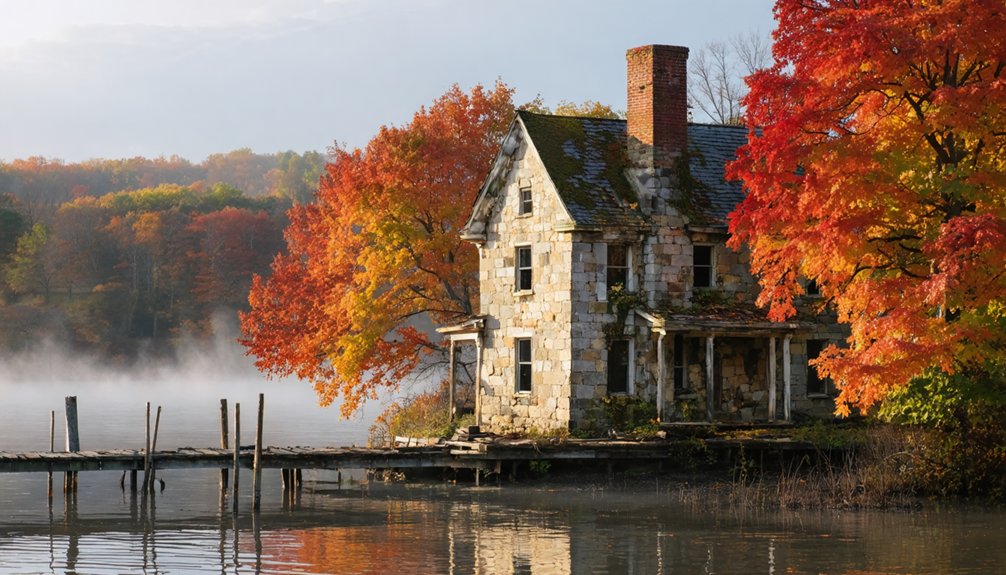
Where the Chesapeake Bay’s tributaries carve into Maryland’s capital region, Annapolis reveals a network of waterfront parks that burst into flame-colored brilliance each autumn. You’ll find Beverly Triton Nature Park where South and West Rivers converge, its pond loop threading through forests ablaze with peak colors from October 19 through November 4.
Quiet Waters Park’s 340 acres unfold along South River and Harness Creek, while Truxtun Park‘s trails hug Spa Creek’s headwaters overlooking downtown’s spires.
Urban waterfronts transform into autumn birdwatching havens here. The Naval Academy’s campus showcases hundreds of mature trees against historic architecture, and Kinder Farm Park‘s 288 acres offer wide-open paths where cool breezes carry the scent of turning leaves. Each location delivers that essential blend: water’s edge, changing canopy, and space to roam.
Howard County’s Centennial Park and Lake Loop
Moving inland from Annapolis’s tidal edges, Howard County’s Centennial Park spreads across rolling terrain where a 54-acre lake mirrors the season’s transformation.
You’ll discover 2.6 miles of paved pathways circling Centennial Lake, where late October brings crimson-gold reflections rippling across calm waters. Wildlife photography opportunities abound—white-tailed deer emerge at dawn, beavers patrol the shoreline, and herons wade through autumn’s amber light.
Your Centennial Park Experience:
- 2.6-mile lake loop plus 7.3 miles of interconnecting trails
- Peak foliage late October through mid-November
- White-tailed deer, beavers, and native Maryland herons
- Howard County Bike Share access points nearby
- Calm morning reflections perfect for photography
While historical preservation isn’t this park’s focus, its natural landscape offers unscripted encounters with Maryland’s wilderness—no crowded boardwalks, just open pathways where you’ll breathe deeply and wander freely.
Best Times to Visit Maryland’s Ghost Town and Fall Destinations
Maryland’s autumn color show unfolds like a westward-moving curtain, beginning in Garrett County’s high elevations where hemlock-shaded hollows ignite with yellow poplars and orange sycamores by late September. You’ll chase this wave eastward through October, hitting Allegany County’s Rocky Gap when boat launches frame fiery shorelines.
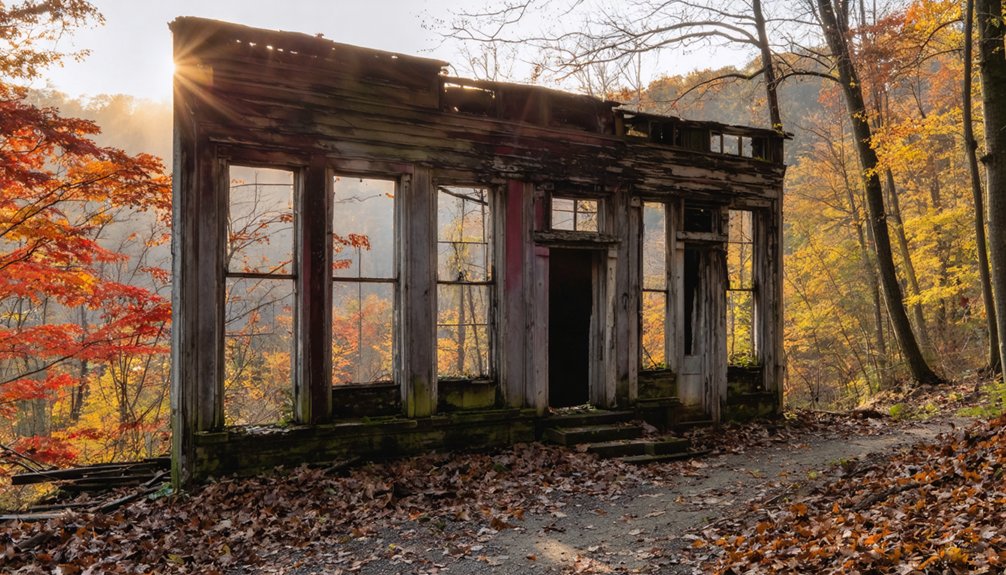
For Daniels Ghost Town, plan your escape between October and March—summer’s aggressive overgrowth conceals the historical architecture you’re hunting. Those gothic church ruins and abandoned mill foundations emerge clearest when leaves drop, revealing 150 years of industrial decay along the Patapsco.
Early autumn brings seasonal birdwatching opportunities before migrations complete. Check foliage prediction maps weekly; timing shifts annually.
The best ghost town adventures pair mid-October’s peak colors with November’s skeletal clarity, when you’ll navigate unobstructed paths through Maryland’s forgotten places.
Frequently Asked Questions
Are There Any Entrance Fees or Permits Required for Daniels Ghost Town?
You’ll pay just $5 as a Maryland resident ($7 out-of-state) to enter Patapsco Valley State Park, where historical preservation meets accessible adventure. The Daniels area welcomes you sunrise to sunset—no special permits needed, just respect visitor regulations and park responsibly.
What Safety Precautions Should Visitors Take When Exploring Abandoned Structures?
You’ll need hazard awareness to navigate crumbling floors and falling debris. Wear protective gear—sturdy boots, long pants, and gloves. I’ve watched sunlight pierce broken windows while testing each floorboard, breathing dust-thick air where nature reclaims forgotten walls.
Can You Camp Overnight Near Any of These Ghost Town Locations?
You’ll find camping near Garrett County’s ghost towns through Savage River State Forest permits. Check camping regulations before venturing out, and remember wildlife safety—black bears roam these misty hollows where autumn leaves crunch beneath your boots at dusk.
Are the Trails Wheelchair Accessible at These Fall Foliage Destinations?
Most ghost town trails aren’t wheelchair accessible—you’ll face accessibility challenges on unpaved, overgrown paths. However, Centennial Park’s paved loops offer freedom to explore fall colors while historical preservation efforts prioritize authenticity over modern accommodations at remote sites.
What Photography Equipment Works Best for Capturing Ghost Town Ruins?
Like autumn leaves catching golden hour, you’ll want a full-frame camera with wide-angle lens (16-35mm) for atmospheric ruins. Use low ISO, slower shutter speeds on tripod, and experiment with camera settings capturing Maryland’s abandoned spaces through fall’s fading light.
References
- https://chesapeake-inspired.com/where-to-see-fall-colors-in-maryland/
- https://www.ospreypoint.com/fall-foliage-maryland/
- https://www.youtube.com/watch?v=7aq_c7-Bmj8
- https://www.visithowardcounty.com/fall-getaways/fall-foliage/
- https://www.onlyinyourstate.com/trip-ideas/maryland/small-town-fall-day-trip-md
- https://www.tripadvisor.com/Attraction_Review-g41131-d10035193-Reviews-Daniels_Ghost_Town-Ellicott_City_Maryland.html
- https://www.visitmaryland.org/article/take-maryland-fall-foliage-trip
- https://www.mdmountainside.com/blog/post/haunted-history-places-to-visit-for-a-ghostly-good-time/
- https://www.youtube.com/watch?v=FoTBXomVN4k
- https://midatlanticdaytrips.com/2015/10/visiting-marylands-ghost-town-daniels/