You’ll find Michigan’s most atmospheric ghost towns in the Keweenaw Peninsula, where nearly 100 abandoned copper mining settlements hide among fall’s crimson maples and golden aspens. Visit Fayette Historic Townsite‘s preserved 1867 iron community against Lake Michigan’s dramatic cliffs, or explore Central Mine’s ruins established in 1854. For a haunted experience, Pere Cheney Cemetery marks a vanished lumber town devastated by 1890s epidemics. Late September through mid-October offers peak colors—and there’s much more to these forgotten places than initially meets the eye.
Key Takeaways
- Fayette Historic Townsite features 20 preserved buildings amid dramatic dolomite cliffs and exceptional fall hardwood colors on Garden Peninsula.
- Pere Cheney Cemetery, Michigan’s most haunted site, offers eerie atmosphere enhanced by surrounding dense forests displaying vivid autumn reds and golds.
- Keweenaw Peninsula’s abandoned copper mines include Clifton, Central Mine, and Delaware Mine surrounded by colorful sugar maples and aspens.
- Peak fall foliage viewing occurs late September through mid-October, providing optimal conditions for exploring ghost towns and historic sites.
- Scenic drives like M-119’s Tunnel of Trees and Brockway Mountain Drive enhance ghost town visits with panoramic autumn vistas.
Fayette Historic Townsite: A Preserved Iron Smelting Settlement
The limestone cliffs of Fayette Historic Townsite glow against autumn’s crimson maples and golden birches, creating a striking contrast between industrial ruins and seasonal splendor.
You’ll explore twenty stabilized buildings from this 1867 iron smelting community on Garden Peninsula, where immigrant workers once produced 230,000 tons of pig iron.
Wander freely through the superintendent’s house, machine shop, and worker homes overlooking Big Bay de Noc’s waters.
October transforms the hardwood forests that once fueled charcoal kilns into a spectacular color show.
Heritage preservation efforts keep this industrial history accessible—you’ll need only a Recreation Passport.
Self-guided trails let you discover the opera house, hotel, and blast furnaces at your own pace, seventeen miles south of US-2 via M-183.
The community of about 500 people thrived here with amenities including a coronet band, baseball team, and horse racing track until operations ceased in 1891.
The site’s dolomite cliffs tower dramatically over the clear waters of the cove, providing exceptional kayaking access for visitors who want to experience the historic townsite from the water.
Keweenaw Peninsula’s Abandoned Copper Mining Communities
Copper-stained cliffs and weathered mine headframes rise through Keweenaw Peninsula’s October canopy, where sugar maples and aspens now reclaim what was once America’s richest copper district. You’ll discover Clifton’s crumbling foundations where 700 residents once worked the Cliff Mine—the region’s first profitable operation that reached 1,080 feet deep before closing in 1870.
Central Mine’s restored cottages tell stories of 1,350 souls who vanished when copper ran out in 1894.
Delaware Mine’s flooded shafts conceal 5,000-year-old prehistoric pits, revealing ancient metallurgy predating European contact by millennia. Mining archaeology here documents 1.5 billion pounds of pure copper extracted between 3000-1200 BCE using stone hammers and fire-setting. The mine operated from 1847 to 1887 with financial backing from prominent investors including newspaper editor Horace Greeley. The ancient copper was 99.9% pure, requiring no smelting and making it exceptionally easy to work with.
These ghost towns offer unrestricted exploration through fall’s brilliant transformation.
Pere Cheney: Michigan’s Most Haunted Cemetery
In Crawford County’s dense pine forests, you’ll find Pere Cheney Cemetery—the sole remnant of a thriving lumber town that twin diphtheria epidemies reduced from 1,500 residents to complete abandonment by 1917.
The remote burial ground now holds roughly 90 graves beneath a canopy of maples and oaks that ignite with crimson and gold each October, their fallen leaves carpeting toppled headstones and vandalized monuments.
This eerie autumn setting has earned Pere Cheney its reputation as Michigan’s most haunted cemetery, where visitors report ghostly children’s laughter echoing through the colorful foliage and unexplained handprints appearing on their vehicles. Legend tells of a witch’s curse placed upon the town after residents banished a woman who subsequently lost her child, with some believing her spirit still lingers in the cemetery. The cemetery’s tallest monument marks the tragic Barber family graves, where Frank and Frances lost all three children—Hattie, Ray, and Roy—during the devastating December 1893 outbreak.
Tragic History and Abandonment
Deep in Crawford County’s hardwood forests, where fall colors blaze brightest 15 miles southeast of Grayling, Pere Cheney’s weathered cemetery marks all that remains of a lumber town that couldn’t outrun tragedy.
George Cheney’s 1873 settlement thrived with 1,500 souls until diphtheria struck twice—devastating epidemics in 1893 and 1897 left just 25 survivors.
You’ll find only 90 graves for 1,500 deaths, a mystery that haunts local burial customs to this day.
Mill fires compounded the devastation, and by 1918, the timber industry’s collapse sealed Pere Cheney’s fate. The town’s land was auctioned off after the population fell below 20, finalizing its status as a ghost town.
The settlement once supported a school, grocery store, and post office during its lumber boom years, all connected by the railroads that fed the timber trade.
Today’s ghost town photography reveals moss-covered ground where headstones once stood—most stolen or toppled through decades of vandalism.
Beaver Creek Township owns these forgotten remains, where spongy earth and autumn maples create Michigan’s most haunting seasonal landscape.
Cemetery’s Haunted Reputation
Beyond the documented tragedies of diphtheria and fire, Pere Cheney’s cemetery has earned its reputation as Michigan’s most haunted burial ground through a darker legend—one involving a woman accused of witchcraft who allegedly cursed the entire settlement. According to local lore, she was banished to the woods and eventually hung from an oak tree where she’s now buried.
The cemetery holds about 90 graves, mostly children, creating an unsettling atmosphere among the fall foliage.
Visitors report ghost sightings including apparitions, glowing orbs, and mysterious lights flickering between autumn trees. You’ll find urban legends come alive here through disembodied voices, unexplained handprints on vehicles, and car troubles. Stories of a logger chasing visitors have made the location particularly popular among thrill-seekers exploring the haunted grounds.
The site ranks #2 among Midwest witch graves, drawing paranormal investigators who explore freely without restrictions during Michigan’s colorful October months. Previous visitors have left toys and flowers at various gravesites, adding to the cemetery’s haunting memorial atmosphere.
Autumn Forest Surroundings
The haunted legends draw visitors here, but Pere Cheney Cemetery’s eerie atmosphere intensifies when you see it surrounded by Michigan’s autumn forest. Brilliant reds, oranges, and golds frame weathered headstones and toppled monuments during October’s peak color season. You’ll navigate narrow Center Plains Trail—a dirt road best suited for higher clearance vehicles—as autumn colors arch overhead.
The cemetery sits isolated among dense woods, accessible only via forest trails that heighten its abandoned feel. Fallen leaves blanket the 90 graves, many marked simply with rocks placed by descendants. That stone monument near the entrance recounts the town’s tragic history while maples and oaks blaze around you.
This remote location, fifteen miles southeast of Grayling, offers both haunting beauty and unsettling solitude when autumn transforms the surrounding wilderness.
Exploring Central and Other Remote Mining Camps
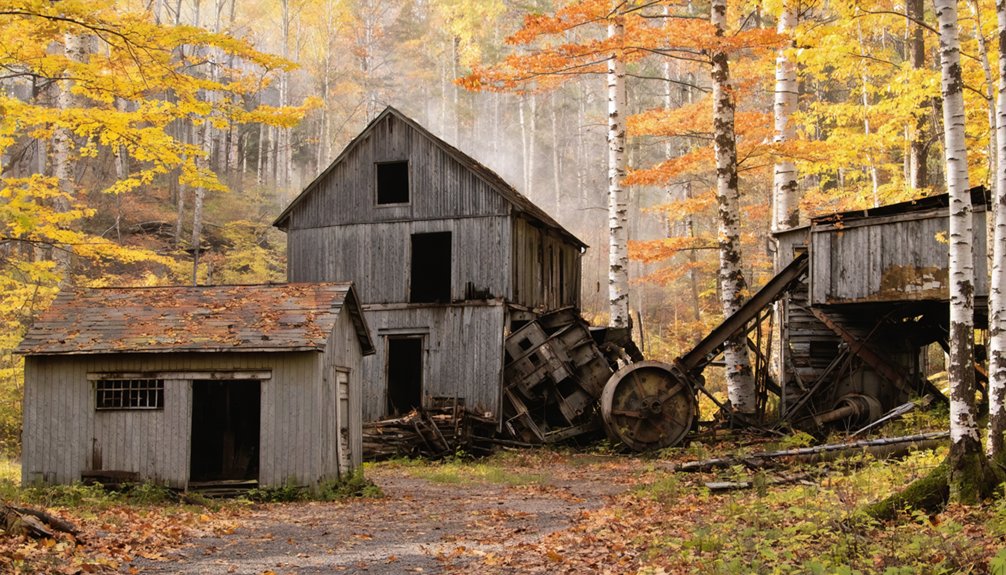
Venture twenty minutes north of Calumet and you’ll discover Central Mine, where copper fever first struck pay dirt in 1854. This ghost town exploration reveals Michigan’s first profitable copper operation, with crumbling structures standing against brilliant autumn maples.
The mining history here runs deep—wooden frameworks and stone foundations emerge from fallen leaves like forgotten monuments.
Push further into Keweenaw’s backcountry and you’ll find Cliff Mine’s 1844 ruins, America’s first mechanized copper operation.
Remote camps like Amyk (built 1902) and the clustered communities of Allouez, Bumbletown, and Copper City offer solitary wandering through nearly 100 abandoned settlements.
Download the Keweenaw Time Traveler App before venturing out—cell service disappears quickly.
Tread carefully around mine shafts and deteriorating buildings where autumn’s gold surrounds century-old silence.
Timing Your Visit for Peak Autumn Colors
When planning your ghost town adventure, late September through mid-October delivers Michigan’s most spectacular fusion of history and nature. You’ll witness crimson maples and golden birch framing weathered structures, while cooler temperatures make extended exploration comfortable. October particularly rewards independent travelers with peak colors and an atmospheric edge perfect for discovering forgotten townsites.
If you’re avoiding crowds, May through June offers quieter alternatives with spring blossoms and accessible trails. However, seasonal weather plays an essential role—Fayette Historic Townsite and similar locations close entirely during winter, reopening in late May. This restriction demands advance planning.
The foliage diversity along Lake Superior’s shoreline creates dramatic contrasts, especially when moody cloud systems roll through. Book accommodations early, as September-October demand strains local capacity near popular ghost town destinations.
Scenic Routes and Nearby Fall Foliage Destinations
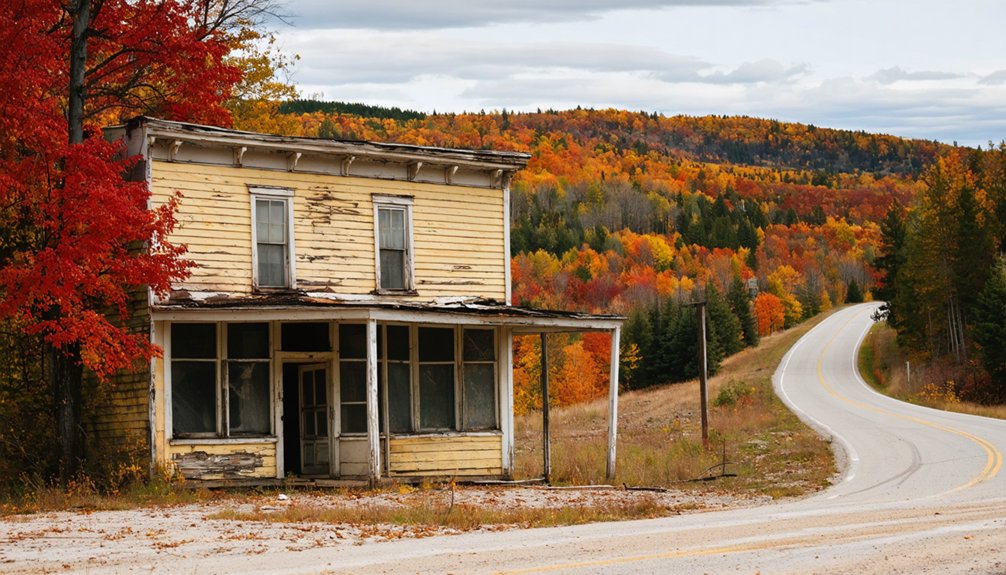
You’ll find Michigan’s ghost towns surrounded by some of the state’s most spectacular fall color drives. The Tunnel of Trees (M-119) winds 28 miles between Harbor Springs and Cross Village, where narrow roads beneath autumn canopies create natural tunnels of gold and crimson along Lake Michigan’s shoreline.
For Upper Peninsula exploration, Brockway Mountain Drive connects Copper Harbor to Eagle Harbor with panoramic views from overlooks like Brockway Mountain Lookout. There, you’ll witness endless forests ablaze in fall color stretching toward Lake Superior.
Brockway Mountain Scenic Drive
Rising 720 feet above Lake Superior’s surface, Brockway Mountain Scenic Drive delivers the highest paved views between the Rockies and the Alleghenies—and autumn transforms this 9.5-mile Upper Peninsula route into Michigan’s most dramatic fall foliage showcase.
You’ll navigate hairpin turns through gold, orange, and green canopies while accessing 360-degree panoramas of Copper Harbor, Eagle Harbor, and thousands of acres of unbroken woodland.
This Great Depression-era road carries historical significance as a 1930s public works project that opened Keweenaw’s wilderness to travelers.
The natural scenery intensifies from mid-September through October, when clear days reveal Isle Royale 50 miles offshore.
Plan 20-30 minutes for the drive, though you’ll want longer at the summit’s observation area and multiple pullouts for photography.
Tunnel of Trees Route
Stretching 27 miles along M-119 from Harbor Springs to Cross Village, Michigan’s Tunnel of Trees delivers what locals consider the state’s most intimate fall color experience—a winding two-lane passage where sugar maples, birches, and aspens create a living canopy overhead. Lake Michigan sparkles through gaps in the foliage.
Peak viewing hits late September through mid-October, when fiery reds and golds transform this scenic tunnel into a photographer’s paradise. You’ll discover autumn tranquility at roadside stops like Good Hart General Store and Legs Inn, though expect company—thousands visit during peak weeks.
Morning and late afternoon light intensifies the colors dramatically. The narrow, winding design means slow going during high-traffic periods. But that pace lets you absorb every curve’s beauty.
For solitude seekers, the Petoskey-to-Wolverine route offers comparable colors with fewer crowds.
Frequently Asked Questions
Are Ghost Town Sites Accessible for Visitors With Mobility Limitations?
Fayette offers accessible paths through its historic townsite with grassy picnic areas, while Keweenaw provides short ¼-mile trails. You’ll find mobility options vary by site, so check individual locations before planning your fall foliage ghost town adventure.
Do I Need Permits to Photograph Abandoned Buildings in Michigan?
You’ll absolutely need permission before stepping foot inside—trespassing charges aren’t worth it. Private property requires owner consent, while public lands need photography permits. Scout Michigan’s autumn ghost towns from legal distances, then secure proper access for your fall foliage shots.
What Safety Precautions Should I Take When Exploring Ghost Towns?
Watch for unstable structures and collapsed foundations at sites like Fayette. Practice wildlife safety in remote Upper Peninsula areas with bears. Respect historical preservation by staying on marked trails, and prepare for Michigan’s unpredictable fall weather shifts.
Are There Guided Tours Available at These Ghost Town Locations?
You’ll find guided tours at Fayette Historic Townsite, where preservation efforts showcase historical significance through 20+ buildings. Central Mine offers self-guided trails, while Delaware provides mine tours. Pere Cheney’s cemetery invites independent autumn exploration.
Can I Camp Overnight Near These Ghost Town Sites?
Yes, you’ll find overnight camping at several sites. Fayette’s established campground contrasts Huron National Forest’s dispersed primitive spots. Pack your camping gear—Fayette needs reservations, while National Forest locations don’t require overnight permits for 14-day stays.
References
- https://www.theinnatstonecliffe.com/blog/fayette-historic-townsite-a-ghost-town-frozen-in-1891
- https://www.dangerous-business.com/fall-color-michigan/
- https://shaleewanders.com/michigan-fall-colors-guide/
- https://www.uptravel.com/things-to-do/attractions/fayette-historic-state-park-townsite/
- https://www.visitkeweenaw.com/blog/post/our-top-7-keweenaw-ghost-towns-to-explore/
- https://mymagicgr.com/ghost-towns-michigan/
- https://www.youtube.com/watch?v=7-vjuqiGWJU
- https://www.michigan.org/article/spooky-places-visit-fall-michigan
- https://www.michigan.gov/mhc/museums/fayette
- https://www.michigan.org/property/fayette-historic-townsite