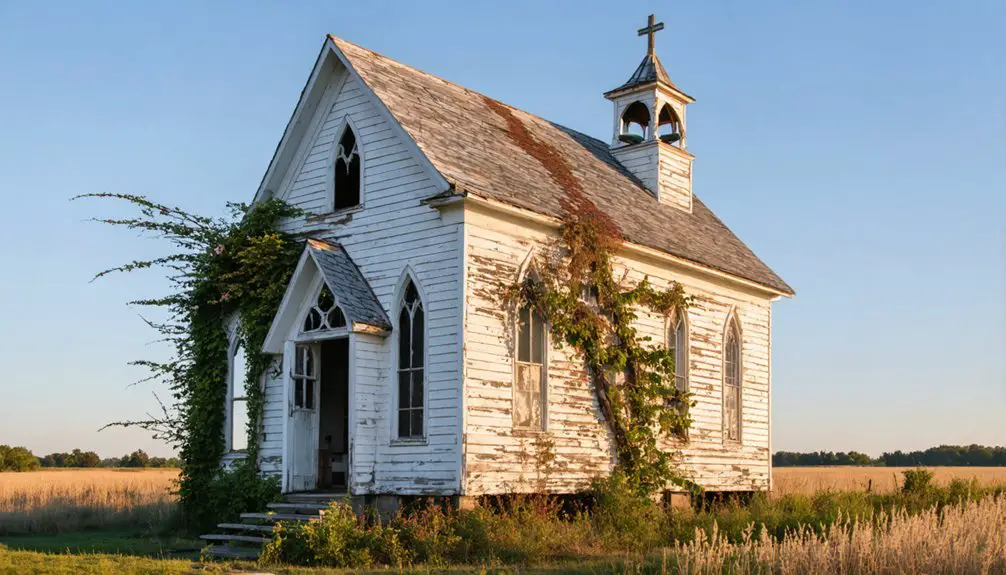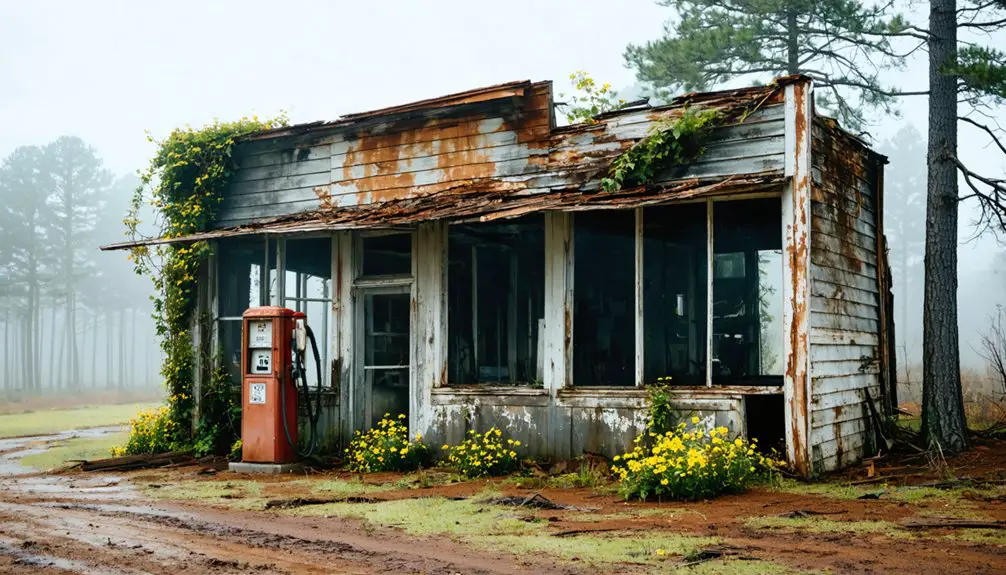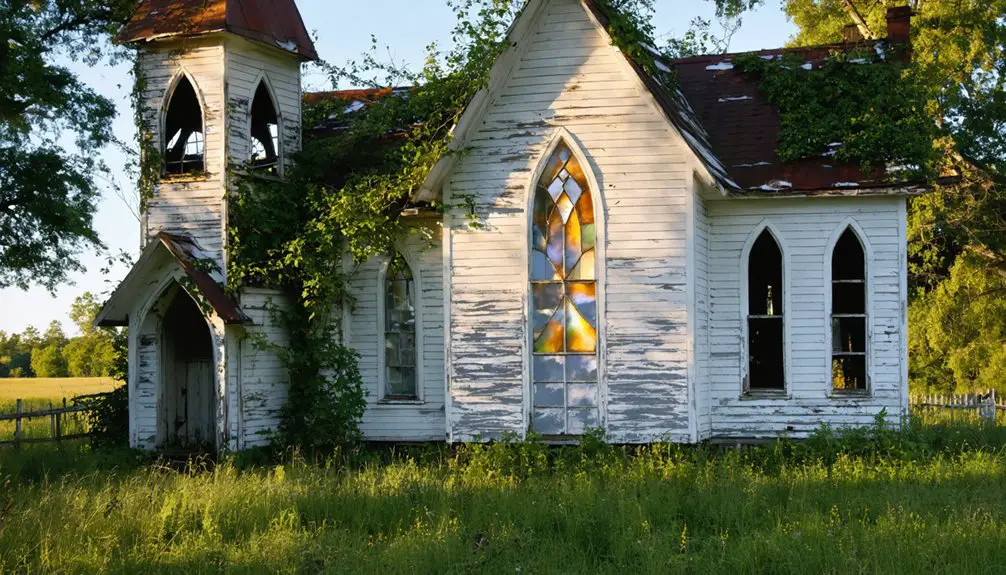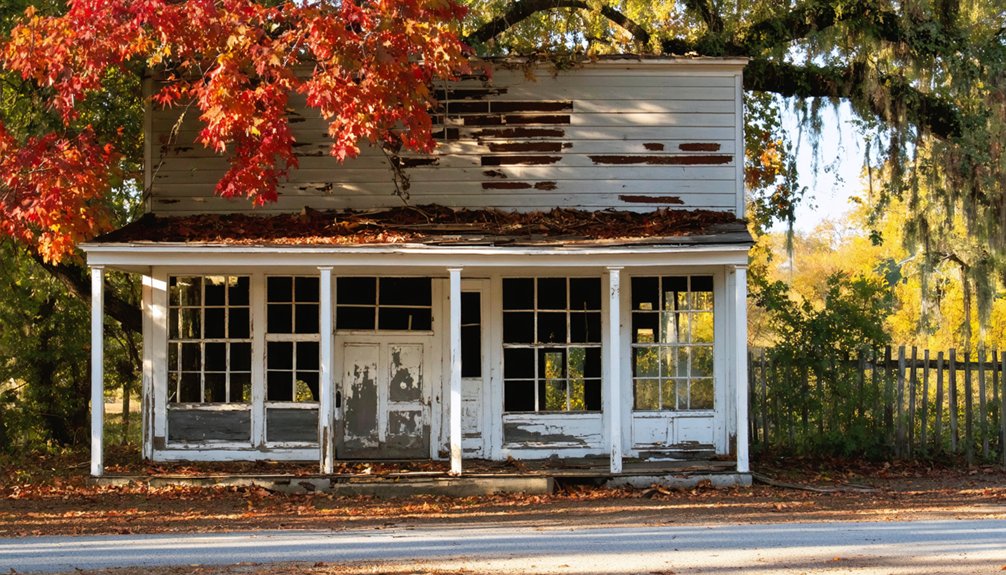
You’ll find Mississippi’s most haunting autumn landscapes at Rodney, where bullet-scarred church walls stand beneath canopies of fiery red and gold, and at Rocky Springs, where an 1837 Methodist church emerges from hardwood forests blazing with October color. The Windsor Ruins‘ 23 Corinthian columns pierce through vibrant fall foliage, creating an otherworldly scene that’s peaked perfection in early November. Along the Natchez Trace Parkway, these forgotten settlements reveal their stories through weathered architecture framed by hickories and black oaks turning spectacular shades of orange and crimson, with trails and historic sites waiting to uncover their secrets.
Key Takeaways
- Rodney features a historic Presbyterian church with Civil War bullet holes, surrounded by vibrant fall foliage peaking mid-October to early November.
- Rocky Springs offers an 1837 Methodist church amid hardwood forests with colorful autumn leaves covering trails and historic foundations.
- Windsor Ruins displays 23 Corinthian columns against fiery fall landscapes, providing panoramic views and iconic antebellum architecture for photographers.
- Peak fall colors occur in early November with scenic trails along Natchez Trace Parkway showcasing reds, oranges, and yellows.
- Visit early mornings for optimal photography, check weather conditions, and wear layered clothing for safe ghost town exploration.
Rodney: Mississippi’s Only Ghost Town With Its Own Newspaper
Long before the Mississippi River abandoned Rodney to the wilderness, this thriving port town commanded the bluffs with the authority of commerce and culture. By 1860, four thousand souls called this place home—more than Jackson itself.
Four thousand souls commanded these bluffs before the river turned its back, leaving Rodney to whisper its forgotten glory.
You’ll find echoes of that prosperity in the Federal-style Presbyterian church built in 1832, still defying time among the autumn hardwoods. The church witnessed dramatic Civil War action when its Confederate cavalry captured a Union captain who had been invited to Sunday services in September 1863.
What sets Rodney apart? It’s Mississippi’s only ghost town maintaining its own newspaper. The *Southern Telegraph* first rolled off presses in 1834, and today’s quarterly *Rodney Telegraph* continues that tradition online.
Historical preservation here feels personal—thirteen residents guard memories the river couldn’t wash away. Rodney once rivaled Vicksburg and Natchez, nearly becoming the state capital itself, losing by only three votes to Washington.
Local legends whisper through the cemetery where fall leaves blanket forgotten graves, reminding you that some stories refuse silence.
Rocky Springs: a Colorful Fall Destination With Eerie Charm
You’ll find Rocky Springs nestled at mile marker 54.8 along the Natchez Trace Parkway, where a solitary 1837 Methodist church stands sentinel over a town that once bustled with 2,600 souls.
When autumn transforms the surrounding hardwood forest into a tapestry of crimson and gold, you can walk self-guided trails past weathered grave markers and the rusted safe from a post office that closed in 1932.
The landscape holds an unsettling beauty—colorful leaves now blanket the same eroded soil that drove every last resident away by 1940. Among the remaining structures, you can spot the blacksmith shop foundation where craftsmen once forged horse shoes and repaired metal tools for surrounding plantations. This ancient route once drew notorious outlaws like Samuel Wolfman Mason, a river pirate who operated his criminal camp near Rocky Springs before being killed by his own gang.
Historic Church Architecture Remains
Walk through weathered cemetery headstones adjacent to the building, where original settlers rest beneath crimson-leaved canopies.
Though regular Sunday services ended in 2010, monthly worship continues, keeping Rocky Springs’ spiritual heritage alive.
The contrast between human-built permanence and encroaching wilderness creates an atmosphere you won’t experience in sanitized heritage sites—this is Mississippi’s past meeting its present, authentically preserved yet wonderfully unrestrained.
The Methodist church structure remains open and accessible for visitors throughout the year, inviting exploration of its historical architecture and connection to the community that once thrived along the Natchez Trace.
Fall Foliage Peak Season
Time your visit between mid-October and early November, when Rocky Springs transforms into Mississippi’s most hauntingly beautiful autumn spectacle. The hardwood forests surrounding this abandoned settlement blaze with reds, oranges, and yellows as cooler nights accelerate nature’s dramatic pigmentation shifts.
Historical motifs emerge through the crimson maples framing weathered gravestones and golden poplars bracketing crumbling cisterns—each rust-colored oak leaf drifting past forgotten structures whispers seasonal folklore of the 2,600 souls who once called this place home.
Late October brings peak color change across Claiborne County’s elevated terrain along the Natchez Trace, where clear skies and 60-70°F temperatures create ideal conditions for exploring. A wooden-fenced trail from the parking lot to the historic town site makes navigation effortless, with information panels providing context as autumn leaves crunch underfoot.
You’ll discover layered canopy effects visible from winding trails, each turn revealing nature’s reclamation through brilliant deciduous displays contrasting against evergreen understory. The 22 campsites available on a first-come, first-served basis allow you to wake surrounded by peak foliage and morning mist rising through the colorful canopy.
Hiking Trails and Access
Located at milepost 54.8 along the Natchez Trace Parkway, Rocky Springs offers multiple pathways into its melancholic past, each trail revealing different chapters of abandonment wrapped in autumn’s fiery embrace. You’ll find a short self-guided loop where placards whisper stories of 2,616 souls who vanished.
The 7-mile Rocky Springs Trail segment stretches through crimson-canopied wilderness. The southbound route leads three miles to Owens Creek Waterfall, though accessibility concerns have closed the northern 4-mile section between the campground and Fisher Ferry Road. Along these paths, you may glimpse coyotes and owls among the native wildlife that now inhabits this forsaken settlement.
Trail maintenance remains minimal—this isn’t manicured parkland but raw history reclaimed by nature. Navigate using coordinates 32.08645, -90.79871, and you’ll discover the 1837 Methodist church standing sentinel among forgotten cisterns and weathered gravestones, autumn leaves collecting where streets once thrived.
Windsor Ruins: Towering Pillars Among Autumn Leaves
Rising like skeletal sentinels from Mississippi’s hardwood forests, twenty-three towering Corinthian columns mark where the state’s largest antebellum mansion once stood. You’ll find Windsor Ruins ten miles southwest of Port Gibson, where forty-five-foot pillars pierce through autumn’s vibrant canopy of reds, oranges, and yellows.
Twenty-three Corinthian columns rise like skeletal sentinels through Mississippi’s autumn canopy, marking the state’s largest lost antebellum mansion.
Built in 1861 and destroyed by fire in 1890, this Greek Revival masterpiece now spawns mythical legends and haunted legends among the hardwoods reclaiming former cotton fields.
The columns’ stark white remnants create haunting contrasts against fall’s explosion of color, offering photographers Mississippi’s most iconic seasonal backdrop.
From this hilltop vantage, you’ll glimpse the distant Mississippi River valley where Union troops once marched during Grant’s Vicksburg campaign. A Union soldier’s drawing from May 1863 remains the only authentic depiction of the mansion before its destruction. The site was added to the National Register of Historic Places in 1971 and donated to the State of Mississippi three years later.
Access the site via gravel lane off Highway 552—nature’s autumn embrace makes these ruins breathtakingly defiant.
Historic Churches That Define Ghost Town Architecture
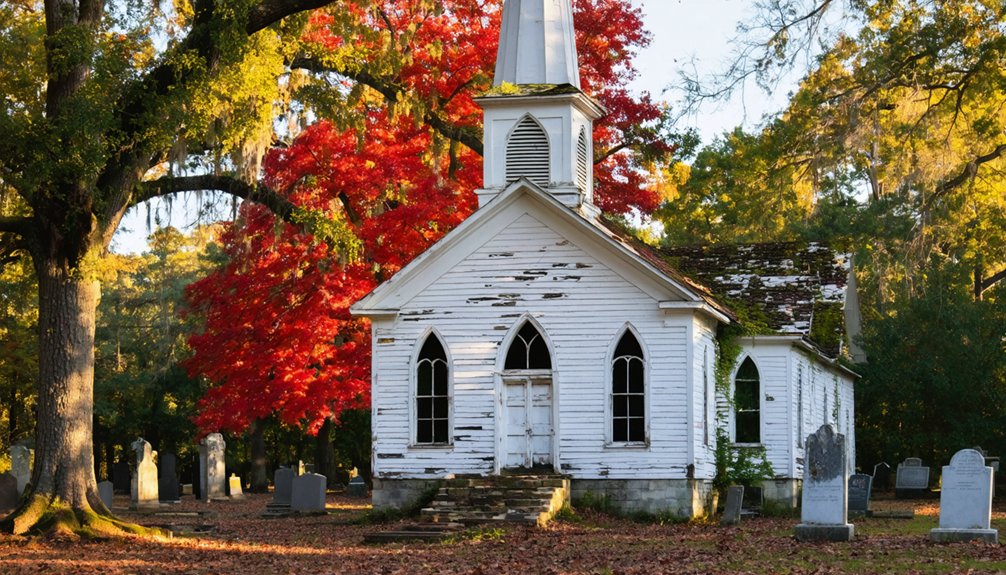
You’ll discover three sacred sanctuaries rising from Rodney’s ghost town landscape, each telling a distinct architectural story through autumn’s amber light. The 1832 red-brick Presbyterian Church stands as Mississippi’s finest Federalist example, its silver-dollar bell tower reaching skyward. A Civil War cannonball remains lodged above the balcony windows.
Nearby, Mount Zion Baptist‘s silver dome catches the fall sun. Its Greek Gothic arches and pointed windows shelter hardwood floors cut from century-old trees—and host persistent reports of spectral visitors who refuse to abandon their pews.
Greek Gothic Baptist Design
Among the crumbling river bluffs of Rodney, Mississippi, a remarkable architectural tension plays out in brick and mortar—the collision between Greek Revival’s rational symmetry and Gothic Revival’s romantic verticality.
You’ll witness this ecclesiastical architecture hybrid at two pivotal structures constructed around 1850, where builders dared to blend classical pediments with pointed Gothic arches:
- Rodney Baptist Church – transitional Greek/Gothic design featuring arched elements that marry both traditions
- Mt. Zion No. 1 Baptist – First Baptist Church showcasing classical foundations topped with Gothic pointed features
- Battle-scarred survival – the 1863 Confederate-Federal standoff within Mt. Zion’s walls left bullet holes still visible today
Historic preservation efforts have struggled against Mississippi River floods that repeatedly claimed this ghost town, yet these hybrid churches stand defiant—monuments to architectural experimentation and faith.
Federalist Presbyterian Bell Tower
Between 1829 and 1832, while Rodney still thrived as a Mississippi River port, Presbyterian builders erected a red brick sanctuary that embodied Federal architecture’s distinctive restraint—an octagonal bell tower rising above rounded arches and stepped gables.
You’ll spot the cannonball scar on its front wall, a permanent reminder of 1863’s Union gunboat assault that forever changed this river town’s trajectory.
The bell tower stands as a proof to Asher Benjamin’s architectural influence spreading through Mississippi’s wilderness.
Unlike the grandeur found in Natchez’s 1828 Presbyterian sanctuary, Rodney’s design embraced frontier practicality without sacrificing elegance.
Today, autumn leaves frame this abandoned treasure, its doors still open to wanderers seeking tangible connections to Mississippi’s antebellum past—where Federal architecture meets ghost town solitude.
Paranormal Activity Reports
The abandoned sanctuaries that punctuate Mississippi’s ghost towns carry more than architectural significance—visitors consistently report unexplained phenomena within their crumbling walls. Chapel of the Cross’s adjoining graveyard fuels haunted legends despite active congregations. Meanwhile, Rodney Presbyterian Church’s silver-dollar bell rings without human touch.
These supernatural sightings transform historic preservation into paranormal investigation.
Documented Paranormal Activity:
- Rodney Presbyterian Church – Phantom cavalry spurs echo on brick walkways, remnants from the 1863 Union bombardment when Confederate soldiers surrounded the sanctuary.
- Chapel of the Cross – Multiple ghost manifestations are reported in the graveyard where Annandale Plantation’s enslaved laborers rest.
- St. Clements Episcopal – Boarded windows and isolation amplify reports of unexplained presences within the 1859 structure.
You’ll find these locations where Spanish moss and deteriorating architecture create atmospheres ripe for otherworldly encounters.
Best Hiking Trails for Fall Foliage Along Natchez Trace Parkway
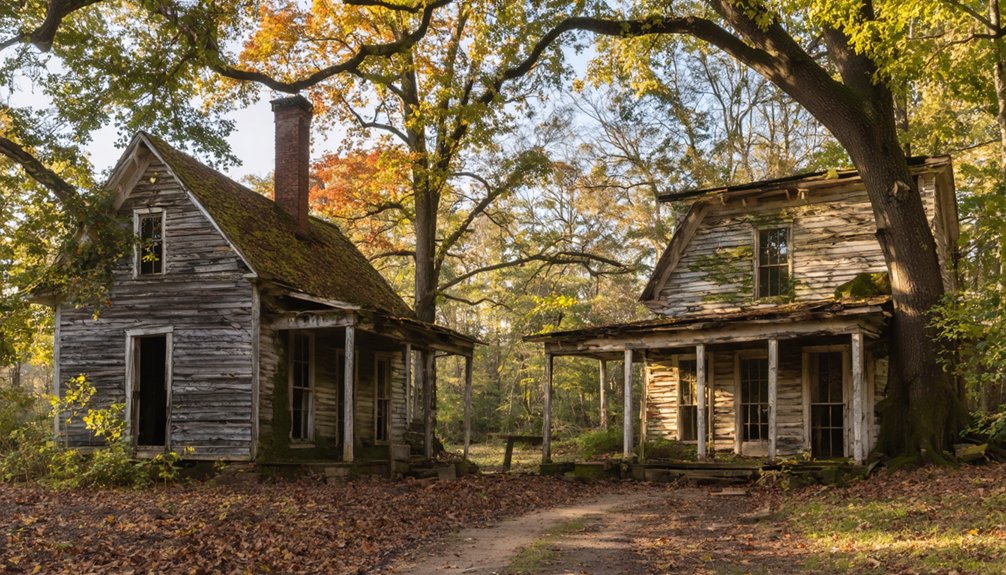
While modern highways rush travelers past Mississippi’s landscape, Natchez Trace Parkway invites you to slow down and experience autumn the way early 19th-century settlers did—on foot, surrounded by blazing hardwoods and whispering pines.
At milepost 391.9, you’ll discover hidden waterfalls at Fall Hollow, where steep trails descend through flame-colored canopies to the cascading base.
Tishomingo State Park’s massive rock formations rise from fern-filled crevices, their moss-blanketed boulders creating forest panoramic views unlike anywhere else in Mississippi.
Walk the Sunken Trace at milepost 41.5, where deeply eroded paths reveal the original route through golden-lit forests.
The Cypress Swamp‘s boardwalk immerses you in tupelo and bald cypress groves, their russet reflections shimmering on dark waters.
These 52 year-round trails spanning 60 miles offer pure escape into Mississippi’s untamed autumn.
When to Visit for Peak Fall Colors and Safety
Timing your ghost town exploration means chasing nature’s calendar through Mississippi’s varied terrain. You’ll find peak colors blazing through abandoned settlements in early November, when black oaks and hickories ignite the Ozark Hills with fiery brilliance.
November transforms Mississippi’s ghost towns into spectacle—fiery oaks and hickories frame abandoned streets in their most photogenic season.
Autumn weather brings warm days perfect for wandering forgotten streets, though you’ll need a light jacket when evening shadows creep through crumbling foundations.
Essential safety tips for your adventure:
- Check river levels before traversing access roads—seasonal flooding transforms paths into impassable mud traps.
- Watch for rattlesnakes and water moccasins among deteriorating structures where they’ve reclaimed territory.
- Pack your camera and arrive at sunrise to capture haunting beauty without crowds.
Respect hunting club boundaries, and you’ll discover freedom in landscapes where nature reclaims civilization‘s forgotten corners.
Other Notable Ghost Towns Worth Exploring
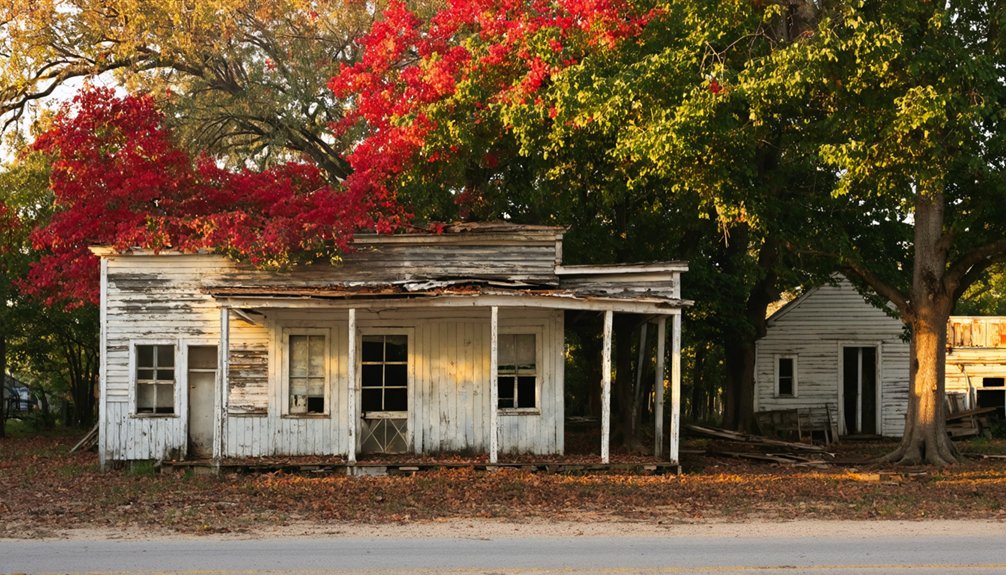
Beyond the well-trodden paths of Mississippi’s mainstream attractions, five haunting settlements beckon you deeper into the state’s forgotten corners. Bankston’s burned factories and cemetery whisper tales of Union raids, while Rodney’s 1832 Presbyterian Church stands defiant against river currents that abandoned it.
You’ll discover Electric Mills where 1,000 souls once thrived around state-of-the-art sawmills, now vanished completely. Rocky Springs and Grand Gulf round out your expedition through Civil War-scarred landscapes.
Historical preservation efforts vary wildly—some sites maintain weathered structures, others offer merely foundations and botanical surveys reclaiming what civilization left behind. These locations reward your wanderlust with unfiltered glimpses into Mississippi’s forgotten chapters, where autumn leaves blanket crumbling remnants and nature slowly erases humanity’s footprints from lands once bustling with Confederate industry and frontier ambition.
What to Bring for Your Ghost Town Adventure
Your expedition into Mississippi’s abandoned settlements demands preparation that honors both the unpredictable Delta climate and the rugged terrain these forsaken places inhabit. Packing essentials begin with layered clothing—mornings bring crisp November air, while afternoons warm considerably along the river’s edge.
Essential gear for your journey:
- Navigation and documentation: Camera for capturing architecture swallowed by autumn maples, plus GPS for charting unmarked paths where fallen trees create natural barricades
- Weather protection: Light jacket and rain gear for sudden Delta storms that transform ghost town roads into slippery mud trails
- Safety precautions: Flashlight for exploring abandoned churches, sturdy boots for steep ravines, and ample water for hiking scattered ruins
Watch for rattlesnakes in warmer pockets. These forgotten places reward the prepared wanderer.
Frequently Asked Questions
Are There Any Guided Ghost Tours Available at Mississippi’s Ghost Towns?
You can’t judge a book by its cover—Mississippi’s ghost towns lack official ghost tour guides. You’ll find historical storytelling through self-exploration at Rodney’s crumbling Baptist Church, where paranormal investigators roam freely, creating their own haunting narratives.
Can You Camp Overnight Near the Ghost Town Locations?
You’ll find overnight permissions vary by location—Grand Gulf’s state park welcomes campers, while Rocky Springs allows dispersed camping. Always prioritize camping safety, respect private boundaries, and secure proper permits before settling beneath Mississippi’s autumn canopy.
Are the Historic Churches Still Used for Services or Events?
Can abandoned sanctuaries still echo with prayer? No, you’ll find no services here—only preservation efforts sustaining the historic architecture. These weathered churches stand empty, their congregations long scattered, awaiting your footsteps through autumn’s golden, liberating silence.
What Wildlife Might You Encounter While Exploring the Ghost Towns?
You’ll encounter remarkable wildlife diversity while exploring—bald eagles soaring overhead, great blue herons stalking riverbanks, and raccoons scavenging campsites. Bird watching reveals red-tailed hawks and wood ducks. Coyotes, bobcats, and river otters roam these forgotten landscapes freely.
Is There Cell Phone Reception in These Remote Ghost Town Areas?
You’ll face cell signal challenges in these forgotten settlements. Remote connectivity fades as you venture down overgrown trails, leaving you truly disconnected from the modern world—a liberating silence where only rustling leaves and distant river currents communicate.
References
- https://oakhallbnb.com/blog/best-places-to-see-fall-foliage-mississippi/
- https://www.onlyinyourstate.com/trip-ideas/mississippi/ghost-town-perfect-for-autumn-day-trip-ms
- https://mississippirivercountry.com/iconic-america/discovering-fall-in-the-heart-of-america/
- https://www.tripadvisor.com/Attraction_Review-g28945-d10045204-Reviews-Rodney_Ghost_Town-Mississippi.html
- https://backroadplanet.com/haunting-rodney-mississippi/
- https://en.wikipedia.org/wiki/List_of_ghost_towns_in_Mississippi
- https://www.southernthing.com/this-ghost-town-is-now-a-national-park-with-stunning-scenery-hiking-and-abandoned-buildings-2639855049.html
- https://www.youtube.com/watch?v=R8iRBp335Lc
- https://digging-history.com/2013/11/20/ghost-town-wednesday-rodney-mississippi/
- https://sethparker.net/rodney-mississippi-the-ghost-town-youve-probably-never-heard-of/