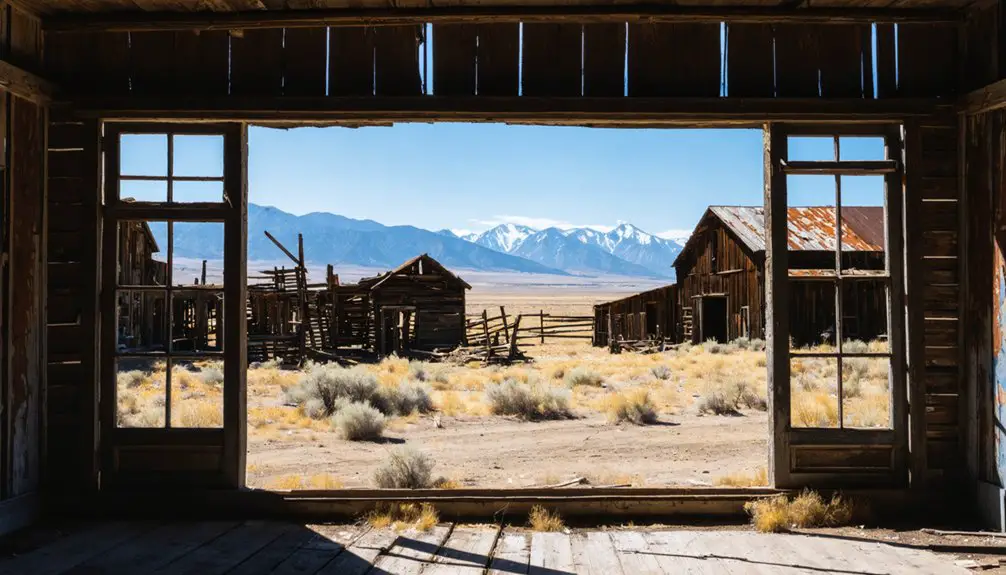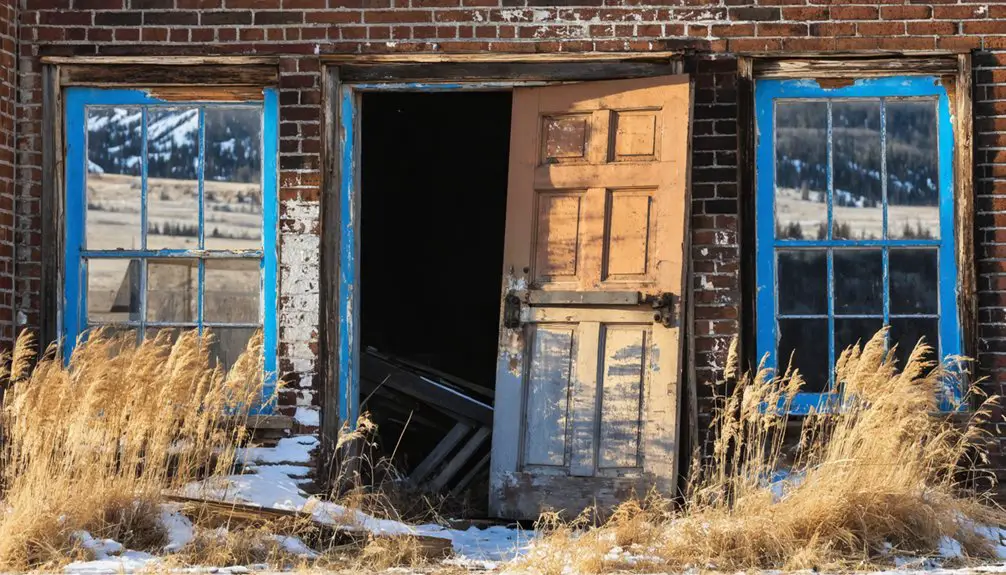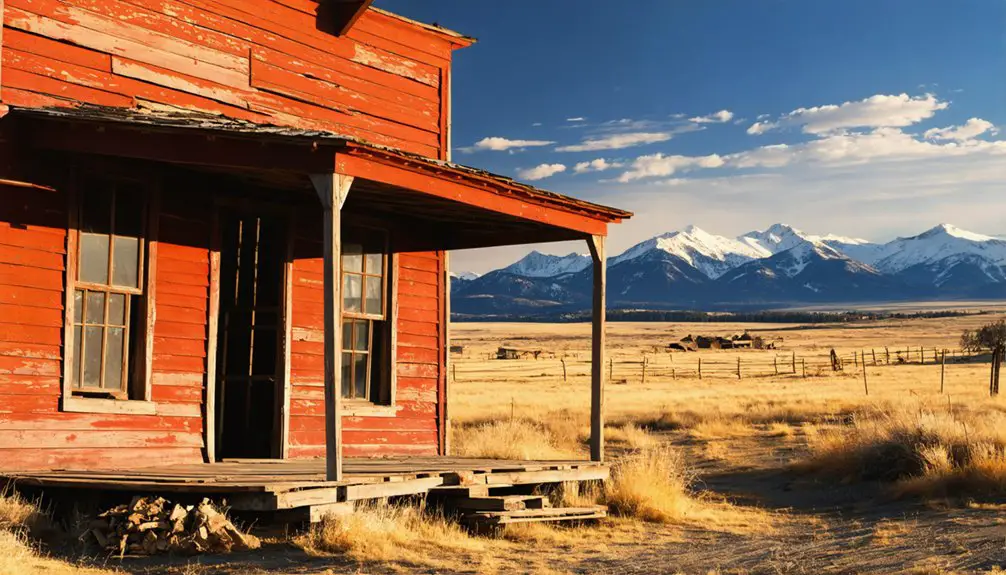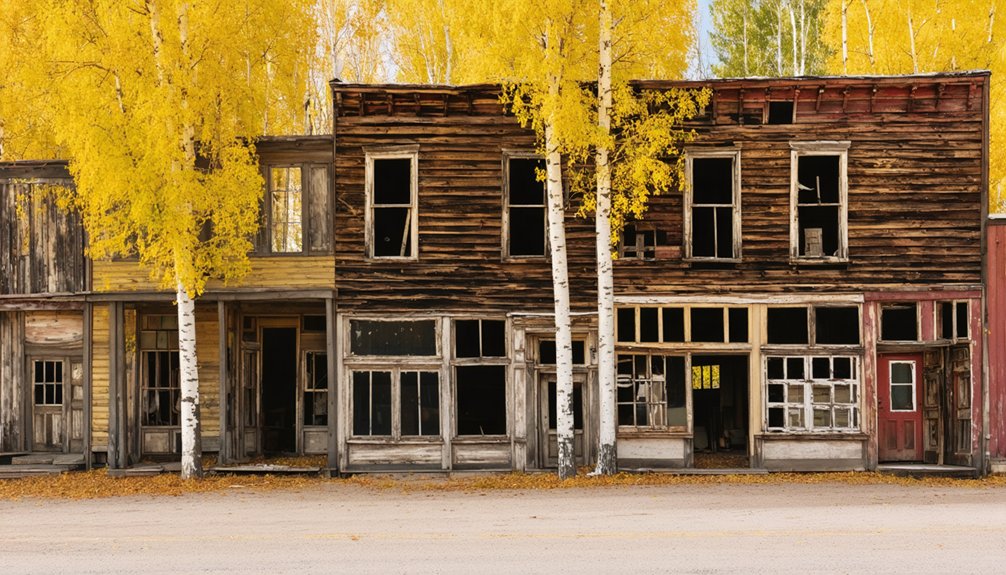
You’ll find Montana’s most photogenic ghost towns framed by spectacular fall color from mid-September through mid-October. Bannack State Park‘s 60 original structures glow against golden hillsides, while remote Coolidge offers crumbling mills surrounded by amber aspens high in the Pioneer Mountains. Virginia City’s Victorian boardwalks wind through valleys ablaze with autumn hues, and the scenic routes connecting these abandoned settlements—especially along Highway 93 and the Pioneer Scenic Byway—showcase fiery larches and crimson maples. The complete southwest Montana ghost town circuit reveals how timing, elevation, and route selection transform history into breathtaking seasonal theater.
Key Takeaways
- Bannack State Park preserves over 60 original structures from Montana’s first territorial capital, enhanced by golden autumn foliage mid-September through mid-October.
- Coolidge Ghost Town in the Pioneer Mountains features crumbling mining ruins surrounded by vibrant fall aspens, accessible via short hike.
- Virginia City and Nevada City showcase Victorian architecture along boardwalks framed by Alder Gulch’s autumn colors and historic gold rush sites.
- Going-to-the-Sun Road near ghost town routes offers fifty miles of fiery larches and aspens against glacier-carved valleys in early October.
- A 3-4 day loop connects multiple ghost towns including Bannack, Garnet, and Granite along scenic byways during peak fall color.
Bannack State Park: Montana’s Premier Preserved Ghost Town
When autumn winds sweep through Grasshopper Creek valley, Bannack State Park transforms into a haunting tableau where weathered wooden facades stand against hillsides ablaze with golden aspens and crimson cottonwoods.
Weathered buildings meet fiery autumn foliage as Montana’s ghost town awakens in spectacular seasonal transformation.
You’ll discover Montana’s first territorial capital frozen in time—over 60 original structures standing exactly where fortune-seekers abandoned them in the 1970s. This isn’t some sanitized replica; it’s authentic decay carefully maintained by volunteers committed to preservation efforts that began when the state established the park in 1954.
The mining history here runs deep. Gold strikes in 1862 pulled over 3,000 prospectors into these mountains, generating half a million dollars within twelve months. What made Bannack’s gold especially valuable was its exceptional 99-99.5% purity, surpassing the typical 95% found in most deposits. By spring 1863, the population exceeded 5,000, transforming Bannack into a bustling hub of miners and merchants.
You’ll walk the same wooden boardwalks where Sheriff Henry Plummer met vigilante justice, explore the governor’s mansion, and feel the Old West’s unvarnished grit surrounding you.
Coolidge Ghost Town: A Remote Mountain Hideaway
Few ghost towns in Montana demand as much commitment from visitors as Coolidge, perched high in the Pioneer Mountains where autumn transforms the remote landscape into a watercolor of amber aspens and rust-colored willows.
You’ll park at the trailhead and hike 10-15 minutes through national forest land to reach this hidden history.
Here, William R. Allen once built an entire mining camp around silver dreams.
What remains tells stories of remote exploration and stubborn determination:
- Crumbling stamp mill structures that once processed 260-ounce silver ore
- Weathered railroad ties from the 1918 narrow-gauge line to Divide
- Board-and-tar-paper residence foundations where 350 souls once lived above the clouds
- Interpretive kiosks revealing the 1923 dam failure that sealed Coolidge’s fate
The Pioneer Scenic Byway delivers you to freedom’s doorstep.
The town’s origins trace back to 1872, when Preston Sheldon made his discovery near elk horns, giving birth to what would become the Elkhorn district’s silver mining legacy.
Allen, who managed enterprises for copper magnate Marcus Daly, later founded the Boston-Montana Development Corporation in 1913 to transform this rugged terrain into a fully operational mining community.
Virginia City and Nevada City: Working Ghost Towns With Historic Character
Unlike Coolidge’s solitary mountain silence, Virginia City pulses with preserved Victorian liveliness where boardwalks creak beneath your boots and false-fronted buildings still conduct business along Wallace Street.
Step onto weathered boardwalks where Victorian storefronts still buzz with life and history echoes through every creaking plank along Wallace Street.
You’re wandering through Montana’s richest gold strike territory—Alder Gulch yielded $30 million in three frenzied years starting 1863. The territorial capital from 1865 to 1875 somehow escaped the fires that devoured most boomtowns, leaving you authentic structures rather than reconstructions. The town developed Montana’s first public school, newspaper, and telegraph system during its boom years.
Two miles down the gulch, Nevada City presents something different: abandoned structures relocated here as an outdoor museum after dredging operations obliterated the original settlement. Costumed interpreters populate saloons on weekends while haunted legends drift through Boot Hill’s vigilante graves. The Alder Gulch Shortline Railroad connects both towns with a 25-minute scenic ride through the gulch.
These twin towns offer autumn gold in aspens framing Victorian false-fronts—accessible adventure 90 miles from Yellowstone’s crowds.
Scenic Drives Through Western Montana’s Autumn Landscapes
You’ll find Montana’s best fall colors along routes that wind through valleys where ghost towns once thrived. The Bitterroot Valley unfolds with amber hillsides and red shrub clusters as you cruise between historic mining sites.
While morning light catches golden aspens reflected in glassy creeks.
Up north, roads skirting Glacier’s boundaries deliver sweeping views where autumn’s yellows and oranges frame mountain peaks that tower over forgotten settlements. The North Fork Road runs along Glacier’s western boundary, connecting mountain vistas with the remote outpost of Polebridge.
East of Billings, the Yellowstone River Ramble showcases cottonwoods along riverbanks that glow golden against big sky country and flowing waters.
Bitterroot Valley Mountain Views
The Bitterroot Valley unfolds like a golden corridor through Western Montana’s wilderness, where 80 miles of Highway 93 weave between the weathered Sapphire Mountains to the east and the rugged Bitterroot range to the west.
You’ll witness aspen and larch ablaze across mountain vistas, transforming September hillsides into living tapestries of copper and gold.
Prime viewing locations:
- Skalkaho Highway – This narrow gravel road penetrates deep into Sapphire Mountain backcountry (June-September)
- Eastside Highway – Less-traveled alternative revealing valley meadows and quiet homesteads
- Guide Creek and Rye Creek Roads – Secondary routes pushing into undisturbed forest territory
- Daly Mansion grounds – 46 acres framed by crimson maples and golden cottonwoods
The Bitterroot River mirrors autumn’s fire, carving through communities like Hamilton, Darby, and Stevensville. From Stevensville, Mountain View Orchards in nearby Corvallis offers fresh apples and cider amid the season’s vibrant colors. Car rentals and biking provide flexible options for exploring these scenic autumn routes at your own pace.
Glacier National Park Routes
North from the Bitterroot’s burnished corridors, Montana’s Crown of the Continent transforms into a cathedral of autumn color. Here, glacier-carved valleys cradle forests ablaze with seasonal fire.
Going-to-the-Sun Road delivers fifty miles of unrestricted beauty—vibrant oranges and golds erupting against evergreen cliffs. Most spectacular is the first twenty minutes from West Glacier, where rushing rivers mirror flame-colored canopies.
You’ll chase golden larches along Highway 2’s southern boundary come mid-October. Those western tamaracks ignite later than aspen groves.
The Looking Glass Highway curves through Blackfeet territory, offering wildlife sightings of bears and moose threading through Two Medicine’s chromatic valleys.
Late September brings ideal conditions before seasonal weather shutters roads in early October.
No reservations bind your wandering—just self-reliance against Montana’s mercurial autumn temperament.
Optimal Timing and Conditions for Your Ghost Town Adventure
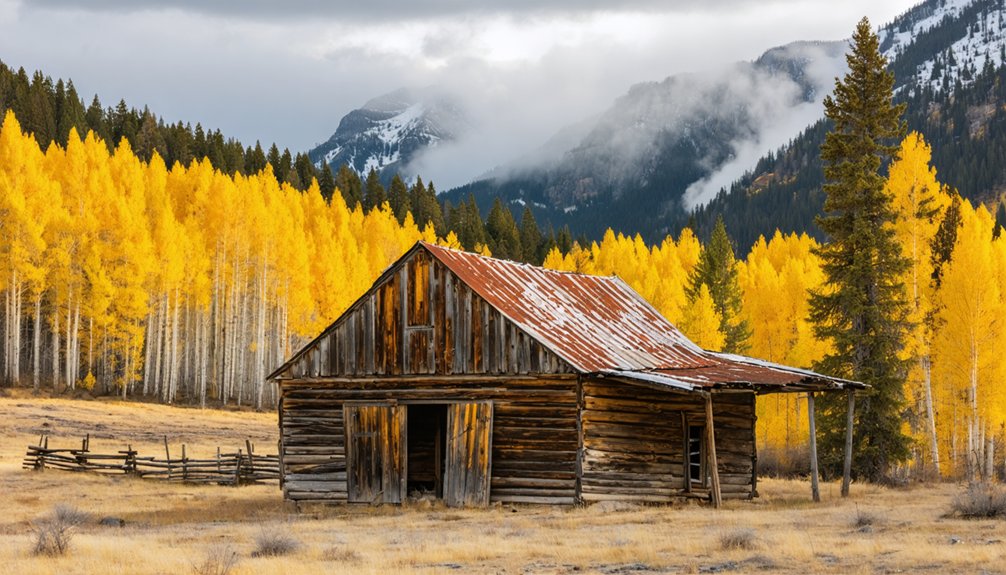
As September’s cool breath sweeps across Montana’s mountains, the state’s abandoned mining camps and forgotten settlements become framed by nature’s most spectacular display. You’ll find prime conditions from mid-September through mid-October, when golden aspens and crimson maples illuminate weathered structures.
Your timing strategy:
- Mid-September to early October: Target higher elevation ghost towns near Glacier Country when larches peak, offering stunning wildlife sightings including increased bear activity.
- Mid to late October: Explore Bitterroot Valley’s abandoned sites amid vibrant forest colors.
- Crisp, sunny days: Maximize visibility for photography and exploration; cooler temperatures mean fewer visitors.
- Evening opportunities: Extended autumn twilight creates exceptional conditions for night photography against historic ruins.
Pack bear spray, embrace fewer crowds, and discover Montana’s haunted past wrapped in autumn gold.
Planning Your Southwest Montana Ghost Town Loop
You’ll want to establish a base in Deer Lodge or a similar central hub, giving you easy access to the ghost town circuit while providing modern amenities after long days on gravel roads.
A well-planned three-to-four-day loop allows you to explore Bannack’s 60 structures, Garnet’s weathered storefronts, Granite’s high-altitude ruins, and the less-traveled sites at Marysville and Pony without rushing through Montana’s mining history.
Consider that early October transforms these abandoned camps into scenes where golden aspens frame log cabins and miners’ shacks, making timing as essential as your route selection.
Base Town Selection Strategy
- Central Access – Day trips reach all Southwest sites without constant packing and unpacking.
- Visitor Amenities – Lodging and supplies support remote explorations requiring bear spray and extra layers.
- Historical Preservation Gateway – Pioneer Mountains Scenic Byway launches from here, connecting Big Hole Valley’s autumn gold to ghost town clusters.
- Elevation Management – Return to comfortable altitude after Coolidge’s chilly, shaded hike at higher elevations.
Virginia City functions as an alternative hub, though Dillon’s positioning better serves solitude-seekers chasing mid-October foliage through Montana’s forgotten mining camps.
Multi-Day Itinerary Considerations
The Southwest Montana ghost town circuit demands at least four days to properly absorb the interplay of crumbling timber frames against October’s blazing aspens. Rushing through in a weekend means you’ll miss the quiet moments when fog settles into Bannack’s empty streets or when afternoon light angles through Coolidge’s skeletal mill windows.
Anchor yourself in the Bitterroot Valley, where morning wildlife photography sessions along the river corridors shift seamlessly into afternoon ghost town explorations.
The Pioneer Mountains Scenic Byway connects Coolidge, Bannack, and Big Hole Valley in a natural loop, while Garnet stands apart as a worthy northern extension.
Factor in river rafting opportunities between historical sites, and you’ve crafted an itinerary that honors both Montana’s spectral past and its untamed present.
Frequently Asked Questions
Are Pets Allowed at Montana Ghost Town Sites During Fall Visits?
You’ll find most Montana ghost towns welcome your four-legged companions like old mining partners. Pet safety requires respecting leash policies—typically six feet—especially around historic structures. Always verify specific rules beforehand, as regulations vary between state parks and private sites.
What Photography Equipment Works Best for Capturing Ghost Towns in Autumn?
You’ll want mirrorless cameras with prime lenses (18-90mm range) paired with sturdy tripods for those moody, low-light shots. Master natural lighting techniques, use circular polarizers for saturated autumn colors, and let wide-angle lens recommendations guide your compositional freedom.
Are There Guided Tours Available at These Ghost Town Locations?
History whispers differently at each site. You’ll find guided tour options at Virginia City and ranger interactions at Bannack, while Garnet and Coolidge offer unbridled freedom through self-exploration. Private tour availability varies—check locally for authentic, personalized experiences.
Do Ghost Towns Have Restroom Facilities or Should Visitors Plan Accordingly?
You’ll find basic restroom amenities like pit toilets at parking areas, but Montana’s ghost towns lack modern plumbing. Visitor preparedness is essential—use facilities before descending into these authentic frontier sites where outhouses remain historical artifacts, not functional conveniences.
What Cell Phone Coverage Can Visitors Expect at Remote Ghost Towns?
You’ll find zero cell coverage at Montana’s remote ghost towns—plan for complete digital silence. Bring satellite internet devices if you need connectivity, though signal boosters won’t help where towers don’t exist in these wild, untamed landscapes.
References
- https://glaciermt.com/fall-road-trips
- https://www.roamingnearandfar.com/coolidge-ghost-town-road-trip/
- https://practicalvagabonds.com/southwest-montana-ghost-towns/
- https://www.mountain-home.com/blog/vacation-planning/guide-montana’s-ghost-towns
- https://www.youtube.com/watch?v=3HsYehzzim0
- https://visitmt.com/things-to-do/ghost-towns
- https://www.onlyinyourstate.com/experiences/montana/abandoned-town-in-mt
- https://www.legendsofamerica.com/mt-bannack/
- https://southwestmt.com/blog/bannack-haunting-montana/
- https://www.mountain-home.com/blog/vacation-planning/step-back-time-bannack-state-park-montana