You’ll find New York’s most haunting ghost towns transformed by autumn’s brilliance, where abandoned iron furnaces at Tahawus stand sentinel beneath crimson canopies and Frontier Town’s weathered Wild West facades emerge from vine-covered decay. The Gilded Age grandeur of Camp Santanoni reveals itself along a 5-mile carriage road through flaming foliage, while Overlook Mountain House’s concrete skeleton frames golden birches in the Catskills. Peak viewing runs late September through October, when nature’s reclamation of these 19th and 20th-century ruins creates an otherworldly spectacle that rewards those who venture deeper into their stories.
Key Takeaways
- Tahawus features 1854 blast furnace ruins and 1940s mining buildings surrounded by crimson maples and golden birches near Mount Marcy trails.
- Frontier Town’s abandoned Wild West structures, including weathered saloons and railways, blend with overgrown vines and vibrant autumn foliage since 1998.
- Camp Santanoni offers a 5-mile carriage road through fall colors leading to an 1893 Great Camp with rustic Gilded Age architecture.
- Overlook Mountain House presents a concrete skeleton mid-construction with exposed floors framed by Catskill forest fall foliage and collapsed foundations.
- Peak viewing occurs late September through October when maples turn red and birches gold, creating ideal photographic conditions at ruins.
Tahawus: Iron Mining Ruins Amid Fiery Autumn Colors
Deep in the Adirondack wilderness, where the Upper Hudson River carves through ancient mountains, the ghost town of Tahawus emerges from the forest like a half-remembered dream. You’ll find the 1854 McIntyre Blast Furnace standing defiantly, trees pushing through its weathered stonework—a symbol of nature’s patient reclamation.
Where wilderness meets industrial ruin, the McIntyre Blast Furnace stands as nature’s monument to forgotten ambitions and patient, inevitable reclamation.
The mining history here spans three distinct eras: iron ore operations that failed in 1858, a brief titanium revival during WWII, and final abandonment in 1962.
Walk among ten preserved 1940s buildings and McNaughton Cottage, where Theodore Roosevelt learned he’d become president.
Autumn transforms this industrial graveyard into something transcendent—crimson maples and golden birches frame crumbling stone, while trails toward Mount Marcy beckon through the Northern Forest‘s spectacular display. The Open Space Institute has managed the site since 2004, preserving 212 acres for educational, historic, and recreational purposes. The Mitchell Stone Company continues extraction operations, selling construction aggregate from old mine tailings with an estimated 20 years of deposits remaining.
Forest renewal marches steadily forward, swallowing man’s ambitions.
Frontier Town: Wild West Relics in Fall-Draped Wilderness
You’ll discover a different kind of ghost town at Frontier Town, where weathered wooden facades and rusted railway tracks emerge from brilliant autumn undergrowth like artifacts from a forgotten Hollywood set. The Adirondack wilderness reclaims this once-bustling Wild West theme park with startling speed—maple saplings push through cracked boardwalks while crimson vines strangle the rodeo arena’s fence posts.
Each fall, nature stages its own spectacular show here, draping abandoned stagecoach stops and cavalry forts in gold and scarlet foliage that somehow makes the ruins feel both more melancholy and more alive. What began as Arthur Bensen’s vision in 1952—a Staten Island phone technician’s dream of bringing the Old West to upstate New York—now serves as the Frontier Town Campground, where visitors can hike trails through history and camp among the remnants of Prairie Junction and Pioneer Village.
The park’s closure in 1998 devastated the region, with about 30 motels in the area experiencing business declines of up to 70 percent as tourism evaporated overnight.
Wild West Themed Ruins
When autumn ignites the Adirondack wilderness near North Hudson, the weathered facades of Frontier Town emerge from a blaze of crimson maples and golden birches like artifacts from another century.
You’ll discover authentic Wild West structures—saloons with swinging doors, a general store frozen mid-commerce, covered wagons surrendering to moss and time. These ghost towns of imagination materialized become ghost towns of reality, where wooden buildings tilt at improbable angles beneath October’s copper canopy.
The rodeo arena stands silent, its bleachers collapsing into earth while fall colors frame every decay. Much like historic venues where Wild Bill Hickok once performed, these structures once echoed with the thunder of hooves and the roar of spectators.
Dirt trails wind past abandoned attractions, their odd shapes mysterious against autumn brilliance. You’re free to explore where stagecoach robberies once thrilled families, now encountering only wind through empty doorways and leaves carpeting forgotten main streets. Like other New York ghost towns hidden within acres of land, these structures remain largely invisible until you venture off the beaten path.
Wilderness Reclaiming Abandoned Attractions
Since Frontier Town closed its gates in 1998, the Adirondack wilderness has staged a relentless invasion. You’ll find parking lots cracked and sprouting through asphalt, signs strangled by vines, and buildings collapsing under nature’s patient assault.
Mosquito-pulsed summers and brutal winters have accelerated decay across these 267 wooded acres, transforming kitschy Western facades into haunting sculptures draped in fall foliage.
The tension between historical preservation and ecological reclamation creates unexpected eco tourism opportunities here. You’re witnessing something rare: a theme park dissolving back into forest, where rodeo arenas hide in shady hollows and narrow gauge railroad traces vanish beneath ferns.
Cold swamps encroach on motel ruins while October’s crimson and gold canopy frames what remains—a peculiar monument to impermanence. Arthur Bensen, a Staten Island phone technician, founded this Western-themed attraction in 1952, never imagining his family-oriented vision would eventually surrender to the forest’s reclamation. The property, now owned by Essex County, awaits potential purchase by the town of North Hudson as various preservation attempts have failed over the years.
Camp Santanoni: Gilded Age Grandeur Among Golden Leaves
The whisper of autumn transforms the 5-mile carriage road to Camp Santanoni into a corridor of flame-colored maples and golden birches, leading you toward the largest Great Camp ever built in the Adirondacks. What Robert C. Pruyn constructed in 1893 as a 12,900-acre private wilderness empire—complete with a 15,000-square-foot main lodge, working farm, and Japanese-influenced architecture—now stands open to exploration.
Its eleven interconnected buildings weathering gracefully on the shores of Newcomb Lake. The complex earned recognition as a National Historic Landmark in 2000, honoring both its architectural innovation and its significance as one of the earliest Adirondack Great Camps. You’ll discover a place where Gilded Age opulence meets rustic mountain elegance, where Theodore Roosevelt once visited, and where the grandest vision of Adirondack living slowly surrenders to the forest’s patient reclamation. After New York State acquired the property in 1972, the camp remained vacant and neglected for over two decades before preservation efforts began in earnest.
Opulent Wilderness Estate History
Deep in the Adirondack wilderness, where golden autumn light filters through cathedral pines and maples ablaze with crimson, stands the ghost of America’s most ambitious Great Camp. You’re walking through Santanoni’s luxurious history, begun when banker Robert C. Pruyn built this 13,000-acre empire in 1892.
His years in Japan—where his father served as Lincoln’s minister—influenced the architectural grandeur that merged Eastern principles with Adirondack rusticity.
Forty-five buildings sprawled across three complexes: the Main Camp’s five interconnected structures beneath a sweeping roof, a self-sufficient farm three miles distant, and the Gate Lodge.
Over 5,000 square feet of porches faced the lake, where Theodore Roosevelt and Cooper’s great-grandson once gathered. Staff buzzers summoned servants who maintained this wilderness palace—opulence disguised as rustic escape.
Exploring the Abandoned Complex
Your journey to Santanoni begins where pavement surrenders to gravel at the Gate Lodge, marking the threshold of a 4.7-mile pilgrimage through autumn’s paintbox. You’ll traverse Newcomb Lake Road by foot or bike, savoring the quiet brilliance of changing leaves uninterrupted by motors.
The abandoned Farm Complex emerges first, then the Main Camp—a monument to historical preservation where weathered logs and stone chimneys stand sentinel against time.
During fall tours, you’ll find the Artist’s Studio transformed into a warming hut, woodstove crackling as you sip complimentary coffee. The buildings open their doors on select dates through October, offering unrivaled seasonal photography opportunities when golden light bathes forgotten architecture.
Lake breezes carry loon calls across Newcomb’s waters, reminding you why this retreat captivated Gilded Age industrialists seeking wilderness on their own terms.
Doodletown: Revolutionary Era Foundations in Bear Mountain’s Fall Splendor
Nestled among Bear Mountain’s fiery maples and golden oaks, Doodletown’s moss-covered foundations emerge from centuries of accumulated leaf litter like half-buried memories. You’ll discover stone cellar holes where French Huguenot families once thrived, their descendants living here for two hundred years until the state forced them out in 1965.
Unlike typical Victorian architecture, these simple mountain dwellings reflected self-sufficient living—though you might stumble upon Civil War artifacts along trails once trodden by British troops.
The crumbling macadam roads wind past seventy demolished homes, their granite stoops defying time. Two preserved cemeteries honor the June family’s legacy while directional signs mark where neighbors gathered.
It’s haunting proof that eminent domain erases more than property—it obliterates communities.
Pottersville: Haunted Remnants Beneath Adirondack Autumn Canopy
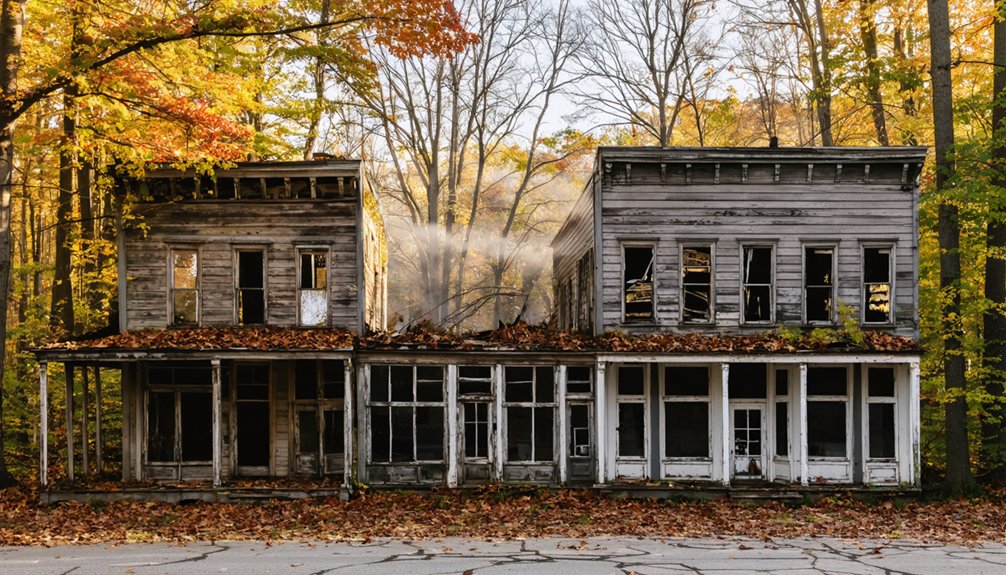
Beyond the crumbling foundations of Pottersville, something darker than autumn shadows lingers in the Shawangunk forest. You’ll navigate three miles of rough terrain to reach this nineteenth-century lumber settlement where Francis Potter’s mill once thrived. Haunted stories permeate these woods—a family massacre-suicide, a hanging, unexplained deaths that followed.
Three miles into Shawangunk’s depths, where Francis Potter’s mill stood, darkness persists beyond what autumn shadows can explain.
The 1927 flood and subsequent fire scattered survivors, but it’s the abandoned structures’ absence that unsettles most. State demolition in 2001 erased nearly everything, leaving only foundation stones visible through crimson leaves.
You’ll feel watched among these remnants. The Open Space Institute now controls this isolated plot where mill workers once raised families. Come prepared with sturdy boots and water—this isn’t tourist territory.
The forest reclaimed Pottersville, yet visitors insist something remains, restless beneath fall’s vibrant canopy.
Overlook Mountain House: Catskill Resort Ruins Framed by Fall Foliage
Rising from the Catskill forest like a concrete skeleton, the Overlook Mountain House stands frozen mid-construction against a backdrop of crimson maples and golden birches.
You’ll discover haunting histories here—three attempts at grandeur, each ending in flames. Morris Newgold’s 1920s vision of fireproof concrete never opened its doors, halted by the Depression’s grip and financial ruin.
The decaying architecture tells stories through empty window frames and exposed floors reaching four storeys high.
You’re free to explore the roofless shell, where autumn light filters through skeletal walls.
The trail leads you past collapsed chimneys and foundation ruins disappearing into foliage.
October transforms this failure into something mesmerizing—nature reclaiming ambition, fall colors softening concrete edges, creating an enchanting monument to dreams that burned too bright.
Planning Your Ghost Town Adventure During Peak Leaf Season
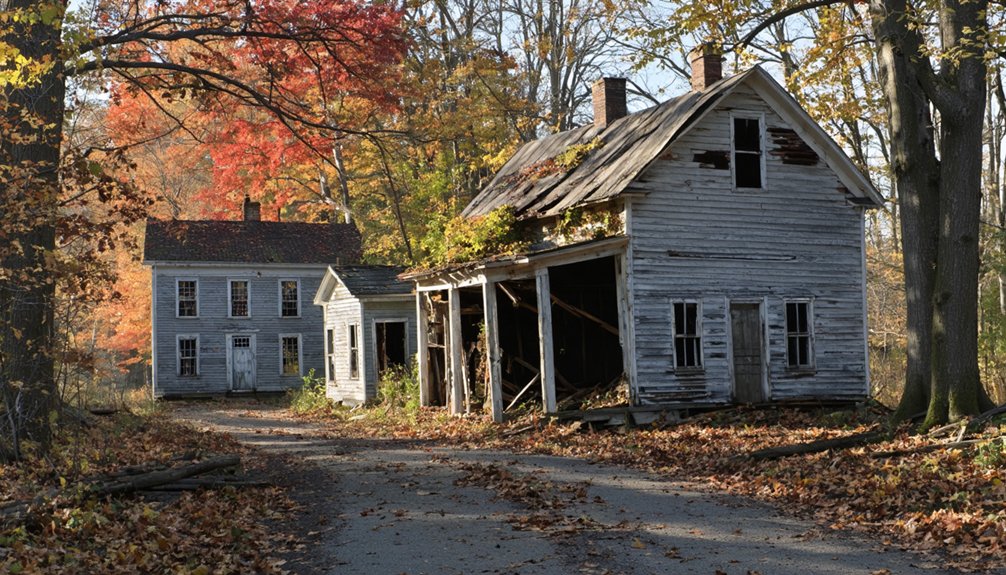
Timing transforms everything when chasing ghosts through autumn forests. Late September through October delivers peak colors across the Adirondacks and Catskills—red maples and gold birches frame Tahawus’s blast furnace and Camp Santanoni’s Great Camp complexes.
Peak autumn colors transform abandoned industrial sites into painterly landscapes where history meets nature’s most dramatic seasonal display.
Early frosts add spectral shimmer to historical architecture, making seasonal photographs impossibly vivid.
You’ll need five hours from New York City to reach Tahawus, or take the train to Port Henry for a scenic inland approach.
Navigate seven miles along Tahawus Road, where birding opportunities merge with abandoned mines.
The Ferncliff Forest Fire Tower offers sweeping Hudson River vistas.
Skip November—foliage fades fast. Respect posted signs around private properties and ruins.
Recent interpretive signs guide exploration, while Lake Placid and Saranac Lake host haunted walks if you crave company beyond departed miners.
Frequently Asked Questions
Are Pets Allowed When Exploring Ghost Town Sites in New York?
Pet policies vary by site, so you’ll need to check local regulations before exploring. Most Adirondack ghost towns permit leashed dogs, but pet safety requires respecting posted restrictions and wilderness guidelines governing these hauntingly beautiful abandoned places.
What Photography Equipment Works Best for Capturing Ghost Towns in Fall?
You’ll need wide-angle lenses (16-35mm) for decaying structures amid autumn brilliance, plus telephoto zooms (70-200mm) for wildlife photography opportunities. Proper lens selection—paired with polarizers and sturdy tripods—captures nature reclaiming these forgotten places through golden, rust-touched freedom.
Can I Camp Overnight Near Any of These Abandoned Locations?
You’ll find designated campsites on adjacent state lands near these ghost towns, though camping restrictions protect the abandoned sites themselves. Pet policies vary by location—always verify DEC regulations before venturing into the wilderness with your four-legged companions.
Do I Need Special Permits to Enter These Ghost Town Areas?
You won’t need special permits for these ghost towns—they’re within public parklands offering unrestricted access. However, verify privately owned access points beforehand, and respect conservation restrictions protecting fragile ruins where nature’s reclaiming what civilization abandoned.
Are Guided Tours Available for Any New York Ghost Town Sites?
No guided tours exist at these ghost towns—you’ll explore independently. Historical preservation efforts focus on interpretive signs and walkways rather than formal tours, letting you wander freely through crumbling walls and rusted relics at your own pace.
References
- https://www.iloveny.com/blog/post/new-york-towns-that-fully-embrace-fall/
- https://secretnyc.co/tahawus-ny-forgotton-ghost-town-halloween-season/
- https://visitadirondacks.com/fall/abandoned-places-ghost-towns
- https://www.atlasobscura.com/things-to-do/new-york-state/abandoned
- https://www.adirondackhub.com/story/2015/10/real-live-ghost-town
- https://www.onlyinyourstate.com/experiences/new-york/ghost-towns-ny
- https://visitcatskills.com/compass-blog/abandoned-places/
- https://secretnyc.co/tahawus-ghost-town-ny/
- https://www.untappedcities.com/the-history-of-tahawus-once-a-thriving-mining-community-now-an-adirondack-ghost-town/
- https://theclio.com/entry/151479