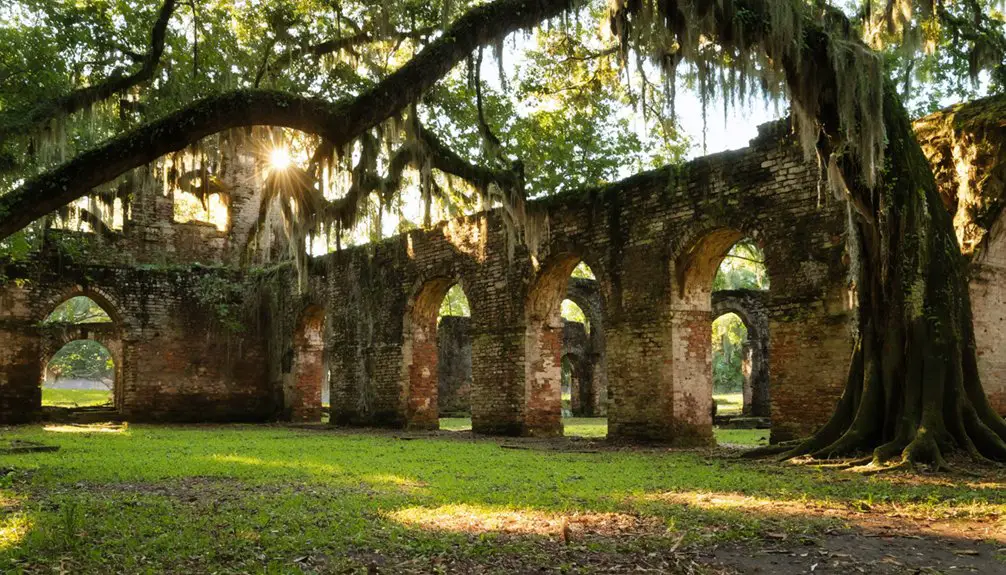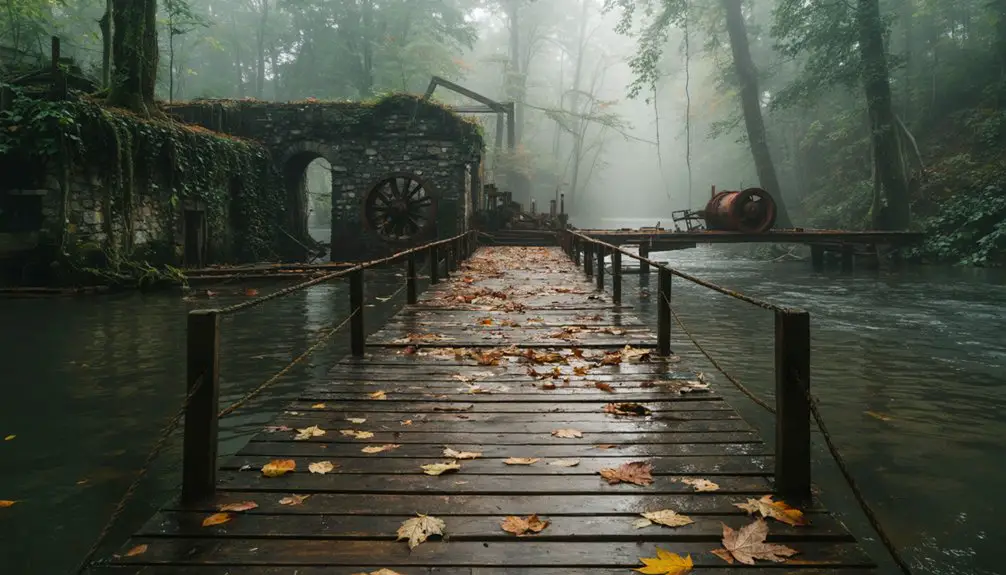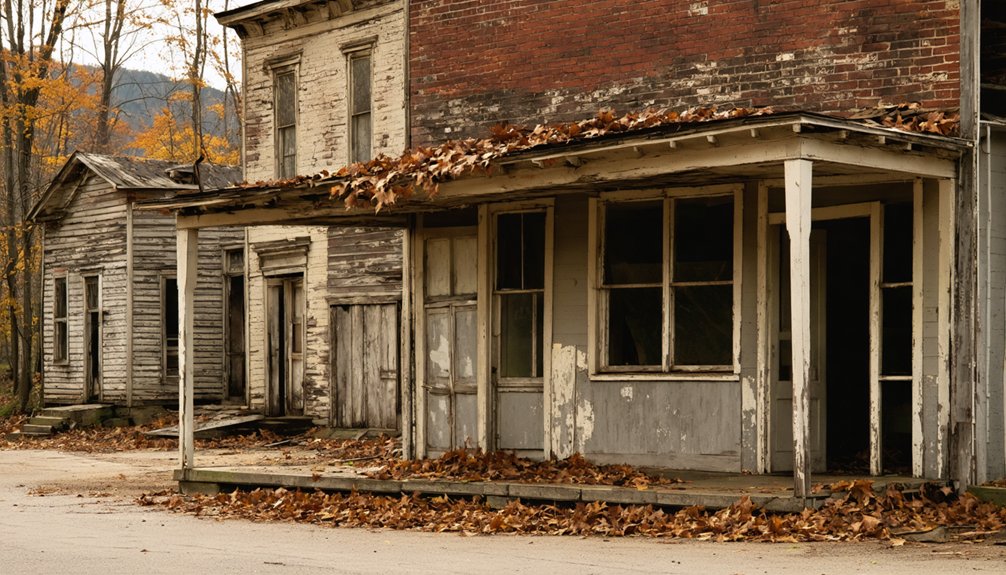
You’ll find North Carolina’s most photogenic ghost towns framed by fiery fall foliage from mid to late October, when Proctor’s crumbling chimneys emerge from Fontana Lake’s receding shoreline and Lost Cove’s moonshiner cabins hide beneath blazing hardwood canopies at 3,500 feet. Henry River Mill Village and Cataloochee Valley offer easier access, their abandoned homes and churches surrounded by peak autumn color. Morning light catches both rust-streaked ruins and crimson leaves perfectly, while fewer crowds mean you’ll explore these forsaken settlements in solitude—if you know when and how to reach them.
Key Takeaways
- Peak fall foliage occurs mid-to-late October in North Carolina mountains, with higher elevations like Lost Cove peaking in early October.
- Lost Cove offers overgrown foundations, old houses, and rock walls surrounded by dense hardwood forests with vibrant autumn colors.
- Cataloochee Valley features historic churches, homes, and schools amid mountain streams, accessible via scenic fall foliage drives through valleys.
- Fontana Lake settlements like submerged Proctor require boat access, with crumbling chimneys and cabin remains visible during lower water levels.
- Combine ghost town exploration with Blue Ridge Parkway drives for optimal photography at Henry River Mill Village and remote backcountry sites.
Proctor: Submerged Lumber Town Beneath Fontana Lake
Deep beneath the emerald waters of Fontana Lake lies Proctor, a once-thriving lumber town that hummed with the voices of over 2,000 residents before the lake swallowed it whole.
You’ll find this submerged settlement‘s archaeological significance in what remains above water—the weathered Calhoun House, crumbling mill ruins, and scattered foundations that whisper tales of prosperity lost.
In 1943, the Tennessee Valley Authority displaced 1,200 families, flooding their homes, their 300-seat theater, and Highway 288 itself.
The dam’s historical preservation efforts seem hollow when you consider families received just $37 per acre.
Proctor’s story began in 1886, flourishing through the lumber boom until the Great Depression and declining lumber market drove the town into decline by the 1930s.
Most of Proctor was torn down during WWII as dam construction progressed, erasing a bustling community that once boasted schools, churches, and theaters.
Today, you can only reach this ghost town by boat or backcountry trail, where autumn colors frame the cemetery headstones—silent witnesses to a community that refused to stay buried.
Lost Cove: Hidden High-Elevation Settlement in Pisgah National Forest
You’ll find Lost Cove’s legacy steeped in illicit whiskey production—moonshiners exploited this settlement’s isolation as early as 1898, running stills where state boundaries and rugged terrain kept tax collectors at bay.
Today, thick hardwood forests have reclaimed what fire didn’t destroy in 2007, wrapping the cemetery and three remaining houses in a canopy that blazes crimson and gold each autumn.
The same dense vegetation that once concealed illegal operations now offers hikers a spectacular color show along the 2.5-mile trail leading to this hidden community’s ruins.
Scattered throughout the overgrown pathways, you’ll discover rock walls and old staircases that mark where the town’s structures once stood before abandonment in the 1950s.
The Southern Appalachian Highlands Conservancy purchased the 95-acre parcel in December 2012, protecting the site’s natural and historical assets with plans to transfer it to Pisgah National Forest.
Moonshine Era Community History
Straddling the Tennessee-North Carolina border above the Nolichucky River, Lost Cove carved out a reputation that’d outlast its buildings by decades. By 1898, moonshine flowed from hidden stills tucked between apple orchards and corn fields, where settlers transformed their harvest into liquid gold.
You’d find no tax collectors brave enough to navigate these remote hollows, where jurisdictional confusion between two states created a perfect sanctuary for those who valued independence over regulation.
Community resilience meant building prosperity on your own terms—logging, farming, and yes, crafting legendary moonshine that whispered freedom through every sip.
The settlement thrived from the 1800s until the 1950s, when the last family finally vacated this mountain ghost town. The name “Lost Cove” itself refers to multiple locations in the region, though this high-elevation settlement remains the most historically significant.
Today’s historical preservation efforts protect more than abandoned homesteads; they honor a settlement where self-sufficiency wasn’t romantic—it was survival, distilled into defiance.
Dense Forest Preservation Today
When you push through the oak and maple thickets above the Nolichucky River today, Lost Cove doesn’t announce itself—you’ll stumble over a moss-covered foundation before you realize civilization once thrived here.
The Southern Appalachian Highlands Conservancy‘s preservation efforts have transformed this high-elevation ghost town into protected wilderness. Their 2012 purchase of 95 acres, transferred to the Forest Service in 2017, plus another 56 acres acquired in 2025, guarantees the mountains reclaim what’s theirs.
Urban decay meets forest recovery in spectacular fashion—chimneys pierce through undergrowth, a rusted Chevy slowly dissolves into soil, and stone walls vanish beneath vegetation.
You’re witnessing nature’s patient erasure, where each hiking season buries homestead remnants deeper. The dense canopy preserves both cultural history and golden eagle habitat, letting wilderness swallow human ambition whole.
Henry River Mill Village: District 12 of The Hunger Games
Deep in the woods between Charlotte and Asherville, twenty weathered cottages cling to the edge of Henry River gorge like ghosts frozen in time. You’ll recognize this 76-acre canvas of urban decay from The Hunger Games—District 12’s coal-dusted streets where Katniss fought for survival.
The 1905 mill village, once buzzing with 450 workers, now stands silent. Heritage preservation efforts saved it from total collapse after the main mill burned in 1977. Walk carefully—floors crumble beneath your feet, walls sag under decades of neglect.
The dam’s concrete crumbles, choked with flood debris. The village’s steep, flood-prone landscape was better suited for industrial mills than farming, a geography that shaped its destiny from the start. Yet fall transforms this abandonment into something hauntingly beautiful. Rust-colored leaves blanket empty porches where mill families once gathered. Guided tours now lead visitors through the restored Company Store that doubled as Mellarks Bakery on screen, proving nature eventually reclaims what we leave behind.
Cape Lookout Village: Seasonal Fishing Community by the Lighthouse
You’ll need to catch a ferry to reach Cape Lookout Village, where weathered keeper’s quarters and life-saving station buildings cluster around the iconic black-and-white diamond lighthouse like shells washed ashore.
The former fishing community—which thrived from the 1870s until becoming part of the National Seashore in 1966—now stands preserved but largely empty. Its 21 historic structures create an eerie maritime snapshot frozen in time.
As autumn light slants across the abandoned village, you can explore the Keeper’s Quarters Museum and imagine the families who once called this windswept barrier island home. The lighthouse’s checkered diamond pattern inspired the name of nearby Diamond City, with black diamonds pointing north-south and white diamonds pointing east-west. The lighthouse itself was constructed between 1857 and 1859, serving as the first major beacon built along North Carolina’s coast in the mid-19th century.
Preserved Maritime Village Buildings
The weathered buildings of Cape Lookout Village stand frozen in time along South Core Banks, their board-and-batten siding silvered by decades of salt spray and Atlantic winds. You’ll discover twenty-one historic structures from the village’s 1887-1960 heyday, though none welcome you inside.
The maritime architecture tells stories of self-sufficient fishermen who built simple five-bay houses on pilings, their engaged porches facing the endless horizon. Preservation efforts monitor these deteriorating structures—some teetering toward collapse—while maintaining their authentic decay.
The iconic 1859 lighthouse with its black-and-white diamonds anchors the north end, while Coast Guard buildings and fishing cottages dot the landscape southward. You’re free to wander among these silent witnesses to island life, imagining autumn winds rattling through abandoned rooms.
Ferry Access and Tours
Island Express ferries slice through Beaufort Inlet‘s churning waters from mid-spring through fall, carrying anglers and history seekers across the sound to Cape Lookout‘s weathered village.
You’ll feel the salt spray as diesel engines power through channels where maritime history and coastal ecology converge.
Ferry Service Essentials:
- Seasonal Schedule: Departures from Beaufort and Morehead City increase during summer and fall fishing season.
- Lighthouse Access: Tours run May 15-September 21, with “Lighting the Way” programs extending through October 14.
- Peak Times: Fall delivers ideal red drum migration viewing and village exploration without summer crowds.
- Charter Options: Beaufort, Morehead City, and Atlantic Beach operators offer guided trips through these protected waters.
The village buildings stand closed but exterior displays reveal generations of fishermen who called these windswept shores home.
Cataloochee: Valley Settlement in the Smokies
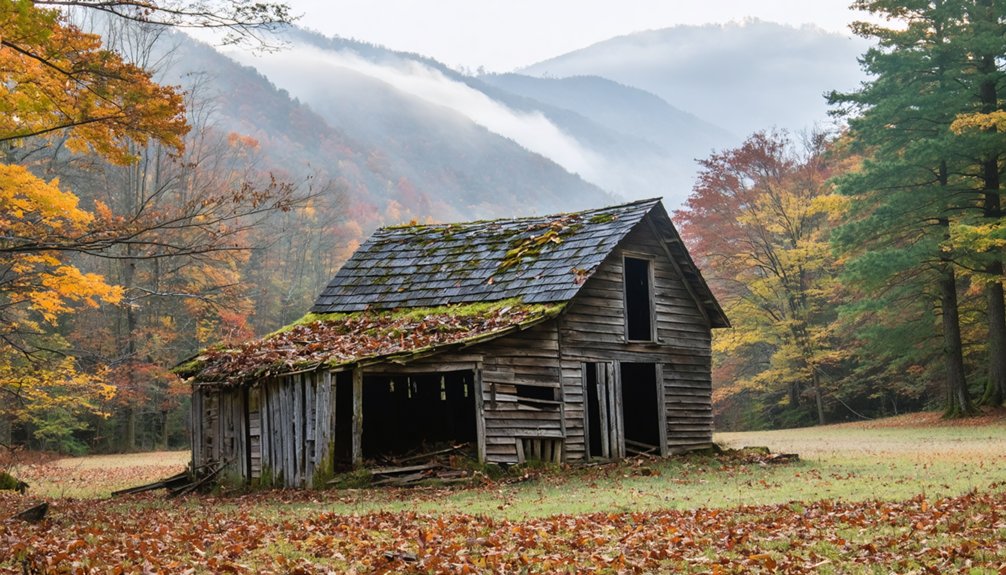
Nestled deep within the Great Smoky Mountains, Cataloochee Valley whispers stories of a once-thriving community where nearly 1,200 souls carved out their lives among wave upon wave of rugged peaks. You’ll discover historical architecture frozen in time—the 1889 Little Cataloochee Church with its working bell, the distinctive “dog-trot” Palmer House that doubled as a post office, and weathered barns that sheltered livestock through harsh mountain winters.
Walk through Beech Grove School where children once learned their lessons, then explore the Caldwell House’s Eastlake elegance. Each structure breathes community storytelling—tales of families who fished stocked trout streams for profit, grew market crops in fertile soil, and welcomed early tourists seeking mountain refuge.
Autumn transforms this ghost settlement into gold and crimson splendor.
Brunswick Town: Colonial Capital Reclaimed by Nature
You’ll discover where preservation efforts have frozen history in dramatic layers:
- St. Philip’s Church walls stand sentinel, surviving Revolutionary torches and Civil War cannons.
- Confederate earthworks sprawl across colonial foundations, creating archaeological time capsules.
- Naval stores—tar, pitch, turpentine—once fueled Britain’s empire from these longleaf pine forests.
- 1766 citizens stormed Governor Tryon’s mansion here, predating Boston’s famous tea party.
Though folklore legends whisper through autumn oaks, the documented rebellion speaks louder than myths.
Best Times to Visit for Peak Autumn Colors
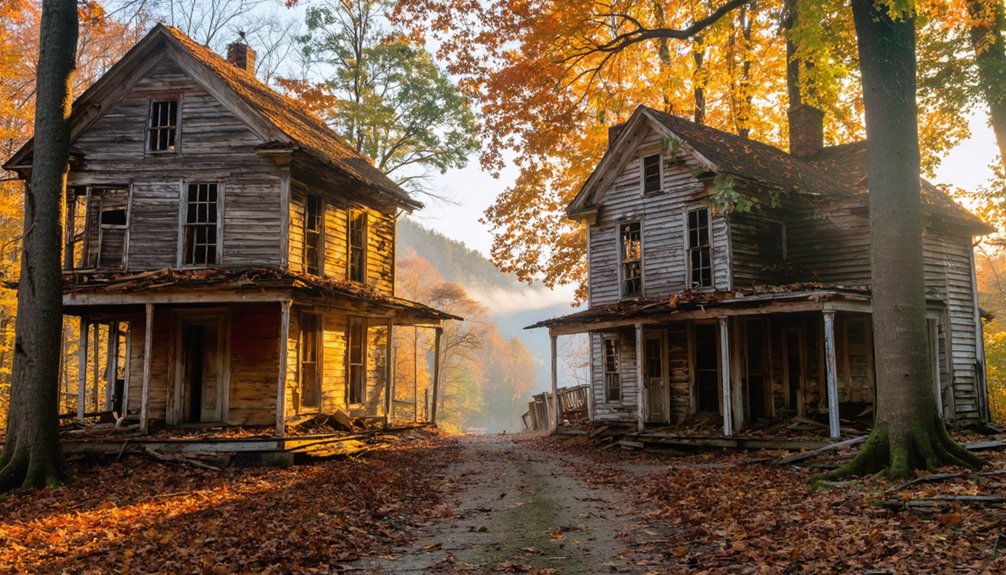
When planning your ghost town exploration, timing becomes everything—the difference between photographing skeletal gray ruins against bare branches or capturing them framed by blazing maples and golden hickories.
You’ll find the sweet spot for haunted legends and abandoned architecture between mid-to-late October, when Western North Carolina’s mountains explode in crimson and gold.
Target higher elevations above 5,000 feet in early October—Ghost Town in the Sky showcases colors by late September.
Mid-elevations like Lost Cove in Pisgah National Forest peak around mid-October at 3,500 feet.
Lower sites color latest, stretching into early November.
Cooler temperatures accelerate the transformation, while dry September conditions hasten the spectacle.
Scout your locations during early morning or late afternoon when angled sunlight ignites the foliage, turning crumbling walls into amber-lit monuments of forgotten time.
How to Access Remote Ghost Town Locations
You’ll need more than just your car keys to reach North Carolina’s most atmospheric ghost towns—these abandoned settlements hide deep in the backcountry where pavement ends and adventure begins.
Picture yourself gripping a boat rail as you cross Fontana Lake’s choppy waters, or feel your boots crunch through fallen leaves inside the pitch-black tunnel at Road to Nowhere’s dead end.
Whether you’re paddling twenty minutes across open water, scrambling up ten miles of mountain trail, or timing your visit for the rare pontoon shuttle during Decoration Days, each route demands careful planning and respect for the rugged terrain that’s kept these places frozen in time.
Boat and Ferry Options
The shimmering waters of Fontana Lake hold North Carolina’s most elusive ghost towns just beyond their depths, where settlements like Proctor and Judson vanished beneath the surface when the dam flooded the valley in 1944. You’ll need your own watercraft to reach these submerged communities, as no regular ferry service exists for inland sites.
Your water access options:
- Private boat rental options from Bryson City marinas offer flexible departure times.
- Annual Decoration Days pontoon shuttles provide rare group transport across the lake.
- Cape Lookout’s barrier island ghost town requires seasonal passenger ferries from Harkers Island.
- Ten-mile hiking alternative from Fontana Dam avoids water crossings entirely.
Prioritize watercraft safety when maneuvering these remote locations. The lake’s fallen timber and submerged structures demand vigilance, especially during autumn’s unpredictable weather patterns.
Hiking Trail Routes
Crumbling chimneys emerge from rhododendron thickets along Big Laurel Creek trail, marking the entrance to Runion—a ghost town that once housed over a thousand residents operating steam-powered sawmills.
You’ll navigate mossy rocks and discover swimming holes while trilliums carpet the forest floor in early spring.
The ghost town architecture reveals itself gradually through dappled light.
Lost Cove demands more effort. You’ll descend several steep miles into Nolichucky Gorge, where four streams converge toward the river below.
The challenging route leads past waterfalls to homesites, farmlands, and gravesites dating to the Civil War era.
Historic preservation here means leaving moonshiner cabins and timber operation remnants untouched.
September and October transform these abandoned settlements into blazing galleries of reds and golds against dark evergreens.
Seasonal Access Restrictions
When autumn colors peak across western North Carolina, accessing these ghost towns requires strategic planning around ownership restrictions, seasonal ferry schedules, and backcountry permits. Historic preservation efforts and wildlife habitats necessitate controlled entry to these vanishing communities.
Key Access Requirements:
- Cape Lookout Village operates passenger ferries only during warmer months, limiting fall visits to early October before services cease.
- Proctor’s submerged remains demand either a 10-mile backcountry hike or annual Decoration Days pontoon shuttles from Park Service.
- Henry River Mill Village recently changed ownership, requiring verification of current trespassing policies before exploring District 12’s film location.
- Lost Cove remains completely restricted until SAHC organizes guided spring hikes, making autumn access impossible.
You’ll need advance reservations, boat transportation confirmations, and property permission before wandering these abandoned settlements.
What to Bring for Ghost Town Exploration
Before stepping into abandoned settlements where nature reclaims what humans left behind, you’ll need gear that protects you from hazards lurking in every shadow and crumbling structure.
Steel-toed boots grip rotting floorboards as you photograph historical architecture through autumn leaves. Cut-resistant gloves shield your hands when steadying yourself against rust-covered abandoned vehicles. A high-lumen headlamp becomes essential when exploring darkened interiors where afternoon sun can’t penetrate.
Where abandoned structures meet overgrown wilderness, your protective gear becomes the thin barrier between discovery and danger.
Pack your dust respirator—mold spores thrive in these forgotten places. Bring multiple flashlights; batteries die when you’re furthest from your car. Your first aid kit isn’t optional, nor is that multi-tool for clearing overgrown paths.
A fully charged phone with offline maps keeps you oriented when trails vanish beneath October’s crimson carpet. Document everything, but prioritize your safety over any photograph.
Combining Ghost Town Tours With Fall Foliage Drives
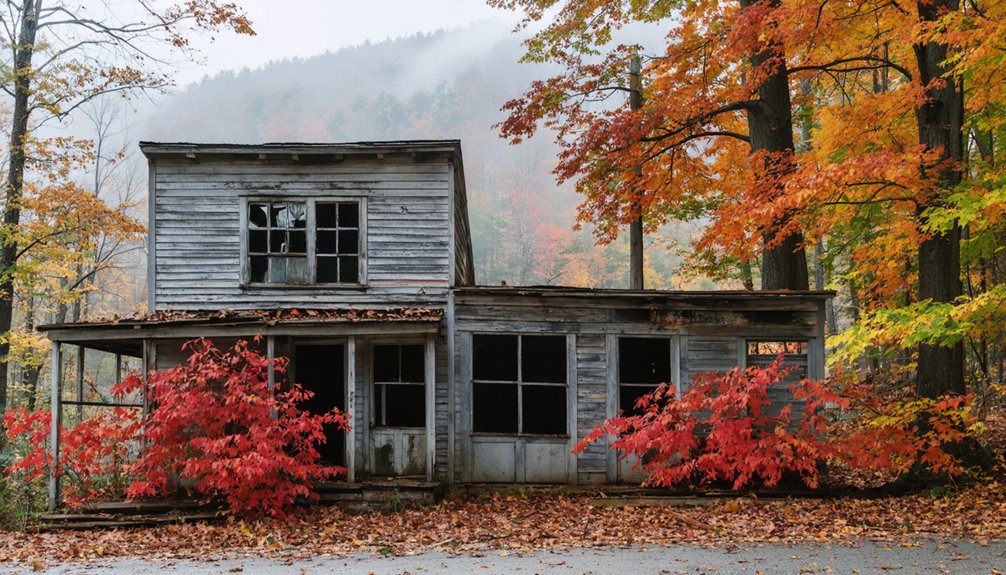
Crimson maples frame weathered mill houses as you navigate Highway 321 toward Blowing Rock, where Outside Magazine’s top-ranked fall foliage destination sits just two hours from Charlotte’s urban sprawl.
You’ll craft remarkable autumn photography by timing Henry River Mill Village‘s sagging porches against mid-October’s peak colors, then pushing toward Moses Cone Manor’s 25-mile carriage trail network.
Strategic ghost town-foliage combinations:
- Blue Ridge Parkway to Proctor: Book Decoration Days pontoon shuttles for Hazel Creek cemetery access amid October brilliance
- Maggie Valley circuit: Ride Ghost Town chairlifts through canopy layers before exploring Stony Creek’s vibrant stands
- Lost Cove isolation: Trek Pisgah National Forest’s 350-acre remnants where high elevation sustains extended color
- Historical preservation routes: Document Henry River’s 1905 architecture framed by riverside foliage before access rules shift
You’ll escape crowds while capturing abandoned America’s autumn transformation.
Frequently Asked Questions
Are Overnight Camping Options Available Near These Ghost Town Locations?
Yes, you’ll find five backcountry campsites near Proctor’s ghost town history along Hazel Creek. You can boat across Fontana Lake or hike ten miles in, discovering incredible photography opportunities among autumn-draped ruins and overgrown cemeteries.
Which Ghost Towns Are Wheelchair Accessible or Suitable for Limited Mobility?
Unfortunately, you’ll find none of these ghost towns wheelchair accessible—unforgiving terrain blocks historical preservation sites. Portsmouth’s sandy paths and Lost Cove’s overgrown trails deny photography opportunities to those with limited mobility, demanding rugged exploration instead.
Do Any Ghost Towns Require Entrance Fees or Special Permits?
You’ll need tickets at Ghost Town in the Sky ($24.95) and Henry River Mill Village ($18 plus tax). There aren’t entrance fee exemptions for adults, though Henry River waives charges for kids. No special permit requirements restrict your exploration freedom.
Are Guided Tours Available or Must These Sites Be Explored Independently?
You’ll find guided tours only at Henry River Mill Village, where historical preservation efforts welcome photographers. Most sites demand independent exploration—you’re free to wander overgrown trails, discover crumbling foundations, and capture autumn’s golden light filtering through abandoned doorways yourself.
What Wildlife Might Visitors Encounter at These Abandoned Settlements?
You’ll encounter black bears, deer, and wild turkeys roaming freely through abandoned structures. Wildlife photography opportunities abound as foxes den in mill ruins, while birdwatching opportunities reveal owls roosting in forgotten rafters and vultures circling crumbling chimneys.
References
- https://www.atlasobscura.com/places/proctor-lost-ghost-town-hazel-creek
- https://www.visitnc.com/list/ncs-mysterious-disappearances-and-abandoned-places
- https://en.wikipedia.org/wiki/List_of_ghost_towns_in_North_Carolina
- https://takingthekids.com/abandoned-north-carolina-destinations-every-explorer-should-visit/
- https://www.youtube.com/watch?v=eR9Quelg2dk
- https://www.romanticasheville.com/henry-river
- https://www.islands.com/1977921/proctor-north-carolina-great-smoky-mountains-ghost-town-war-history-fishing-destination/
- https://wlos.com/news/local/north-carolina-fontana-lake-proctor-town-submerged-underwater-history-100-years-ancestors-families-shorelines-world-war-2-lee-woods-historian
- https://www.wanderingsmokymountains.com/proctor-north-carolina/
- http://www.proctorrevival.com/Stories.html