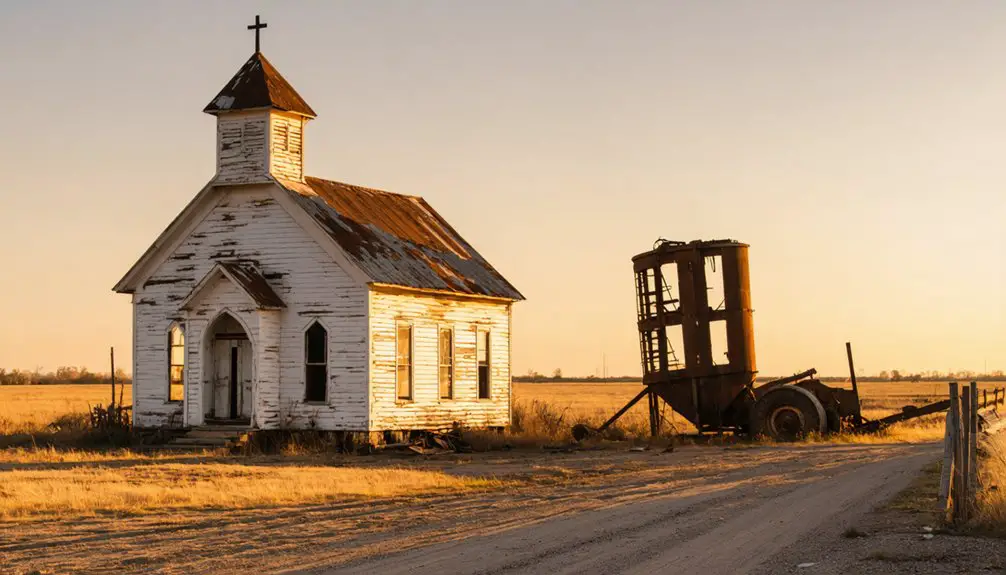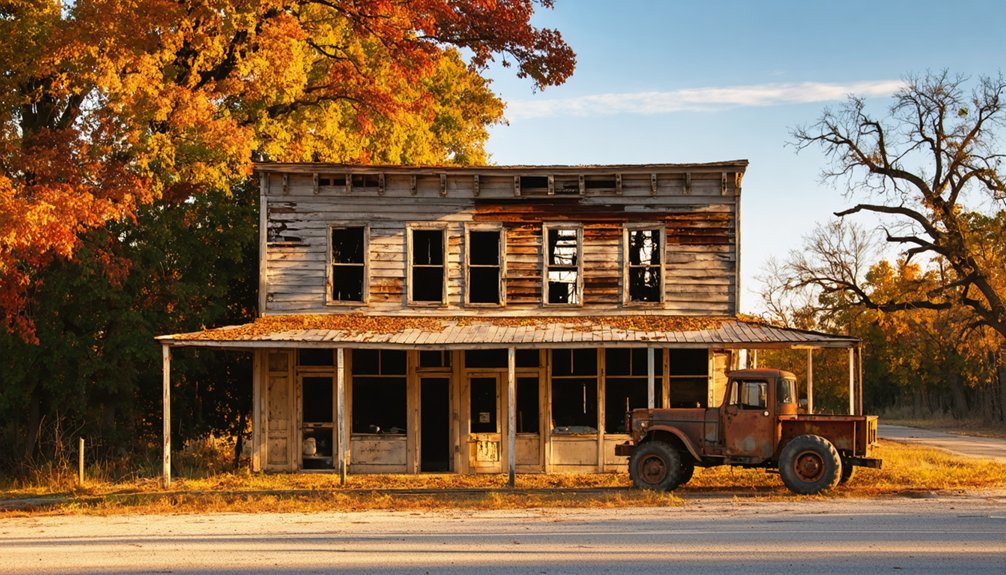
You’ll find Oklahoma’s most photogenic ghost towns cloaked in fall color along State Route 82, where Marshall’s 1898 Gothic church stands surrounded by golden hickory, and near the Talimena Scenic Byway, where abandoned settlements hide among copper-toned oaks. Peak foliage hits mid-October through early November across 2,000 historic sites—from Osage Hills’ oil-boom relics framed by crimson sumac to Hochatown’s drowned structures beneath fiery maples. The convergence of crumbling limestone walls and autumn’s amber light creates scenes worth exploring further.
Key Takeaways
- Oklahoma has approximately 2,000 ghost towns and abandoned settlements, with fall foliage peaking mid-October through early November in vibrant colors.
- State Route 82 connects northeastern ghost towns like Locust Grove and Salina, featuring abandoned infrastructure framed by autumn-colored rolling hills.
- Talimena Scenic Byway spans 54 miles through Winding Stair Mountains, offering mountain vistas and historic sites like Rich Mountain Cemetery in gold foliage.
- Marshall’s 1898 Carpenter Gothic Methodist Church and Gideon’s Blue Springs Cemetery showcase historic architecture amid crimson and gold seasonal displays.
- Osage Hills features Depression-era CCC structures and abandoned oil-boom towns like Blackland, surrounded by oak-hickory forests in autumn hues.
Understanding Oklahoma’s Abandoned Settlements and Autumn Color Timeline
The wind whispers through abandoned storefronts differently in October, when Oklahoma’s ghost towns dress themselves in unexpected color. You’ll find roughly 2,000 of these settlements scattered across the state—remnants of liquor towns, mining camps, and 1893 Land Rush communities like Marshall and Covington that couldn’t survive the Great Depression’s crushing weight or the 1930s railroad failures.
Historical preservation takes on deeper meaning when blackgum and hickory trees flame red against crumbling walls from mid-October through early November, particularly in eastern Oklahoma’s Ozarks. Some settlements predate Oklahoma’s statehood, their foundations witnessing over a century of seasons before abandonment and decay. Marshall’s Carpenter Gothic Methodist Church, built in 1898 and listed on the national register, stands as one of these enduring witnesses.
Abandoned architecture becomes art when framed by autumn’s palette—Hollister’s ruins in Tillman County, Ingalls’ monument in Payne County, structures that once housed dreams now hosting only changing leaves and memory.
Northeast Oklahoma Ghost Town Routes Through Peak Foliage Zones
You’ll find State Route 82 cutting through northeastern Oklahoma’s rolling hills like a thread connecting forgotten moments—the Mickey Mantle birthplace in Spavinaw, Civil War battlegrounds where grass now grows over old scars, and lakeshores reflecting October’s amber light.
The road winds past Locust Grove and Salina as sugar maples ignite in crimson and hickories turn gold, their colors deepening near Lake Hudson‘s shores. Each small town along this corridor holds fragments of Osage and Cherokee history, their stories pressed between layers of autumn leaves that crunch underfoot at roadside markers. The landscape transforms into reds, yellows, and oranges as hardwoods reach their seasonal crescendo, painting the ghost town routes in Oklahoma’s signature fall palette.
Plan your journey for late October when the foliage reaches its vibrant peak around Halloween, transforming the entire route into a corridor of blazing color.
State Route 82 Corridor
Winding through northeastern Oklahoma’s hill country, State Route 82 splits into two distinct segments that thread past forgotten towns where history lingers in peeling paint and empty storefronts.
You’ll discover Spavinaw’s population has crashed from 623 to 350—a common tale along this corridor where railroad history determined which communities thrived and which withered.
The northern stretch connects Gideon, Peggs, and Salina through territories steeped in Native American heritage, while abandoned water towers pierce autumn canopies ablaze with color.
Lakes Spavinaw and Hudson break the landscape where ghost towns meet recreation, their shores dotted with skeletal structures.
Churches and post offices stand sentinel in near-empty hamlets, their weathered facades framed by October’s crimson and gold—nature’s grand finale over Oklahoma’s fading settlements.
Locust Grove anchors the route at the crossing of SR 82 and Highway 412, where remnants of an 1862 Civil War battle blend with turn-of-century architecture.
The southern section first appeared on maps in 1977, carving through Haskell County where Stigler—originally called Newman—rose from railway origins to become the region’s largest settlement.
Osage Hills Historic Sites
Between Pawhuska’s weathered storefronts and Bartlesville’s outskirts, the Osage Hills rise like ancient sentinels guarding stories carved into limestone and sandstone.
You’ll find Osage Hills State Park along Highway 60, where Depression-era stonework tells its own tale—Company 895’s laborers built these structures between 1936 and 1939, their craftsmanship still standing firm against October winds.
The park’s trails wind through Native heritage territory, where rolling hills blaze crimson and gold each fall.
Those original CCC facilities weren’t just conservation efforts—they were promises etched in stone, connecting you to an era when hands shaped landscapes into sanctuaries.
This northeastern Oklahoma location sits squarely within Green Country region, where lush landscapes define the terrain. The Travelers’ Choice award distinguishes this hidden gem among Oklahoma’s top-rated natural destinations. Pull off at coordinates 36.764271, -96.173292, grab a trail map from the ranger station, and let these hills whisper their forgotten stories through rustling leaves.
Exploring Route 82’s Historic Sites During Fall Color Season
When you pull into Gideon during late October, the Blue Springs Cemetery materializes through a curtain of rust-colored blackjack oaks, their leaves crunching beneath your boots as you walk among weathered headstones dating back to the 1800s.
Just north, Lake Spavinaw’s shoreline transforms into a painter’s palette—crimson sumac and golden hickory reflecting off the still water where old fishing camps once thrived.
The abandoned storefronts along Route 82 frame these natural displays like forgotten picture windows, their empty doorways offering unexpected glimpses of wooded hills ablaze with autumn color. The crisp air and rustling branches signal the peak of fall foliage season, when golden and amber tones dominate the landscape around these historic sites. Out-of-town visitors often discover these hidden scenic routes while searching for Oklahoma’s most photogenic autumn destinations.
Gideon’s Blue Springs Cemetery
The triangular patch of ground where Blue Springs Road branches from Highway 82 holds more stories than most travelers racing past on their autumn drives will ever know. Blue Springs Cemetery rests behind Gideon Fire Station, its weathered markers standing sentinel beside the old Baptist church.
You’ll find this burial ground serves as both waypoint and destination—a place where historical preservation meets the quiet surrender of abandoned settlements to nature’s reclaiming hand.
The cemetery’s genealogical records, maintained through Find a Grave and local historians, reveal Cherokee County’s earliest settlers who pushed into Indian Territory. During fall, golden leaves drift across stones dating back generations.
Cemetery tours here aren’t guided affairs—you’re free to wander among the graves, reading names, imagining lives lived when Gideon still thrived.
Lake Spavinaw Autumn Views
Where Highway 82 curves northeast from Cherokee County into Mayes County, the landscape shifts from prairie-edged roads to forested ridges that cradle Lake Spavinaw in their valleys. You’ll find Tulsa’s primary reservoir framed by hardwoods that ignite each November—maples bleeding crimson, oaks burning orange, sweetgums glowing gold.
The forest canopy creates natural tunnels along Duck Creek, where pullouts let you pause without schedule or permission.
The route passes remnants of early settlement sites and Spavinaw’s original townsite, their weathered structures half-hidden beneath October’s blaze. Autumn reflections double the spectacle where Highway 82 parallels Grand Lake’s shores, water mirroring the hillsides’ transformation.
You’re driving through Cherokee heritage country, where history and color intertwine. Check foliage reports starting September, then claim this road when peak arrives.
Osage Hills Region: Combining Faded Communities With Seasonal Landscapes
Rolling hills adorned with rust-colored oak and golden hickory create the backdrop for Osage County’s forgotten oil-boom settlements, where October’s peak foliage season transforms abandoned storefronts and crumbling foundations into something almost romantic.
You’ll find haunted landscapes near Blackland, twelve miles into hilly terrain north of Pawhuska, where nature’s reclaimed what oil money built. Carter Nine sits twenty-two miles northwest—former Carter Oil Company workers abandoned their sidewalks and shelters when Shidler offered better prospects.
Gray Horse once housed 10,000 souls; now autumn leaves drift through its couple remaining structures.
The seasonal scenery here doesn’t sugarcoat history’s harsh truths. Empty windows in Pawhuska’s mansions frame perfect views of oak-hickory forests ablaze with color. Meanwhile, the Tallgrass Prairie Preserve stretches endlessly nearby—untamed territory where freedom still means something.
Southeastern Ghost Towns Near Premium Leaf-Peeping Destinations
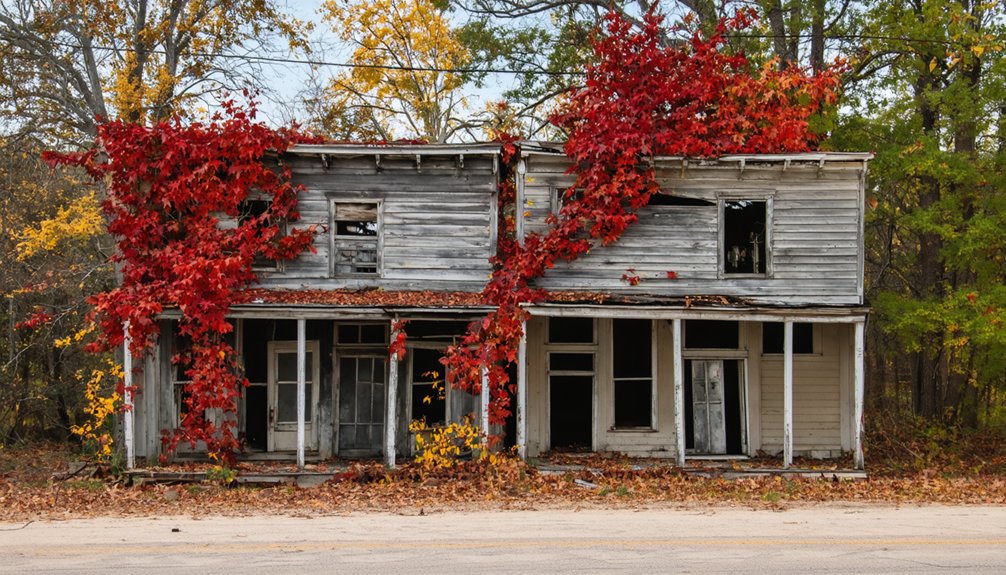
Ouachita Mountains’ crimson sumacs and amber-leafed hickories surround Oklahoma’s most accessible ghost towns, where autumn transforms southeastern timber graveyards into photographer’s gold.
You’ll find Clebit ruins emerging through October mists near Kosoma, weathered mill foundations swallowed by oak and maple. The Clebit ruins whisper stories of Depression-era collapse while scarlet leaves blanket forgotten homesteads.
Drive unpaved roads toward Pine Valley heritage sites, where lumber-camp remnants hide beneath golden canopies.
Original Hochatown’s relocated cemetery rests miles from Broken Bow Lake’s vacation crowds—perfect for solitary walks among migrated gravestones.
McCurtain’s Garden of Memories holds seventy-three miners beneath turning leaves, its downtown buildings standing sentinel over vanished prosperity.
These southeastern sites reward explorers who crave both historical solitude and nature’s seasonal spectacle.
Talimena Scenic Byway’s Disappearing Towns and Mountain Vistas
Along the 54-mile spine of the Winding Stair Mountains, you’ll chase vanished settlements through twenty-two scenic overlooks where oak leaves burn copper against impossible blue skies.
Pioneer Cemetery waits at trail’s end, its weathered headstones whispering stories beneath crimson canopies.
At Horse Thief Spring, stone walls built during the Depression still guard water where outlaws once watered stolen horses—now just folklore and fall foliage.
The mountain vistas from Wolf Pen Gap’s fire tower reward your hundred-step climb with ridgeline panoramas stretching into Arkansas.
You’ll find Rich Mountain Cemetery cloaked in autumn gold, its ghost legends feeling less far-fetched when fog rolls through at 3,000 feet.
The iron border monument stands sentinel where the Choctaw Nation once began, surrounded by blazing maples reclaiming what civilization briefly touched.
Creek and Payne County Abandoned Sites Within Autumn Driving Loops
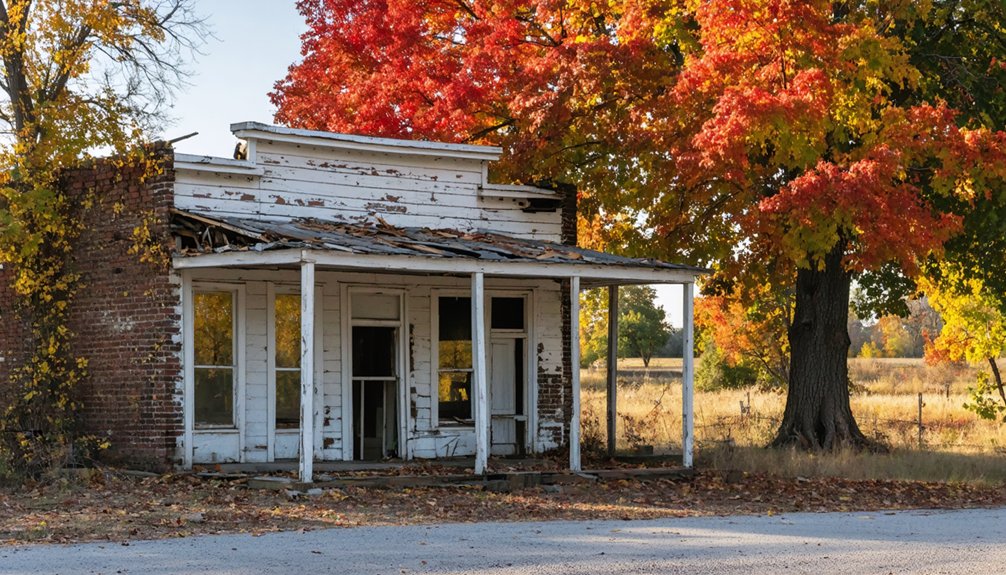
Where Oklahoma’s red earth meets crumbling oil dreams, Creek County’s Slick stands frozen in 1930. Tom B. Slick’s cottonfield fortune vanished with depleted wells, leaving weathered structures along Bristow’s outskirts.
You’ll find historical preservation efforts barely touching these authentic ruins where faded storefronts tell community stories of boom-to-bust desperation.
Drive north through autumn-painted landscapes to Payne County’s Orlando, abandoned since 1964. Its skeletal buildings frame perfect fall photography—grain elevators silhouetted against copper foliage, stone foundations reclaimed by prairie grass.
You’re free to explore connecting red dirt roads between sites, discovering cemeteries and schoolhouses that mark settlement dreams drowned by reservoirs or scattered by tornadoes.
These north-central loops deliver unfiltered Oklahoma history: no admission fees, no guided restrictions—just you, crumbling Main Streets, and October’s golden light filtering through broken windows.
Ouachita Mountain Ghost Settlements and Forest Color Displays
Southeast of those prairie ruins, Oklahoma’s landscape buckles into forested ridges where McCurtain County’s ghost towns hide beneath autumn canopies thick enough to filter sunlight into amber streams.
You’ll find McCurtain’s timber relics scattered through Ouachita National Forest, where downtown storefronts once thrived before 1944’s final exodus.
The hickories blaze orange above Miners Cemetery—73 souls resting in what’s now Garden of Memories on N4510, their cemetery preservation maintained by volunteers who understand freedom means remembering those who carved paths before you.
Drive to where D2225 meets N4780 and you’ll see two weathered houses standing sentinel over old Hochatown’s drowned remains beneath Broken Bow Lake.
The maples don’t care that moonshine runners once raced these mountain roads—they turn scarlet regardless.
Planning Your Combined Historic Exploration and Foliage Adventure
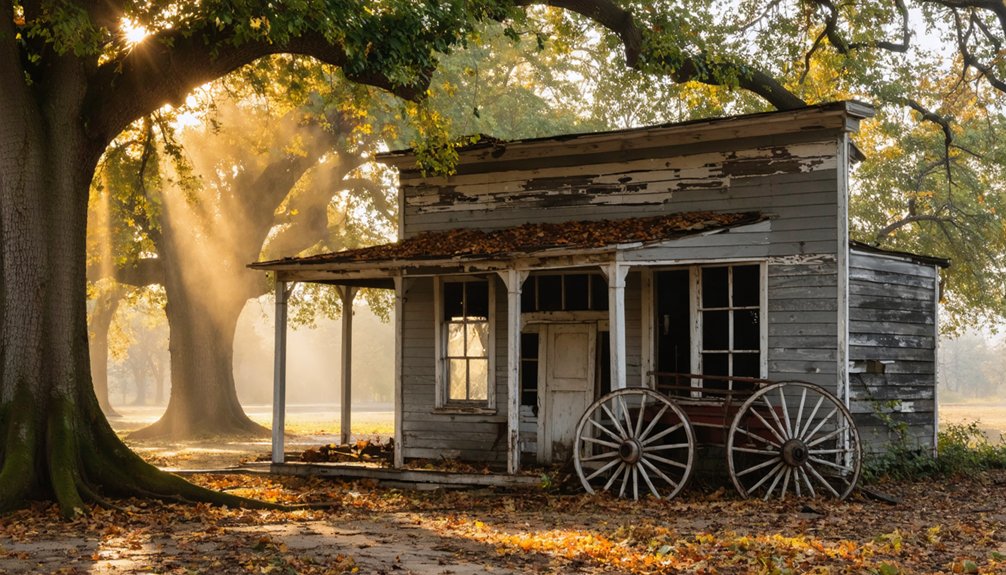
Because Oklahoma’s ghost towns scatter across three distinct terrain zones—prairie flatlands, forested hills, and mountain ridges—you’ll need to match your itinerary to the calendar’s shifting palette.
Oklahoma’s abandoned settlements span prairies, hills, and peaks—demanding seasonal planning to match terrain with weather’s dramatic transformations.
Target late October when sweetgums blaze crimson along Cherokee Nation routes, perfect for wildlife photography amid abandoned homesteads.
Your three-day freedom route:
- Day One: Fuel up in Tulsa, drive the 54-mile Talimena Byway at 2,600 feet, camping near Heavener while locals share ghost town folklore over campfires.
- Day Two: Explore Burke City’s flood-claimed ruins, then hike Robbers Cave’s leaf-covered trails where outlaw legends echo through oak groves.
- Day Three: Navigate State Route 82’s forgotten settlements—Gideon, Peggs, Salina—capturing golden hickories framing weathered structures.
Check abandonedok.com before departing. Pack sturdy boots.
Frequently Asked Questions
Are Oklahoma Ghost Towns Safe to Explore Alone or at Night?
Exploring alone or at night isn’t safe—you’ll face crumbling structures, zero lighting, and isolation without emergency services. Follow safety tips: never venture solo, avoid night exploration entirely, and stick to daylight visits with companions who share your adventurous spirit.
Do I Need Special Permits to Access Abandoned Buildings in Oklahoma?
Craving unfettered exploration? You won’t need special permits for public ghost towns, but private property demands owner permission. Legal restrictions protect these crumbling sanctuaries—trespassing risks $500 fines or jail time, transforming your freedom-seeking adventure into costly consequences.
What Photography Equipment Works Best for Ghost Towns and Foliage?
You’ll want mirrorless cameras like Sony a7iii for low-light interiors, wide-angle lenses to capture vast abandonment, and sturdy tripods for long exposures. Photography tips: pack flashlights for shadowy corners and filters for dramatic skies over decaying structures.
Can I Find Overnight Accommodations Near Remote Ghost Town Locations?
You’ll discover comfortable refuges in gateway towns like Heavener and Talihina, where historic landmarks whisper forgotten stories. State parks offer camping under star-scattered skies, though meal options grow scarce near abandoned settlements—pack provisions for your liberating backroad adventures.
Which Ghost Towns Have the Most Intact Structures Still Standing?
You’ll find Osage and Oktaha showcase impressive historical preservation with their standing churches and post offices. Their structural integrity defies time—I’ve walked through weathered doorways where autumn light streams across forgotten floorboards, revealing stories etched in aged wood.
References
- https://the405voyager.com/fall-foliage-in-oklahoma-5-spots-for-leaf-peepers/
- https://www.bluebeavercabins.com/143143/oklahomafall-foliage/
- https://www.tulsakids.com/the-best-places-to-view-oklahoma-fall-foliage/
- https://www.okhistory.org/publications/enc/entry?entry=GH002
- https://pocketsights.com/tours/tour/Shamrock-Oklahoma-Ghost-Towns-Creek-Lincoln-Payne-and-Pawnee-Counties-2749
- https://www.youtube.com/watch?v=CYSGQsnt_FY
- https://abandonedok.com/class/disappearing-town/
- https://en.wikipedia.org/wiki/List_of_ghost_towns_in_Oklahoma
- https://www.ou.edu/content/dam/archsurvey/docs/archsur-Sites_By_County.pdf
- https://www.youtube.com/watch?v=jcbyntLCj2U