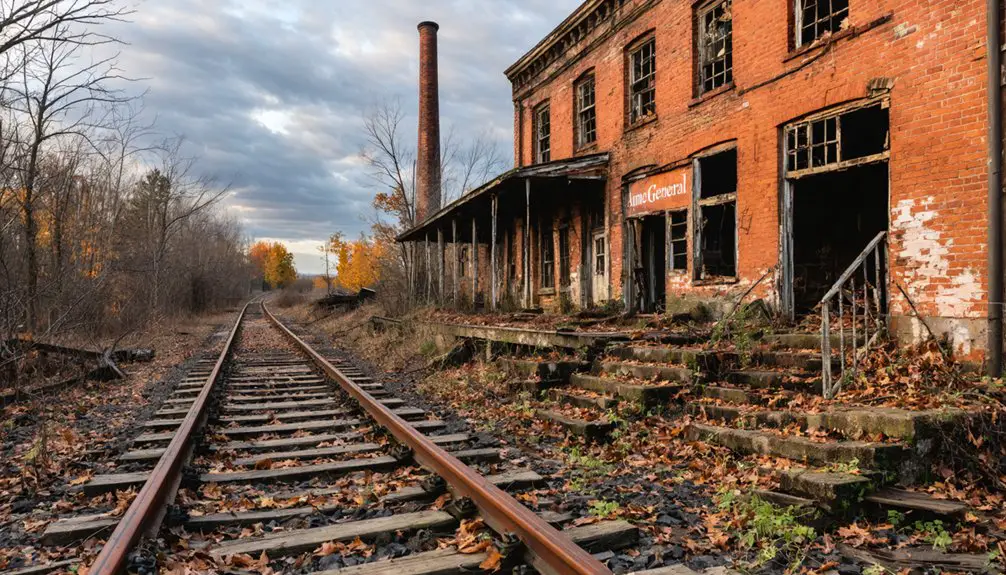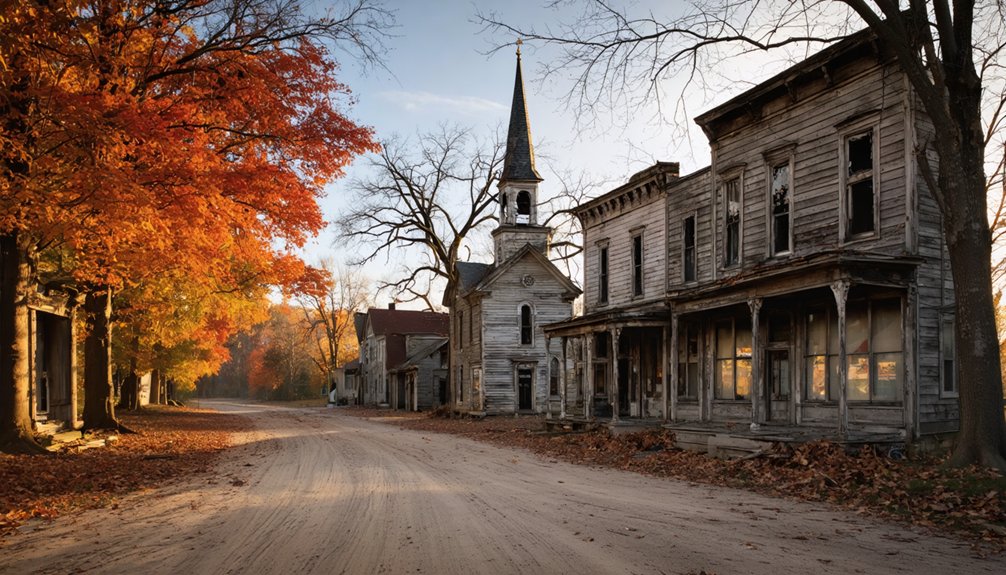
You’ll find Pennsylvania’s most atmospheric ghost towns framed by October’s brilliant foliage—Pithole’s oil boom ruins near colorful creek trails, Lausanne’s mining remnants along Lehigh Gorge’s scenic railway, and Yellow Dog Village’s 26 frozen-in-time buildings reclaimed by forest. Jim Thorpe serves as your Victorian gateway to haunted coal country, while Wellsboro leads to Pine Creek Gorge and Fall Brook’s vanished mining settlement. Late September through mid-October offers peak colors illuminating crumbling foundations, rusted equipment, and overgrown paths where dawn wildlife encounters transform history into something mystical.
Key Takeaways
- Pithole ghost town offers oil boom history with artifacts at Drake Well Museum, best visited during late September through mid-October foliage.
- Fall Brook near Wellsboro features cemetery ruins, overgrown miners’ paths, and mountain vistas amid vibrant Pine Creek Gorge autumn colors.
- Lausanne’s Turn Hole Tunnel and mining remnants pair with Lehigh Gorge Scenic Railway’s narrated rides through spectacular fall landscapes.
- Yellow Dog Village preserves 26 historic limestone mining buildings along forest-reclaimed dirt roads, offering guided tours through Appalachian industrial history.
- Jim Thorpe combines Victorian architecture, haunted Old Jail Museum tours, and October Fall Foliage Festival with artisans and live music.
Pithole: Oil Boom Ghost Town Near Colorful Oil Creek Trails
When Thomas Holmden leased 65 acres of his Venango County farm to oil speculators Frazier and Faulkner in 1865, he couldn’t have imagined the chaos about to erupt from his land. The successful Frazier Well triggered Pennsylvania’s wildest oil boom, transforming quiet farmland into a roaring city of 15,000 fortune-seekers within months.
This ghost town pumped 5,000 barrels daily while shootouts echoed through mud-covered streets. You’ll find remnants of 900 wooden buildings that vanished after bank failures and devastating fires crushed the economy. The August 2 blaze consumed parts of the town and nearby oil wells, accelerating Pithole’s collapse from thousands of residents to just 2,000 by December 1866. Today’s visitors can explore the site and view artifacts at the nearby Drake Well Museum & Park, which features historical photos and operational oil machinery from the era.
Centralia: Underground Fires and Autumn Forests in Columbia County
Beneath autumn’s golden canopy in Columbia County, an inferno has raged for over six decades through abandoned coal tunnels that honeycomb the earth. Centralia’s leaf peeping comes with an edge—sulfurous smoke rising through cracked pavement, ground warm enough to melt snow in winter.
What began as a 1962 landfill fire now burns across 3,700 acres, consuming coal seams 300 feet deep. The forest folklore here isn’t whispered legends but documented danger: sinkholes swallowing earth, toxic gases seeping upward, roads buckling from subsidence. The fire advances at approximately 75 feet per year along four distinct branches, a slow-motion catastrophe measurable by surveyor’s marks rather than emergency dispatches.
Fewer than six souls remain in this condemned borough where autumn maples frame skeletal church steepes and crumbling foundations. Before the fire, Centralia thrived as a coal town officially incorporated in 1866, its mining operations dating back to the 1840s. You’ll find no official welcome—Pennsylvania’s DEP warns against visiting—yet the abandoned highway and surrounding woodlands draw those seeking beauty tinged with apocalypse.
Lausanne: Mining Ruins Along the Scenic Lehigh Gorge Railroad
From Centralia’s toxic flames, the narrative shifts northeast where industry’s ghosts take a different form—not consumed by fire but reclaimed by forest.
Where abandoned railroad tunnels pierce cliffsides and autumn leaves drift onto century-old ties.
Time suspends in these hollow passages where rail commerce once thundered, now surrendered to silence and the patient advance of wilderness.
You’ll find Lausanne’s remnants near Jim Thorpe, where the 496-foot Turn Hole Tunnel cuts through Lehigh Gorge‘s cliffs. Built in 1866 for coal transport, it’s now a soot-stained chamber filled with collapsed boulders and mining history. The entrance was carved into solid rock, a feat accomplished entirely without powered machinery.
The Lehigh Gorge Scenic Railway still runs past these ruins, its narrated rides revealing anthracite’s industrial legacy against October’s blazing maples.
Explore freely—climb the unofficial trail to Moyer’s Rock Overlook above the tunnel, where graffiti marks generations of wanderers. Inside, old support pillars align along the tunnel’s edge, remnants of platforms that once served the bustling railroad operations.
The D&L Rail Trail winds alongside, connecting you to Pennsylvania’s forgotten industrial spine.
Yellow Dog Village: Frozen-In-Time Streets With Western PA Fall Colors
The twenty-six buildings of Yellow Dog Village stand motionless along dirt roads carved into Armstrong County’s hillsides. Their weathered clapboard facades hold stories of workers who once defied union organizers in Pennsylvania’s limestone mines.
You’ll find abandoned structures where 148 residents lived until E. coli contamination drove them away in 2008. Now maples and oaks reclaim these frozen-in-time streets, painting duplexes in rust and gold each October.
What Makes This Ghost Town Unique:
- Worker families embraced the “yellow dog” insult as their community’s proud name
- Haunted legends drift through the boarding house where miners once gathered
- The mine manager’s hilltop residence still overlooks his former domain
- Buffalo Creek’s tributary waters wind past simple two-story homes
- Current owner offers tours through this Appalachian time capsule
Pittsburgh Limestone Corporation founded the village in the 1920s near Worthington to create a self-contained world for its workforce. The company built not just employment opportunities but an entire infrastructure of homes and communal facilities that defined life in this early 20th-century industrial settlement. After the mine closed in the early 1950s, the site transitioned into a mushroom mine that sustained the community for decades longer.
Jim Thorpe: Historic Town Gateway to Ghost Tours and Foliage Festivals
You’ll find Jim Thorpe’s Fall Foliage Festival transforms this Victorian mountain town into a vibrant celebration where crimson maples frame 19th-century architecture. The scent of autumn mingles with coal-town history.
The Old Jail Museum opens its iron doors during peak season, inviting you to trace your fingers along cold stone walls where the infamous Molly Maguires left their mark—including the ghostly handprint in Cell 17 that refuses to fade.
Between festival booths selling spiced cider and handcrafted goods, you can book evening ghost tours that wind through gaslit streets where Pennsylvania’s coal mining past whispers from shadowed doorways. These guided walks last approximately 1 hour and cover haunted locations without entering private properties, offering authentic storytelling of the town’s supernatural encounters. The town was originally founded in 1818 as Mauch Chunk, meaning “bear mountain” in the Lenni Lenape language, before its eventual renaming in honor of the legendary athlete.
Fall Foliage Festival Events
Every autumn, downtown Jim Thorpe transforms into a vibrant celebration of fall when the Fall Foliage Festival takes over its Victorian streets for three consecutive weekends in October. You’ll discover authentic harvest festivals atmosphere as local artisans showcase handcrafted pottery and jewelry alongside pumpkin patches and seasonal treats.
Live music fills the mountain air from multiple stages:
- PA Villagers Polka Band energizes the Downtown Gazebo from noon to 4 p.m.
- Twin Hill and The Mountain performs at Quarry Street Stage
- Shawn McGeehan commands the Race Street Stage in Shozo Park
- Justin Skylar Band and Becky and The Beasts rock the Mauch Chunk Opera House
- Linwee Belly The Dancer adds cultural flair to Quarry Street
You’ll want to arrive early—parking disappears quickly as crowds gather for this beloved Carbon County tradition.
Old Jail Museum Tours
Behind massive stone walls that have witnessed 150 years of human suffering and defiance, the Old Jail Museum stands as Jim Thorpe’s most haunting architectural landmark.
You’ll explore 72 rooms where Carbon County’s darkest prison history unfolded from 1871 to 1995, including the reconstructed gallows that executed seven Molly Maguires in 1877—Irish-American miners whose trials Pennsylvania later deemed unconstitutional.
The guided tours lead you through original cells, the basement dungeon used for solitary confinement until 1980, and Cell #17’s mysterious handprint that refuses removal.
Visitors report shadowy figures and unexplained sounds echoing through corridors where prisoners once carved desperate messages into stone.
You’ll handle 19th-century handcuffs and hear haunted stories that blur the line between historical tragedy and supernatural phenomena, making this fortress essential for those seeking Pennsylvania’s most authentic paranormal experience.
Wellsboro: Pine Creek Gorge Views and Fall Brook Ghost Town
Nestled in the mountains of Tioga County, Wellsboro serves as your gateway to two of Pennsylvania’s most dramatic autumn destinations: the breathtaking Pine Creek Gorge and the haunting remains of Fall Brook ghost town.
Where Pennsylvania’s Grand Canyon meets forgotten mining history, autumn transforms tragedy into breathtaking beauty.
From Wellsboro’s charming Main Street, you’ll venture into wilderness where nature reclaims what industry abandoned.
Fall Brook, once a thriving mining settlement of 2,500 souls, now whispers stories through autumn leaves that blanket its forgotten streets.
What You’ll Discover:
- Fall Brook Cemetery – the sole surviving structure from this 1858 company town
- Eight abandoned roadways – overgrown paths where miners once walked home
- Stone-lined basements – ghostly foundations beneath crimson foliage
- Coal Railway traces – rusted remnants threading through golden forests
- Tioga River valley vistas – panoramic views from mountain peaks where coal once reigned
The gorge’s fiery maples frame your exploration of Pennsylvania’s vanished past.
Best Times and Tips for Visiting Pennsylvania Ghost Towns in Autumn
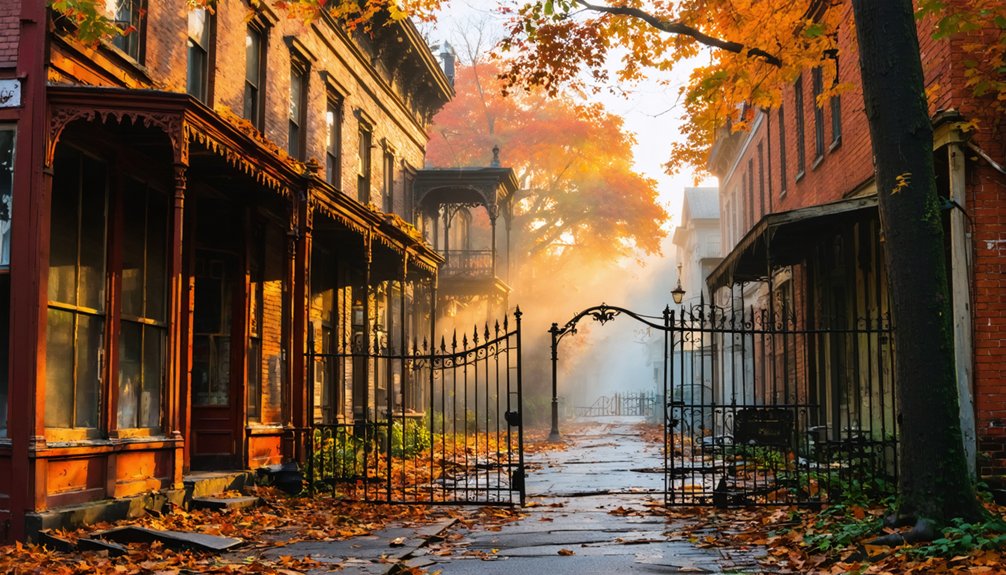
When autumn sets Pennsylvania’s forests ablaze, timing your ghost town exploration becomes as essential as choosing which abandoned settlement to visit.
You’ll find late September through mid-October delivers the most dramatic backdrop for historical site preservation sites like Pithole near Oil Creek State Park, where mowed streets emerge through crimson foliage.
Early October rewards your journey to accessible ruins with peak color intensity, while wildlife photography enthusiasts should arrive at dawn when deer and fox traverse abandoned foundations.
Check Pennsylvania DCNR Fall Foliage Reports weekly—conditions shift rapidly across elevations.
Pack layers for fluctuating mountain temperatures, and explore weekdays to escape crowds at popular sites like Jim Thorpe’s ghost tours.
Your freedom lies in wandering forgotten paths where history and nature intertwine without barriers.
Frequently Asked Questions
Are Pets Allowed When Visiting Pennsylvania Ghost Towns During Fall Foliage Season?
Yes, you’ll find pets welcome at Pennsylvania’s ghost towns during fall foliage season. Follow pet etiquette by respecting leash requirements under six feet, letting your companion explore crumbling foundations while amber leaves crunch underfoot in these forgotten places.
These locations not only provide a picturesque backdrop for exploring with your pet but also serve as unique ghost towns for film production in Pennsylvania. The eerie atmosphere and historical charm make them ideal for filmmakers looking to capture the essence of a bygone era. As you stroll through the remnants of these towns, imagine the stories that could be told on screen.
What Photography Equipment Works Best for Capturing Ghost Towns in Autumn?
Like a painter choosing brushes, you’ll need smart lens selection—wide-angles for expansive ruins, telephotos for intimate details—paired with tripod stability for those moody, low-light shots. Polarizing filters make autumn colors pop against weathered wood and crumbling stone.
Can You Camp Overnight Near These Pennsylvania Ghost Town Locations?
You’ll find camping near several Pennsylvania ghost towns, where historical preservation meets outdoor adventure. Oil Creek State Park near Pithole offers facilities, letting you explore local legends while autumn leaves crunch beneath your feet during moonlit walks through abandoned streets.
Are Guided Tours Available at These Ghost Towns During Fall Months?
You’ll find absolutely zero guided tours at these ghost towns during fall—they’re wonderfully wild and unstructured. Historical preservation here means freedom to explore independently, though tourist amenities remain minimal. You’ll wander through rustling leaves and crumbling foundations entirely on your own terms.
What Safety Precautions Should Visitors Take When Exploring Abandoned Structures?
You’ll need to assess structural stability before entering—test floors, avoid rotted stairs, and watch for crumbling walls. Always respect trespassing laws by seeking permission first. Wear sturdy boots, bring flashlights, and never explore alone in these decaying remnants.
References
- https://www.visitpa.com/blog/post/when-and-where-view-best-fall-foliage-pa/
- https://aishaurbanescapist.com/fall-in-the-poconos/
- https://pabucketlist.com/my-20-favorite-pa-fall-foliage-destinations-of-2022/
- https://uncoveringpa.com/ghost-towns-in-pa
- https://www.youtube.com/watch?v=uMtEti4E_-Q
- https://www.atlasobscura.com/things-to-do/pennsylvania/ghost-towns
- https://assets.simpleviewinc.com/simpleview/image/upload/v1/clients/pennsylvania/Fall_PA_6240cc8b-7cd9-46a7-b497-2407486644ef.pdf
- https://www.youtube.com/watch?v=_u5MUuwynhw
- https://pabucketlist.com/exploring-the-ghost-town-of-pithole-in-venango-county-pa/
- https://www.travelgumbo.com/pithole-pennsylvania-oil-industry-hometown/