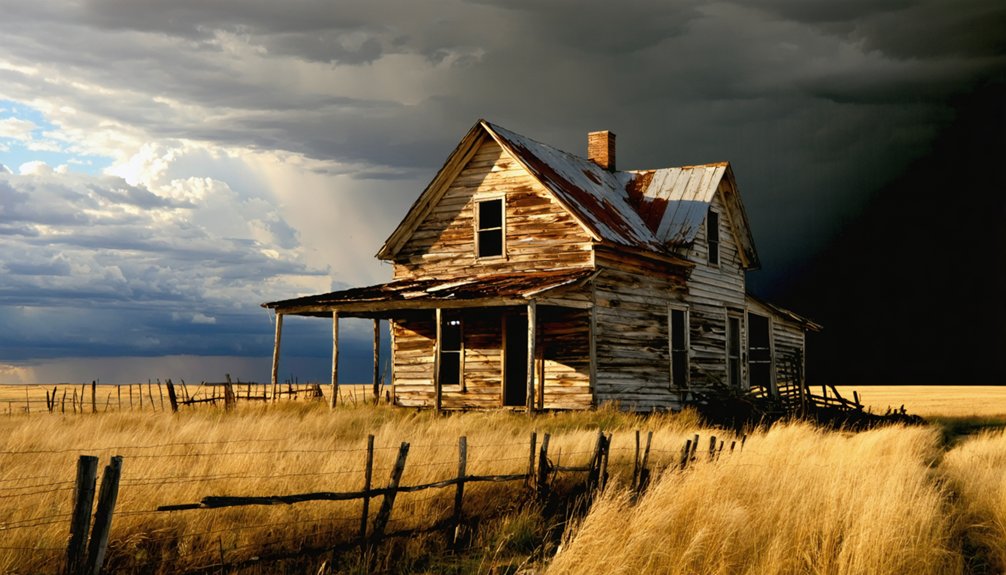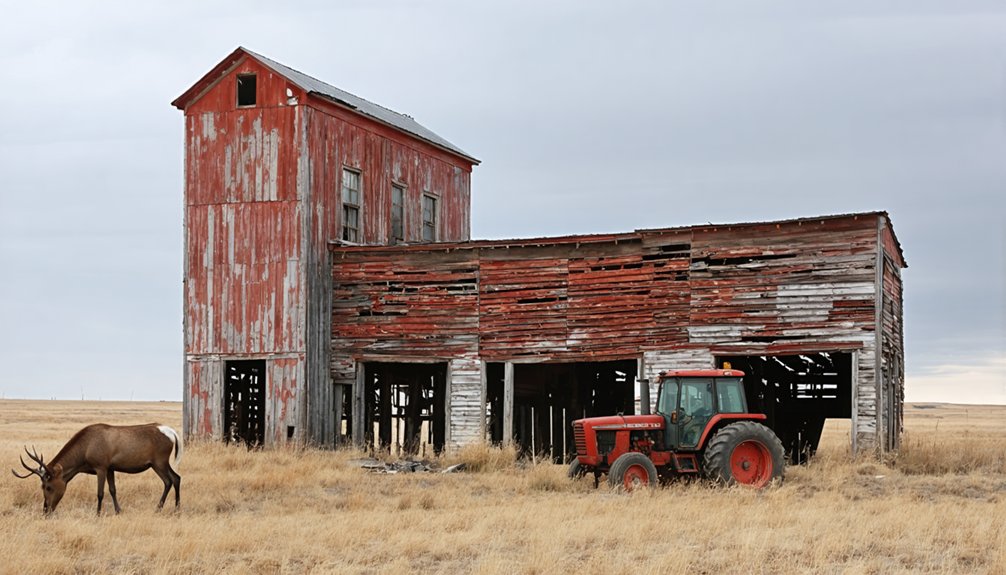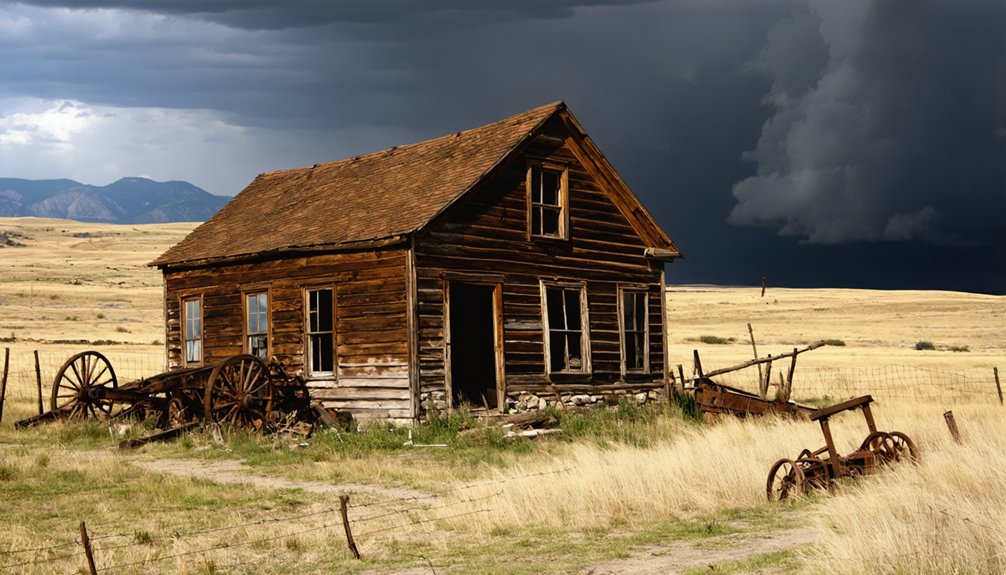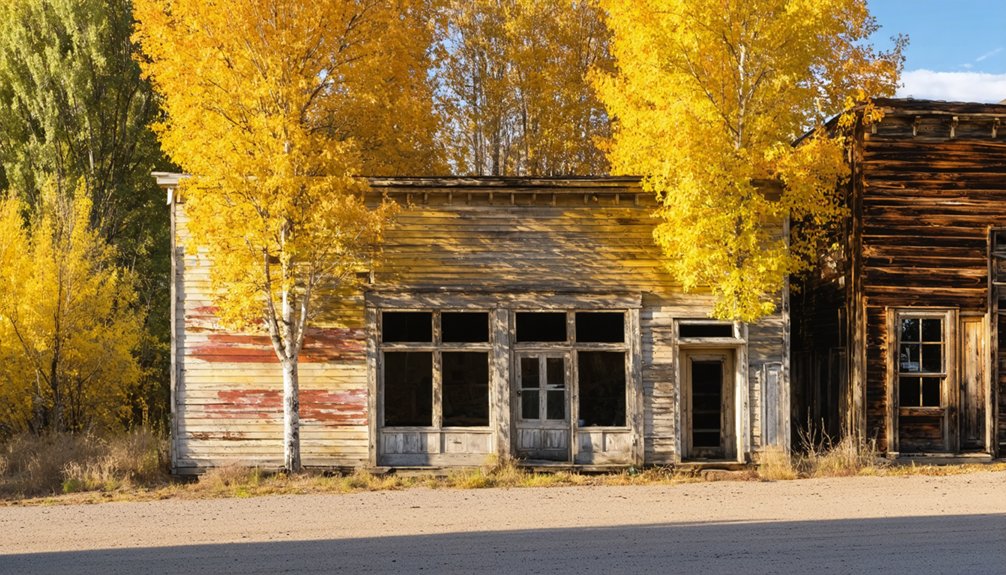
You’ll find South Dakota’s most haunting beauty where rusted mining equipment emerges from golden aspen groves in Spearfish Canyon, best viewed mid-September through early October. Spokane Ghost Town—abandoned since the 1980s—offers weathered structures framed by thousand-foot limestone walls ablaze with autumn color, while Cottonwood’s brick ruins and tiny jail stand sentinel among prairie grasses turning amber. The scenic byway winds past Bridal Veil Falls and over 600 mining sites, where October’s morning light transforms century-old dreams into something worth capturing on camera and in memory.
Key Takeaways
- Spokane Ghost Town, founded in 1890, features rusted mining equipment and historic structures surrounded by golden aspens during autumn.
- Cottonwood Ghost Town displays weathered brick ruins, a wooden church, and charred foundations enhanced by vibrant fall foliage.
- Spearfish Canyon Scenic Byway showcases limestone cliffs, waterfalls, and mining remnants framed by colorful aspen and birch trees.
- Mid-September to early October offers peak foliage viewing with daytime temperatures around 70°F and fewer crowds post-Labor Day.
- Over 600 Black Hills mining sites provide autumn photography opportunities featuring amber and crimson canyon walls with historic ruins.
Spokane Ghost Town: Mining Ruins Among Golden Aspens
The crunch of gravel beneath your boots echoes through the valley as you climb the half-mile rocky road toward Spokane, where rusted mining equipment pokes through stands of golden aspens like skeletal fingers reaching from the past.
Founded in 1890, this Black Hills ghost town shipped nearly $150,000 worth of precious metals during its 1927 peak before abandonment claimed it by the mid-1980s.
From boom to bust in less than a century—Spokane’s golden era peaked in 1927 before silence reclaimed these mountain ruins.
You’ll discover the watchman’s house standing defiant against decay, its first floor still explorable, while vintage cars from the roaring twenties rust beneath flame-colored leaves.
The mine manager’s residence overlooks everything from its hillside perch.
For seasonal photography enthusiasts, autumn transforms these ruins into pure gold.
Historical preservation here means nature’s reclamation—no velvet ropes or guided tours, just raw freedom to wander among glory holes and forgotten foundations.
The trail begins at Spokane Creek Campground, winding through forest where signs point you toward the ghost town remains.
Lead, zinc, and gold once flowed from deep shafts that now stand silent among the autumn landscape.
Cottonwood Ghost Town: Prairie Relics and Seasonal Safety
Where the prairie stretches endlessly toward horizons painted in autumn golds and russets, Cottonwood emerges like a whisper from 1906—a town that time forgot but never quite erased. You’ll find remote photography opportunities among weathered brick ruins where carved initials still tell stories, and that warped wooden church stands defiant against decades of wind.
The tiny jail with visible perspectives through October’s golden light.
But freedom here demands respect. With only twelve residents remaining, you’re walking through someone’s home. Historic preservation isn’t just about admiring relics—it’s recognizing private property boundaries. Three major fires swept through Cottonwood in 1913, 1933, and 1938, leaving scars still visible in the charred brick foundations and skeletal storefronts that dot Main Street.
Fall brings pheasants rustling through tall grass and snakes seeking warmth before winter. The railroad shutdown accelerated the town’s decline, leaving behind the rusting tracks that wind through amber prairie grass. Those overgrown railroad tracks and unstable grain elevator aren’t Instagram props; they’re hazards requiring careful navigation through prairie that’s beautiful precisely because it remains untamed.
Exploring Over 600 Black Hills Ghost Town Sites
You’ll find yourself standing among the skeletal remains of hard rock mining operations—rusted bull wheels groaning in the wind, collapsed stamp mills half-buried in tailings, and timber shaft houses leaning like gravestones over forgotten depths.
The Black Hills cradle over 600 such sites, ranging from Galena’s weathered homes where Sarah Campbell once staked her claim to the foundation traces of Camp Crook now drowned beneath Pactola Lake’s cold waters. These abandoned settlements represent places where past lives and deeds whisper amid ruins, adding to the area’s cultural and historical heritage.
Silver City, which swelled to over 300 residents by 1878 before dwindling to fewer than 100 today, maintained a post office until 1964 as one of the longer-surviving communities. Before you set out on those ATV trails threading through places like Rochford’s Irish Gulch or the 17-minute drive to Spokane’s silver-scarred hillsides, know that autumn’s beauty can’t mask the unstable mine shafts and rotting timbers waiting to collapse under your boots.
Mining Ruins and Remnants
Scattered across more than 600 sites throughout the Black Hills, gaping mine shafts pierce hillsides like dark wounds in the earth, while rust-stained waste piles and eroded tailings spill down slopes in frozen cascades of ochre and gray.
You’ll discover mining history written in the landscape itself—beehive coke ovens at Cambria stand like ancient monuments, their brick arches framing autumn skies.
At Hornblend and Blue Lead, geological formations reveal where hard rock miners chased veins deep underground, replacing surface placer operations that first lured prospectors in 1874.
The Lookout Mine mill on Castle Creek looms as a skeletal cathedral of industry. Original structures include houses, stores, and graves that provide glimpses into the daily lives of those who once worked these unforgiving claims.
These ruins aren’t merely abandoned—they’re testimonies to human ambition carved into unforgiving stone, where fortune-seekers challenged mountains and left their marks forever.
Near Custer, French Creek marks the site where gold was discovered during the 1874 Custer expedition, sparking the mining rush that transformed these 4,500 square miles of sacred Sioux territory into a landscape of industrial ambition.
Safety Tips for Explorers
Before you step into the skeletal remains of these 600+ ghost town sites, understand that the Black Hills don’t forgive carelessness. Gaping mine shafts lurk beneath crumbled foundations at Hornblend and Bald Mountain—test every foothold.
Wildlife precautions become critical when bears prowl Custer County’s Bugtown ruins and rattlesnakes sun themselves in Vanocker Canyon’s fall grasses.
I’ve watched weather turn violent near Pactola Lake in minutes, transforming golden aspen groves into whiteout conditions.
Boundary awareness separates legal exploration from trespassing charges—modern homes dot Galena Road between historical remnants. Photograph from public roads when private property markers appear.
The Forest Service doesn’t patrol remote locations like Camp Bradley frequently, so pack emergency supplies. Sites like Allens Camp in Pennington County recall the 1875-1876 mining rush when prospectors extracted thousands in gold dust from Spring Creek.
Poison ivy hides beautifully among autumn colors, and those eroded tailings? They’ll slide beneath you without warning. At Spokane, located 16 miles from Custer, resist the urge to climb fragile structures despite their seemingly solid appearance—they’ve been deteriorating since the town’s 1940 abandonment.
Spearfish Canyon Scenic Byway: Waterfalls and Historic Mines
You’ll wind through ancient limestone walls that tower a thousand feet above your car, where Bridal Veil Falls cascades down moss-covered rock faces framed by aspen trees turned brilliant gold.
The 19-mile drive along US Highway 14A traces an abandoned railroad grade that once served operations like the historic Golden Reward Mine. Its weathered remnants are still visible among the pines.
Each hairpin turn reveals another waterfall or crumbling mining structure, their stories etched into canyon walls that glow amber and crimson under the autumn sun.
Bridal Veil Falls Views
Cascading 60 feet down a sheer granite cliff, Bridal Veil Falls transforms Spearfish Canyon into a mist-veiled corridor where water meets stone in perpetual dance. You’ll find this natural wonder right off Highway 14A, nine miles south of Spearfish, where a viewing platform offers intimate encounters with the falls’ ethereal spray.
Spring runoff amplifies the spectacle, though late summer reveals delicate veils of water perfect for capturing local wildlife drawn to the creek below. Photography tips: arrive early when soft light penetrates the canyon’s depths.
For the adventurous:
- Descend boulder “stairs” left of the platform
- Wade Spearfish Creek in water shoes
- Explore Devil’s Bathtub trailhead a quarter-mile north
The roadside location means you’re minutes from freedom, trading your vehicle for canyon solitude.
Golden Reward Mine Remnants
The scent of autumn pine gives way to something metallic as you wind four miles south of Lead, where rusted machinery and crumbling stone foundations mark the Golden Reward Mine‘s century-old scar on Terry Peak’s flank. You’ll find remnants of the 1894 chlorination plant scattered among golden aspens—concrete walls dissolving back into earth, oxidized equipment strangling in brush.
This was gold mining stripped raw: cyanide processing, heap leaching, 280,000 ounces extracted before abandonment. The historical relics speak of boom-and-bust freedom—prospectors chasing fortune at 5,801 feet, building empires that collapsed like rotted timber.
Walk carefully around the weathered structures. These ruins don’t charge admission or demand permits. They simply exist, crumbling monuments to ambition’s impermanence, framed perfectly by October’s crimson oak leaves.
Prime Fall Foliage Viewing Locations in the Black Hills
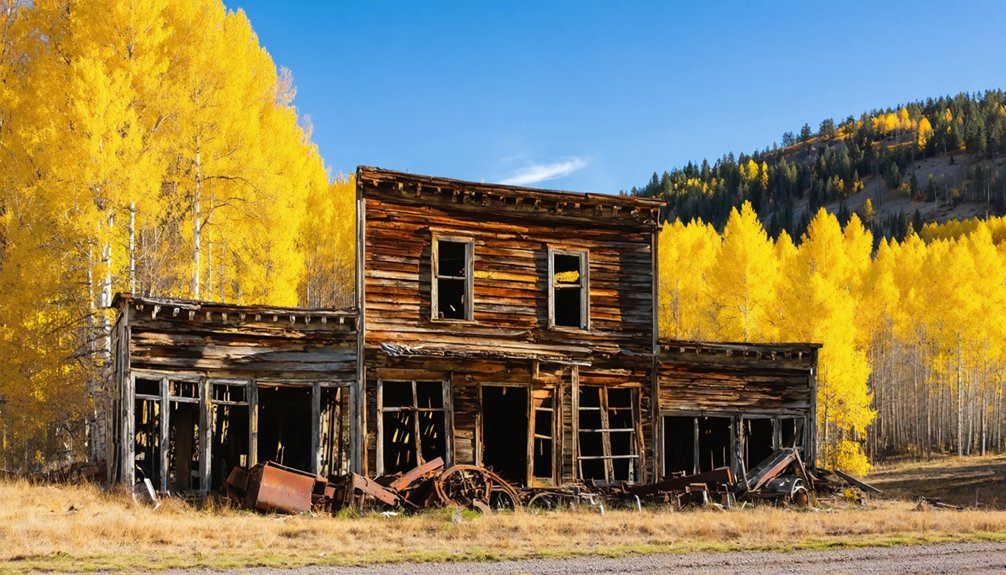
When autumn transforms the Black Hills into a kaleidoscope of gold and crimson, few experiences rival the journey through Spearfish Canyon Scenic Byway.
You’ll find yourself surrounded by aspen and birch blazing against rugged limestone cliffs, while native wildlife prepares for seasonal weather shifts ahead.
The 59-mile Black Hills Parkway lets you chart your own course between Custer and Deadwood, where oak and ash paint the slopes overlooking Sheridan Lake.
For reflection-doubled beauty, Sylvan Lake mirrors the surrounding autumn glory.
Hit the trails for unfiltered freedom:
- Roughlock Falls offers 2 miles of accessible canyon exploration
- Hell Canyon’s 5.5-mile path winds through regenerated aspen groves
- Horsethief Lake Trail delivers 2.7 miles of wilderness solitude
Peak colors ignite September 30 through October 5—your window awaits.
Best Times to Visit Ghost Towns During Autumn
Timing your ghost town expedition means dancing with South Dakota’s fleeting autumn window—blink and you’ll miss those perfect golden days. Mid-September through early October delivers peak autumn foliage when aspen and birch ignite against weathered timber ruins. You’ll find September’s 70-degree days ideal for wandering abandoned streets post-Labor Day, as crowds vanish like the towns themselves.
October shifts cooler—50s and 60s—but rewards you with fiery reds and golds framing decaying structures, perfect for seasonal photography. Dawn breaks around 6:45, gifting you sixteen hours of golden light to capture peeling paint against amber leaves. Late October brings solitude seekers, minimal crowds, and lingering color.
Pack layers, chase that crisp air, and let South Dakota’s ghost towns reveal themselves in autumn’s brief, brilliant transformation.
Notable Abandoned Towns: Ardmore, Okaton, and Oakton
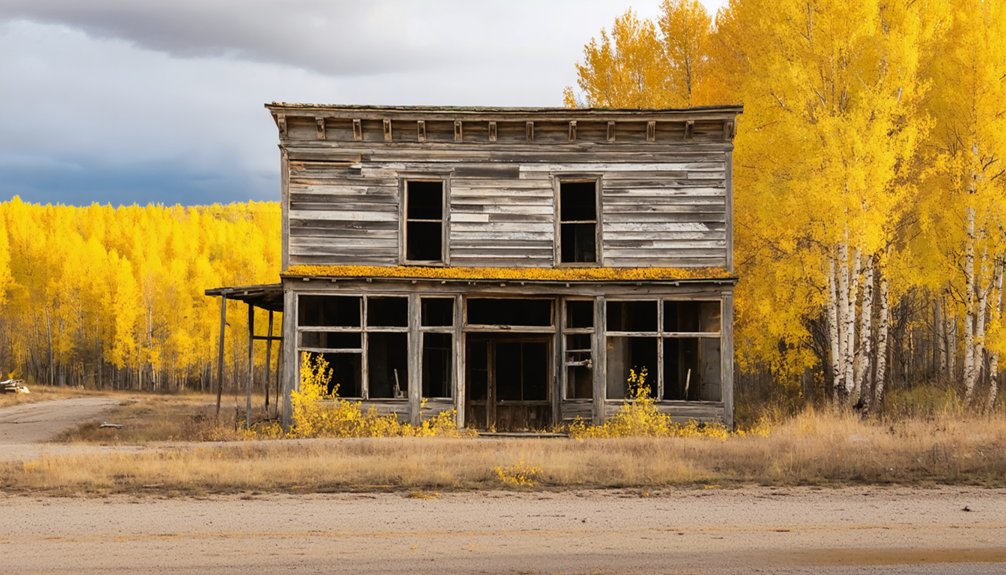
Along Highway 71, just one mile from where South Dakota surrenders to Nebraska, Ardmore clings to existence with a single resident and the ghosts of sixteen others who’ve scattered since 1980. Between fifteen and twenty-five abandoned houses stand as seasonal sanctuaries where autumn winds whistle through broken windows, painting peeling clapboards with rust and gold.
These notable ghost towns offer different faces of abandonment:
- Ardmore — Where Calvin Coolidge once picnicked in 1927, and a white experimental farm barn still watches from the hill
- Okaton — Jones County’s eerie skeleton, barely standing after railroad collapse
- Oakton — South Dakota’s forgotten mystery, lacking even basic records
You’ll find minimal historical preservation here—just raw decay meeting prairie sky, freedom from crowds, and unfiltered access to America’s abandoned dreams.
Planning Your Ghost Town and Fall Color Adventure
Before you load your camera and lace your hiking boots, understand that South Dakota’s ghost towns demand respect for both their dangers and their dying beauty. Plan autumn explorations when rattlesnakes retreat and aspens blaze gold—Spokane’s particularly stunning with sun-dappled ruins beneath vibrant canopies. Cool months offer safer wandering through Cottonwood’s collapsing structures and prairie remnants.
Watch for concealed holes and sharp metal lurking in tall grass. Never enter decaying buildings; capture vintage photographs from exterior vantage points instead. These crumbling foundations represent more than picturesque decay—they’re fragile monuments deserving historic preservation consideration.
Route your adventure strategically: pair Galena’s June event with Deadwood’s nearby attractions, or combine Spokane with Iron Mountain Road‘s scenic drive. Over 600 Black Hills sites await your discovery, each whispering stories through wind-blown grasses and weathered wood.
Frequently Asked Questions
Are Ghost Town Sites on Private Property or Open to Public Access?
Ghost town access varies wildly—you’ll find some offering unrestricted public access where you can roam freely, while others sit on private land requiring permission. Always research beforehand; respecting boundaries guarantees future explorers maintain these freedoms too.
What Photography Equipment Works Best for Capturing Autumn Ghost Town Scenes?
Like a painter’s brush capturing fleeting light, you’ll need thoughtful lens selection—wide-angles for expansive ruins—and tripod essentials for crisp details. I’ve found lightweight carbon fiber models liberate your wandering spirit while steadying those golden-hour shots perfectly.
Can Visitors Enter the Abandoned Buildings or Only View From Outside?
You’ll mostly view buildings from outside, as historical preservation and safety considerations restrict interior access. However, you’re free to explore exteriors where weathered wood frames autumn gold—each peeling paint layer telling stories of frontier lives once lived here.
Are There Guided Tours Available for Black Hills Ghost Town Exploration?
You’ll find several guided tour benefits exploring Black Hills ghost towns—from Geofuntrek’s customizable adventures to ToursByLocals’ private experiences. Expert guides guarantee historical accuracy while you’re hiking unmarked trails, uncovering forgotten settlements where autumn leaves blanket crumbling foundations.
What Camping Options Exist Near Multiple Ghost Town Locations?
You’ll discover rustic camping scattered like autumn leaves across Black Hills—dispersed sites near Spokane’s ruins, primitive spots by Cottonwood’s prairie, and backcountry permits at mining camps where historical preservation meets your untamed spirit seeking complete independence.
References
- https://www.worldatlas.com/places/7-autumn-ready-south-dakota-towns-for-a-weekend-retreat.html
- https://tranquiltrekker.com/spokane-sd-ghost-town/
- https://www.youtube.com/watch?v=HLH0vw2tVJs
- https://www.sdpb.org/rural-life-and-history/2023-08-21/some-black-hills-ghost-towns-and-their-origins
- https://www.onlyinyourstate.com/trip-ideas/south-dakota/best-ghost-town-in-autumn-sd
- https://www.sdhspress.com/journal/south-dakota-history-2-2/some-black-hills-ghost-towns-and-their-origins/vol-02-no-2-some-black-hills-ghost-towns-and-their-origins.pdf
- https://en.wikipedia.org/wiki/List_of_ghost_towns_in_South_Dakota
- https://www.atlasobscura.com/things-to-do/south-dakota/ghost-towns
- https://www.travelsouthdakota.com/trip-ideas/fall-colors-viewing-guide
- https://myxoadventures.com/the-ghost-town-of-spokane-south-dakota/