You’ll find Tennessee’s most atmospheric ghost towns wrapped in autumn gold at Elkmont, where Victorian cottages from the 1830s peek through vibrant fall foliage along Jake’s Creek Trail. At Big Ridge State Park, Loyston’s submerged foundations emerge during lake drawdowns, framed by late October colors. Weathered chimneys at Big Greenbrier and Salem-Overall stand sentinel among kudzu-draped ruins, while Mousetail Landing’s riverboat relics glow against Perry County’s autumn corridor. The seasonal transformation turns these abandoned settlements into living history lessons, and there’s much more waiting beyond each trailhead.
Key Takeaways
- Elkmont features Victorian cottages and restored craftsman structures amid vibrant autumn colors, accessible via Jake’s Creek and Cucumber Gap trails.
- Big Greenbrier offers stone schoolhouses, log cabins, and moss-covered springhouses surrounded by peak fall foliage in late October.
- Loyston’s submerged ruins beneath Norris Lake become visible during drawdowns, framed by colorful autumn scenery at Big Ridge State Park.
- Mousetail Landing preserves Civil War-era ruins along Tennessee River corridors with 11 miles of trails showcasing brilliant fall colors.
- Salem-Overall area displays lone chimneys and Methodist Church remnants providing photo opportunities against vibrant seasonal landscapes.
Elkmont: Historic Cabins Among Smoky Mountain Autumn Colors
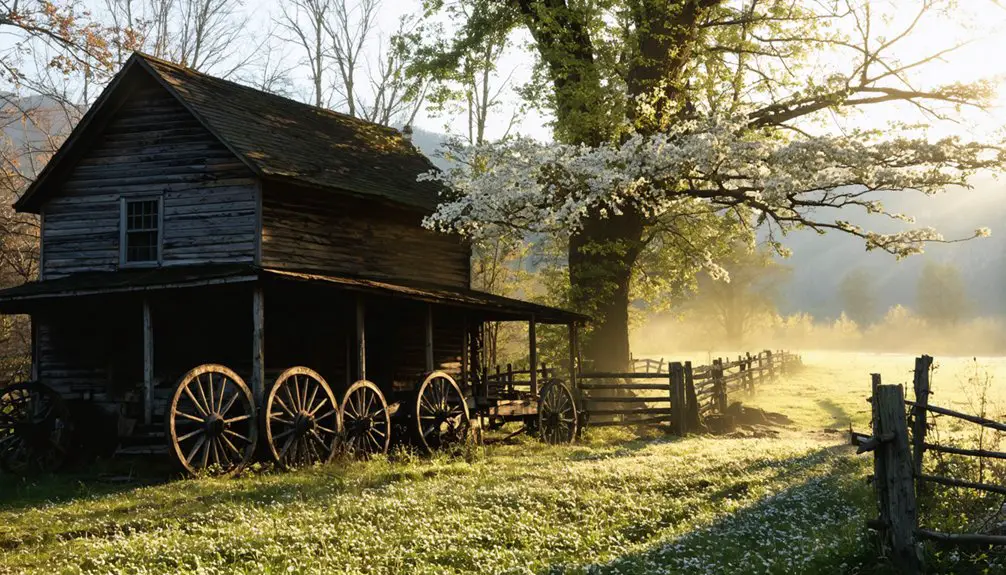
Where else can you wander through painted Victorian cottages frozen in time while golden hickories and scarlet maples frame weathered porches? Elkmont’s Daisy Town delivers exactly that—16 restored structures showcasing craftsman-style architecture with extravagant colors that pop against autumn’s canvas.
You’ll discover the 1830 Levi Trentham Cabin and explore the Appalachian Clubhouse, fruits of the National Park Service’s 15-year preservation efforts completed in 2024.
Hit the Jake’s Creek Trail (2 miles round-trip) to reach the Avent Cabin, where artist Mayna Avent once painted. The creek itself honors Jacob Hauser, an early valley resident who helped settle the area in the 1840s.
While haunted legends whisper through these former vacation retreats of Knoxville businessmen, you’re free to roam exteriors and imagine life in what was once Sevier County’s second-largest town. The area’s transformation began when the Little River Lumber Company established operations here in 1910, eventually evolving into a resort community with vacation homes.
Pack your camera—October’s peak foliage transforms this ghost town into pure magic.
Loyston: Underwater Ruins at Big Ridge State Park
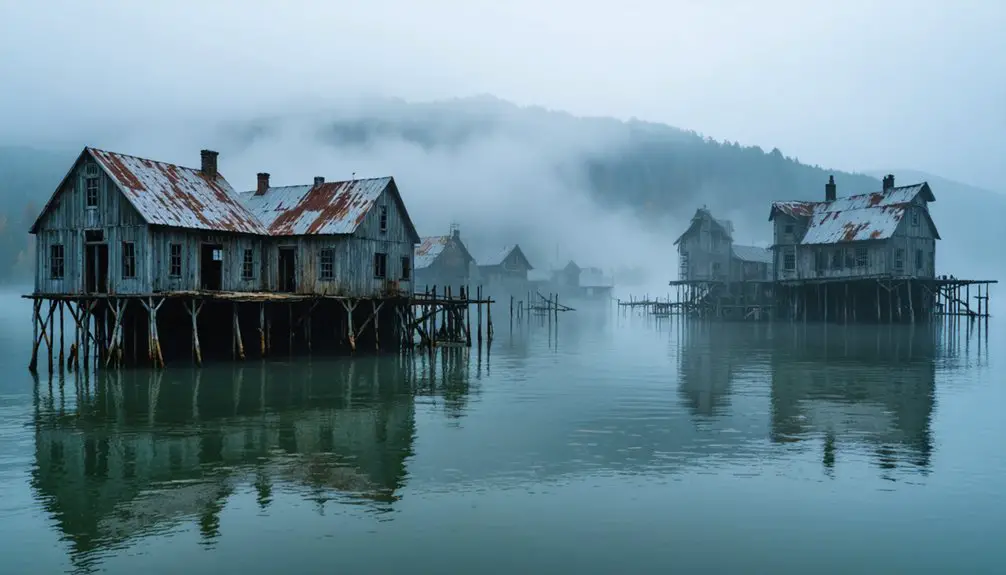
Beneath the tranquil waters of Norris Lake lies Loyston, a once-thriving trading center that vanished when the Tennessee Valley Authority completed Norris Dam in 1936.
You’ll find the widest section of the lake—called Loyston Sea—where 70 residents once called home. The submerged architecture rests 60 to 90 feet below, depending on water levels.
Big Ridge State Park offers your gateway to this underwater archaeology site:
- Hike Ghost House Loop to Maston Hutchinson’s former haunted house location
- Explore 1800s cemeteries scattered throughout park trails
- Visit Norton Grist Mill showcasing valley history
- Watch for drawdowns revealing foundations beneath the surface
- Drive scenic Highway 61 along Loyston Dike
The 3,600-acre park’s fall foliage frames where Mill Creek Valley once flourished, letting you glimpse freedom lost to progress. The park sits within the Appalachian Ridge and Valley range, where three ridges rise sharply from the lake and descend into fertile valleys below. The community was originally known as Ly Crossroads in the early 19th century before being renamed Loyston around 1894, growing around a foundry built by John L.
Mousetail Landing: Lakeside Legends and Tannery Remains
While Norris Lake’s waters swallowed Loyston’s past, the Tennessee River at Mousetail Landing State Park preserved a stranger piece of history—one born from fire, fur, and folklore.
You’ll find yourself walking among blacksmith shop ruins and tannery remains where a Civil War-era blaze supposedly sent rodents flooding toward the riverbank. That quirky legend named this 1,247-acre wilderness escape, but the real draw is exploring authentic riverboat history along preserved pier foundations.
Marine archaeology enthusiasts can examine original landing structures while autumn transforms Perry County’s eastern river corridor into blazing color. The park’s 11 miles of trails wind past Parrish Cemetery and through October’s golden canopy, offering solitude that modern crowds haven’t ruined. Rangers lead monthly wildlife programs featuring resident animal ambassadors like Eastern Screech Owls and Red-Tailed Hawks that can’t be returned to the wild.
With 250,000 annual visitors, you’ll still find empty campsites along Spring Creek’s riverfront—especially midweek. The park’s limestone bedrock provides stable foundations for both hiking trails and the preserved historical structures scattered throughout the grounds.
Big Greenbrier: Stone Structures Reclaimed by Nature
You’ll find Big Greenbrier’s stone schoolhouse and log cabins standing defiant among the crimson and gold leaves that now claim this mid-1800s settlement. The autumn vines crawl up weathered walls where Walker Sisters once tended their homestead.
Maple trees burst with orange fire around the simple desks still arranged inside the 1882 schoolhouse. When October arrives, nature transforms these structures into a photographer’s dream—moss-covered springhouses framed by scarlet dogwoods, and cemetery stones half-hidden beneath drifts of fallen yellow poplar leaves. The well-maintained paths wind through gentle hills, making this an accessible trek for those seeking both history and natural beauty. The area’s proximity to Great Smoky Mountains National Park has made it a destination for ghost hunters and history enthusiasts since the 1930s.
Historical Settlement Remnants
Deep in the Greenbrier section of the Smokies, nature steadily reclaims what mountain families built with their own hands over a century ago. You’ll discover stone chimneys standing sentinel among towering oaks, their hearths cold since the 1930s buyouts displaced over 800 residents.
Feral livestock descendants occasionally wander past crumbling foundations where self-sufficient settlers once thrived.
The remnants tell powerful stories:
- Springhouses mark mineral sources where families kept milk cold
- Rock walls border vanished gardens and property lines
- Cemetery stones display weathered names from the 1800s
- Log cabin ruins showcase Appalachian craftsmanship and resourcefulness
- Old roadbeds wind through forest reclaiming former farmsteads
These ghost settlement traces offer freedom-seekers tangible connections to pioneering independence, especially stunning when framed by October’s blazing foliage. The community once supported local churches, schools, stores, sawmills, and even a hotel before park creation forced families to relocate. A 1.5-mile roundtrip trail from Metcalf Bottoms leads to the 1882 Little Greenbrier School, where headstones mark the final resting places of the mountain community that once gathered for both education and worship.
Autumn Vegetation Overgrowth
Those abandoned homesteads don’t simply fade into the forest—autumn’s explosion of color reveals just how aggressively nature reclaims what settlers left behind. You’ll find stone chimneys strangled by kudzu’s crimson leaves and foundations buried beneath Japanese honeysuckle’s golden vines.
These invasive species dominate disturbed sites faster than native vegetation can recover, transforming ghost towns into nearly impenetrable tangles.
The Greenbrier area demonstrates this takeover perfectly. Trail crews recently pruned overgrown vegetation along Ramsey Cascades Trail, clearing paths that’d vanished beneath autumn olive and multiflora rose.
Without proper vegetation management, these historic sites become completely inaccessible by late October when foliage peaks.
When you’re exploring, watch for ailanthus trees and pawlonia—their brilliant fall colors mask how they’re preventing native forest regeneration around old settlements.
Sunshine: Railroad Ghost Town Near Cades Cove
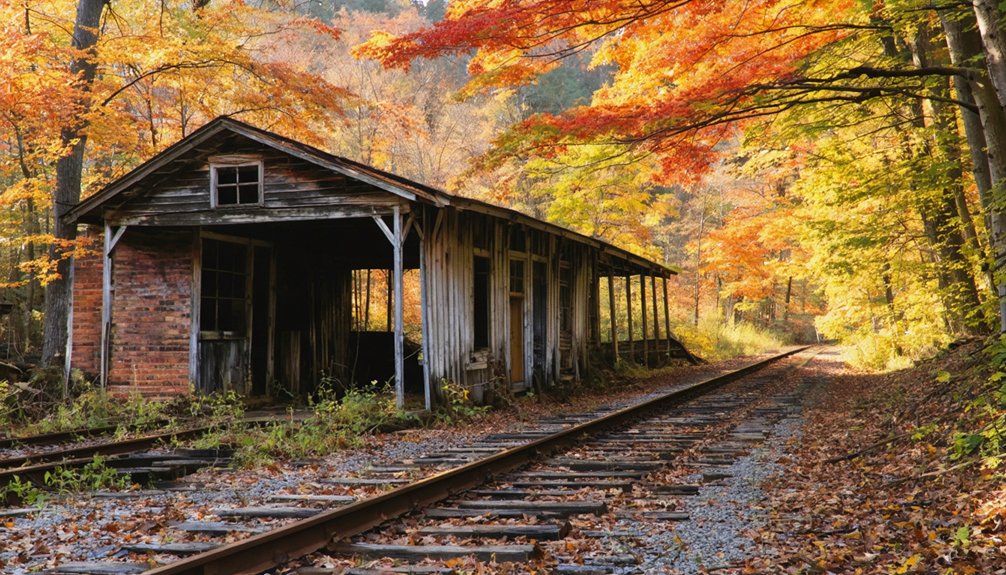
Though its name evokes bright sunlight, Elkmont’s story begins in shadow—tucked along Jakes Creek where Robert Trentham built his cabin in the 1830s, long before lumber barons and railroad tracks transformed this quiet settlement into something far grander.
You’ll discover railroad nostalgia threading through weathered structures along SR 231, where the “Elkmont Special” once delivered Knoxville’s elite to Millionaire’s Row.
Today’s preservation efforts showcase sixteen restored buildings:
- Levi Trentham Cabin from the 1830s, carefully relocated
- Avent Cabin, pre-1845, one mile on Jakes Creek Trail
- Wonderland Hotel cottages in Daisy Town
- Stone chimneys marking vanished homesteads
- Appalachian Clubhouse foundations
Navigate freely from Elkmont Campground through autumn-gilded paths where lumber wealth once reigned, then faded into Great Smoky Mountains National Park history.
Wheat: Manhattan Project Era Settlement Remnants
When the U.S. Army Corps of Engineers swept through Oak Ridge in October 1942, they erased entire communities overnight. You’ll find Wheat among these vanished settlements, where families received eviction notices on their doors without explanation. Children learned through their school principal they’d relocate for the war effort.
Today, you can explore this industrial heritage site where the Manhattan Project‘s secretive development displaced thousands. The location’s remoteness—20 miles from Knoxville—made it perfect for classified operations.
By 1945, Oak Ridge had exploded from 3,000 residents to 75,000, becoming Tennessee’s fifth-largest city.
Walk these grounds during fall, and you’ll discover crumbling foundations beneath brilliant foliage where farms once thrived along Emory Road before vanishing into atomic history.
Salem-Overall: Hidden Chimneys in the Murfreesboro Landscape
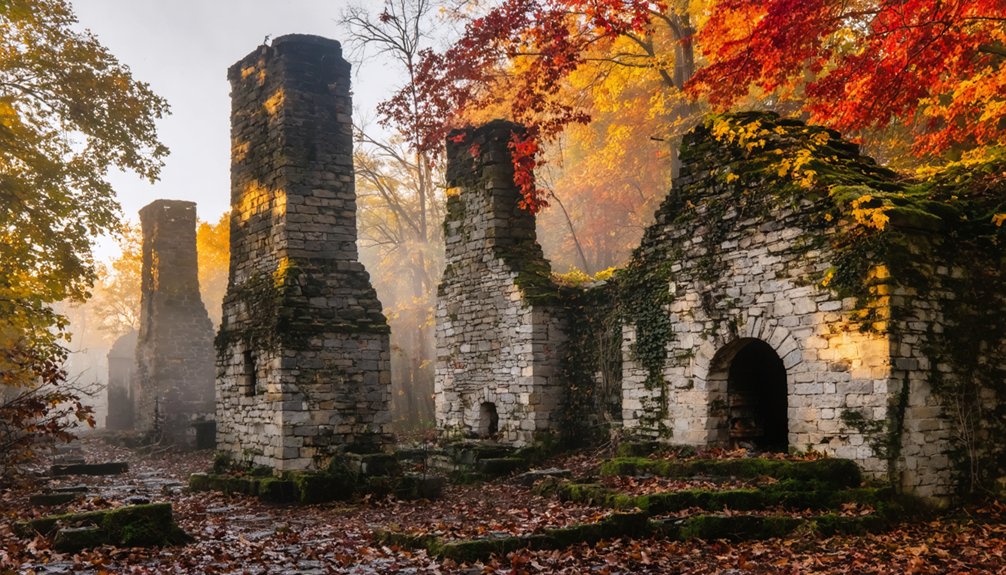
The lonely chimney rising from a Middle Tennessee field tells stories your GPS can’t capture. You’ll find this sentinel of Salem-Overall at I-24 exit 80, where Murfreesboro’s sprawl hasn’t completely erased the 1800s township.
Where modern highways meet forgotten settlements, a solitary chimney guards memories that sprawl and progress haven’t managed to pave over.
The Lillyard Estate chimney stands defiant against development, offering landscape photography opportunities framed by autumn’s gold and crimson palette.
What You’ll Discover:
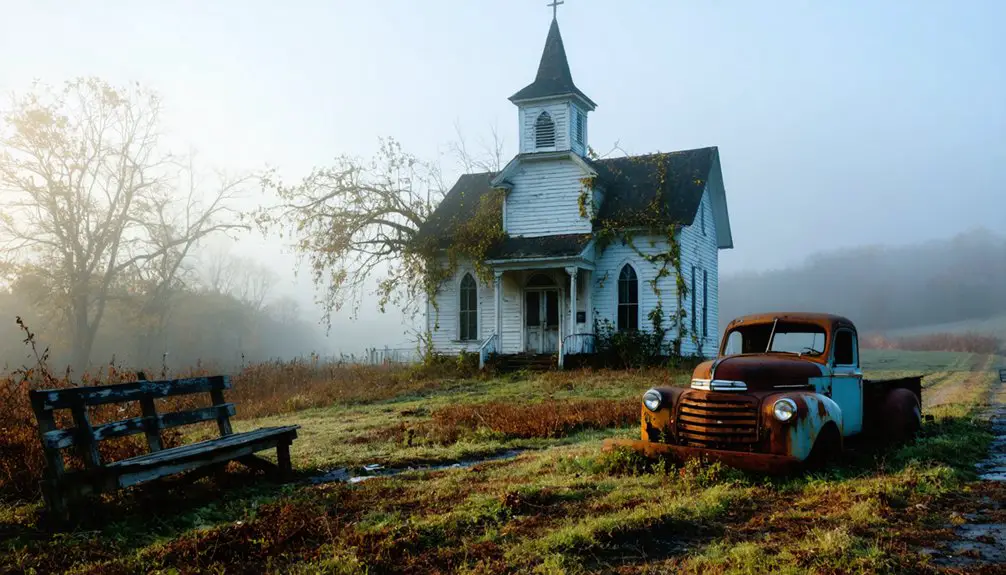
- Historic Methodist Church from 1812 still standing
- Solitary chimney in eastern field (chimney preservation at its simplest)
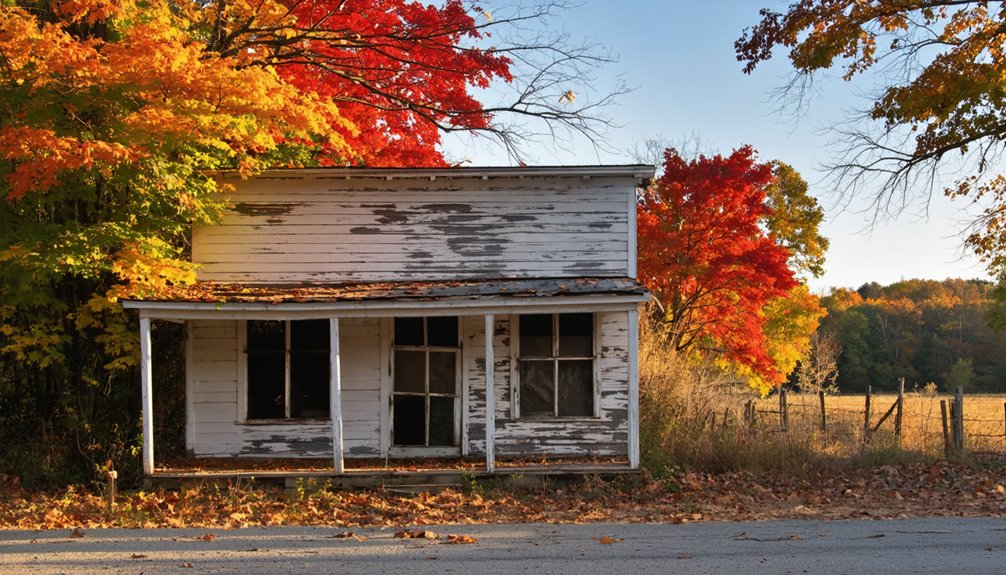
- Early 1900s country store remnants
- Three-way intersection replacing the old gathering spot
- Occupied houses mingling with ghost town fragments
Visit during October when fall foliage transforms this subtle site into something worth capturing.
You won’t find dramatic ruins here—just honest remnants of pioneer life refusing to vanish completely.
Best Trails for Accessing Tennessee Ghost Towns in Fall
You’ll find Elkmont’s ghost town accessible through Jakes Creek Trail, where crumbling stone foundations peek through crimson maple leaves just steps from the parking lot. The path connects to Cucumber Gap Trail, climbing nearly 3,000 feet before dropping you onto Little River Trail—a route lined with moss-covered chimneys that once warmed logging families now surrounded by golden hickory canopies.
For a quick immersion in haunted history, tackle Elkmont Nature Trail‘s 20-minute loop through laurel thickets, where autumn light filters onto the forest floor that loggers once cleared a century ago.
Elkmont Historic Trail Routes
Exploring Elkmont’s abandoned structures becomes far more rewarding when you know which trails deliver the best combination of ghost town ruins and spectacular fall color.
You’ll discover the restored Levi Trentham cabin and crumbling stone walls along Jakes Creek Trail, where ghost town mysteries unfold through chimneys and foundations hidden among autumn leaves. The Little River Trail follows an old railroad bed past former Elkmont cabins, offering river views framed by October’s crimson and gold.
Essential Elkmont routes:
- Daisy Town paths wind through 16 preserved vacation cottages on flat terrain
- Cucumber Gap Trail climbs to 3,000 feet through forests ablaze with color
- Fighting Creek Gap Road provides flat 0.8-mile access to abandoned resort remnants
- Huskey Branch Falls connection via interconnected trail system
- Appalachian Clubhouse and Wonderland Hotel sites accessible from parking area
Big Greenbrier Settlement Paths
Just six miles east of Gatlinburg’s crowds, Big Greenbrier’s forgotten settlement paths transport you to a mountain community that thrived for generations before the park’s creation.
You’ll discover two distinct routes from the picnic area bridges: Old Settlers Trail stretches 15.9 miles east past cemeteries and homesites along Copeland Creek, while Grapeyard Ridge Trail meanders 7.6 miles west through quieter forests.
Historic trail markers distinguish Old Settlers from typical park paths, guiding you to old settlement artifacts like fallen fireplaces and fieldstone foundations.
The Parton Cemetery spur offers particularly poignant autumn views. These smoother paths wind through deciduous forests ablaze with October color—massive oaks and tulip poplars frame your journey through what once housed dozens of mountain families before displacement.
Planning Your Autumn Ghost Town Adventure
When autumn transforms Tennessee’s ghost towns into a photographer’s paradise, timing becomes everything. You’ll want to hit these forgotten settlements between early and mid-autumn when the foliage peaks and cooler temperatures make exploration comfortable.
Pack essentials for your adventure:
- Camera gear with extra batteries for capturing historic structures against blazing fall colors
- Hiking boots for traversing trails to remote cabin ruins and crumbled chimneys
- Layered clothing since morning mist gives way to warmer afternoons
- Seasonal picnic supplies to enjoy lunch among the wilderness
- Binoculars for spotting autumn wildlife moving through the colorful canopy
Plan full-day excursions to truly experience these sites.
Jake Creek parking areas provide closest access to major structures, while nearby campgrounds offer convenient overnight stays for multi-day exploration.
Frequently Asked Questions
Are There Entrance Fees for Visiting Tennessee Ghost Towns in State Parks?
Most Tennessee ghost towns don’t charge entrance fees, giving you freedom to explore. You’ll find historical preservation efforts at accessible sites where drone photography captures stunning aerial views of abandoned structures amid vibrant fall colors.
Can I Camp Overnight Near Ghost Town Sites During Fall Season?
Yes, you’ll find autumn camping at Elkmont Campground steps from the ghost town. Book early—fall foliage draws crowds fast. You’ll wake to golden leaves framing weathered cabins, giving you sunrise access before day-trippers arrive.
Are the Ghost Town Trails Suitable for Children and Families?
Yes, ghost town trails are excellent for families! You’ll find family friendly hikes like the easy 1.2-mile Ghost House Loop, plus engaging children’s historical tours through Elkmont’s preserved cabins. Kids love exploring the “magical” cemetery and homestead remnants together.
What Wildlife Might I Encounter While Exploring Tennessee Ghost Towns?
You’ll spot native birds like wild turkeys and great blue herons near ghost towns, plus woodland mammals including white-tailed deer and beavers. I’ve encountered turtles, songbirds, and even bald eagles while exploring these forgotten places—nature’s reclaimed them beautifully.
Do I Need Special Permits to Photograph the Historic Structures?
You don’t need permits for legal photography at most Tennessee ghost towns, but check drone regulations before flying—state parks often restrict them. Shoot freely on public land, respecting posted signs and private property boundaries for hassle-free exploration.
References
- https://www.tnvacation.com/trip-inspiration/articles/ghost-towns-tennessee
- https://www.theroamingdad.com/our-adventures/elkmont
- https://www.onlyinyourstate.com/experiences/tennessee/tn-ghost-towns
- https://hikinginthesmokymountains.com/blog/reasons-visit-elkmont-ghost-town/
- https://www.pigeonforge.com/elkmont-ghost-town/
- https://www.visitmysmokies.com/blog/smoky-mountains/about-elkmont-ghost-town/
- https://www.youtube.com/watch?v=abn43yeDmfE
- https://www.appalachianhistory.net/2014/07/ghost-towns-cumberland-plateau.html
- https://www.visitmysmokies.com/blog/smoky-mountains/historic-cabins-in-elkmont-ghost-town-now-open-after-restoration/
- https://smokymountainnationalpark.com/blog/avent-cabin-in-elkmont-tennessee/