You’ll find excellent ghost town gift shops at Arizona’s Goldfield, where the Blue Nugget and General Store sell mining memorabilia and handcrafted pottery, and throughout California’s gold country—Downieville, Sutter Creek, and Angels Camp offer antiques and local crafts in historic buildings. These shops blend authentic frontier items like gold nugget pendants and vintage tools with nostalgic souvenirs, fudge, and regional artwork. Summer offers full access with 10am openings, while winter weather may close mountain routes, so check conditions beforehand for the complete experience.
Key Takeaways
- Arizona’s Goldfield Ghost Town offers authentic souvenirs at Blue Nugget and General Store, featuring mining merchandise, Indian jewelry, and handcrafted pottery.
- California mining towns like Downieville, Sutter Creek, and Angels Camp house gift shops in historic gold rush structures selling antiques and collectibles.
- Ghost town gift shops stock eclectic items including folk art, handmade fudge, fossils, vintage signage, and regional Southwest pottery.
- Jerome and Virginia City combine shopping with attractions like artist galleries, haunted tours, and preserved Victorian architecture for complete visitor experiences.
- Summer provides full access with daily hours from 10am; winter visits require checking conditions due to seasonal closures and weather restrictions.
Arizona’s Goldfield Ghost Town Shopping Experience
While most ghost towns crumble into dust and memory, Goldfield refuses to fade quietly into Arizona’s desert landscape. You’ll discover this reconstructed 1890s mining town perched between the Superstition and Goldfield Mountains, forty miles east of Phoenix, where commerce thrives alongside history.
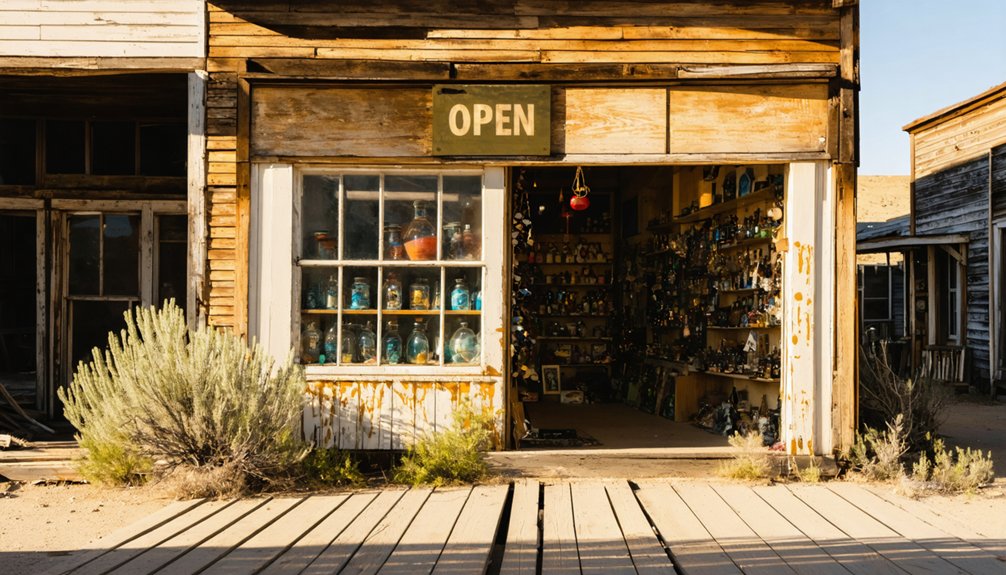
The Blue Nugget and General Store anchor your shopping adventure, offering authentic souvenirs that capture the Old West’s rebellious spirit. You’re not browsing corporate chains here—you’ll find vintage collectibles nestled among mining-themed merchandise that honors the four thousand souls who once called this place home. Beyond antiques, you can browse Indian jewelry, paintings, and handcrafted mud pottery that reflect the region’s cultural heritage. The apothecary carries natural body products that bring a touch of Old West wellness to modern life.
Even the Mammoth Saloon blends retail with genuine frontier atmosphere, while the mine tunnel’s snack bar lets you grab provisions like prospectors did generations ago. This isn’t preserved history—it’s living, breathing freedom.
California’s Historic Mining Towns and Their Retail Offerings
Long before California’s tech giants minted digital fortunes, its mountain towns struck gold the old-fashioned way—with picks, pans, and desperate hope. Today, you’ll find their stories preserved in storefronts where museum exhibits meet commerce.
Downieville’s 1852 stone store survived fires that consumed wooden competitors, now displaying claim maps alongside gift shop wares. In Sutter Creek, you’ll browse Main Street’s retail offerings housed in structures funded by Motherlode wealth. Angels Camp balances history with hospitality—explore wagon collections, then grab lunch at Pickled Porch Cafe or hunt treasures at Nellie Lou’s Antiques. Weaverville’s Jake Jackson Museum pairs stamp-mill demonstrations with exhibits on mining history and Chinese-American heritage.
These weren’t ghost towns that died; they evolved:
- Placerville transformed from “Hangtown” vigilante camp to transportation hub
- Sonora shrunk from 15,000 miners to under 5,000 determined locals
- Historic architecture now shelters modern enterprises
Nevada City blends preservation with commerce along Highway 49 Scenic Route, where the National Hotel—one of the oldest continually operating hotels in the west—welcomes visitors exploring gold rush heritage. You’re walking where fortunes were won and lost.
What You’ll Find in Ghost Town Gift Shops and Trading Posts
Step through a ghost town trading post and you’ll encounter capitalism’s oddest archaeology—where $600 folk art whirligigs share shelf space with $42 ceramic decanters shaped like tombstones.
These repositories of frontier commerce blend authentic oddities with calculated nostalgia. You’ll find $300 clay bowling balls from the 1800s alongside handmade fudge, while vintage signage advertises everything from sterling silver turquoise jewelry to $185 sledgehammers with hidden compartments.
The unique souvenir displays reveal America’s magpie instinct—carnival strongman mallets, geological specimens, and hand-painted leather jackets competing for your attention. Local artisans stock their creations beside mass-produced magnets, while the real treasures hide in corners: cobbler’s boot molds at $375, fossils for modest budgets, gold nugget pendants catching dusty sunlight. Vintage medical items like anatomical skeletons stand alongside the curious and collectible. Southwest pottery and handmade ceramics add regional artistry to the eclectic mix. It’s commerce as time travel, profit meeting preservation.
Planning Your Visit: Hours, Distances, and Seasonal Availability
Before you load the car with empty coolers for fudge and dreams of $375 cobbler’s boot molds, understand that ghost towns operate on their own temporal logic—part attraction, part archaeological site, part weather-dependent whim.
As you explore the intriguing landscape, consider checking out ghost towns for sale in Arizona, where the echoes of the past beckon to adventurous souls. Many of these towns come with unique histories and the potential for restoration, offering a true slice of American heritage. Whether you seek a weekend getaway or a long-term investment, these forgotten places possess stories waiting to be revived.
As you embark on this journey, be sure to explore ghost towns with dining options to savor local flavors that accompany the adventure. Dining experiences in these towns often include family-run establishments that offer a taste of the area’s culinary heritage. With each meal, you not only nourish your body but also connect with the rich stories that these unique locations have to share.
Three realities shape your visit:
- Summer delivers access—Goldfield merchants open 10am daily, St. Elmo’s general store welcomes browsers, and gold panning runs May through September at preserved museums.
- Winter narrows possibilities—Montana sites become caretaker-only territories; Colorado routes close under snowpack blocking scenic viewpoints.
- Distance demands commitment—Bodie’s 10,000-person ghost requires California desert crossing; Bannack sits hours from Bozeman’s local dining comforts.
Jerome’s steep galleries and wine bars stay open year-round.
Goldfield’s Cactus Shoppe reduces hours July-October.
Calico offers family-friendly activities like train rides alongside its historical sites.
Savannah combines haunted tours with ghost-themed merchandise for history enthusiasts.
Check conditions before departing—arrested decay waits patiently, but your vacation days don’t.
Beyond Shopping: Additional Attractions at Ghost Town Destinations
Once you’ve browsed the gift shops and calculated luggage space for that cast-iron skillet, the ghost towns reveal their deeper appeal—the reason you drove all those hours in the first place.
At Bodie, you’ll peer through weathered windows into a frozen world where bottles still line the saloon shelves. Jerome’s steep hillsides harbor haunted stories at the Grand Hotel, while artists’ galleries occupy spaces once thick with copper dust.
Through dust-streaked glass, yesterday’s whiskey bottles wait on shelves—while uphill, artists paint where miners once coughed copper.
Calico stages gunfights that echo its lawless past, and its mining train rattles through the same tunnels prospectors carved. Between adventures, local cuisine grounds you—Goldfield’s Miner’s Grill serves burgers and homemade waffle cones that taste better after exploring abandoned stamp mills. The Calico House Restaurant serves breakfast, lunch, and dinner with classic early town meals and barbecue from 8 am to 5 pm.
Virginia City’s streets lead past Victorian-style buildings with intricate details from the Gold Rush era, where the Fourth Ward schoolhouse stands as the original model for Disneyland Paris.
These places weren’t preserved for commerce; they’re monuments to American restlessness.
Frequently Asked Questions
Do Ghost Town Gift Shops Accept Credit Cards or Cash Only?
Most ghost town gift shops accept both credit cards and cash for historical souvenirs and vintage collectibles. You’ll find Bodie prefers cash while Terlingua’s Trading Company readily takes cards. Always carry backup cash for remote locations.
Are Ghost Town Shops Wheelchair Accessible for Visitors With Mobility Issues?
Rolling into history needn’t be a bumpy ride—you’ll find wheelchair ramps and accessible facilities at most ghost town shops. Vulture City’s concrete pathways and Galveston’s ramped curbs welcome your freedom to explore independently.
Can I Ship Purchases Home From Ghost Town Gift Shops?
You’ll find most ghost town gift shops offer shipping for historical souvenirs and unique handcrafted items you’ve discovered. Many provide free shipping over $100, letting you explore freely without lugging purchases through your adventure—they’ll arrive home waiting.
Are Pets Allowed Inside Ghost Town Retail Establishments and Trading Posts?
Picture your dog’s tail wagging at the threshold—pet policies vary wildly. You’ll find some trading posts welcome store animals enthusiastically while others restrict them outdoors only. Always call ahead; each ghost town establishment sets its own rules for furry companions.
Do Gift Shops Offer Tax-Free Shopping or Special Discount Days?
Gift shops rarely offer tax-free shopping since local tax policies apply universally. However, you’ll find souvenir pricing strategies that compensate—bundled deals, cash discounts, and seasonal markdowns let you stretch your dollars while exploring these forgotten outposts.
References
- https://goldfieldghosttown.com/merchants/
- https://secretlosangeles.com/ghost-towns-los-angeles/
- https://www.timeout.com/los-angeles/travel/ghost-towns-near-los-angeles
- https://californiathroughmylens.com/strange-los-angeles-shops/
- https://www.tripadvisor.com/Attractions-g28926-Activities-c47-t14-California.html
- https://www.youtube.com/watch?v=Q_yjBgICWl8
- https://www.bodie.com/store/
- https://www.etsy.com/listing/511227352/chesterfield-ghost-town-old-store-idaho
- https://blarefilms.net/goldfield-ghost-town/
- https://en.wikipedia.org/wiki/List_of_historic_properties_in_Goldfield