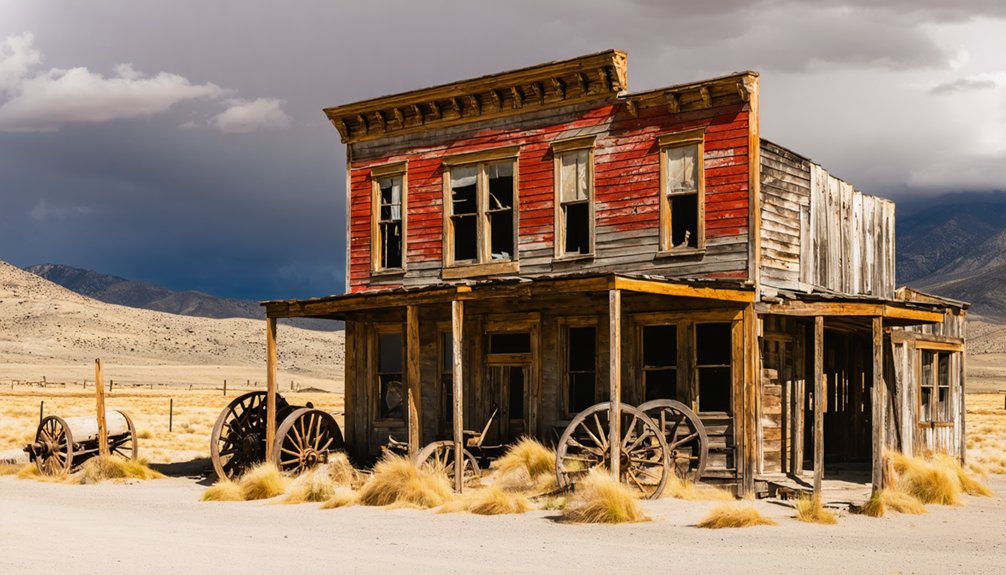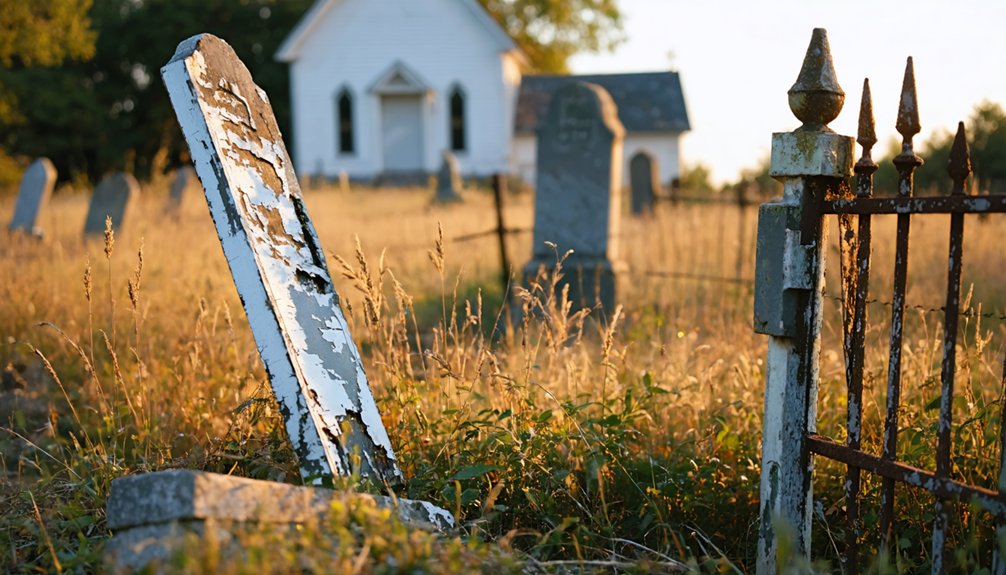
You’ll discover America’s most poignant historical records in ghost town cemeteries like Keota, Colorado, where 1918 Spanish flu victims rest alongside pioneer children, or Charleston, Arizona’s 37 graves from 1882-1883 documenting mill workers and violence victims. Pineville, Georgia preserves segregated burial grounds dating to 1838, while Pine Grove, Nevada’s cemetery tells stories from an $8 million silver boom that peaked in 1893. These weathered headstones and unmarked graves reveal frontier hardships, economic collapses, and community resilience that shaped the American West and rural South in ways official histories often overlook.
Key Takeaways
- Keota, Colorado features graves of 1918 Spanish flu victims and children, maintaining community reunions despite 1991 disincorporation.
- Pineville, Georgia’s cemetery contains segregated burial grounds with unmarked graves predating 1838 near a collapsed Primitive Baptist Church.
- Pleasant Valley Cemetery in Corfu, Washington holds 43 pioneer burials from settlers who arrived after 1909 railroad development.
- Pine Grove, Nevada’s cemetery includes graves from its 1866-1893 mining boom when the town housed over 1,000 residents.
- Charleston, Arizona’s cemetery contains 37 graves from 1882-1883, including mill workers and violence victims from the silver boomtown era.
Keota, Colorado: A High Plains Settlement Frozen in Time
When sisters Mary and Eva Beardsley established their homestead in 1880 on Colorado’s windswept high plains, they couldn’t have anticipated that their settlement—named Keota, meaning “the fire has gone out” in Native American language—would become a prophetic monument to agricultural collapse.
You’ll find Keota’s cemetery preserving the harsh realities of frontier life through graves of children like 5-year-old George Andrew Haak, killed by a horse kick, and numerous 1918-marked burials from the Spanish flu epidemic that devastated families. Among the most poignant markers is a grave for a 14-year-old, reflecting the tragic early mortality rates that plagued frontier communities.
Despite disincorporation in 1991 after environmental hardships forced abandonment, historical preservation efforts continue—gravestones placed as recently as 2013 reflect ongoing community nostalgia among descendants. The town’s Post Office operated continuously from 1909 to 1973, managed by Clyde Stanley alongside his sister Fae at the General Store.
Former residents still gather for reunions on this privately-owned land, where the Burlington & Missouri River Railroad once connected 1,250 homesteads to markets before abandonment in 1970.
Pineville, Georgia: Where Early Settlers Rest in Sumter County
While Colorado’s high plains witnessed agricultural collapse in the 20th century, Georgia’s antebellum settlements faced their own erasure—though Pineville’s fate began much earlier. You’ll find nothing of this Marion County community except an abandoned church and cemetery, where Spanish moss shrouds broken fieldstones dating to 1838.
Elder Andrew Hood’s 1830 pine log Baptist church once anchored a prosperous planter village, documented in William Tappan Thompson’s 1853 *Chronicles of Pineville*. The settlement thrived with leisure and cultural activities, including a notable race track that served the planter community.
Cemetery preservation efforts reveal the site’s dual history:
- Segregated burial grounds—one white, one African American—now equally neglected
- Historical architecture includes a collapsed Primitive Baptist Church built with round nails
- Brick marker bases crumble among unmarked graves predating official records
- Railroad bypass condemned this thriving settlement to obscurity
- Community descendants still worship at nearby church under Elder Slaughter
Corfu, Washington: Railroad Pioneers in the Desert
Railroad ambitions carved improbable communities across Washington’s shrublands, and Corfu emerged as one such specimen when the Chicago, Milwaukee, St. Paul and Pacific Railroad established its station in 1909. You’ll find this Grant County outpost peaked at 131 souls by 1920, sustaining depot operations, a two-story mercantile, and scattered homesteads until economic realities intervened.
The population collapsed to 62 by 1930, with rail service ceasing around 1943. Pleasant Valley Cemetery, established in 1912, preserves 43 burial records of pioneer ancestors who challenged the desert’s hostility.
Weathered headstones and unmarked graves testify to settlers who gambled on railroad heritage that couldn’t sustain permanent occupation. The intact rail line still extends across the landscape, marked by Raa 120 Inland 1927 steel rails that were discontinued in the 1980s. These physical remnants mirror how reconstructed sites across historic towns often preserve stories of communities that once thrived. Today’s remnants—abandoned buildings and silent gravestones—document freedom’s price in eastern Washington’s unforgiving terrain.
Pine Grove, Nevada: A Silver Mining Town’s Lasting Legacy
Gold fever transformed Nevada’s Pine Grove Hills in June 1866 after William Wilson, guided by a local Indian, discovered precious metal deposits that would spawn a town ultimately producing $8 million in bullion by 1893.
You’ll find remnants of mining architecture scattered across this mile-long settlement that once housed over 1,000 residents during its 1880s zenith.
The Wilson and Wheeler mines, positioned 3,500 feet apart on opposite canyon sides, employed innovative steam-powered stamp mills processing ore at 1.36 ounces per ton.
Ghost town preservation efforts reveal:
- Three hotels and five saloons serving frontier communities
- Female miners earning $4 daily as ore judges in 1901
- Two-hundred-forty-thousand ounces of extracted gold
- Freight lines hauling weekly $10,000 bullion shipments
- Modern exploration drilling 273 holes since the 1960s
The 1893 silver demonetization sealed Pine Grove’s fate.
The town’s high ridge cemetery on the canyon’s north side contains graves including Alice Maria Robinson, who died in 1868 at age 15-½ with her last wish inscribed as “be an angel.”
Within two years of its founding, the settlement established a post office and weekly newspaper serving its 200 residents.
Charleston, Arizona: The Nearly Lost Cemetery of a Boomtown
Silver discoveries across the American West created hundreds of boomtowns, but few vanished as completely as Charleston, Arizona, where a devastating 1887 earthquake erased nearly all traces of a settlement that once processed Tombstone’s richest ore. Founded in 1879, Charleston peaked at 400 residents before flooding mines triggered its abandonment by 1889.
You’ll find the cemetery 1.5 miles north of the townsite, hidden within San Pedro Riparian National Conservation Area. Thirty-seven recorded graves from 1882-1883 mark mill workers and violence victims—including four boys killed by Apache Chief Nana. The town served a crucial role transporting silver via Charleston to Millville’s stamp mills for processing.
Archaeological exploration reveals only rock piles remain; looters stripped headstones decades ago. Historical preservation efforts now protect Jim Howell’s elaborate iron-fenced grave and his sister-in-law Viola Slaughter’s burial site, rare indicators of 1880s wealth in this nearly forgotten outpost. The San Pedro River flows year-round, sometimes crossing its banks with enough force to erode portions of the Charleston ruins along its edge.
Frequently Asked Questions
Are Ghost Town Cemeteries Legally Accessible to the Public?
You’ll generally have legal access to ghost town cemeteries if they’re verified and publicly used, though privacy concerns arise on private land. You must follow proper notification procedures under Texas Health & Safety Code Section 711.041 before visiting.
Exploring these abandoned settlements with historic charm often reveals unique stories of the past. Enthusiasts frequently document their experiences, hoping to capture the essence of a time long gone. As you wander through these remnants, it’s essential to respect the sites and the memories they hold.
How Do Historians Identify Unmarked Graves in Abandoned Cemeteries?
You’ll find historians use ground penetrating radar and remote sensing technologies to detect subsurface anomalies, then cross-reference geophysical data with archival records, soil coring, and metal probes to confirm unmarked burial locations in abandoned cemeteries.
Who Maintains These Cemeteries After Towns Become Abandoned?
Like guardians of forgotten stories, you’ll find volunteer efforts stepping in when towns vanish, though preservation challenges mount. County boards, cemetery associations, or descendants typically assume care, but unfunded sites often depend on passionate historical societies mobilizing community support.
What Causes Gravestone Damage in Desert Versus Humid Climates?
You’ll find climate erosion differs drastically: deserts cause abrasive wind damage and salt crystallization, while humid areas accelerate acid rain dissolution and biological growth. These preservation challenges require distinct conservation strategies based on local environmental conditions and stone composition.
Can Genealogists Access Burial Records From Ghost Town Cemeteries?
You’ll find burial records through USGenWeb’s 3.5 million transcriptions, Find A Grave’s databases, and state cemetery surveys. Volunteers employ relic preservation techniques to document ancient burial sites, ensuring you can access ghost town cemetery data despite scattered original registers.
References
- https://95rockfm.com/colorado-ghost-town-cemetery-young-graves/
- https://www.youtube.com/watch?v=7HCxA37uVDg
- https://www.youtube.com/watch?v=thZwkLMkR8k
- https://nvtami.com/2023/05/22/pine-grove-cemetery-2023/
- https://www.youtube.com/watch?v=-acl_PYH0Dc
- https://www.youtube.com/watch?v=MwMrcHienYo
- https://www.findagrave.com/virtual-cemetery/27225
- http://coloradosghosttowns.com/page322.html
- https://www.kunc.org/arts-life/2014-09-25/arid-adversity-of-prairie-life-has-yet-to-erase-keota-colorado
- https://alyciaquilts.blogspot.com/2022/07/colorado-ghost-towns-keota.html