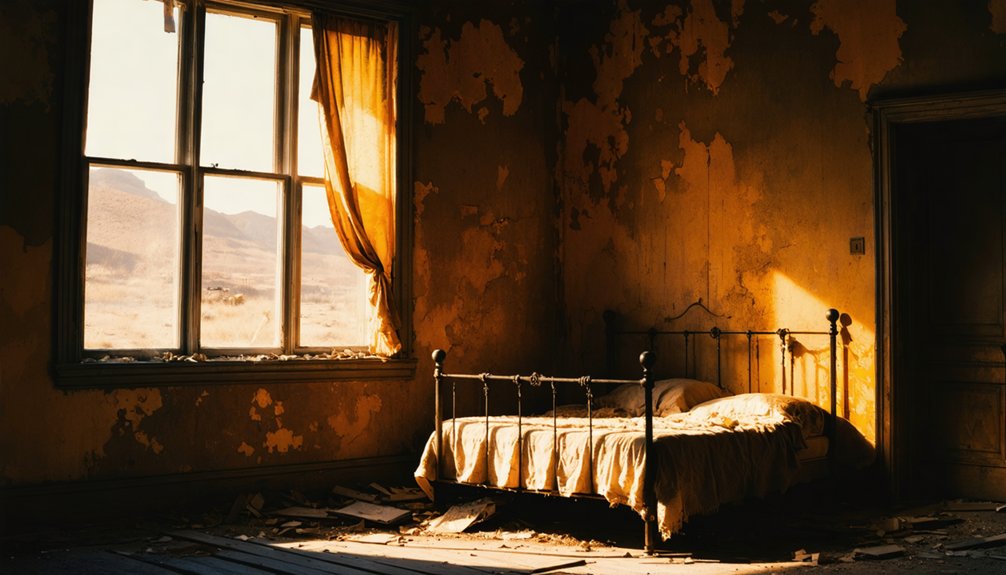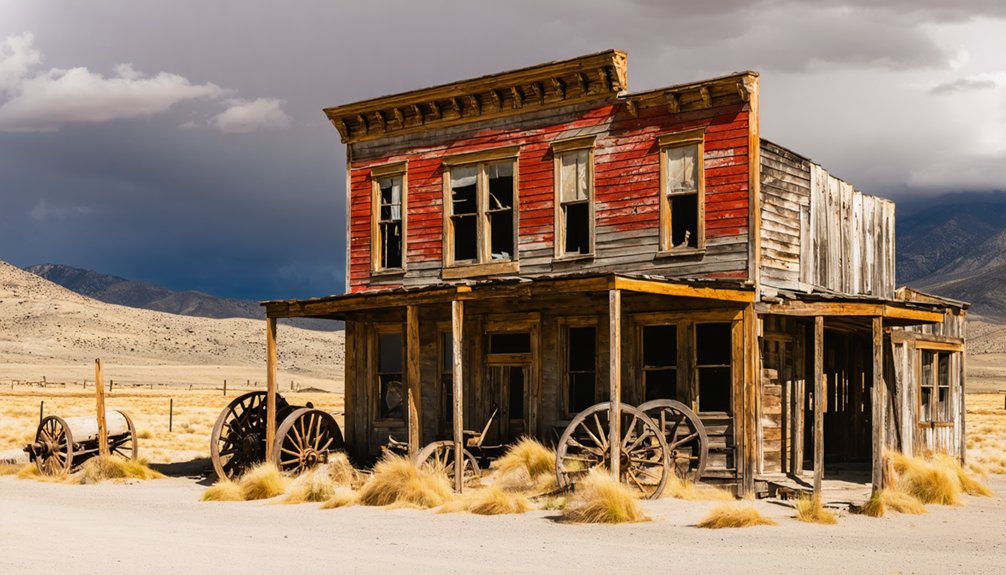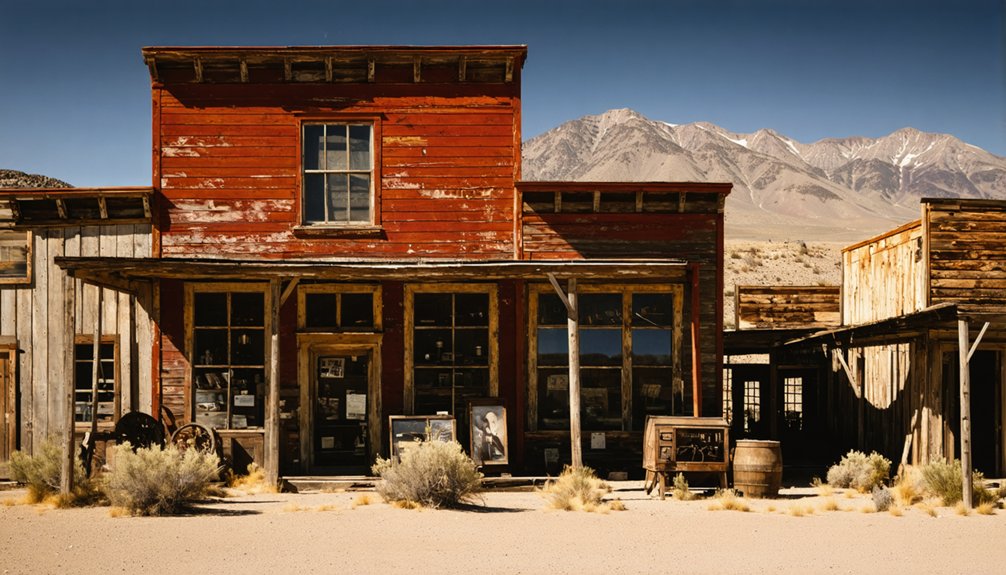
You’ll find exceptional ghost town museums at Virginia City, Nevada, where 600 Victorian buildings showcase $400 million in historic silver wealth, and Bodie, California, preserving 170 structures in “arrested decay” as a State Historic Park. The Lost City Museum in Moapa Valley interprets Ancestral Puebloan ruins from AD 300–1150, while Eureka’s Tintic Mining Museum displays frontier artifacts and mineral collections. Alabama’s Cahawba Archaeological Park protects the state’s first capital alongside prehistoric mounds. Each site offers deeper insights into America’s layered frontier and ancient heritage.
Key Takeaways
- Virginia City, Nevada features over 600 preserved Victorian buildings and mines with 19th-century equipment showcasing silver and gold mining history.
- Bodie, California maintains 170 buildings in “arrested decay” as a State Historic Park, preserving authentic gold rush-era structures and artifacts.
- Rhyolite, Nevada includes Tom Kelly’s bottle house and the Goldwell Open Air Museum with contemporary art installations among historic mining ruins.
- Cahawba, Alabama Archaeological Park preserves Alabama’s first capital with Greek Revival buildings, Civil War ruins, and prehistoric Mississippian mound sites.
- Frisco, Utah displays charcoal kilns, mining equipment, and cemetery remains from its 1875 boomtown era near the San Francisco mine site.
Virginia City, Nevada: the Living Ghost Town With Mining Exhibits
When the Comstock Lode was discovered in 1859, few could have predicted that Virginia City, Nevada would become the richest mining district in America.
Ultimately, it produced over $400 million in silver and gold—a sum equivalent to billions in today’s currency.
The Comstock Lode yielded over $400 million in precious metals—a fortune worth billions by modern standards.
You’ll find over 600 preserved Victorian-era buildings documenting mining legends that financed the Union Army and built San Francisco.
Museums showcase extraction processes through preserved mine structures extending 3,000 feet beneath the streets, displaying authentic 19th-century industrial equipment.
Charles and Sue Bovey’s 1940s restoration efforts created America’s largest authentic mining boomtown. The restoration modeled after Williamsburg’s revolution-themed approach transformed the town into an open-air museum celebrating Montana’s frontier heritage. Their collection includes over a million artifacts that bring the Wild West era to life.
Samuel Clemens worked as a reporter in Virginia City before adopting his Mark Twain pen name, and his former newspaper sites still stand today.
Beyond the mining exhibits, you’ll encounter haunted legends at locations like the Bucket of Blood Saloon and Delta Saloon’s cursed poker table, where violent deaths from shootouts and vigilante hangings left paranormal traces throughout this living ghost town.
Lost City Museum: Ancient Puebloan Heritage in Moapa Valley
You’ll find that Lost City Museum in Overton preserves archaeological evidence of Ancestral Puebloan civilization through reconstructed pueblos and a pit house built by the Civilian Conservation Corps in 1935, when the original Boulder Dam Park Museum opened to interpret sites threatened by Lake Mead’s rising waters.
The museum’s three exhibition galleries display artifacts spanning 300 AD to 1150 AD—including pottery, lithic tools, and turquoise items—recovered from M.R. Harrington’s excavations at Pueblo Grande de Nevada between 1924 and the 1930s. These collections reveal extensive trading networks evidenced by ornaments crafted from shells, turquoise, and beads found throughout the sites. An 1981 extension was added to incorporate and protect the archaeological ruins on site.
Since its transfer to state control in the mid-1950s and subsequent renaming, this National Register property has served as the primary interpretive center for understanding the sophisticated culture that occupied Moapa Valley for nearly a millennium before abandoning the region in the mid-12th century.
Reconstructed Pueblo Archaeological Sites
Along the sun-baked banks of the Muddy and Virgin Rivers in Nevada’s Moapa Valley, the Ancestral Puebloan people established permanent settlements that flourished from approximately AD 200 to 1200.
You’ll find archaeological preservation efforts at Lost City Museum showcasing reconstructed ancient dwellings that survived systematic excavation before Lake Mead’s waters submerged hundreds of original structures following Hoover Dam’s completion.
The Civilian Conservation Corps constructed authentic pueblo reproductions using traditional adobe techniques from 1935 to 1938, racing against impending floods. These reconstructions display both surface structures and semi-subterranean pit-houses characteristic of Basketmaker cultures.
The 1981 museum extension incorporated actual on-site ruins, allowing you direct access to pre-contact architectural evidence spanning over a millennium of sophisticated desert adaptation. Museum exhibits feature baskets, tools, and weapons recovered during the systematic excavations, alongside petroglyphs that document the artistic traditions of these ancient inhabitants. Modern Hopi culture in Arizona identifies these ancestors as Hisatsinom, establishing direct cultural connections to the valley’s ancient residents.
Artifact Galleries and Exhibits
Inside the Lost City Museum’s exhibition galleries, you’ll encounter one of Nevada’s most thorough collections of Ancestral Puebloan material culture, spanning nearly 1,500 years of desert occupation from approximately 300 BC to AD 1150.
Three distinct exhibition halls showcase artifacts excavated from Pueblo Grande de Nevada between 1924-1938, before Lake Mead’s waters submerged dozens of sites.
You’ll examine Moapa Gray Ware, Boulder Gray Ware, and Virgin White Ware ceramics alongside prehistoric lithic materials, turquoise ornaments, and bone implements.
The museum’s artifact conservation efforts extend beyond physical preservation—Benjamin Van Alstyne created three-dimensional digital models hosted on SketchFab.com, allowing virtual reality exploration with detailed annotations about Native crafts manufacturing techniques. These digital representations include bowls, canteens, jars, and cooking pots with clickable numbered notes that provide information about artifact decoration, usage period, and manufacturing details.
The Fay Perkins Gallery uniquely houses an actual archaeological site, while the 1935 Gallery occupies the original adobe structure, connecting you directly to preservation history. The museum’s significance is reinforced by its listing on the National Register of Historic Places.
CCC Construction and History
When the Civilian Conservation Corps constructed the Boulder Dam Park Museum in 1935, they created more than a repository for artifacts—they built an urgent response to archaeological catastrophe.
Lake Mead’s rising waters threatened to submerge approximately five miles of Moapa Valley archaeological sites, forcing accelerated excavations before Hoover Dam’s 1938 completion.
The CCC’s construction techniques proved innovative: they incorporated actual prehistoric ruins into the museum structure itself, preserving Pueblo Grande de Nevada’s foundations in situ.
You’ll find replica Anasazi pueblo clusters built directly atop excavated sites, demonstrating unprecedented archaeological preservation methods for the era.
The 1981 extension continued this integration philosophy, protecting additional ruins while expanding exhibit space.
This approach transformed salvage archaeology into permanent public education, ensuring ancestral Puebloan heritage—spanning 300 AD to 1150 AD—survived federal dam construction.
The museum’s collection has grown beyond initial excavations, as local ranchers have donated discovered artifacts from the surrounding region over the decades.
Governor James Scrugham had commissioned archeologist Mark Raymond Harrington in the 1920s to lead the excavation efforts that would ultimately provide the foundation for the museum’s extensive artifact collection.
Tintic Mining Museum in Eureka, Utah
The Tintic Mining Museum occupies a relocated mine office building at 241 W Main Street in Eureka, Utah, a former mining community in Juab County that serves as the primary gateway to the broader Tintic Mining District. This facility preserves mining heritage dating to 1869, when prospector Rust initiated the gold and silver boom that transformed the region.
The relocated mine office building at 241 W Main Street preserves Eureka’s mining heritage from the 1869 gold and silver boom.
The museum’s mineral collection includes crystalline galena-barite specimens and Tintic Quartzite indigenous to the area, supplemented by donations from a retired geology professor.
You’ll find assay equipment, mining tools, and cultural artifacts documenting frontier life from the late 1800s onward.
The museum operates Thursday through Saturday, 12:00 PM to 4:00 PM, with weekday appointments available through the Tintic Historical Society.
Admission is free, though donations support preservation efforts.
Rhyolite, Nevada: Ruins Meet Modern Art
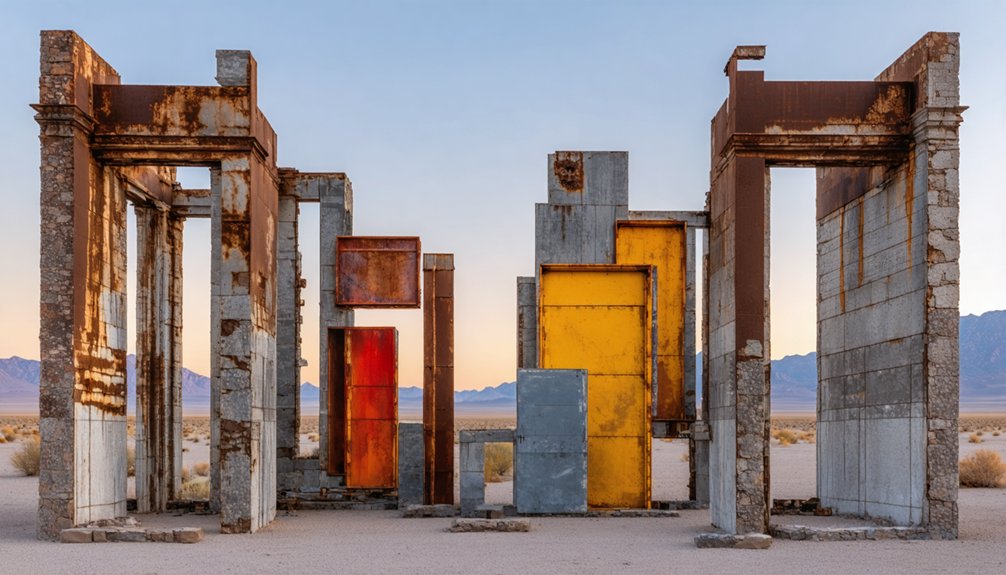
Gold discoveries by prospectors Shorty Harris and E.L. Cross in 1904 transformed Rhyolite into Nevada’s most ambitious boomtown. By 1908, it was producing $1 million in gold and supported 5,000 residents. The town’s infrastructure included a $130,000 railroad depot.
You’ll find historical preservation efforts maintaining Tom Kelly’s 50,000-bottle house and mission-style depot ruins under Bureau of Land Management oversight.
The Goldwell Open Air Museum, established in 1984 with Albert Szukalski’s *The Last Supper*, represents freedom from conventional museum constraints. Each art installation dialogues with Rhyolite’s decay.
This juxtaposition of modern sculpture against abandoned stone buildings creates what preservationists call “creative reuse,” where contemporary artists claim desert space once dominated by extractive capitalism.
This environment offers you unrestricted access to both historical ruins and evolving artistic expression.
Cahawba, Alabama: Alabama’s First Capital as Archaeological Park
Between AD 1500 and 1600, indigenous inhabitants constructed a flat-topped mound spanning ½ acre as the central feature of a semicircular village protected by defensive walls and a moat. Establishing what archaeologists recognize as the northern political center of coastal Mississippian culture.
Indigenous artifacts discovered at this prehistoric settlement link the site to Moundville and Pensacola phase cultures, confirming its role as a regional trade hub.
When you visit Old Cahawba Archaeological Park today, you’ll encounter:
- The 1850s Greek Revival Visitor Center housing museum exhibits
- Crocheron Columns marking antebellum mansion sites
- Restored St. Luke’s Episcopal Church (1854, Richard Upjohn design)
- Castle Morgan prison ruins from Civil War era
Alabama’s first capital (1820-1826) transformed from a cotton distribution center to an archaeological site, preserved on the National Register since 1973.
Frisco, Utah: Stone Kilns and Frontier Commerce
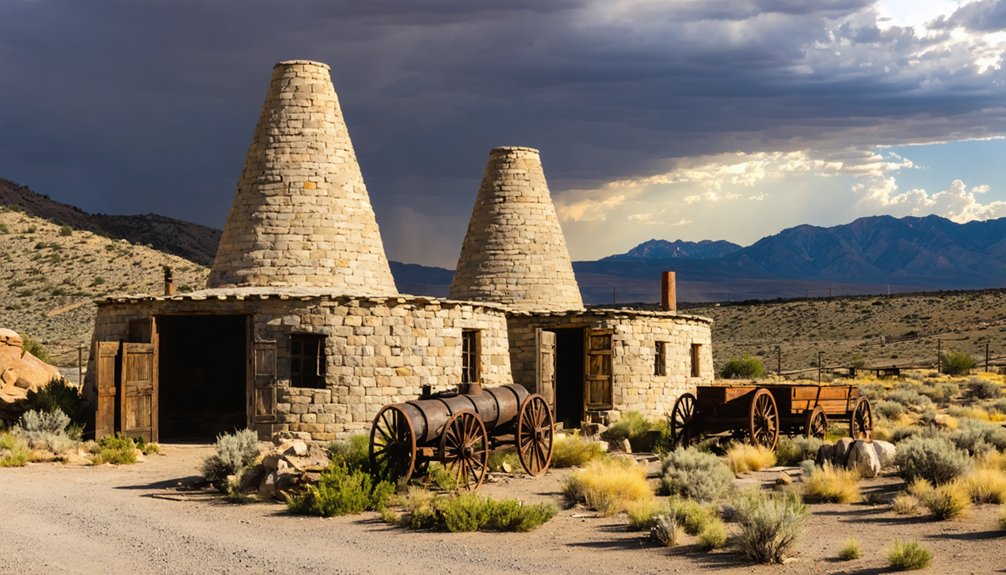
When silver prospectors located the San Francisco Mine in 1875—subsequently renamed the Horn Silver Mine—they triggered one of Utah’s most explosive mining booms in the remote juniper-covered hills of Beaver County’s West Desert, 15 miles west of Milford.
By the late 1870s, over 6,000 fortune-seekers populated twenty-three saloons along ancient trade routes connecting Nevada’s Pioche mining district.
Historic blacksmith shops serviced the mule trains hauling $60 million in ore to Utah Southern Railroad terminals.
Lawlessness peaked with daily murders until Nevada sheriffs imposed frontier order.
The February 13, 1885 Horn Silver Mine collapse—a 900-foot pit caving to seventh-level depths—ended prosperity instantly.
Today’s National Register-listed charcoal kilns stand alongside rusting equipment and cemetery headstones, accessible only by off-road vehicles for those seeking authentic Great Basin solitude.
Bodie, California: America’s Most Famous Preserved Ghost Town
You’ll find California’s best-preserved gold rush ghost town in Bodie State Historic Park, where 170 buildings remain frozen in “arrested decay”—a preservation method that stabilizes structures without restoration to their original condition.
Designated a National Historic Landmark in 1961, Bodie draws 200,000-250,000 annual visitors to witness authentic artifacts left untouched since the town’s decline: beds, clothing, desks, and canned goods still visible through windows and doorways.
This 8,000-10,000 person boomtown (1879-1880) produced $3,000,000 yearly in gold ore before fires in 1892 and 1932 reduced it to today’s meticulously maintained remnants along two main streets.
Gold Rush Mining History
Gold’s discovery in July 1859 by William S. Bodey and E.S. Taylor launched Bodie’s transformation from remote wilderness to thriving mining camp.
You’ll find the town’s fortune changed dramatically when the Standard Company struck a profitable vein in 1876, triggering explosive growth.
Gold panning gave way to sophisticated mine layouts extracting nearly 10,000 tons of ore after an 1875 cave-in revealed massive deposits.
The peak years (1877-1882) produced staggering wealth:
- Over $38 million in combined gold and silver output
- Population surging to 10,000 fortune-seekers by 1879
- 2,000 buildings stretching along a mile-long Main Street
- Total production reaching $70 million through 1941
State Historic Park Status
Since California State Parks assumed control in 1962, Bodie has operated under a distinctive “arrested decay” preservation philosophy that maintains 170 buildings across 495 acres in their weathered, authentic condition rather than pursuing traditional restoration.
Park accessibility remains year-round, though winter conditions at 8,375 feet require skis, snowshoes, or snowmobiles when Highway 270 becomes impassable.
You’ll find self-guided walking tours available through ranger-provided materials, with preservation efforts focusing on structural stabilization rather than reconstruction.
The Foundation’s ongoing capital improvement project—beginning with Phase 1’s $50,000 architectural assessment—demonstrates commitment to maintaining historical integrity while enhancing visitor experience.
Unlike conventional museums with curated exhibits, Bodie’s approach lets you experience authentic decay: no restored façades, no recreated interiors, just preserved deterioration.
Arrested Decay Preservation Method
Unlike conventional preservation approaches that restore historic sites to their former glory, Bodie’s arrested decay method maintains structures precisely as they appeared when the final residents departed in the 1940s—furniture remains positioned where last used, goods sit on shelves, and deterioration continues under carefully controlled monitoring.
California’s Parks and Recreation Department initiated this policy in 1962, stabilizing rather than reconstructing approximately 110-170 surviving structures.
You’ll encounter authentic urban decay throughout:
- Skewed hotels underpinned solely for structural stability
- Partially burned buildings left deliberately unrestored
- Littered shards, nails, and bottles (removal illegal)
- Classic cars rusting beside original residences
Year-round rangers combat preservation challenges including 100-mph wind gusts and fire threats while maintaining this time-capsule approach.
The Bodie Foundation’s under-$500,000 annual budget funds stabilization efforts, preventing further deterioration without reversing history’s natural patina.
St. Thomas, Nevada: the Town That Rose From Lake Mead
When Mormon pioneers established St. Thomas in 1865 near Nevada’s Muddy River confluence, they couldn’t foresee their settlement’s unique fate.
Territorial confusion placed the town under Arizona’s Pah-Ute County jurisdiction until Nevada claimed it in 1870, demanding three years’ back taxes. Many settlers abandoned their homes rather than pay.
Those who remained built a thriving community of 500 residents by the early 1900s, farming and mining salt along the Arrowhead Trail.
However, the 1928 Boulder Dam Act sealed St. Thomas’s destiny. Town submersion began in 1935 as Lake Mead‘s waters rose, forcing evacuation by 1938.
Sixty feet underwater for decades, the settlement reemerged during 2000s droughts.
Today, the National Park Service protects these ruins, where you’ll find foundations and streets accessible for exploration.
Frequently Asked Questions
What Are the Best Ghost Town Museums for First-Time Visitors?
You’ll find Ghost Town Museum Colorado Springs ideal for first-timers—it’s indoors with hands-on historical preservation elements. Museum exhibits let you touch authentic artifacts, churn butter, and pan gold without desert hiking, making Old West history accessible and interactive.
As you explore the rich history of the Old West, consider making a trip to the surrounding area, where you can visit abandoned towns for stunning landscapes that capture the essence of a bygone era. The striking scenery provides a perfect backdrop for photography and reflection, allowing you to truly immerse yourself in the natural beauty intertwined with history. Whether you’re hiking through the remnants of ghost towns or simply enjoying the views, the area offers a unique experience that complements your museum visit.
Which Ghost Towns Have Accessible Archaeological Sites Beyond Museum Exhibits?
You’ll find accessible abandoned ruins at Bodie, California, where 200 structures stand open for exploration. Rhyolite, Nevada offers archaeological tours through its dramatic bank skeleton and bottle house, while Kennicott, Alaska provides ranger-guided wilderness access to copper mining remnants.
Are There Ghost Town Museums Suitable for Children and Families?
You’ll find family-friendly ghost town museums featuring hands-on activities, interactive exhibits, and gold panning experiences. Colorado Springs offers butter churning and arcade games, while some locations incorporate haunted legends and local dinosaur displays for educational entertainment.
Exploring abandoned places in California’s desert unveils a haunting history intertwined with the state’s gold rush era. These forgotten remnants often tell stories of resilience and adventure, drawing in thrill-seekers and history buffs alike. Visitors can wander through crumbling structures and dusty streets, imagining the vibrant lives once lived in these now desolate locations.
What Ghost Towns With Museums Are Located Near Major Highways?
You’ll find hidden relics along Interstate 10 at Steins and Lordsburg, New Mexico, while Route 66 offers abandoned architecture at Goffs, California and Glenrio, Texas—all accessible directly from major highways for independent exploration.
Do Ghost Town Museums Require Advance Reservations or Guided Tours?
You won’t need advance reservations for standard visits, as museum policies allow self-guided exploration at your own pace. Guided tour requirements don’t exist—you’re free to control your experience, spending 45 minutes to an hour browsing independently.
References
- https://www.christywanders.com/2024/08/top-ghost-towns-for-history-buffs.html
- https://www.united.com/en/us/hemispheres/places-to-go/5-western-ghost-towns.html
- https://nvtami.com/2021/04/21/girls-day-moapa-valley/
- https://www.visitutah.com/things-to-do/history-culture/ghost-towns
- https://www.tripadvisor.co.uk/ShowTopic-g28927-i252-k15484663-o10-Museums_Living_History_Museums_Ghost_Towns-Colorado.html
- https://www.atlasobscura.com/lists/americas-best-preserved-ghost-towns
- https://wewhoroam.com/ghost-towns-across-america/
- https://sherilyndecter.com/virginia-city-from-ghost-town-to-tourist-mecca/
- https://ghostcitytours.com/virginia-city/
- https://visitvirginiacitynv.com/history/