You’ll find ghost towns like Cerro Gordo still pulling 250 gallons daily from springs 700 feet below abandoned mine shafts, pumped through 13.5 miles of original piping. Hydroelectric plants built between 1898-1901 continue generating power without remediation, while Rhyolite’s corridor now carries 525-kV transmission lines along the same routes that failed in 1920. This infrastructure wasn’t preserved—it simply outlasted the communities it served, revealing how engineering choices determine what survives long after populations vanish and why some systems endure while others require perpetual intervention.
Key Takeaways
- Cerro Gordo maintains a functional water system pumping 250 gallons daily from a spring 700 feet below the Union Mine shaft.
- The system uses 13.5 miles of piping and pressurization equipment, unchanged since mining operations ceased in 2010.
- Historic hydroelectric plants like Minnehaha (1898) and Skagway (1901) still generate power over a century after construction.
- Rhyolite’s modern lithium operations plan self-sufficient power generation through steam turbines, avoiding grid dependence.
- These surviving systems demonstrate infrastructure durability, with some facilities operating continuously without requiring major remediation.
Cerro Gordo’s Underground Water System: From Mine Depths to Modern Supply
Since Cerro Gordo‘s founding in 1865, water scarcity has defined nearly every operational decision at what became California’s largest silver mine. You’ll find the only reliable source 700 feet down the 900-foot Union Mine shaft, where a natural seep feeds the current system.
Unlike typical copper mine aquifer recharge zones, this singular spring delivers just 250 gallons daily—enough for basic cleaning and toilet flushing, nothing more.
The original 1800s infrastructure pumped water through 13.5 miles of 3-inch boiler-flue piping, losing one-third to leaks and winter freezing. Springs discovered between 1869-1873 provided additional sources that enabled the town’s boomtown growth, with peak consumption reaching 35,000 gallons daily.
Today’s system uses 500 feet of Pex piping to a 3,500-gallon barrel, supplemented by a 40,000-gallon sprinkler tank. A Neptune diaphragm pump handles the pressurization process, moving water at 8 gallons per hour while building system pressure from 65 psi to over 300 psi before delivery to the town above.
You’re witnessing survival engineering: maximum utility from minimal resources, unchanged since operations ceased in 2010.
Rhyolite’s Electric Grid: Desert Infrastructure That Outlasted the Boom
While Cerro Gordo’s miners descended 700 feet for every gallon, Rhyolite’s boomtown engineers in 1907 erected poles carrying 11,000 volts across 28 miles of open desert—a $100,000 gamble that electricity could sustain what water alone couldn’t. That historical infrastructure failed alongside the town by 1920.
Yet today’s Greenlink West 525-kV transmission line traces similar corridors through BLM lands near Highway 265. The irony deepens: Ioneer’s lithium facility will generate its own electricity through steam turbines, requiring zero grid dependence despite proximity to modern power infrastructure. The 26-year project will power millions of lithium batteries annually from Nevada’s only known lithium-boron deposit. The project will recycle half of its processing water, applying modern conservation techniques to challenges that defeated earlier desert enterprises.
This self-sufficiency mirrors what Rhyolite’s founders couldn’t achieve—desert sustainability through localized generation rather than vulnerable transmission across hostile terrain. The abandoned ruins now face viewshed threats from 6,810-acre solar arrays, proving infrastructure persistence outlasts the communities it once served.
Drowned Communities of the Ashokan Reservoir: When Ghost Towns Became Water Sources
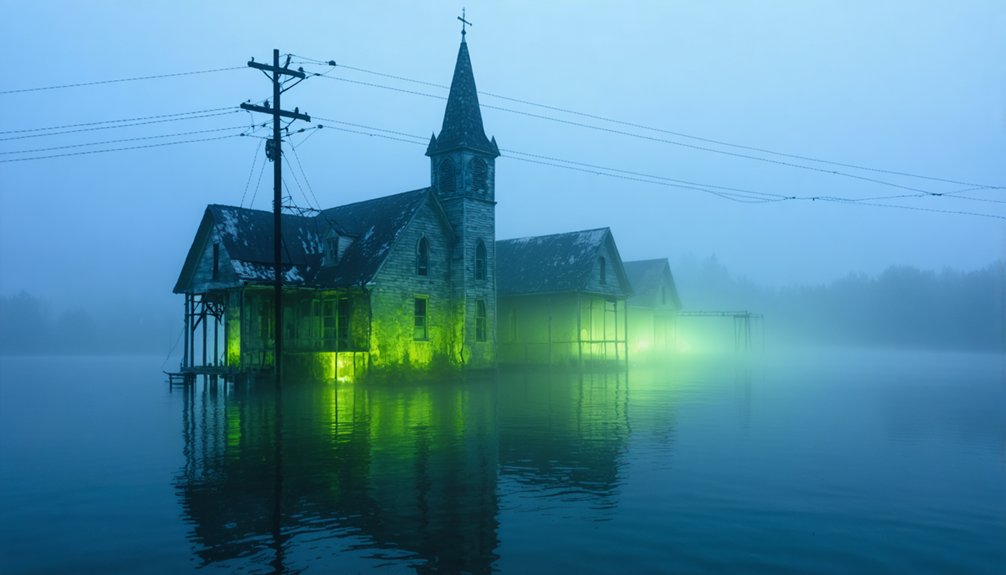
You’ll find a stark inversion of the ghost town narrative in New York’s Ashokan Reservoir, where eleven hamlets were deliberately erased rather than abandoned. Between 1907 and 1915, the city appropriated 12,000 acres of Catskill land, displacing roughly 2,000 residents to create what became one of the world’s largest reservoirs.
The transformation required relocating over 2,600 graves, destroying 500 homes, and splitting the town of Olive itself—a calculated sacrifice of living communities to sustain the infrastructure demands of urban expansion. Residents received meager compensation, paid just $15 per grave and $3 per headstone for the disinterment and relocation of their ancestors. The reservoir opened in 1915 with a capacity of 122.9 billion gallons, covering 8,300 acres and delivering water to New York City through a gravity-fed system spanning 100 miles.
New York’s Water Appropriation
The creation of New York City’s Ashokan Reservoir stands as one of America’s most aggressive exercises in municipal eminent domain, transforming a thriving agricultural valley into infrastructure through systematic displacement. Beginning in 1901, city engineers trespassed on private property without notice, while the 1905 Board of Water Supply wielded condemnation powers against 2,350 residents.
Officials justified seizing 12,000 acres by falsely labeling the prosperous Esopus Valley “practically a wilderness” in their 1903 report. Water rights trumped property rights as the city paid below-market compensation, gave residents just two months to relocate, and exhumed 2,500 bodies at $15 per grave.
This systematic community displacement destroyed 500 homes, 35 stores, and split the Town of Olive permanently—all to supply distant urbanites with drinking water. The construction relied heavily on African-American and Italian immigrant laborers who built the infrastructure that would erase these communities. The displacement particularly devastated women entrepreneurs, as only two of Olive’s boardinghouse proprietors successfully reestablished their businesses elsewhere.
Displaced Communities Under Water
Between 1907 and 1915, twelve Esopus Valley communities disappeared beneath rising floodwaters as New York City’s Ashokan Reservoir consumed an entire agricultural landscape.
You’ll find no trace of the historical architecture that once defined these thriving hamlets—504 homes, 10 churches, 10 schools, and countless businesses vanished through eminent domain proceedings.
The systematic erasure proceeded ruthlessly:
- Residents received two months’ notice and inadequate compensation before forced removal.
- Giant steam whistles blared for one hour signaling immediate evacuation when the dam completed.
- Authorities burned homes and businesses after families departed, erasing community resilience built over generations.
Over 2,500 bodies were exhumed from cemeteries at $15 per grave.
The displaced residents established new communities nearby, some of which still exist today.
The reservoir now holds 122.9 billion gallons at full capacity, providing approximately 40% of New York City’s daily drinking water during non-drought periods.
Towns like Brown’s Station and Olive City ceased existing entirely, their locations now marked only by roadside signs commemorating what liberty-minded communities lost.
Homestake Mining’s Toxic Legacy: Treating Billions of Gallons in Abandoned Uranium Country
Since 1958, Homestake Mining Company’s uranium mill near Grants, New Mexico has generated one of the American West’s most persistent contamination crises. You’re looking at 49 years of remediation treating over 10 billion gallons of groundwater—extracting 1.3 million pounds of uranium and 75,000 pounds of selenium.
Contaminant migration from unlined tailings piles continues despite hydraulic barriers pumping 478 gallons per minute.
The irrigation of 3.1 billion contaminated gallons poisoned 3,500 acres of farmland. Groundwater treatment systems can’t address the source, only symptoms.
Now Barrick Gold wants NRC permission to demolish these treatment facilities and transfer perpetual monitoring responsibilities to DOE. Cleanup deadlines have slipped from the 1980s to 2017 to 2022—promises unfulfilled while uranium concentrations remain elevated in residential wells and radon threatens nearby communities.
Beaver Creek’s Hydroelectric Pipeline: Century-Old Power Still Flowing From Pikes Peak
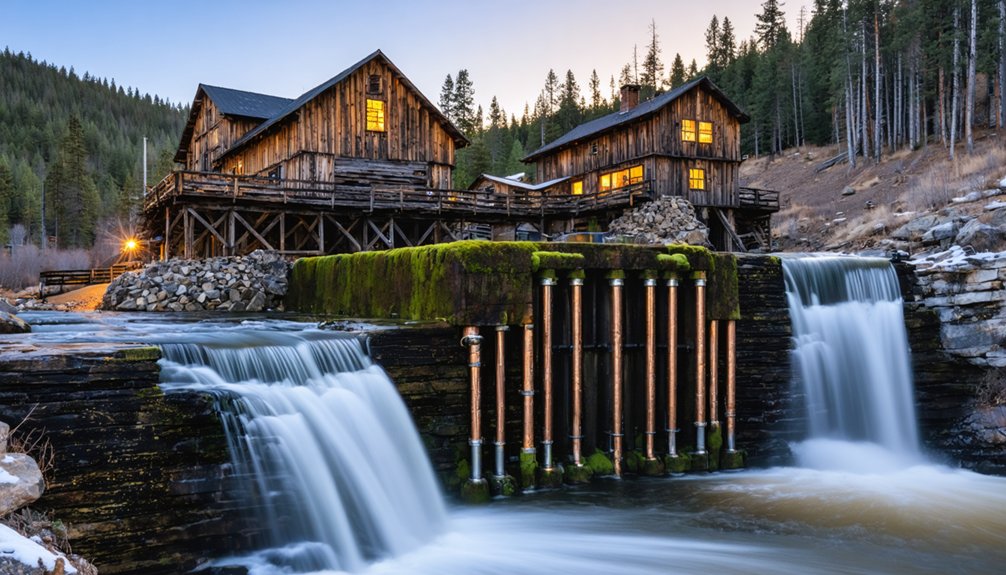
While contaminated groundwater demands perpetual treatment in New Mexico’s uranium fields, Colorado’s Pikes Peak region demonstrates how century-old water infrastructure can function without creating lasting environmental liabilities.
Well-engineered water systems can operate for centuries without environmental remediation—a stark contrast to extractive industries requiring perpetual cleanup.
The Beaver Creek hydroelectric system, built between 1898-1901, still conveys water through gravity-fed tunnels and pipelines you can trace today.
This hydropower history reveals remarkable achievements:
- Minnehaha Hydro Plant (1898): World’s first fully automated facility, constructed in six months to power the 6,427-foot Strickler Tunnel
- Skagway Powerplant (1901): Five massive turbines supplied electricity to mining towns for sixty years
- Rosemont System: Continues moving water from 13,000-foot elevations through original granite infrastructure
Infrastructure preservation here required no ongoing remediation—just engineering that respected gravity and geography, powering communities without poisoning watersheds.
Submerged Settlements: Ghost Towns Sacrificed for Dams and Reservoirs
Reservoirs required erasure. You’ll find St. Thomas, Nevada’s foundations emerging when Lake Mead drops below 1,050 feet—a Mormon settlement of 500 sacrificed in 1935.
Conowingo, Maryland met an identical fate: 300 residents displaced for hydroelectric ambition.
Historical preservation wasn’t prioritized when Ashokan Reservoir’s construction destroyed 500 homes, 10 churches, and paid merely $15 per grave disinterment. These weren’t voluntary evacuations—eminent domain forced communities out, often with below-market compensation.
Proctor, Tennessee vanished beneath Fontana Lake for WWII electricity generation to Oak Ridge.
Neversink, New York saw 340 evicted from 6,149 condemned acres.
The environmental impact extends beyond flooded streets: you’re witnessing systematic obliteration of communities for centralized infrastructure.
During droughts, these submerged settlements resurface as testimonies to governmental priorities—power generation trumping individual property rights and ancestral homelands.
Frequently Asked Questions
Can Visitors Access the Underground Mine Shafts Where Water Is Sourced?
No, you can’t access underground mine shafts for water sourcing—they’re sealed or flooded for safety. Ironically, mining history that once promised freedom now restricts it. Legal barriers and hazardous conditions prevent exploration of these archival water infrastructure sites.
Are Any Original Residents Still Living in These Ghost Towns Today?
Original residents have largely disappeared from these ghost towns. You’ll find Centralia retains just a handful, while Bodie’s become a historic preservation site and tourist attraction with no original inhabitants—only managed decay and visitors seeking authentic Western experiences.
Exploring ghost towns in Arizona offers a unique glimpse into the past, with remnants of thriving communities now left to the elements. These towns, such as Jerome and Tombstone, tell stories of gold rushes and the Wild West, where adventurers and prospectors once roamed. As you wander through these deserted streets, the echoes of history linger in the air, inviting you to imagine the lives that once filled these spaces.
Is the Water From These Systems Safe for Human Consumption?
Like ancient Roman aqueducts crumbling unseen, you’ll find historical water safety questionable in ghost towns. Utility infrastructure viability depends on abandonment duration—aging pipes, untested sources, and absent monitoring mean you shouldn’t drink without professional testing first.
How Much Does It Cost to Maintain Utilities in Abandoned Towns?
Infrastructure costs for abandoned towns vary dramatically based on population decline rates. You’ll find historical preservation efforts face $30-$1,600 annual increases per remaining customer as the base shrinks, plus overhead maintenance averaging $1.07 per mile annually.
Do Property Rights Still Exist for Submerged Town Buildings and Land?
Property rights for your submerged structures technically persist until formally transferred through foreclosure or abandonment processes. However, you’ll find habitation prohibited, and public trust doctrine gradually shifts ownership to state control as waters rise inland.
References
- https://archaeology.org/issues/may-june-2024/letters-from/ghost-towns-of-the-ashokan-reservoir/
- https://www.youtube.com/watch?v=RWzj8HlMGLE
- https://grist.org/accountability/a-uranium-ghost-town-in-the-making/
- https://www.youtube.com/watch?v=U5y0LU-V7Gc
- https://www.youtube.com/watch?v=E0mfoxW3XIs
- https://en.wikipedia.org/wiki/List_of_ghost_towns_by_country
- https://www.mtnmouse.com/california/dva_rhyolite.html
- https://www.youtube.com/watch?v=p92WrSPJ8yA
- https://mtnmouse.com/california/inyob03cerro_gordo_4_water.html
- https://www.youtube.com/watch?v=-73HxvOqFUg