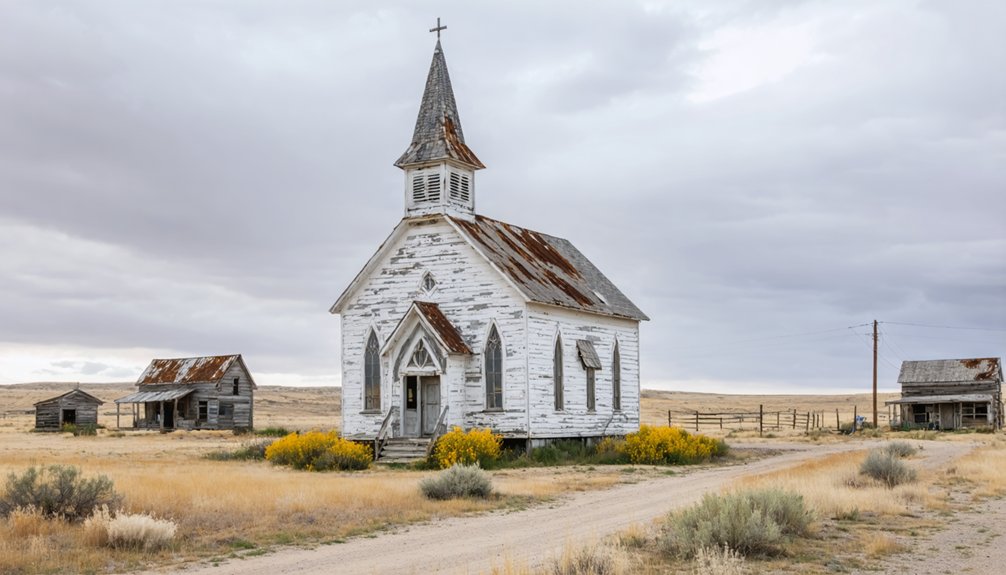
You’ll find remarkable ghost town churches across the globe, from Rodney, Mississippi’s twin 1830s-1850s Presbyterian and Baptist sanctuaries—survivors of Civil War battles and river course changes—to Sacred Heart’s 1905-1914 Romanesque Revival structure in Oklahoma, built after fire destroyed the original 1876 mission. Michigan’s wood-frame Wildwood Methodist chapel and New Mexico’s 1857 Santo Niño de Atocha adobe shrine stand preserved, while Kolmanskop’s German colonial church battles Namibian desert sands that have consumed the once-prosperous diamond town since 1956, each structure revealing unique stories of architectural resilience and community memory.
Key Takeaways
- Rodney, Mississippi features two standing 19th-century churches with a cannonball artifact from the Civil War still lodged in one.
- Sacred Heart Catholic Church in Oklahoma showcases Romanesque Revival architecture built between 1905-1914 after fire destroyed the original 1876 structure.
- Wildwood Church in Michigan is a preserved wood-frame Methodist chapel with a distinctive blue round stained glass window.
- Santo Niño De Atocha in New Mexico is an 1857 adobe chapel that remains an active pilgrimage site for cultural observances.
- Kolmanskop, Namibia contains German colonial-era church architecture with neo-Baroque elements, now partially buried by desert sand.
Rodney Presbyterian Church: A Testament to Perseverance in Mississippi
When plantation owner David Hunt donated land to the Bethel Congregation in 1828, he set in motion the creation of what would become Mississippi’s most distinct surviving Federal style church.
David Hunt’s 1828 land donation launched Mississippi’s most distinctive Federal style church still standing today.
You’ll find the Rodney Presbyterian Church standing as architectural symbolism of early American religious traditions, built between 1830-31 under Rev. Jeremiah Chamberlain’s leadership and dedicated January 1, 1831.
The brick structure’s bell tower witnessed dramatic history on September 13, 1863, when Confederate Lt. William T. Allen arrested Union sailors during service. The USS Rattler’s retaliatory cannonball remains lodged in the exterior wall—a permanent reminder of conflict interrupting worship.
Though Rodney’s population crashed after the Mississippi River changed course around 1870, causing the town’s unincorporation by the 1930s, this National Register landmark endures through preservation efforts. The Mississippi U.D.C. acquired and restored the building in 1966, ensuring its survival for future generations. In fall 2018, the Rodney History + Preservation Society assumed ownership and began actively working on restoration and fundraising for emergency repairs.
Rodney Baptist Church: Greek Gothic Revival in the Woods
The Rodney Baptist Church rose around 1850 as Mississippi’s architectural tastes shifted from Greek Revival toward Gothic sensibilities. This transition created what preservation specialists now recognize as the region’s finest example of interim ecclesiastical design.
You’ll find this one-and-a-half-story frame structure thirty-two miles northeast of Natchez, where its pointed-arch entrance and polygonal belfry demonstrate Gothic Revival elements merged with Greek Revival’s denticulated cornice.
Originally serving as Mt. Zion Baptist Church No. 1, it became Rodney’s second church and later ministered to rural African Americans.
Despite recurrent flooding that’s thwarted restoration efforts, the building’s Architectural Resilience keeps it standing among moss-draped woods. The town that nearly became the state capital, losing by only three votes to Washington, had already established its first Presbyterian church in 1832. A Confederate skirmish occurred when soldiers surrounded a Union church service during the Civil War, followed by Union gunboat bombardment in retaliation.
Its silver dome still pierces the sky above this ghost town, symbolizing the port city that nearly became Mississippi’s capital.
Sacred Heart Catholic Church: From Ghost Town to Historic Landmark
Father Isidore Robot secured a tribal land grant from the Potawatomee Indians in October 1876, establishing what would become Sacred Heart Mission six miles east of present-day Asher, Oklahoma. The community thrived until January 15, 1901, when fire destroyed the monastery, schools, and original church.
You’ll find the present church, constructed between 1905 and 1914, standing as the primary survivor in this ghost town. During construction, Mass continued in a converted granary while builders crafted the permanent structure’s stained glass and altar design.
After the post office closed in 1954 and educational functions relocated to Shawnee, the site declined into abandonment. The church’s feast day celebration, traditionally held on the third Friday after Pentecost, continued to draw former parishioners and pilgrims even as the surrounding town emptied. The structure exhibits Romanesque Revival architecture with its characteristic thick brick walls and arched windows. Today, this Catholic church preserves the mission’s legacy, representing early evangelization efforts among indigenous peoples.
Wildwood Church: A Restored Beacon in Northern Michigan
Originally established as Mentor Corners in 1882, this small hamlet in Mentor Township, Cheboygan County, underwent a name change to Wildwood just two years later.
You’ll find this shadow town southwest of Indian River, where William and Jeanette first settled.
The wood-frame Methodist chapel stands as the community’s most prominent relic, featuring a distinctive blue round stained glass window with a white star—resembling Captain America’s shield.
While urban decay claimed the stores, blacksmith shop, and most residences after lumber mills departed, someone’s committed to heritage restoration.
The church received fresh paint, preserving this beacon amid undisturbed grasslands.
Though worship services ended long ago, you can still locate this structure along a dirt road, standing defiant where few buildings remain from Wildwood’s bustling past.
The town’s decline mirrors the typical lifecycle of resource-dependent communities across Northern Michigan, where settlements faded once timber operations exhausted local forests.
Like many mining community churches, the building once hosted annual reunion gatherings that brought former residents together to maintain their cultural ties and sense of belonging.
Santo Niño De Atocha: Adobe Heritage in New Mexico’s Cuervo
When Severiano Medina fell gravely ill in 1857 at his home in El Potrero, New Mexico, he made a desperate vow to the Santo Niño de Atocha—a promise that would forever alter the spiritual landscape of northern Rio Grande Valley communities. After recovering, he traveled to Plateros, Mexico, obtained permission, and constructed a simple adobe chapel in Chimayó to house the miraculous statue.
The chapel’s enduring legacy includes:
- Adobe construction reflecting authentic Hispanic village architectural traditions
- blessed dirt posito used for healing sacramentals
- Artistic significance through retablos modeled after 1848 Mexican prints
- Post-WWII pilgrimage tradition honoring Bataan Death March survivors’ intercession
- Private ownership until 1992 Archdiocese acquisition
This unassuming sanctuary became central to New Mexico’s spiritual identity, drawing thousands seeking intercession for prisoners, miners, and immigrants. Situated along the High Road corridor connecting Santa Fe and Taos through the Sangre de Cristo mountains, the chapel anchors one of the region’s most significant spiritual destinations. Today, pilgrims leave children’s shoes on wall shelves as offerings, symbolizing their hopes for the Santo Niño to provide comfort and aid to those in need.
Kolmanskop Church: German Architecture Against the Namibian Desert
You’ll find Kolmanskop’s church standing among German colonial buildings that served a thriving diamond mining community of 1,300 residents before World War I, when workers extracted over 2,000 pounds of diamonds from the Namib Desert sands.
The town’s 1956 abandonment transformed these structures into sand-filled ruins, though the church remains listed among the settlement’s preserved buildings alongside the hospital and school.
This ghost town presents a unique preservation challenge where the same desert that yielded diamonds now steadily reclaims the German-style architecture through relentless sandstorms that have already consumed homes, with only those built on higher ground offering any resistance to the encroaching dunes.
Diamond Mining Boom Era
In 1908, railway worker Zacharias Lewala discovered diamonds near Lüderitz, triggering a mining rush that transformed a desolate stretch of German South-West Africa into Kolmanskop—one of the world’s wealthiest settlements within just three years.
By 1911, you’d find Africa’s richest town producing over a million carats annually, representing 11% of global diamond output.
The German government established a 10,400 square mile Sperrgebiet to protect underground tunnels and mining operations from desert erosion and intruders.
Diamond wealth funded extraordinary amenities:
- First X-ray machine in the southern hemisphere
- Electric power predating most German towns
- Casino, ballroom, and bowling alley
- Full-service hospital
- Complete educational facilities
This prosperity continued until diamond depletion triggered abandonment by 1956.
Sand Reclaiming German Structures
After Kolmanskop‘s final residents departed in 1956, the Namib Desert began its methodical reclamation of German colonial architecture.
The town’s Evangelical church has become the most photographed symbol of this architectural surrender.
You’ll witness Wilhelminian neo-Baroque structures—complete with stucco ceilings and expansive windows—gradually filling with sand dunes that now reach doorframes and cascade through Gothic interiors.
Desert winds accelerate architectural erosion across buildings that once supplied electricity when contemporary German towns couldn’t.
Photographers document this sand preservation phenomenon during week-long permits, capturing sunrise-to-sunset transformations as dunes shift through ballrooms, gymnasiums, and the vertical church structure.
The German colonial stamp remains visible despite nature’s encroachment: Renaissance elements and pyramidal spires stand defiant while sand buries the rational Rundbogenstil designs that once housed Africa’s richest settlement.
Desert Preservation Challenges
Standing against the Namib Desert’s relentless forces, Kolmanskop’s church confronts preservation challenges that its German architects never anticipated when they transplanted Wilhelminian designs into southern Africa’s most arid environment.
Since the town’s 1956 abandonment, innovative conservation efforts have struggled against material scarcities that plagued even the original 1908 construction—no straight timber, insufficient clay for fired bricks, and sand accumulation overwhelming interiors.
Environmental resilience requires addressing:
- Rapid sand reclamation threatening structural integrity in abandoned buildings
- Extreme aridity accelerating deterioration of imported German construction materials
- Desert winds eroding stucco façades and pyramidal spires
- Sperrgebiet forbidden zone restrictions limiting preservation intervention
- Absence of local building resources complicating restoration work
Despite national monument declarations for nearby Felsenkirche (1978) and Deutsche Afrika Bank (1980), Kolmanskop’s ongoing battle demonstrates how colonial architectural ambition confronts desert reality.
The Enduring Legacy of Sacred Spaces in Abandoned Places
You’ll find that abandoned churches often outlast every other structure in ghost towns, their brick-and-stone construction proving more resilient than wooden houses that succumbed to fires, floods, and neglect.
These sacred buildings serve as physical anchors to community memory—Rodney Presbyterian’s 1828 red brick walls still stand while the surrounding Mississippi town disappeared, and Geamăna’s church remains visible above toxic copper mine waters that drowned an entire Romanian village.
The churches’ architectural endurance transforms them into monuments that document both the aspirations of vanished communities and the forces—economic collapse in Gary, war in Caen, environmental disaster in Geamăna—that drove populations away.
Architectural Preservation Through Abandonment
When churches outlive their congregations, their architecture often proves more resilient than the communities that built them. Urban decay paradoxically becomes a preservation method when abandonment shields structures from destructive renovations. You’ll find architectural resilience embedded in Gothic Revival’s thick masonry walls and Romanesque vaulted ceilings that distribute weight efficiently, preventing total collapse.
Natural forces sometimes aid preservation:
- Flooding forced 14th-century Santa Clara-a-Velha’s abandonment yet preserved its lower walls.
- Vines infiltrating cracks stabilize facades through organic reinforcement.
- War damage at St-Etienne-le-Vieux left skeletal ruins standing post-WWII.
- Storm-damaged St. George’s Church persists as a UNESCO site since 1926.
- Flying buttresses maintain structural integrity in ghost towns.
These mechanisms allow stone and masonry to resist weathering without intervention, transforming abandonment into accidental conservation that honors craftsmanship while granting you access to inaccessible histories.
Churches as Community Memory
Long after their congregations disperse, ghost town churches remain as deliberate monuments to collective memory, anchoring community identity through physical permanence. You’ll find these sacred spaces generating emotional attachment that transcends declining religious participation.
Bodie’s church draws 200,000 annual visitors who witness 1880s boomtown life through preserved pews and artifacts. In Pennsylvania’s Oil Region, community leaders hosted town halls with 70+ attendees discussing church futures as cultural hubs amid closures.
Spain’s Belchite ruins evoke folklore stories of Civil War battles, while urban decay transforms structures into memory sites people actively discuss and preserve. These buildings sustain narratives of displacement and pioneer legacy, revealing gaps between popular history and authentic events that shaped communities before abandonment.
Frequently Asked Questions
Can Visitors Legally Enter and Explore These Abandoned Ghost Town Churches?
Look before you leap—you can’t legally enter abandoned ghost town churches without owner permission. Historical preservation laws and trespassing statutes restrict access. You’ll need written consent for legal access, even if structures appear unguarded or publicly accessible.
Are Any of These Churches Still Used for Occasional Services or Weddings?
None of these churches host services or weddings today. You’ll find they’re completely abandoned without community engagement or architectural preservation efforts, remaining unsafe, inaccessible ruins rather than functional worship spaces despite their historical significance and enduring structural presence.
What Causes Some Ghost Town Churches to Survive While Others Collapse?
Stone walls weather centuries while wooden frames splinter—you’ll find architectural preservation depends on durable materials and simple designs. Churches with historical significance attract restoration grants, while complex structures without community support or funding inevitably crumble into prairie dust.
How Much Does It Typically Cost to Restore an Abandoned Historic Church?
You’ll face restoration costs between $2.5 million and $50 million for historic churches, depending on size and condition. Preservation funding remains scarce since federal grants exclude non-primary worship buildings, leaving you with limited financial options.
Who Owns These Abandoned Churches and Maintains Them Today?
Like guardians of forgotten temples, you’ll find diverse stewards: historic ownership transferred to preservation societies (Rodney Presbyterian), religious organizations purchasing entire hamlets (Iglesia Ni Cristo’s Johnsonville), and wealthy benefactors funding church preservation (Duggans’ Holy City acquisition).
References
- https://mississippifolklife.org/articles/haunted-by-a-ghost-town-the-lure-of-rodney-mississippi
- https://www.newmexicoghosttowns.net/historic-churches
- https://theforgottensouth.com/rodney-mississippi-sacred-heart-catholic-history/
- https://lostinmichigan.net/ghost-town-church/
- https://stephentravels.com/top5/ghost-towns/
- https://www.youtube.com/watch?v=6y5ySxDZ_QM
- https://www.loveproperty.com/gallerylist/133643/discover-the-secrets-of-these-abandoned-american-churches
- https://www.youtube.com/watch?v=7zlpus_SXr4
- http://southernlagniappe.blogspot.com/2011/01/rise-and-fall-of-rodney-presbyterian.html
- https://theforgottensouth.com/rodney-presbyterian-church-history/