You’ll discover ghost towns where tragedy froze time and left mysteries unsolved. Varosha’s luxury hotels remain abandoned since 1974, personal belongings still inside. Belchite’s bullet-riddled ruins preserve Spain’s Civil War carnage, with half its 3,100 residents dead. Black Hope Cemetery in Texas conceals 60 unmarked graves beneath suburban homes, discovered only when construction unearthed coffins. Yosemite’s wilderness yielded severed remains unidentified for decades, linked to cult activity and possible serial killings. These sites blend documented historical trauma with paranormal claims, forensic gaps, and questions that continue challenging investigators today.
Key Takeaways
- Varosha, Cyprus remains frozen since 1974, with abandoned luxury hotels and unresolved property disputes despite UN resolutions demanding Greek Cypriot ownership.
- Belchite, Spain preserves Civil War ruins where 5,000-11,000 died; reports of paranormal activity and ghost sightings persist among visitors.
- Panamint’s abrupt abandonment followed silver theft and factional conflicts; Govan’s 1902 axe murders remain unsolved with no identified perpetrator.
- Black Hope Cemetery in Texas was built over unmarked slave graves, causing unexplained deaths and supernatural phenomena among residents.
- Newport Subdivision residents report apparitions and illnesses linked to disturbed graves of Charlie and Betty Thomas, fueling curse legends.
Varosha: The Frozen Resort That Time Forgot
Before Turkish forces swept across northern Cyprus in the summer of 1974, Varosha stood as the crown jewel of Mediterranean tourism—a glittering resort district south of Famagusta that rivaled the French Riviera in prestige and glamour.
Over 100 hotels housed European elites in luxury that vanished overnight when Greek Cypriot residents fled advancing troops. Turkish military fenced the entire district August 14, 1974, creating a forty-five-year freeze-frame of abandoned prosperity.
A Mediterranean paradise abandoned mid-stride—European luxury frozen in time as 100 hotels became monuments to sudden displacement.
Breakfast tables remained set, laundry hung on lines, luxury cars sat untouched—initial looting stripped copper cables, but personal belongings stayed eerily preserved. UN resolutions demanding return to original Greek Cypriot owners went unenforced.
Recent announcements promise military decommissioning and tourist resurgence through staged reopening, yet the ghost resort remains contested territory, its revival benefiting uncertain claimants. A small mosque was reopened in 2021, followed by a second beach stretch in 2022, as authorities continue partial restoration of the frozen district. Turkish entrepreneurs purchased several large hotels in 2023, with plans to restore and reopen them under their historic names.
Belchite: Spain’s Preserved Battlefield Ghost Town
Unlike most ghost towns that emptied gradually through economic decline, Belchite died violently in a matter of days. During Spain’s Civil War, 180,000 soldiers clashed here between August 24 and September 6, 1937.
Republicans deployed 80,000 infantrymen and over 100 T-26 tanks against entrenched Nationalists, resulting in 5,000 to 11,000 casualties—nearly half the town’s 3,100 residents perished.
Franco deliberately preserved the ruins as a memorial, forbidding reconstruction while building Belchite Nuevo nearby.
For fifteen years, survivors lived among the devastation before their new town’s completion in 1954.
Today, you’ll find bullet-riddled walls, roofless churches, and shattered homes frozen in urban decay. The Church of San Martín de Tours, a Gothic-Mudejar structure from the 14th century, held Nationalist resistance until September 5 before finally falling to Republican forces.
Investigators report hearing soldiers’ screams, while locals claim the exhumed Count of Belchite wanders the ruins—making it Spain’s most haunted battlefield memorial. Visitors can arrange tours by appointment, with special night visits available on weekends at 10 p.m. when paranormal activity reportedly intensifies.
Black Hope Cemetery: A Housing Development Built on Forgotten Graves
What happens when a community’s burial ground vanishes from official records? You’ll find the answer in Crosby, Texas, where developers built Newport subdivision over Black Hope Cemetery in the early 1980s. The unregistered 19th-century burial ground held up to 60 African Americans, primarily former slaves.
When Sam Haney excavated for a swimming pool, he discovered coffins containing Charlie and Betty Thomas, former slaves who died in the 1930s. The discovery spawned urban legends of vengeful spirits—toilets flushing repeatedly, shadowy apparitions, unexplained deaths.
Cemetery folklore intensified when residents sued developers for nondisclosure but lost, facing $50,000 in court costs instead. The lawsuit failed due to lack of proof that an entire graveyard existed, beyond the few bodies that had been discovered. Like Mississippi’s Good Hope Cemetery with over 500 burials documented, forgotten African American burial grounds often contained far more graves than visible markers suggested. The graves remain undisturbed beneath manicured lawns, their occupants’ rest perpetually disturbed by unwitting homeowners above.
Yosemite’s Unsolved Body Part Discoveries
You’d think a national park famous for its granite cliffs and waterfalls would be the last place to stumble upon severed human remains, yet Yosemite’s wilderness concealed a grim discovery in June 1983 when hikers found a severed arm and hand.
Five years later, a skull surfaced in the same area, but investigators couldn’t identify the victim until genetic genealogy cracked the case in April 2021, revealing the remains belonged to a person connected to convicted killer Cary Stayner’s past.
Despite the identification breakthrough, authorities never charged anyone with the murder, leaving the motive and circumstances of the dismemberment officially unresolved for nearly four decades. The unsolved case stands in stark contrast to Stayner’s 1999 decapitation of Joie Ruth Armstrong, whose body was discovered in a ditch near her Foresta home following evidence of a violent chase through the wilderness. Stayner himself is currently held at San Quentin State Prison, where he remains a suspect in additional unsolved killings beyond his confirmed convictions.
The Severed Hand Discovery
When a tourist stumbled upon a severed hand in Yosemite’s Summit Meadow in 1983, National Park Service investigators opened what would become one of the park’s most haunting cold cases.
The suspicious circumstances immediately prompted a murder investigation, though the victim remained unidentified for decades.
You’ll find this case’s resolution demonstrates how persistence pays off. Special agents Don Coelho and Kim Tucker worked the investigation for years before DNA breakthroughs finally cracked it.
Nearly 40 years later, rookie agent Cullen Tucker helped achieve identification using DNA analysis and digital composite technology.
Serial killer Henry Lee Lucas confessed to the murder, claiming he’d picked up a hitchhiker on Highway 41 near Fresno-Yosemite.
While he provided details only the killer would know, detectives harbored doubts. Lucas died in prison in 2001, leaving questions unanswered.
The investigation revealed the victim had been involved in a cult before her death, adding another layer of complexity to understanding her final days.
Yosemite would later become the scene of another disturbing case when Carole Sund, her daughter Juli, and Silvina Pelosso were murdered at a motel where Cary Stayner worked.
Unidentified Skull Found Later
Five years after the severed hand discovery, hikers found a human skull missing its lower jaw in Summit Meadow during May 1988.
Park Rangers confirmed it belonged to the same victim from 1983, though searches for additional remains proved unsuccessful.
Forensic anthropologists determined the deceased was between their late teens and thirty years old.
You’ll find that skeletal identification techniques evolved considerably during this case.
Forensic artists created digital facial reconstructions from CT scans, distributing them through law enforcement bulletins nationwide.
Despite these forensic breakthroughs and collaboration between multiple laboratories, no leads emerged for two decades.
The 2009 reopening brought DNA analysis capabilities unavailable in the 1980s.
California’s Department of Justice confirmed the remains were female, ultimately identifying her as Patricia Hicks in 2022—ending Summit Meadow Jane Doe’s anonymity after thirty-nine years.
Case Remains Completely Unsolved
Despite Patricia Hicks’s identification in 2022, her death remains classified as an unsolved homicide with no arrests or prosecutions.
You’ll find this case joins 33 other unresolved disappearances at Yosemite, creating a repository of tragedy that rivals any collection of urban legends.
The cult leader’s vanishing before incarceration leaves investigators without their primary suspect. No additional body parts emerged despite exhaustive searches around Summit Meadow and Glacier Road.
While cryptid sightings draw curious visitors to national parks, these documented cases reveal genuine dangers lurking in wilderness areas.
The severed hand discovered in 1983 represents one fragment of truth in a decades-long mystery.
Authorities continue monitoring developments, but without witnesses or evidence connecting suspects to Hicks’s dismemberment, justice remains elusive in this mountain terrain.
Sportsman’s Island: Minnesota’s Hidden Graveyard Mystery
You’ll find Sportsman’s Island abandoned on the Mississippi River near St. Cloud, Minnesota.
A once-thriving 1949 recreational hub now sits empty on 19 acres of private property.
Local accounts persistently reference unmarked graves hidden somewhere on the island.
Though no historical records from the St. Cloud Community Wildlife Club or St. Cloud State University’s earlier occupation document any cemetery.
The disconnect between documented history—baseball diamonds, trap shooting, and family picnics—and whispered reports of a graveyard has transformed this formerly bustling venue into a focal point for trespassers seeking evidence of its rumored burial ground.
Abandoned Island’s Lost Past
Just south of St. Cloud, Minnesota, a 19-acre river island holds secrets its owners won’t share.
Historical ownership traces back to the 1930s when the landmass was donated to St. Cloud State University, then leased to the St. Cloud Community Wildlife Club in 1949.
For three decades, it thrived as “Sportsman’s Island”—hosting weddings, baseball games, and famous smelt fries.
By the early 1980s, everything stopped.
Today, the St. Cloud Country Club maintains strict private ownership, blocking all access to what remains: a deteriorating baseball diamond, abandoned buildings, and unanswered questions.
Why the sudden closure? What happened to the infrastructure?
The club’s silence on island preservation raises more mysteries than it solves, leaving curious residents wondering what really lies across that forbidden bridge.
Unmarked Graves and Hauntings
While Sportsman’s Island lacks confirmed graves, St. Cloud’s pattern of disturbed resting places feeds speculation:
- Homeowners discovered gravestones and remains on former cemetery sites near Lake George.
- Strange happenings reported where unmarked graves disrupted residential development.
- No verified connection between island abandonment and burial grounds despite local rumors.
Historical burial myths thrive where records fade. The island’s eerie isolation—accessible only via broken bridge, scattered with rusted playground equipment—creates perfect conditions for graveyard legends, even without evidence supporting them.
The Marfa Lights: Texas Desert’s Century-Old Enigma
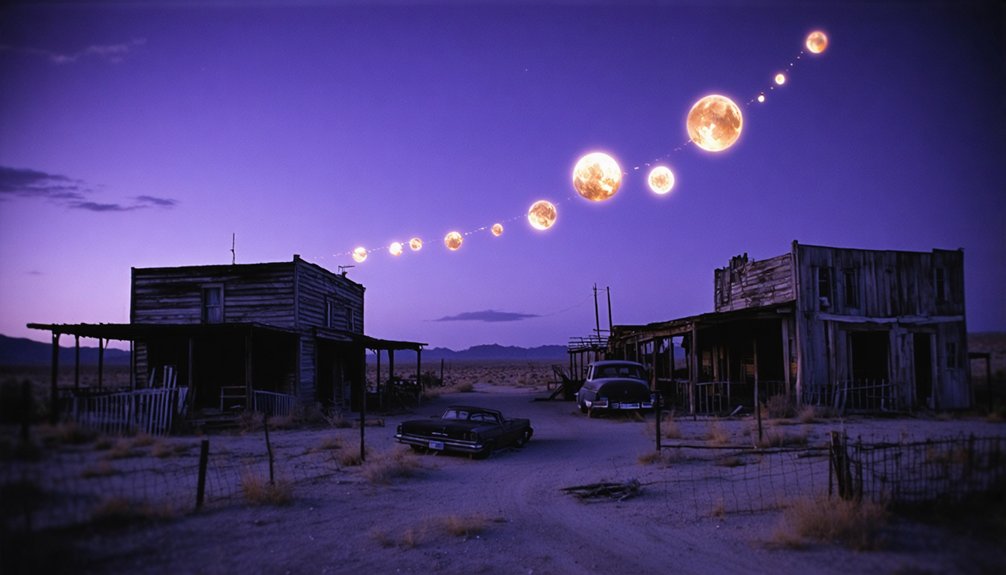
On a spring evening in 1883, cowhand Robert Reed Ellison spotted flickering lights near Paisano Pass while driving cattle through West Texas and assumed he’d discovered an Apache campfire. Settlers found no ashes.
Since then, Marfa sightings have documented colored orbs that split, merge, and vanish across Mitchell Flat—averaging 9.5 lights appearing 5.25 nights yearly between 1945-2008.
You’ll find conventional explanations unsatisfying. Scientists attribute the phenomenon to automobile headlights refracted through stratified desert air, creating desert illusions visible only from specific distances.
Yet historical accounts predate highways, and WWII pilots reported lights following their aircraft and disrupting communications. Indigenous tribes shared similar stories generations before Ellison’s encounter.
The mystery persists despite modern monitoring stations, drawing freedom-seeking travelers to the viewing center nine miles east of Marfa.
The Strange Illnesses and Deaths at Black Hope
When developers built homes over Black Hope Cemetery in Houston’s Newport Subdivision during the early 1980s, residents discovered human remains in their yards—triggering a cascade of unexplained deaths and debilitating illnesses that drove families from their properties.
You’ll find documented accounts of residents like Sam and Judith Haney suffering severe psychological trauma after unearthing the graves of Charlie and Betty Thomas, former enslaved individuals buried in unmarked plots.
The disturbances became so pervasive that families abandoned their investments entirely, with some fleeing to distant states while reporting shadows, putrid odors, and physical symptoms that defied medical explanation.
Unearthed Remains Spark Tragedies
How could anyone predict that disturbing century-old graves would lead to a cascade of unexplained deaths and illnesses?
When Sam and Judith Haney’s backhoe struck pine boards covering skeletal remains in their Crosby backyard, they’d inadvertently desecrated Charlie and Betty Thomas’s final resting place. Jasper Norton, who’d dug these graves as a teenager, confirmed their worst fears: their home sat atop Black Hope Cemetery.
The discovery’s aftermath proved devastating:
- Haneys experienced overwhelming guilt after handling the deceased’s rings, ultimately abandoning their property.
- Ben and Jean Haney found marked trees indicating two sisters buried beneath their yard.
- Multiple families filed lawsuits against developers who’d knowingly built over sixty unmarked graves.
Unlike ancient petroglyphs or mysterious crop circles that intrigue from safe distances, these residents couldn’t escape their disturbed ground.
Families Suffer Unexplained Ailments
The Williams family’s encounter with the cemetery grounds triggered a devastating medical crisis that defied conventional explanation. Jean Williams died from a massive heart attack at thirty after excavating the burial site.
Meanwhile, six relatives received rapid cancer diagnoses—three fatal.
You’ll find their ghostly encounters paralleled the Haney family’s tragedy, where their daughter’s mysterious disappearances from health to death followed supernatural disturbances in their home built over Betty and Charlie Thomas’s graves.
Skeptics proposed toxic ground emissions and undiagnosed conditions, yet conventional medicine couldn’t explain the pattern.
The jury recognized the families’ suffering, awarding $142,400 for mental anguish, though a judge later overturned it.
Meanwhile, plants died repeatedly near the disturbed graves, and bone-chilling phenomena persisted throughout the subdivision.
Curse Claims Multiple Lives
After Sam Haney’s shovel struck human remains in his backyard, a pattern of unexplained deaths and illnesses swept through the Newport subdivision that defied medical explanation. The cryptic curses associated with disturbing Charlie and Betty Thomas’s graves evolved into something more sinister. Residents reported escalating supernatural encounters that preceded tragedy.
The haunted legends gained credibility through documented incidents:
- An elderly neighbor complained of children keeping her awake before experiencing visits from a “dark lady”
- Multiple families experienced increasingly malicious apparitions alongside unexplained physical ailments
- The Haneys’ reburial of bone fragments in their yard coincided with intensifying paranormal activity
Despite anecdotal evidence from eyewitnesses, little verifiable documentation exists.
The subdivision’s construction over 60 unmarked paupers’ graves created conditions where separating coincidence from supernatural causation remains impossible.
Paranormal Encounters in War-Torn Belchite
Since Franco preserved Belchite’s ruins as a war memorial in 1939, visitors and locals have reported unexplained phenomena among the bullet-scarred buildings and roofless churches.
You’ll find accounts of residual spirits throughout the devastated town, where 5000 casualties fell during fifteen days of relentless bombing and siege.
The Church of San Martin, with its shell-scarred spire, and San Agustin’s tower containing an embedded unexploded shell serve as haunted artifacts that seemingly trap echoes of August-September 1937’s violence.
Witnesses describe hearing phantom gunfire and anguished voices near artillery positions on Lobo Hill.
The eerie atmosphere you’ll experience walking these rubble-lined streets stems from authentic war damage—every bullet hole and shattered structure documenting real human tragedy, making paranormal claims particularly compelling to investigators.
Varosha’s Untouched Relics of 1974
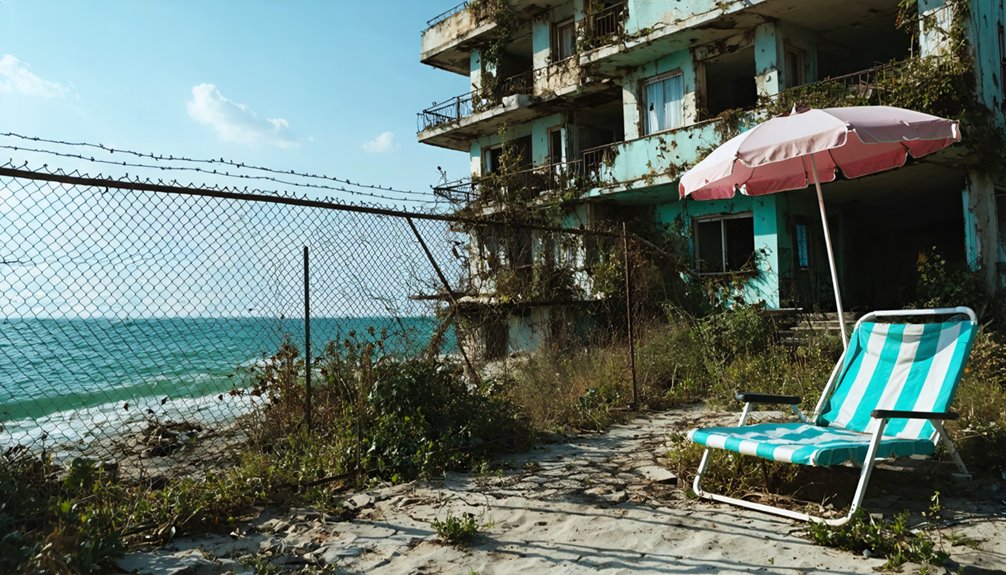
When Turkish forces swept into Varosha in August 1974, fleeing Greek Cypriot residents left behind a thriving Mediterranean resort that had generated 57% of Cyprus’s GDP through tourism just four years earlier.
A prosperous resort generating over half of Cyprus’s tourism revenue became a frozen ghost town overnight in 1974.
You’ll find a six-square-kilometer time capsule where nature now reclaims luxury hotels that once hosted Elizabeth Taylor and Richard Burton.
The military occupation transformed this jewel of the Eastern Mediterranean into a sealed zone where:
- Personal belongings remain scattered in villas and shops after 48 years
- Over 100 abandoned hotels stand as decaying monuments to interrupted lives
- Turkish military barracks occupy territory stripped of valuables through systematic looting
Recent partial openings since 2019 allow former residents to visit but not reclaim their properties. Any tourism revival faces a 10-billion-euro price tag, while military sovereignty guarantees ownership remains contested.
Unanswered Questions in America’s Abandoned Places
America’s ghost towns harbor mysteries that defy conventional historical explanations, leaving gaps in the archaeological record that researchers still can’t reconcile.
these forgotten ghost towns in America serve as poignant reminders of the struggles and dreams of those who once called them home. Each dilapidated building tells a story of hope and despair, inviting curious explorers to uncover their secrets. As nature reclaims these lost places, the echoes of the past become increasingly haunting and enigmatic.
The Panamint curse exemplifies unresolved questions—tribal conflicts and the outlaws’ stolen silver created a settlement that collapsed under circumstances beyond documented heat and isolation. Primary sources mention the curse but offer no empirical evidence for the town’s rapid abandonment.
Govan’s 1902 axe murders remain unsolved despite contemporary investigations. Court records confirm the brutality but provide no suspects or motives.
The Hopefield flood presents archaeological challenges: Union burning records exist, yet Mississippi River submersion erased physical evidence.
You’ll find no structural remains—steamboat navigation logs prove the streets flooded, but what caused total erasure after 1910s floods remains speculation without underwater archaeological surveys.
Frequently Asked Questions
Can Tourists Legally Visit Any of These Ghost Towns Today?
You can legally visit some ghost towns with haunted legends and abandoned landmarks, but you’ll need permits for private properties and should avoid toxic sites. Public heritage destinations along Route 66 remain accessible without restrictions.
Have Any Families Successfully Sued Developers Over Cursed Burial Ground Properties?
Legal battles over cursed burial grounds rarely succeed. Property rights typically trump indigenous claims, as shown in Wana the Bear v. Community Construction. You’ll find no successful family lawsuits in these cases—developers consistently prevail despite sacred desecration.
What Technology Is Used to Investigate Unexplained Phenomena at These Locations?
You’ll find investigators deploying lidar surveys, X-ray tomography, and advanced fingerprint technology at these sites. They’re also using spectral analysis to examine anomalies, drone surveillance for aerial mapping, and audio equipment to track unexplained vibrations and sounds.
Are There Security Measures Preventing Original Residents From Returning to Varosha?
Yes, you’ll find fences erected in 1984 block original residents’ return. Despite haunted legends and ontological mysteries surrounding Varosha, Turkish forces maintain barriers restricting access—UN Resolution 550 demands reversal, but restrictions persist, denying freedom.
How Do Local Governments Profit From Ghost Town Tourism?
Local governments profit through sales taxes on visitor spending and accommodation fees. You’ll find economic incentives driving preservation efforts, as ghost town tourism generated $1.7 million annually at one trail site while creating sustainable revenue streams for communities.
References
- https://www.losethemap.com/scariest-ghost-towns-in-the-world/
- https://minnesotasnewcountry.com/8-of-st-clouds-haunted-creepy-unsolved-mysteries/
- https://www.outsideonline.com/adventure-travel/national-parks/national-park-mysteries/
- https://unsolved.com/gallery/black-hope-curse/
- https://www.youtube.com/watch?v=yeTVfoQxqJc
- https://www.youtube.com/watch?v=Al4x_93nzh0
- https://www.youtube.com/watch?v=51HIZUu1FME
- https://www.dark-tourism.com/index.php/1493-varosha
- https://www.dlubal.com/en/news-and-events/news/blog/000157
- http://www.iwm.at/publication/iwmpost-article/the-strange-case-of-varosha-in-cyprus