You’ll discover numerous ghost towns across America equipped with visitor centers that bring abandoned settlements to life. These facilities offer interpretive displays, guided tours, historical exhibits, and essential amenities like parking and restrooms. Notable destinations include Bodie State Historic Park in California, Virginia City in Montana, and Kennecott in Alaska, where knowledgeable staff share compelling stories about boom-and-bust eras. These centers serve as gateways to exploring preserved ruins while promoting responsible tourism and heritage conservation. The following locations provide exceptional visitor experiences for history enthusiasts.
Key Takeaways
- Ghost town visitor centers provide maps, historical information, and interpretive displays to educate tourists about abandoned mining settlements.
- Centers are typically located near well-preserved ghost town sites along scenic routes in historically significant mining regions.
- Staffed facilities offer guided tours, souvenirs, restrooms, and parking to enhance the exploration experience for visitors.
- These centers help preserve local heritage narratives while promoting responsible tourism and supporting regional economic development.
- Visitor centers serve as gateways to exploring authentic ruins, reconstructed buildings, and artifacts from gold rush eras.
Bodie State Historic Park Visitor Center and Museum Complex
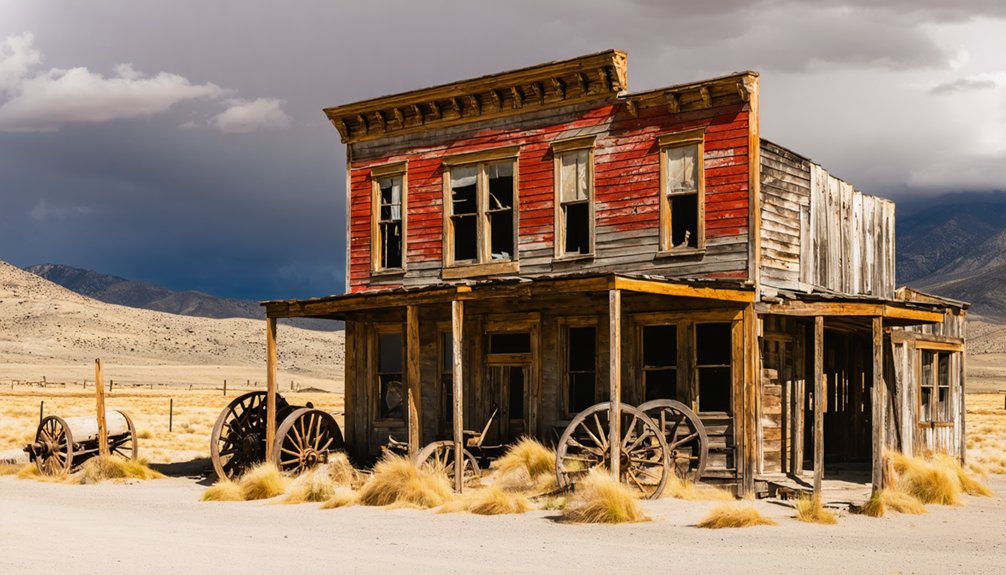
Perched at the end of a 13-mile dusty road in California’s high desert, Bodie State Historic Park preserves the West’s largest unrestored ghost town in a state of “arrested decay.”
The visitor center operates out of the old Miner’s Union Hall, a building that once served as the boomtown’s community center, theater, and church when Bodie’s population swelled to nearly 10,000 residents during the 1880s gold rush.
Inside, you’ll find exhibits detailing the mining history that began when W.S. Bodey discovered gold near Bodie Bluff in 1859.
The bookstore offers tour information, including $6 tickets for guided stamp mill excursions.
You’re free to explore 114 abandoned buildings spread across 495 acres, their weather-beaten wood interiors frozen in time since miners walked away decades ago.
A hike to the cemetery provides panoramic views of the surrounding landscape while revealing personal stories etched on weathered headstones.
The park hosts Friends of Bodie Day each August, offering members free entry to special programming and activities at this historic site.
Virginia City Welcome Center and Historical Resources
Unlike Bodie’s remote location, Virginia City’s Welcome Center sits right on bustling C Street at number 86, making it an accessible first stop in Nevada’s largest National Historic Landmark.
Conveniently located on C Street, Virginia City’s Welcome Center offers easy access to Nevada’s premier National Historic Landmark.
You’ll find it open Monday through Saturday from 9:00 AM to 5:00 PM, with Sunday hours from 10:00 AM to 4:00 PM year-round.
The staff doesn’t just hand you brochures—they share local stories and insider knowledge about the town’s historic architecture.
You’ll score an “Everyone Is A Local” sticker for merchant discounts, plus there’s free Cemetery Gin sampling with fascinating historical context.
Clean restrooms, curated books, and tour bookings make this your launchpad for exploring freely.
Inside, you can admire historic features like the Crystal Bar and era-specific chandeliers that reflect the building’s late 1800s origins.
If you misplace anything during your visit, the center provides lost and found services where you can report missing items online.
Contact them at 775-847-7500 or VisitorInfo@StoreyCounty.org to plan your adventure.
Kennecott Visitor Center at Wrangell-St. Elias National Park
You’ll find the Kennecott Visitor Center in Alaska’s vast Wrangell-St. Elias National Park and Preserve. It is housed within the historic Blackburn School at the heart of a remarkably preserved copper mining ghost town. The center serves as your gateway to exploring the dramatic Kennecott Mines National Historic Landmark.
Where massive red mining structures stand frozen in time against a backdrop of glaciers and peaks. From here, you can plan your visit to the iconic 14-story concentration mill—one of the most photographed industrial ruins in North America—and access trails that wind through this copper mining complex abandoned abruptly in 1938. The visitor center operates from late May to mid-September, offering exhibits, ranger programs, and a bookstore before closing for the fall, winter, and spring months. The center maintains daily hours from 9 am to 12 pm and 1 pm to 4:30 pm during the operating season.
National Park Preserve Location
Deep within Alaska’s vast Wrangell-St. Elias National Park and Preserve, you’ll discover the Kennecott Visitor Center at the heart of a mesmerizing ghost town. This wildlife habitat stretches across America’s largest national park, where preservation efforts protect both natural wonders and historic mining structures.
The center occupies the historic Blackburn School building on Kennecott’s main street, clearly visible as you walk down the old thoroughfare. You’re standing within the Kennecott Mines National Historic Landmark, where buildings stand frozen in time since 1938’s sudden abandonment.
The National Park Service’s preservation efforts began in 1999, stabilizing these remarkable structures. Located five miles from McCarthy, you’ll access this remote destination on foot or skis during winter—no vehicles or shuttles available.
It’s authentic wilderness adventure combined with fascinating industrial history. Park rangers are on hand to assist with trip planning and share insights about the area’s natural and cultural resources. The park features over 3,100 glaciers, including the nearby Kennicott and Root glaciers that dominate the landscape.
Historic Copper Mining Operations
The story of Kennecott’s copper riches began in summer 1900 when prospectors Jack Smith and Clarence Warner spotted an unusual green patch on the mountainside—malachite and chalcocite revealing massive copper deposits beneath. Their Bonanza claim attracted heavyweight investors like J.P. Morgan and the Guggenheim family, who formed Kennecott Copper Corporation.
Once the Copper River and Northwestern Railway arrived in 1911, copper extraction accelerated dramatically. Advanced mining technology enabled workers to process nearly $200 million worth of copper between 1911 and 1938—one of America’s richest strikes. The operation’s remarkable efficiency made Kennecott the largest U.S. copper company, establishing it as an influential international force in the industry.
You’ll find it remarkable how 300 mill workers and 200-300 miners carved prosperity from these unforgiving slopes. The operation abruptly ended in the late 1930s when deposits depleted and prices dropped, freezing this technological marvel in time. Today, the Kennecott Visitor Center serves as the main hub within Wrangell-St. Elias National Park, offering exhibits about the area’s mining history and natural environment.
Kennecott Mill Photography Opportunities
Positioned at the heart of this frozen-in-time mining complex, Kennecott Visitor Center operates from the historic Blackburn School building on the mill town’s main street. You’ll find unparalleled photography opportunities radiating from this hub, where rangers provide trail maps before you venture out to capture the ghost town’s dramatic essence.
Prime Photography Locations:
- The 14-story red concentration mill – This towering structure dominates the landscape, offering striking angles of historic mining machinery against mountain backdrops.
- Root Glacier trail – A mostly flat 4-km hike leads to panoramic viewpoints where you’ll photograph spectacular ice formations and glacier vistas.
- Abandoned townsite structures – Decaying and restored buildings throughout Kennecott create authentic ghost town shots. These are accessible from multiple trailheads including Jumbo Mine and Bonanza Mine routes.
Cahawba Archaeological Park Information Station
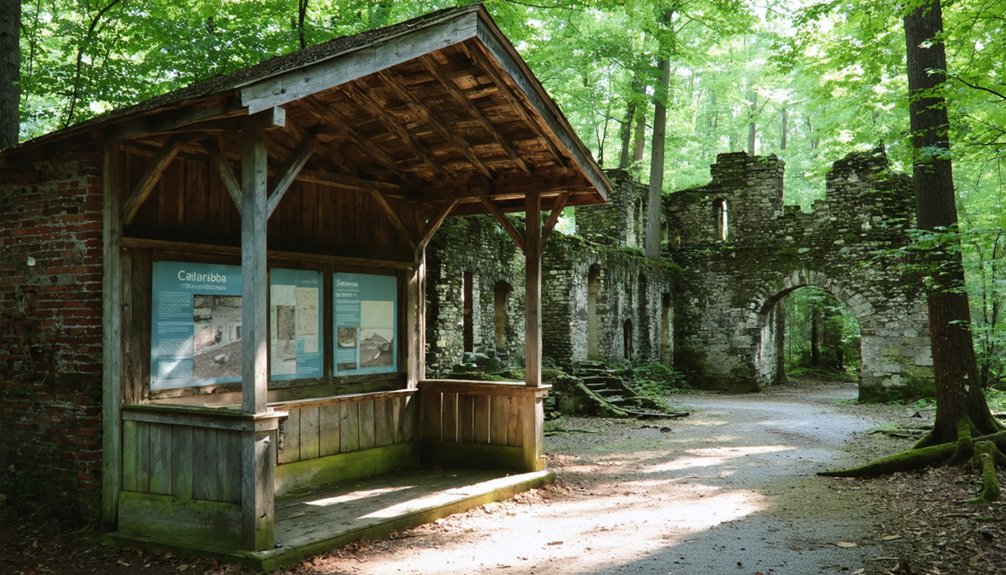
You’ll discover Alabama’s first state capital at Cahawba Archaeological Park, where the once-thriving 1840s cotton river town stood before declining into abandonment by 1900.
The visitor center, housed in an authentic 1850s Greek Revival cottage, displays artifacts, photographs, and archaeological finds that bring this historic site to life.
Staff members provide educational resources and guided information to help you explore the remnants of antebellum mansions, Civil War prison sites, and the post-war African American settlement that emerged here.
Historical Capital Background Information
Long before Alabama achieved statehood, Indigenous peoples recognized this confluence’s strategic importance.
Between AD 1500-1600, Mississippian villagers established a fortified political center here, demonstrating sophisticated mound construction techniques. Their half-acre flat-topped earthwork served as the ceremonial heart of a semicircular settlement protected by defensive walls and a moat.
Key Historical Layers You’ll Discover:
- Native trade networks connecting Moundville to the north and Gulf Coast Pensacola phase sites to the south.
- Alabama’s first state capital (1819-1826), where Governor Bibb surveyed streets over ancient earthworks.
- Antebellum cotton wealth that made Dallas County Alabama’s richest by 1860, with 2,000 residents.
This site’s visitor center reveals how successive cultures—from Indigenous leaders to plantation aristocrats—valued this strategic river junction.
Archaeological Site Educational Resources
At the heart of Cahawba Archaeological Park stands an authentic 1850s Greek Revival cottage that serves as your gateway to understanding this layered historical site. You’ll discover Native artifacts from the Mississippian mound village that preceded the colonial settlement, alongside treasures from Cahawba’s boom years as Alabama’s first capital.
The exhibits showcase archaeological techniques used to uncover foundations, trade goods, and everyday items that reveal how people lived here. Interpretive displays guide you through centuries of occupation, from indigenous inhabitants through Civil War prison operations.
You can explore at your own pace, following trails marked with signs explaining ruins and excavation sites. The center’s open Thursday through Monday, 10am-4:30pm, with bicycle rentals available for touring the expansive town site.
Jerome Historical Society and Mine Museum
Nestled in the heart of Jerome at 200 Main Street, directly across from the Spirit Room and Connor Hotel, the Jerome Historical Society Mine Museum offers an intimate glimpse into the town’s copper mining heritage.
Step into Jerome’s mining past at this Main Street gem showcasing the copper heritage that shaped this historic Arizona mountain town.
For just $2 admission (free for kids under 12), you’ll explore mining artifacts ranging from carbide lamps and underground potty cars to Marshal Johnny Hudgens’ Colt pistol and an original Chinese laundry machine.
What You’ll Discover:
- Mining Evolution – From hand tools to pneumatic drills, witness the technological transformation that built this copper empire.
- Ethnic Diversity – Explore the contributions of Chinese, Italian, Slavic, Mexican, Irish, and Russian communities.
- Interactive Experience – Watch video presentations and explore at your own pace through detailed displays.
Open daily 10:00 a.m. to 5:00 p.m., this compact museum packs powerful stories into every corner.
Rhyolite Ghost Town Information Facilities
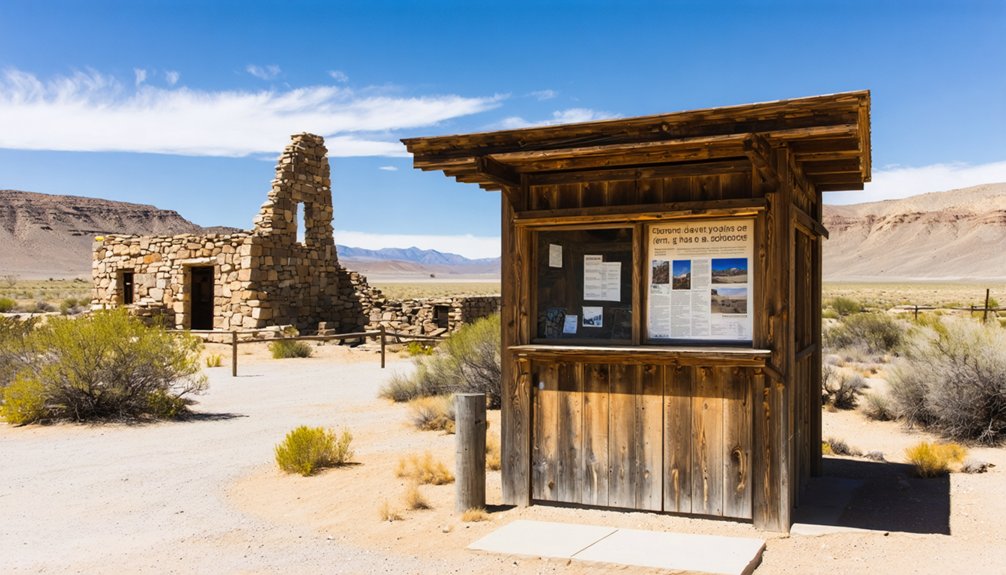
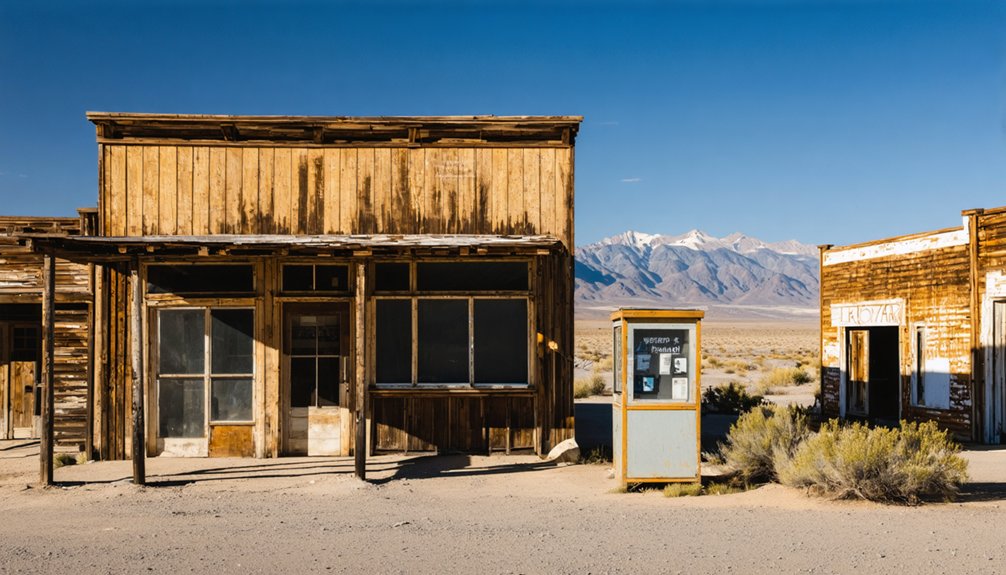
Rising from the Mojave Desert floor 35 miles northwest of Death Valley’s Furnace Creek, Rhyolite Ghost Town welcomes visitors with a paved road that branches north from Highway 374, delivering you straight into one of Nevada’s most photographed ruins.
You’ll find Rhyolite interpretation scattered throughout the site via weathered signs explaining this 1904 boomtown’s explosive rise and rapid collapse.
The adjacent Goldwell Open Air Museum operates a small volunteer-run visitors center with ghost town exhibits featuring vintage photos and memorabilia, though hours vary randomly.
They’ll sell you T-shirts and brochures when open, typically 10am-4pm.
The surreal outdoor sculptures remain accessible 24/7.
Don’t expect restrooms or water—this place embraces its raw abandonment, letting you explore crumbling bank buildings and Kelly’s famous bottle house freely before sunset.
Grafton Ghost Town Visitor Information Services
Unlike Rhyolite’s adjacent museum facility, Grafton operates as a completely self-guided experience without any staffed visitor center or formal welcome area. You’ll find interpretive signs and accessible buildings throughout this agricultural ghost town, where placards detail Grafton history and its former inhabitants.
The Grafton Heritage Partnership maintains the site through regular checks and 24-hour video surveillance, though you won’t encounter docents or guided tours.
To make the most of your visit:
- Arrive prepared with your own water and snacks, as no facilities exist onsite
- Support ghost town preservation through donation boxes positioned near interpretive signage
- Depart by dark to help prevent vandalism and respect partnership maintenance efforts
You’ll explore five restored structures from the original 30+, discovering this filming location‘s authentic atmosphere independently.
Belchite Guided Tour Reception Center
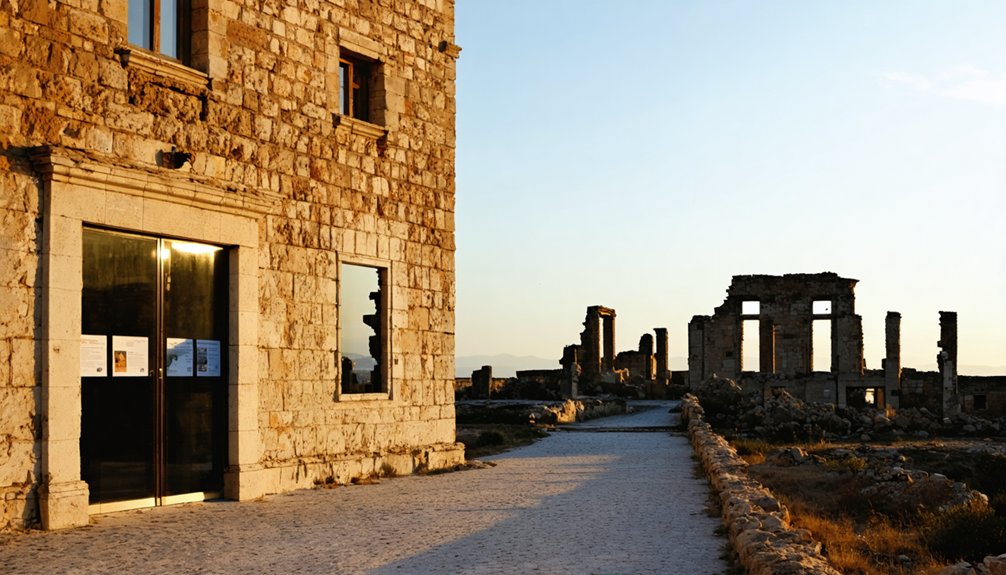
Spain’s Belchite presents a stark contrast to self-guided ghost towns—you can’t simply wander through these haunting Spanish Civil War ruins on your own. Since 2014, mandatory guided tours protect both visitors and this preserved battle reconstruction from vandalism.
Unlike typical ghost towns, Belchite’s Civil War ruins require mandatory guided tours—no solo exploration allowed since 2014.
You’ll book your 90-minute tour at the reception center, where English audio players complement Spanish guides. Tours depart at noon and 5:00 pm daily, with additional weekend options.
For roughly 6 euros, you’ll explore war memorials including the scarred San Martín de Tours Church, the barely-standing clock tower, and the Cruz de todos los caídos memorial cross.
Franco ordered these 1937 battle ruins preserved exactly as destroyed, creating Spain’s most powerful *testimony* to civil war devastation. Night tours offer atmospheric experiences through rubble-strewn streets where 3,000 residents once lived.
Deadwood History and Information Center
Deadwood’s 1897 railroad depot transforms history into an accessible experience at 3 Siever Street, where you’ll find South Dakota’s most extensive visitor center dedicated to the Wild West’s most notorious gold rush town.
This historic architecture houses interactive exhibits revealing mining legends and the characters who shaped frontier America.
You’ll discover three essential resources here:
- Hands-on exhibits featuring biographies of notorious figures like Wild Bill Hickok and Calamity Jane
- Trip planning assistance from knowledgeable staff who’ll direct you to authentic historic sites
- Daily access from 9:00 a.m. to 5:00 p.m. year-round, with extended summer hours
The center’s strategic location near Adams Museum positions you perfectly for exploring Deadwood’s preserved gambling halls and saloons.
Free parking at 501 Main Street eliminates barriers between you and genuine Western adventure.
Frequently Asked Questions
Are Overnight Stays Permitted at Any Ghost Town Visitor Centers?
You’ll find the *ultimate* overnight adventure at Gold Point, Nevada, and St. Elmo, Colorado ghost towns. Unlike typical visitor centers with guided tours and souvenir shops, these rare gems offer authentic cabin stays where you’ll experience genuine frontier freedom.
Do Visitor Centers Offer Accessibility Accommodations for Wheelchair Users?
Yes, you’ll find accessibility features at ghost town visitor centers, including wheelchair facilities like accessible restrooms, parking spaces, and level pathways. Some locations even offer specialized balloon-tired wheelchairs for maneuvering rough terrain freely.
What Photography Restrictions Exist at Ghost Town Visitor Centers?
Snap away freely—most visitor centers welcome personal photos without restrictions. However, you’ll need photography permits for commercial work, and artistic guidelines prohibit drones, disruptive setups, or climbing on historical structures to protect everyone’s experience.
Can Visitors Purchase Authentic Artifacts at Ghost Town Visitor Centers?
You can’t purchase authentic artifacts at ghost town visitor centers due to federal and state laws protecting historical items. Souvenir shops offer replicas, educational materials, and period reproductions instead, preserving genuine pieces for future generations’ enjoyment.
As these ghost towns turned tourist destinations evolve, they attract visitors eager to explore the remnants of a bygone era. Many offer guided tours that delve into the rich history and stories behind these abandoned places, enhancing the overall experience. This transformation not only educates tourists but also supports local economies through tourism revenue.
Are Pets Allowed Inside Ghost Town Visitor Center Facilities?
Most ghost town visitor centers don’t allow pets inside their facilities due to animal restrictions. You’ll need to take turns with your travel companion outside while exploring interiors. However, service animals typically have different access under pet policy exemptions.
References
- https://blog.batchgeo.com/ghost-towns/
- https://www.christywanders.com/2024/08/top-ghost-towns-for-history-buffs.html
- https://en.wikipedia.org/wiki/List_of_ghost_towns_by_country
- https://www.losethemap.com/scariest-ghost-towns-in-the-world/
- https://www.lonelyplanet.com/articles/coolest-ghost-towns-us
- https://whakestudios.com/us-ghost-towns/
- https://www.geotab.com/ghost-towns/
- https://www.elledecor.com/life-culture/travel/g43455278/ghost-towns-around-the-country/
- https://www.marinmommies.com/chasing-ghosts-bodie-state-historic-park
- https://www.wmf.org/monuments/bodie-state-historic-park