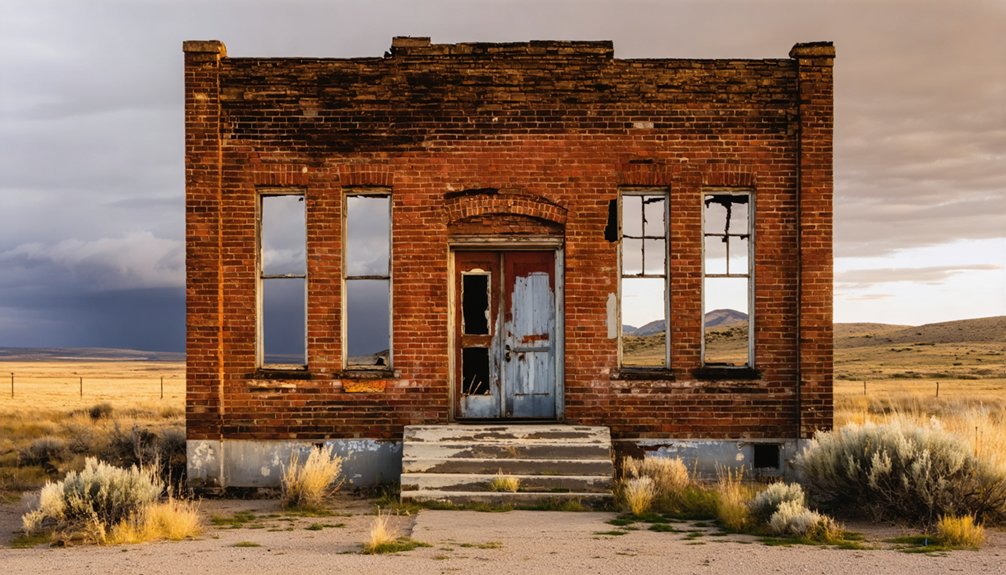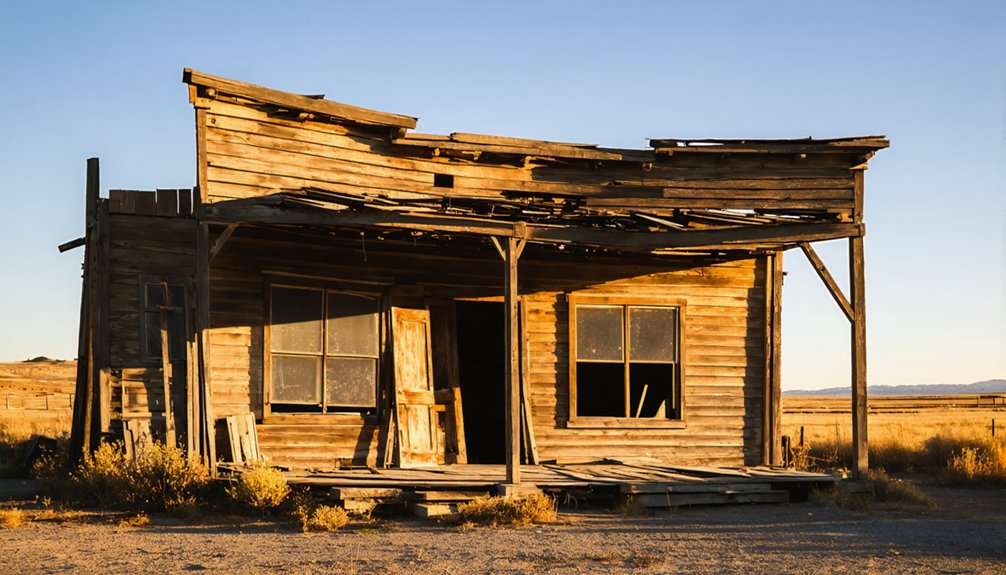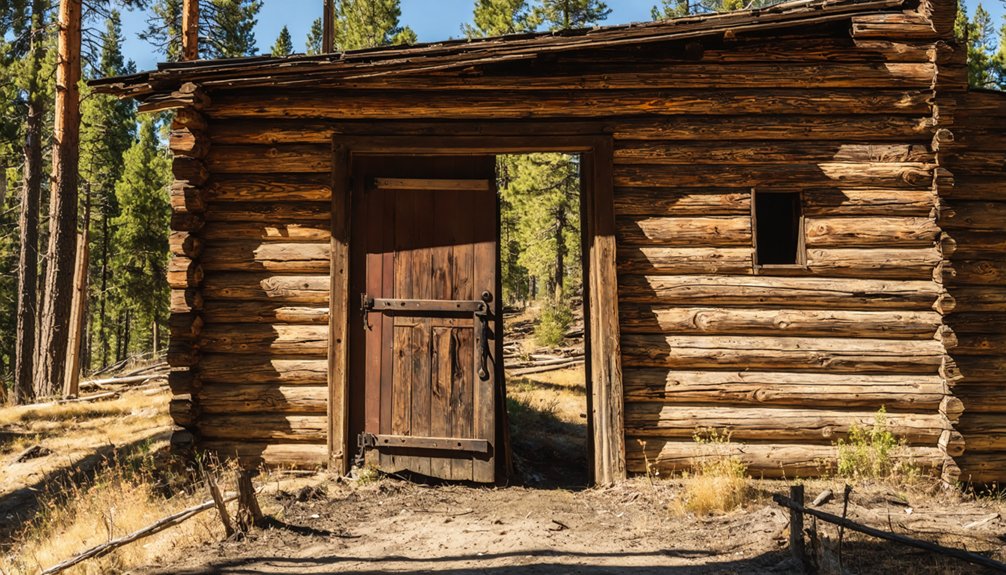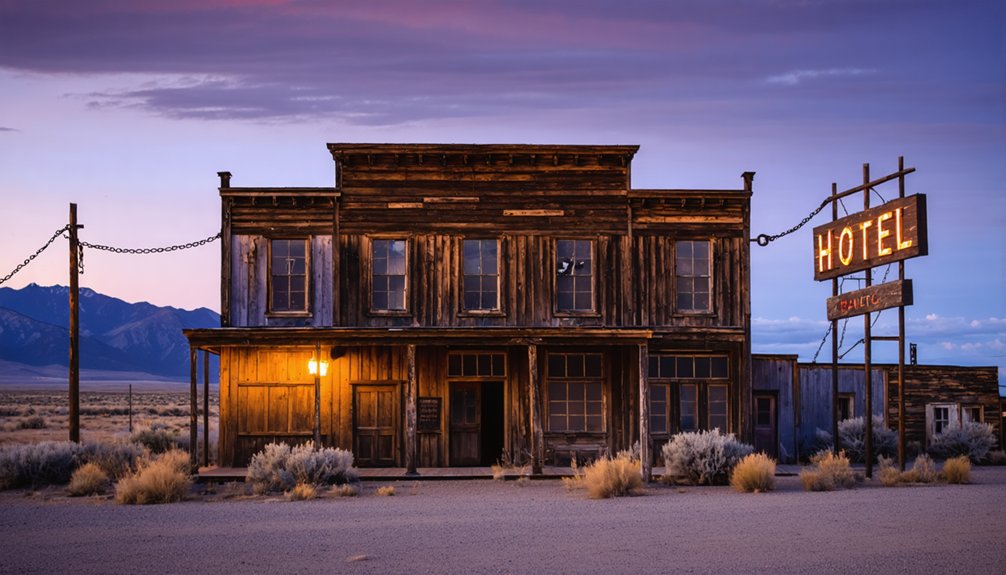
You can spend the night in Idaho’s authentic ghost towns at places like Silver City’s historic Idaho Hotel, where 75 weathered structures from the 1860s surround you at 6,000 feet elevation. Burgdorf Hot Springs Resort offers cabins and natural pools fed by 150-gallon-per-minute springs, while Shoup’s converted log schoolhouse sits along the Salmon River with a population of just four. These high-elevation sites require high-clearance vehicles and careful planning, with *prime* access from late spring through early fall when mountain roads remain passable and you’ll discover the complete story behind each settlement’s remarkable history.
Key Takeaways
- Silver City offers overnight stays in the historic Idaho Hotel, preserving 1860s ambiance without electrical grid at 6,000 feet elevation.
- Burgdorf Hot Springs Resort provides cabin lodging with hot spring access, requiring reservations up to 90 days in advance year-round.
- Shoup features historic cabin rentals and a converted log schoolhouse for overnight guests seeking wilderness isolation along Salmon River.
- Bayhorse Ghost Town allows camping within Land of the Yankee Fork State Park boundaries near preserved mining structures and mill ruins.
- Gilmore offers primitive overnight camping opportunities among 20 remaining structures at the Lemhi Range base, 65 miles south of Salmon.
Silver City and the Haunted Idaho Hotel
Perched at 6,000 feet in Idaho’s remote Owyhee Mountains, Silver City stands as one of the state’s most authentic ghost towns.
At 6,000 feet elevation, Silver City remains one of Idaho’s most genuine and well-preserved ghost towns in the Owyhee Mountains.
There are 75 weathered structures from the 1860s that cling to a narrow canyon carved by Jordan and Sinker Creeks.
You’ll access this silver-rush relic via a winding gravel road that snakes up the mountain, leading to a town that produced $60 million in precious metals.
At its peak, Silver City once housed 2,500 residents.
The Idaho Hotel anchors your overnight adventure, its original bar and Wells Fargo office still intact.
Local legends swirl about haunted spirits wandering the historic corridors, while preservation efforts by year-round residents keep the town’s legacy alive.
During summer months, property owners rely on generators or solar power since the town has no electrical grid.
You’ll explore nearly a dozen cemeteries, an 1869 Masonic Lodge, and the 1898 church—all testaments to lives lived on freedom’s rugged frontier.
The town’s boom began when assays showed $2,800 in gold and $7,000 in silver per ton in 1864, triggering a massive influx of prospectors and investment.
Burgdorf Hot Springs Resort
Deep in the Payette National Forest, 30 miles north of McCall, Burgdorf Hot Springs Resort clings to mountain terrain at 6,115 feet—a living ghost town where 150-gallon-per-minute hot springs have drawn seekers since Chinese miners first discovered the waters in the 1860s.
You’ll find the historic lodge’s eight-foot-wide fireplace warming over 20 rooms, surrounded by log buildings dating to 1851.
Four pools await: one nearly Olympic-sized at 100°F, two smaller basins at 113°F, and a children’s pool.
The resort operates in summer through fall, accessible via Warren Wagon Road, then switches to snowmobile-only winter access.
Book your wood-fired cabin up to 90 days ahead, or drop in for day-soaks at $6-$8.
This hot spring outpost has survived since 1870, rebuilding after fires, standing testament to Idaho’s untamed frontier spirit. Historic Burgdorf remains one of central Idaho’s most authentic preserved sites, drawing visitors seeking both relaxation and a glimpse into mining-era history. The resort shares its name with multiple locations worldwide, from Swiss cities to German towns.
Shoup on the Salmon River
Along the churning waters of the Salmon River, 27 miles west of North Fork, Shoup stands as one of Idaho’s most defiant ghost towns—a gold mining outpost established in 1881 that refuses to fade completely into history. With just four hardy souls calling it home, this remote canyon settlement offers you authentic mining history through historic cabins available on vacation rental sites and an old log schoolhouse converted to lodging.
You’ll reach Shoup via River Road from Salmon, passing rusted mining equipment and weathered mills clinging to canyon walls. The town’s connection to the “River of No Return” nickname adds mystique to your stay. Once a bustling gold administrative hub, Shoup actively served miners and adventurers who flocked to the area during its heyday.
While public gold mine tours ended in 2004, you can still explore the riverfront, book cozy cabins for two, and experience genuine wilderness isolation. For a more upscale retreat, Rivers Fork Lodge sits 13.4 miles from Shoup center along the Salmon River, offering full RV hookups and highly rated accommodations with river views.
Bayhorse Ghost Town
High in a narrow canyon at 6,000 feet elevation, Bayhorse Ghost Town preserves one of Idaho’s most dramatic silver mining stories—a settlement named for a prospector’s bay horses that transformed from wilderness to thriving community and back again in barely three decades.
You’ll discover authentic mining history through its remarkable three-story gravity-fed mill built directly into the canyon side, stone Wells Fargo building, and weathered log cabins. During its 1880s peak, 300-400 residents supported seven saloons, multiple stores, and productive silver operations like the Beardsley and Ramshorn mines.
A devastating 1889 fire triggered rapid abandonment, with the town emptying within two weeks.
Ghost town preservation efforts maintain original structures including charcoal kilns, ore processing facilities, and residential buildings showcasing pioneer ingenuity in Idaho’s rugged Yankee Fork Mining District. The site is located within Land of the Yankee Fork State Park, making it part of a broader network of historical mining sites near Challis. The site is accessible year-round with managed guidelines by the Bureau of Land Management, though visitors should bring essential supplies as minimal amenities are available.
Gilmore Mining Town
You’ll find Gilmore’s demise written in the twin catastrophes of a 1927 power plant explosion and the 1929 Great Depression, which together silenced its once-thriving mines and drove residents away.
The town’s remarkable narrow-gauge railroad—nicknamed “Get Off and Push” for its steep grades over the Continental Divide—ceased operations by 1940, leaving behind rusting rails and fading memories.
The settlement’s origins trace back to the discovery of rich silver and lead deposits in 1879, when mineral exploration swept through Lemhi County during a period of rising industrial demand.
Today, approximately 20 weathered structures stand as haunting symbols of this boomtown’s brief prosperity, their stabilized frames offering glimpses into Idaho’s volatile mining heritage.
Located 65 miles south of Salmon off Highway 28, the ghost town sits at the base of the Lemhi Range, where peaks soar above 11,000 feet and provide a dramatic backdrop to the decaying settlement.
Great Depression Era Abandonment
The catastrophic power plant explosion of 1927 set Gilmore on an irreversible path toward abandonment.
You’ll witness how this infrastructure disaster, combined with plummeting silver prices and the 1929 Great Depression, created a perfect storm of economic collapse.
The town’s population crashed from 600 thriving residents to virtual emptiness within just three years.
The cascading failures that sealed Gilmore’s fate:
- Mine closures in 1929 eliminated the town’s sole economic lifeline
- Railroad shutdown in 1939 severed the community’s connection to civilization
- Post office closure in 1957 marked the official transition to ghost town status
Today, you can explore the urban decay where ghost stories echo through eight remaining structures—tangible reminders of prosperity’s fleeting nature and capitalism’s unforgiving cycles.
Historic Railroad and Ruins
Winding through some of Idaho’s most punishing terrain, the Gilmore & Pittsburgh Railroad earned its sardonic nickname “Get Off and Push” when it connected this remote mining camp to the outside world in 1910.
You’ll find industrial relics scattered across this high desert landscape, where ore tramways once ferried lead and silver from nearby Leadore mines to waiting railcars.
The abandoned structures you can explore today include eight stabilized log-frame buildings from Ragtown, the itinerant settlement established in 1882.
Head west of the main townsite to discover these weathered remnants on BLM land, where platform tents and scrap-built sheds once sheltered miners and their families.
The railroad quit running in 1939 after the mines closed, leaving behind rusted tracks and forgotten dreams.
What to Expect When Staying in Idaho’s Ghost Towns
When planning overnight adventures in Idaho’s ghost towns, expect a unique blend of rustic authenticity and modern comfort that varies dramatically by location.
You’ll discover accommodations ranging from 1800s-furnished rooms with hot showers to creaky cabins where paper-thin walls reveal every sound.
Essential preparations include:
- Remote access navigation – Gravel roads and rugged terrain require proper vehicle preparation, especially when reaching Owyhee Mountains settlements.
- Temperature considerations – Pack layers for 6,000-foot elevations where cold persists even in early summer.
- Timing strategy – Arrive weekdays to avoid motorcycle and ATV crowds that descend around 10am.
You’ll experience wildlife encounters amid mining remnants and restored structures.
While local cuisine options remain limited in preserved settlements, nearby towns like McCall and Challis provide supply points.
Embrace the solitude of unrestored ghost towns and prepare for minimal amenities beyond your lodging.
Best Times to Visit Idaho Ghost Towns
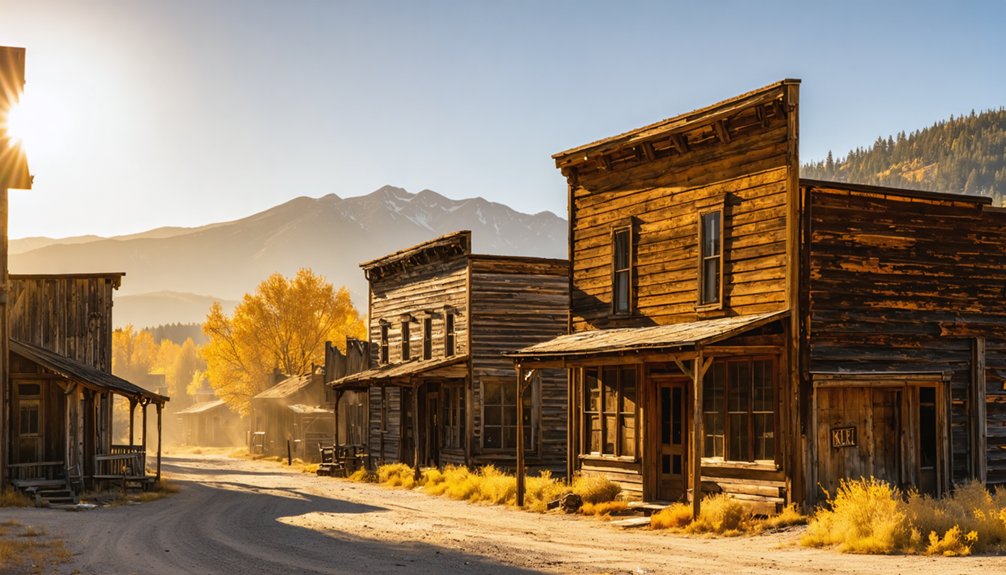
Timing your ghost town exploration transforms a simple visit into an unforgettable Idaho adventure. You’ll find late spring through early fall (May–September) offers ideal access to remote sites like Silver City, where dirt roads become navigable and ghost town architecture stands crisp against clear skies.
Summer’s 52–84°F temperatures let you roam preserved structures without crowds.
September’s golden foliage creates stunning backdrops for photography.
Winter closes high-elevation roads from November to May, limiting your freedom to explore 6,200-foot sites.
Spring’s snowmelt reveals accessible waterfall hikes near ghost towns, and reduced crowds mean you’ll experience local legends in peaceful solitude.
Pack for arid conditions year-round, bring high-clearance vehicles for gravel roads, and plan around seasonal closures to maximize your independent adventure.
Preparing for Your Ghost Town Overnight Adventure
Planning an overnight stay in Idaho’s remote ghost towns requires careful preparation. You’ll encounter rocky dirt roads, seasonal weather extremes, and limited amenities.
You’ll need sturdy provisions since these mountain locations rely on propane and generators, with some accommodations offering heat while others don’t. Pack layers, vehicle emergency supplies, and gear for rugged terrain—the Owyhee Mountains’ elemental wear has exposed jutting rocks that can damage your undercarriage, and help isn’t around the corner.
Essential Gear and Supplies
Before you venture into Idaho’s remote ghost towns, assembling the right gear can mean the difference between an unforgettable adventure and a miserable ordeal.
Since eco friendly accommodations like Burgdorf’s rustic cabins lack modern amenities, you’ll need self-sufficiency tools.
Your Essential Packing List:
- Navigation and Safety: High-clearance vehicle for gravel roads, flashlights for exploring unlit buildings where local ghost stories come alive, and portable chargers for off-grid locations.
- Clothing: Layered outerwear for 6,000-foot elevations, sturdy boots for uneven terrain, and dust protection against ATV traffic.
- Provisions: Ample water for remote Owyhee Mountains access, non-perishable foods for overnight stays, and hydration packs for hiking.
Pack backup batteries for cameras—you’ll want documentation when exploring structures with century-old features and paranormal reputations.
Safety and Weather Considerations
Your carefully packed gear won’t matter if you underestimate Idaho’s backcountry conditions. Silver City receives four to six feet of snowfall annually, closing roads from fall through spring and requiring snowmobiles or tracked ATVs for access.
During open seasons, you’ll navigate steep dirt roads with exposed rocks that’ll scrape your undercarriage—four-wheel drive isn’t optional. Road hazard awareness becomes critical where shadows obscure terrain, demanding controlled speeds and constant vigilance.
Winter brings punishing wind gusts and blowing snow that’ll strand unprepared visitors. The county doesn’t mess around: ignore closure warnings, and you’re footing search and rescue costs plus fines.
No cell service or GPS means bringing maps and compasses. Wildlife precautions matter too—you’re entering their territory.
County fire departments dispatch regularly for stuck vehicles, risking both travelers and responders.
Exploring Historic Mining Sites and Attractions
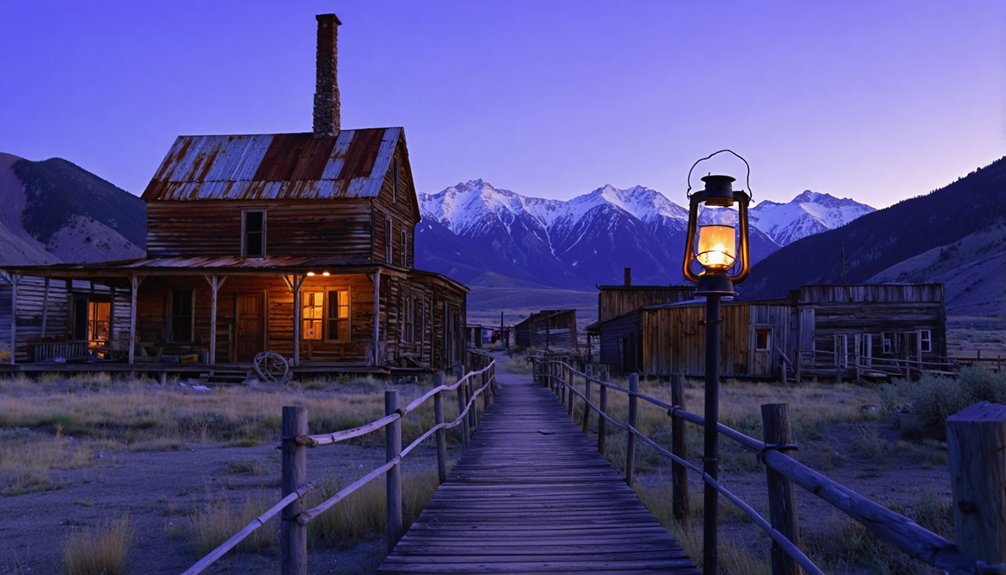
Among Idaho’s rugged mountains and remote valleys, dozens of abandoned mining towns stand frozen in time, offering visitors tangible connections to the state’s silver and gold rush era. You’ll discover authentic ghost town legends at these remarkable sites:
- Silver City – Explore nearly 75 original mid-1800s structures, including buildings that housed Idaho Territory’s first telegraph and daily newspaper by 1874.
- Bayhorse – Walk through Idaho’s longest-running silver producer, where mining technology from the Beardsley and Ramshorn Mines still stands after operations ceased in 1915.
- Custer and Bonanza – Take guided tours through restored buildings at Custer, then venture to Bonanza’s weathered cabins and overgrown cemetery within Land of the Yankee Fork State Park.
Each site tells stories of fortune-seekers who ventured into Idaho’s wilderness pursuing precious metals.
Photography and Preservation Tips for Ghost Town Visitors
When you’re photographing Idaho’s ghost towns, you’ll want to set your camera to a high f-stop (f/8 to f/16) for sharp depth of field.
Use a tripod for those essential long-exposure shots in dim interiors.
Golden hour lighting transforms weathered structures into dramatic subjects, but always check posted regulations before entering buildings or removing any artifacts.
Remember that these fragile sites survive only through visitor respect—take nothing but photographs, leave nothing but footprints, and never climb on unstable structures that could collapse under your weight.
Best Camera Settings Tips
Because ghost towns often sit in shadowy valleys or require late-afternoon visits when the light grows dim, mastering manual camera settings becomes essential for capturing these atmospheric locations. Your camera gear setup should prioritize low-light performance for night photography adventures.
Core Settings for Ghost Town Photography:
- Aperture: Set your lens to its widest setting (f/2.8-f/4) to maximize light gathering in dim interiors and twilight exteriors.
- Shutter Speed: Use 15-30 seconds for stationary structures, allowing sufficient light while maintaining sharpness with your tripod.
- ISO: Boost to 1600-3200 for adequate exposure without excessive noise in dark scenes.
Lock manual focus after illuminating your subject with a flashlight, then switch to continuous burst mode for creative light painting techniques that’ll bring weathered buildings to life.
Respecting Historic Site Rules
Capturing stunning images of Idaho’s ghost towns means nothing if your presence damages these irreplaceable historic sites. When you’re exploring places like Historic Chesterfield, you’ll need to follow designated camping areas and keep pets leashed at all times.
Firearms are prohibited on the townsite, so leave them secured in your vehicle. Historic signage throughout these locations isn’t just decorative—it marks boundaries and protects fragile structures from foot traffic.
Site preservation depends on visitors like you respecting fire restrictions and staying within assigned zones. You’re free to roam and photograph, but that freedom comes with responsibility.
These weathered buildings have survived decades of Idaho’s harsh elements; don’t let your overnight adventure become the thing that finally destroys them.
Frequently Asked Questions
Are Pets Allowed at Idaho Ghost Town Overnight Accommodations?
Like a welcome mat for your four-legged companions, pet policies at Idaho’s ghost town accommodations embrace animal accommodations. You’ll find dog-friendly cabins, rentals, and campgrounds near Bayhorse and Stanley, where pets roam freely alongside their adventurous owners.
What Is the Cell Phone Coverage Like in Remote Ghost Towns?
Cell service is mostly nonexistent in remote Idaho ghost towns like Silver City, where you’ll find no coverage during your stay. Plan accordingly for emergencies, as you’ll be off-grid without reliable communication access in these isolated locations.
Do Any Ghost Towns Offer Guided Night Tours or Paranormal Investigations?
Like miners once searched for gold by lantern light, you’ll find Idaho City and Custer offer guided ghost town legends tours where you can explore spooky stories after dark, though formal paranormal investigations aren’t officially organized by tour operators.
Are There Restaurants or Do Guests Need to Bring Food?
Restaurant options vary by location. Silver City’s Idaho Hotel and Gold Mine’s Saloon serve meals seasonally, while Village Inn offers local dining near Bayhorse. You’ll need to pack your own food for remote spots like Burgdorf Hot Springs.
What Medical Facilities Are Nearest to These Remote Ghost Town Locations?
Medical facilities are typically 50+ miles away from Idaho’s ghost towns. You’ll find hospitals in larger towns like Mountain Home or Boise. When exploring historical artifacts and chasing local legends, you should bring first-aid supplies and emergency communication devices.
References
- https://www.thegoldminehotel.com/ghost-towns-and-haunted-places-in-idaho
- https://visitidaho.org/travel-tips/boom-or-bust-exploring-idaho-ghost-towns/
- https://idaho-forged.com/idahos-ghost-towns-eerie-yet-approachable/
- https://www.tripadvisor.com/Hotel_Review-g35602-d291449-Reviews-Idaho_Hotel-Silver_City_Idaho.html
- https://www.visitsalmonvalley.com/historic-adventures/ghost-towns/
- https://wheresashawent.wordpress.com/2019/11/13/silver-city-and-the-idaho-hotel/
- http://www.onlyinyourstate.com/stays/idaho/oldest-haunted-hotel-id
- https://www.historicsilvercityidaho.com
- https://www.expedia.com/Bayhorse-Ghost-Town-Hotels.0-l553248635922902209-0.Travel-Guide-Filter-Hotels
- https://www.hhhistory.com/2016/10/a-ghost-town-that-lives-on-by-marilyn.html