You’ll discover Nebraska’s most haunting overnight experience at Crofton’s Argo Hotel, a beautifully preserved 1911 Victorian inn where you can sleep among genuine paranormal activity—including Alice, the resident ghost who’s been documented by investigators since the 1940s. While Nebraska boasts over 900 ghost towns scattered across its windswept plains, the Argo uniquely combines modern comfort with authentic frontier history and supernatural encounters. For those seeking adventure beyond Crofton, restored historic inns and lakeside resorts near abandoned settlements offer comfortable bases for exploring the state’s forgotten communities and their lingering spirits.
Key Takeaways
- The Argo Hotel in Crofton offers 11 guest rooms in a haunted 1911 Victorian building with documented paranormal activity.
- Arrow Hotel in Broken Bow provides overnight stays in a restored historic property linked to Nebraska’s ghost town heritage.
- Olde Main Street Inn in Chadron serves as lodging near abandoned settlements across northwest Nebraska’s Sandhills region.
- Admiral’s Cove Resort at Lake McConaughy offers lakeside accommodations ideal for exploring nearby ghost town remnants.
- Historic Nebraska hotels combine modern amenities with authentic paranormal experiences including ghost tours and reported supernatural encounters.
The Historic Argo Hotel in Crofton: Where Paranormal Meets Preservation
When Nicholas Michaelis and his family arrived from Kansas in 1912, they didn’t just build another hotel—they transformed Crofton’s skyline with the town’s first electric lights. This commercial prairie-style masterpiece served railroad travelers with 24 rooms, becoming a cornerstone of Knox County’s development.
You’ll discover historical architecture worth exploring: pressed tin ceilings, grand oak staircases, and original stained glass windows that survived over a century.
The preservation efforts by Jerry and Sandra Bogner in 1994, followed by Frank and Megan Marsh’s recent renovations, earned this gem National Register status in 1999.
Today’s 11 guest rooms blend Victorian elegance with modern comforts—private bathrooms, Wi-Fi, and air-conditioning.
The Friday-Saturday steakhouse and basement bar keep the building’s communal spirit alive. Located near Lewis and Clark Lake, the hotel offers easy access to outdoor recreation along the Missouri River.
Alice and the Mysterious Apparitions: Ghostly Encounters at the Argo
Behind the Argo Hotel’s pressed tin ceilings and grand oak staircases lurks a darker chapter—one whispered about in the basement bar where Alice’s portrait hangs. You’ll need your flashlight to see her face emerge from the darkness, watching eternally for the child she lost during 1940s childbirth.
When renovators discovered a baby’s skeleton sealed in concrete in 1994, urban legends crystallized into a chilling possibility. Now you might hear phantom crying echoing through hallways, feel unexplained pressure on your bed’s edge, or witness pictures moving independently.
Paranormal investigations, including Ghost Hunters’ documented phenomena, have captured evidence of Alice’s restless search. Cold spots dissipate around you. Doors slam. Glasses shatter. The basement holds its secrets close, but Alice’s presence remains undeniable—forever seeking what was taken. The building originally opened in 1911 as The Argo, catering to traveling businessmen before its transformation into the haunted destination it is today. Located at 211 Kansas St., the hotel continues to welcome brave visitors who seek authentic paranormal encounters.
Understanding Nebraska’s 900+ Ghost Towns: A Brief History
Across Nebraska’s windswept prairies, over 900 ghost towns mark the ambitious dreams and harsh realities of frontier settlement. You’ll find remnants of communities born from wild speculation—27 towns platted in Cass County alone during 1857’s fever pitch. These weren’t just random failures; they represented calculated gambles on railroad routes, county seats, and industrial futures.
The railroad boom between 1870-1890 sparked rapid urban development, creating thriving communities like Factoryville with its mills and colleges. But what the rails gave, they could take away.
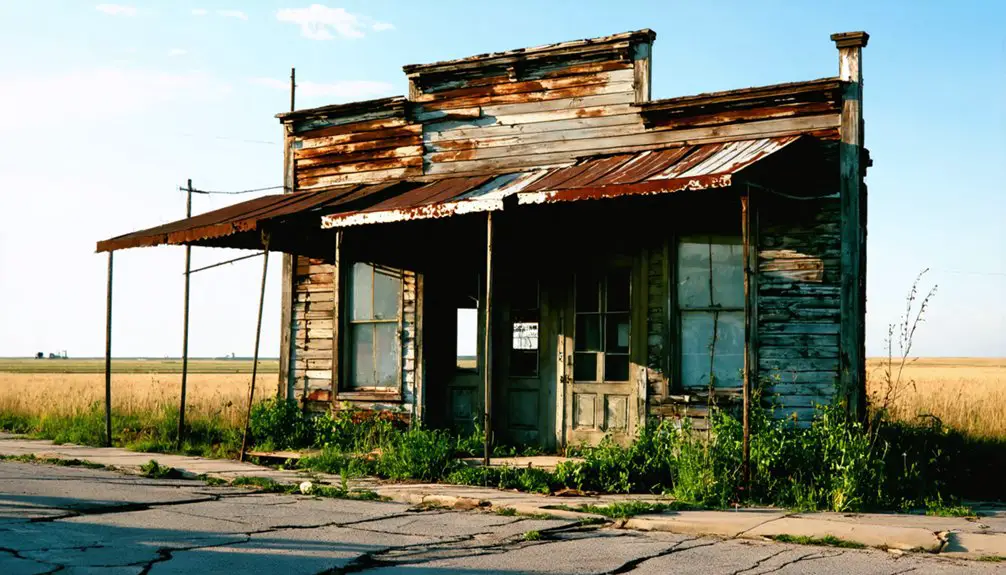
When tracks bypassed towns or agricultural markets collapsed in the 1930s, economic decline followed swiftly. River settlements vanished beneath floods, stagecoach stops became obsolete, and speculative “paper towns” left only cemeteries behind—silent witnesses to Nebraska’s relentless transformation. Many towns died when gold mines closed or farming became impossible, eliminating the economic foundations that had sustained entire communities. Today, grain elevators and abandoned streets serve as the most visible markers of these once-thriving railroad towns scattered across the prairie landscape.
How to Discover Forgotten Communities Across the State
You’ll find Nebraska’s forgotten communities by studying historic railroad maps from the 1870-1890 expansion period, when land development companies platted hundreds of towns that never materialized beyond paper.
Compare these century-old documents against modern maps to spot vanished settlements, then scan aerial photographs for telltale signs—weathered foundations, abandoned roadbeds, and old railroad rights-of-way etched into farmland.
County histories and newspaper archives fill in the stories these geographic ghosts left behind, transforming grid coordinates into real places where people once built homes, opened stores, and dreamed of permanence. Look for historic hotels listed on the National Register of Historic Places, which often preserve the architectural character of these early settlements. When exploring these forgotten communities, book accommodations early since lodging fills quickly in rural Nebraska, particularly during events that draw visitors to remote areas along highways like NE Hwy 11 and NE Hwy 2.
Research Historic Maps and Records
The landscape of Nebraska holds secrets that only maps can reveal. You’ll uncover ghost towns fastest through map comparison—lay a current atlas beside historic railroad maps from the 1870s-1890s expansion era, and vanished communities emerge like phantom images. Railroad records from Union Pacific document settlements that bloomed and died with the branch lines, abandoned by the late 1930s.
County plat books become your treasure maps, documenting over 900 forgotten towns across Nebraska. You’ll find grain elevators standing at odd angles to modern roads, marking where rails once ran. Cass County alone lists sixty-four ghost towns with exact plat dates. Atlas maps from 1903 reveal clusters of communities like Addison, Lindy, and Tewsville that operated within three and a half miles of each other, complete with stores, churches, and schools. Railroad companies often named towns alphabetically, creating sequences that help you trace entire corridors of settlement and decline.
Plunge into newspaper archives and cemetery records at local historical societies—they’ll reveal the stories maps can only hint at, guiding you toward authentic frontier remnants worth exploring.
Explore Aerial Photography and Foundations
When you lift your perspective skyward through aerial photography, Nebraska’s vanished communities reveal themselves in patterns invisible from the ground. Through aerial mapping, you’ll spot graded streets cutting through prairie grass, tree-lined avenues marking settler plantings, and grain elevators standing sentinel over forgotten crossroads. Foundation archaeology becomes your treasure hunt—those earthen remnants of Dobytown near Fort Kearny, the adobe-style structures hiding beneath vegetation, the building foundations that once supported St. Deroin’s 300 residents.
Highway 12 transforms into your discovery corridor, where Brocksburg’s homesteads huddle beneath mature trees on distant hills. Railroad rights-of-way etch themselves across the landscape, their angled geometry defying county road grids.
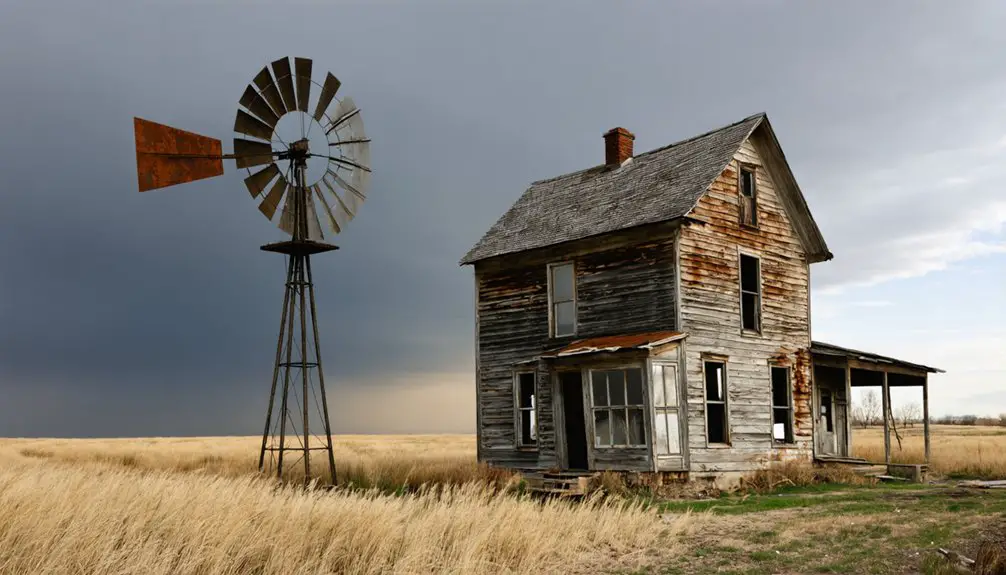
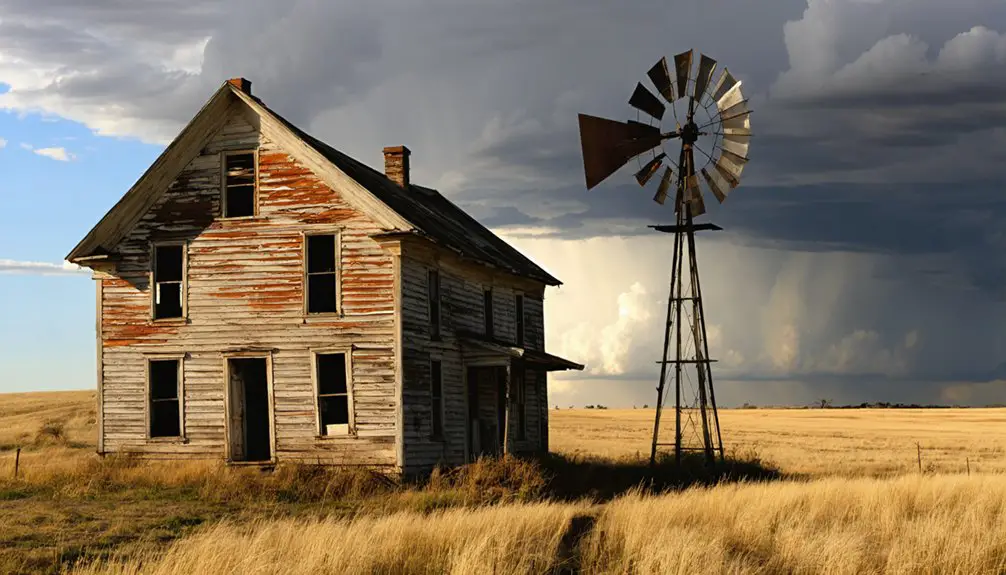
You’ll find Western Nebraska especially rewarding—deserted homesteads with rusting barns emerge from the mist like eye sockets, waiting for your exploration.
Lemoyne’s Admiral’s Cove and Other Overnight Options Near Abandoned Sites
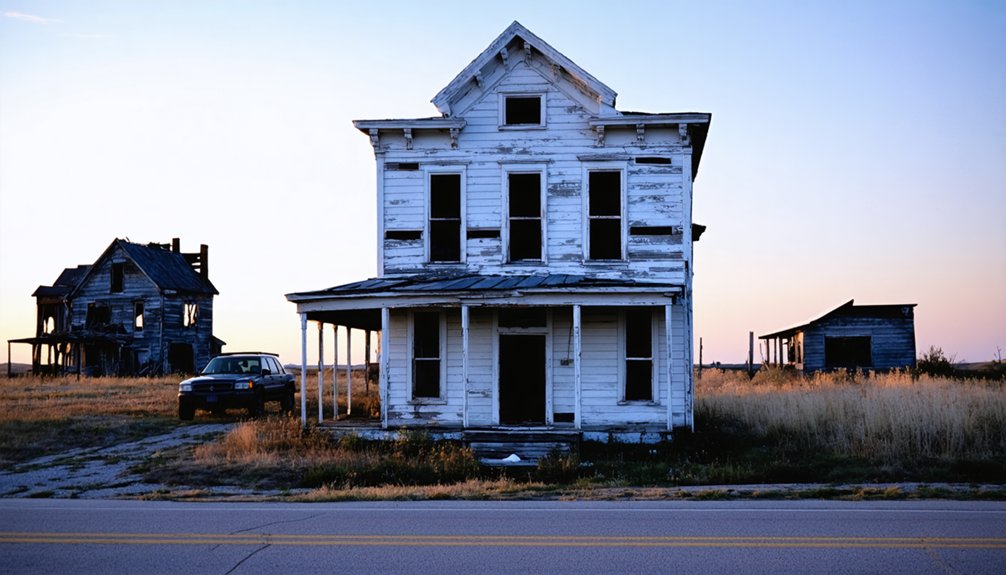
You’ll find modern comfort meets historical intrigue at Admiral’s Cove, where your lakeside cabin sits directly above the drowned streets of old Lemoyne.
When drought conditions drop the water level, you can walk from your lodging straight onto exposed foundations of the town’s gas station and bank—artifacts that spent decades hidden beneath Lake McConaughy’s surface.
The Sandhills region surrounding this underwater ghost town offers additional retreats where ranchers-turned-innkeepers share stories of vanished communities over morning coffee, connecting you to Nebraska’s lost settlements through living memory.
Admiral’s Cove Resort Amenities
Nestled on the shimmering shores of Lake McConaughy, Admiral’s Cove Resort offers ghost town explorers a welcome contrast to Nebraska’s abandoned settlements—a vibrant lakeside retreat where you’ll find comfort after dusty backroad adventures.
Modern amenities transform your base camp into something extraordinary:
- Flexible accommodations ranging from beachfront tent sites to full RV hookups and private cabins—each positioned steps from sandy shores with scenic views stretching across Nebraska’s largest reservoir.
- The Cove Restaurant serves everything from weekend breakfast buffets with live omelette stations to evening filet mignon, fueling your explorations with American fusion cuisine that surpasses typical roadside fare.
- On-water conveniences including kayak and jet ski rentals, plus dockside dinner delivery, let you embrace lakeside freedom between ghost town expeditions.
New ownership brings genuine hospitality to this adventure hub, where free parking and premium gas keep you mobile.
Sandhills Lodging Near Ghosts
After savoring Admiral’s Cove’s lakeside comforts, you’ll discover the Sandhills region harbors distinctive overnight sanctuaries that transform ghost town exploration into multi-day adventures. High Plains Lodging near Crawford provides welcoming hospitality as your basecamp for investigating abandoned settlements across northwest Nebraska’s windswept terrain.
You’ll appreciate the owners’ genuine warmth after dusty days traversing forgotten streets.
For those craving authentic paranormal encounters alongside historical exploration, haunted architecture awaits at Arrow Hotel in Broken Bow and Argo Hotel in Crofton. These restored establishments offer more than proximity to ghost towns—they deliver their own spectral residents.
Room #205’s apparitions and nighttime disturbances create immersive experiences where past and present collide.
Chadron’s Olde Main Street Inn rounds out your options, where disembodied footsteps echo through Victorian halls, merging abandoned town histories with lingering spiritual presences.
Planning Your Haunted Stay: What to Expect in Nebraska’s Ghost Town Accommodations
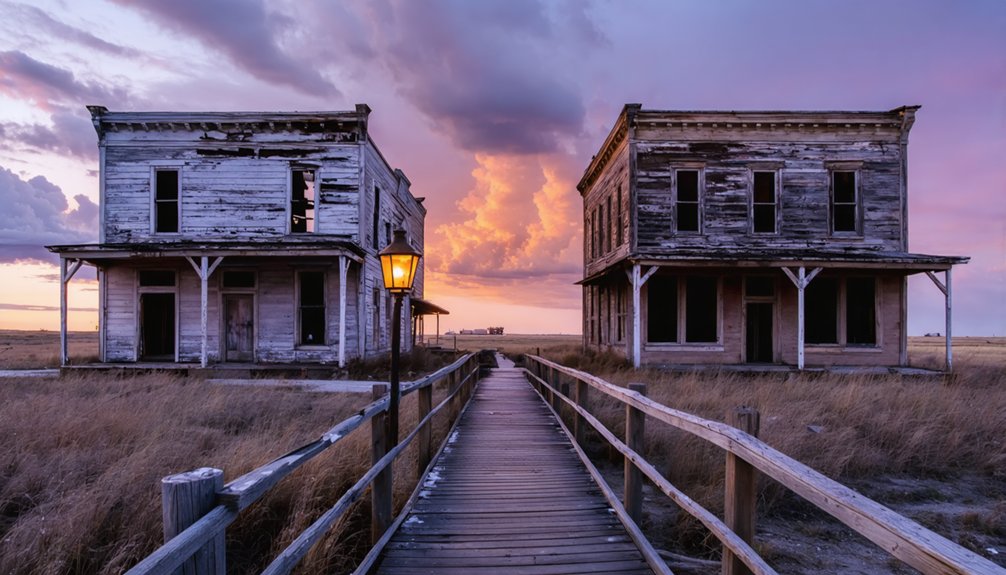
When darkness settles over Nebraska’s prairie ghost towns, the historic Argo Hotel in Crofton transforms from a charming Victorian inn into something far more atmospheric.
You’ll navigate dimly lit hallways where Alice’s spirit lingers in the basement, still searching for her infant child decades after her 1940s death during childbirth.
What awaits paranormal tourism seekers at haunted hotels:
- Genuine encounters – Guests report footsteps echoing through empty corridors, pictures relocating themselves, and phantom cries piercing quiet nights.
- Modern comfort meets history – Victorian rooms feature Wi-Fi and private bathrooms alongside authentic 1912 restoration details.
- Expert guidance – Hosts Frank Marsh and Megan offer ghost tours, sharing documented experiences that converted skeptics into believers.
Ghost Hunters investigated and confirmed intense paranormal energy here, making your overnight adventure authentically unsettling yet surprisingly welcoming.
Frequently Asked Questions
Are Children Allowed on the Ghost Tours at the Argo Hotel?
Yes, children are welcome on Argo Hotel’s ghost tours. You’ll find ghost tour safety prioritized through controlled storytelling rather than extreme scares. These family friendly activities blend paranormal intrigue with historical exploration, letting your crew experience Nebraska’s haunted heritage together.
What Is the Best Season to Visit Nebraska’s Ghost Towns?
Like a wanderer chasing solitude, you’ll find fall your ideal season. Seasonal weather brings crisp, comfortable temperatures perfect for exploration, while minimal visitor crowds let you roam these abandoned places freely, experiencing their haunting atmosphere without distraction.
Do I Need Special Equipment to Explore Abandoned Town Sites Safely?
Yes, you’ll need necessary gear for safety precautions: sturdy boots, thick gloves, a reliable flashlight, and dust mask. These abandoned sites hold sharp debris, unstable floors, and airborne particles that’ll challenge your adventurous spirit while protecting your freedom to explore.
Are Pets Permitted at Overnight Accommodations Near Ghost Towns?
You’ll find pet policies and accommodation restrictions vary wildly across Nebraska’s ghost town lodgings—nothing’s standardized here. Contact each property directly before booking, since some welcome your furry companions while others don’t permit them at all.
How Much Does It Cost to Stay at the Argo Hotel?
Specific rates aren’t publicly listed, so you’ll need to call (402) 388-2400 directly. This 1912 gem balances historical preservation with comfort, where local legends of friendly spirits add character to your authentic Nebraska railroad-town experience.
References
- https://www.hauntworld.com/haunted-hotel-in-crofton-nebraska-argo-haunted-hotel-in-crofton-nebraska
- https://www.nebraskahauntedhouses.com/real-haunt/argo-hotel.html
- https://negenweb.us/knox/stories/ghosttowns.htm
- https://www.youtube.com/watch?v=CDZuHYXPHXw
- https://www.tripadvisor.com/Attractions-g45745-Activities-c47-t14-Ogallala_Nebraska.html
- https://history.nebraska.gov/finding-nebraskas-ghost-towns/
- https://ruralresurrection.com/ghost-towns-lemoyne-nebraska/
- https://visitnebraska.com/sandhills/places-to-stay
- https://nebraskapassport.com/sandhills/places-to-stay
- https://npgallery.nps.gov/GetAsset/9da373a2-cffc-4b55-b52a-175210a1381e