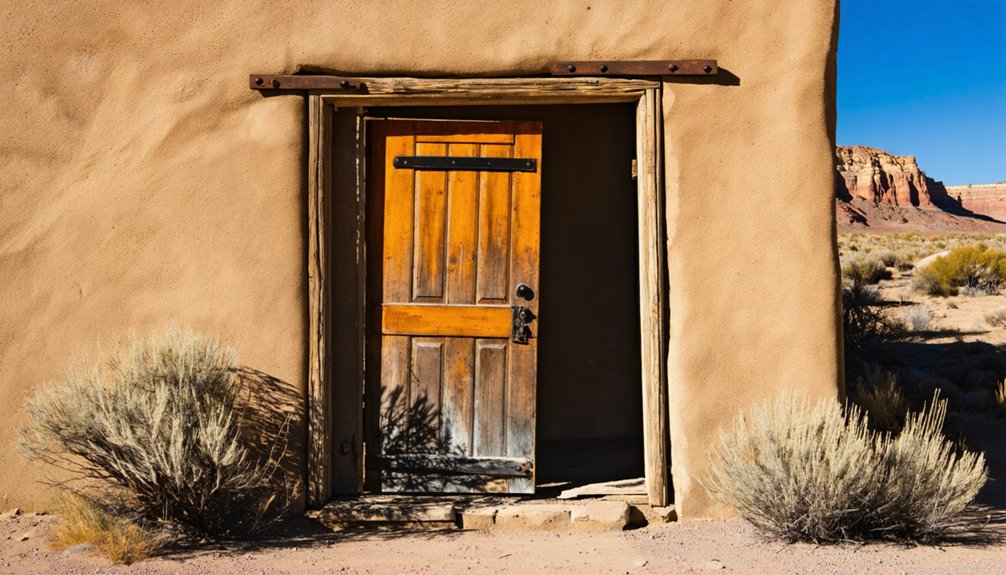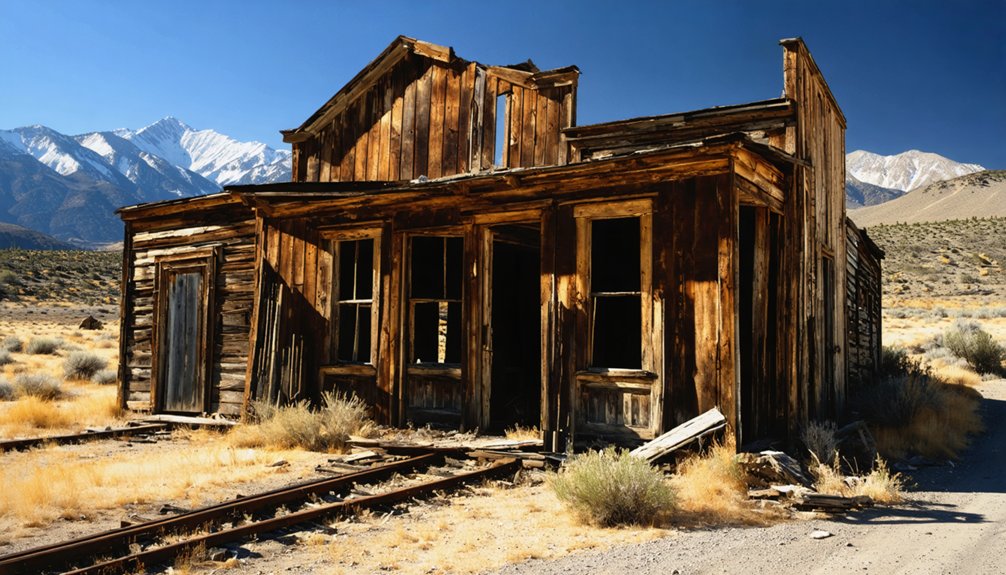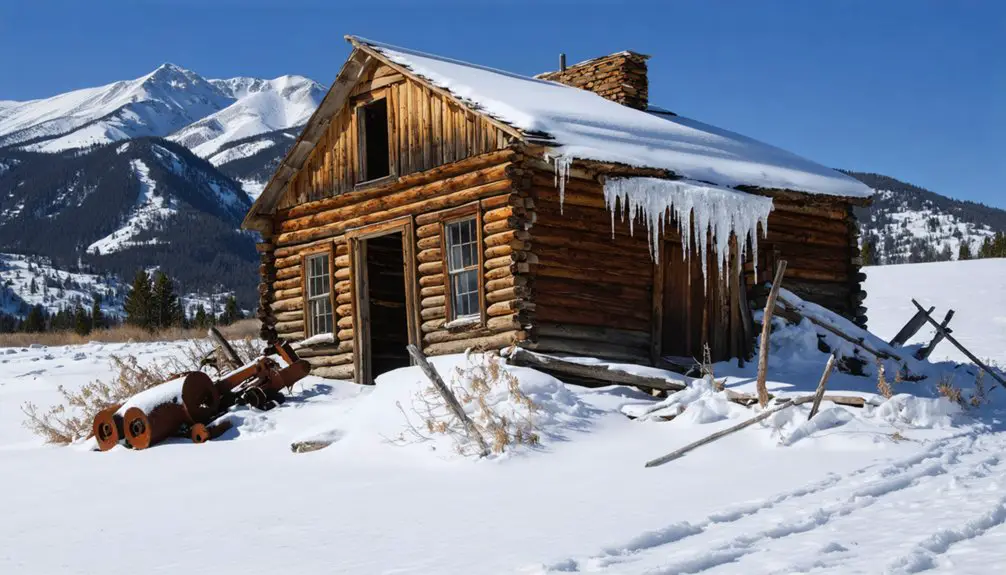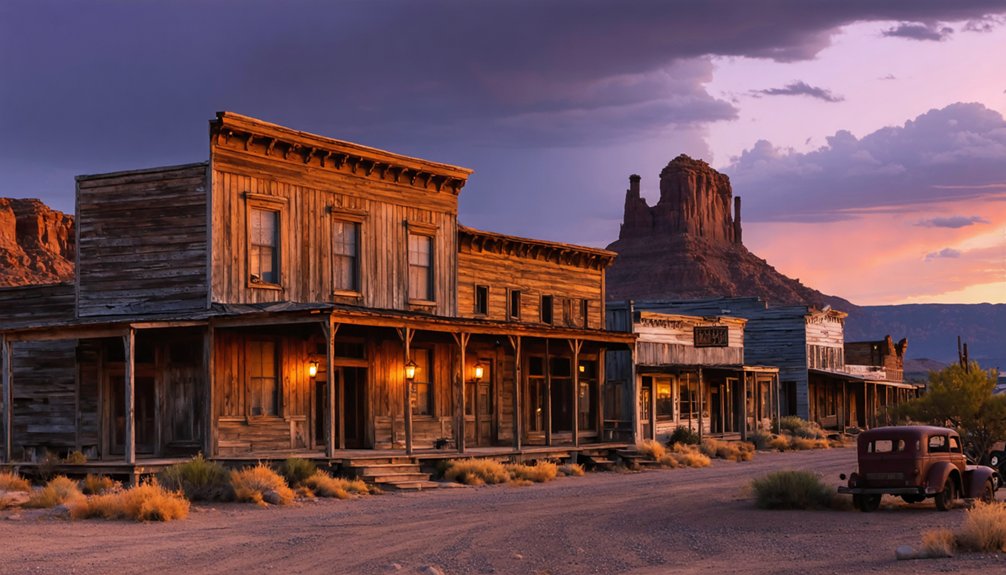
You’ll find Utah’s unique Ghost Town Cabin Get-Away nestled in Helper Canyon’s 800-acre landscape, where you can sleep among authentic 1800s mining ruins from the abandoned Latuda settlement. This seven-bedroom modern retreat accommodates twenty guests and costs $1,200 nightly, placing you steps from weathered dugouts and pioneer structures. While you can’t stay overnight in other ghost towns like Grafton or Silver Reef, they’re perfect day trips from your cabin base. Discover how spring and fall booking strategies maximize your immersive historical adventure.
Key Takeaways
- Ghost Town Cabin Get-Away in Helper Canyon offers modern lodging on 800+ acres near preserved ghost towns like Latuda.
- The 7-bedroom cabin sleeps 20 guests at $1,200 nightly, providing authentic nighttime views of 1800s abandoned structures.
- Adults-only stay includes modern amenities, wildlife encounters, hiking trails, and proximity to mining museums and historical sites.
- Book 6-12 months ahead for peak seasons; spring and fall offer ideal temperatures and fewer crowds for exploration.
- Nearby ghost towns like Grafton, Harrisburg, and Silver Reef are accessible for daytime exploration from the cabin base.
Ghost Town Cabin Get-Away: Your Home Base for Exploring Utah’s Mining Heritage
Nestled deep in a remote canyon near Helper, Utah, the Ghost Town Cabin Get-Away sits on over 800 acres of geologist-studied land that whispers tales of Utah’s mining past. You’ll find yourself positioned in the Carbon Corridor, where ghost towns like Latuda stand as testaments to historical preservation—the mine closed in 1967, leaving behind stories etched in stone and soil.
This isn’t your typical sanitized resort. You’re miles from town on an asphalt road, with wildlife encounters practically guaranteed in this untamed landscape. The cabin sleeps 20, serving as your launching pad to explore nearby mining sites, hike forgotten trails, and discover the raw beauty that geologists have studied for decades. For a different ghost town experience, consider a day trip to Grafton Ghost Town, established circa 1859 near Zion National Park, where authentic buildings and a historic cemetery offer a glimpse into Utah’s cotton-growing past. Check the photo gallery to preview the rustic interior and outdoor spaces before you commit.
At $1,200 nightly, you’re buying complete freedom to roam 800 acres of authentic Utah wilderness.
Why Staying Overnight Enhances Your Ghost Town Experience
When darkness settles over Utah’s abandoned mining camps, ghost towns shed their tourist veneer and reveal their authentic character. You’ll experience solitary exploration through 1800s architecture as wind whistles through abandoned structures, creating an eerie authenticity. Daytime crowds dilute.
Modern amenities like claw-foot tubs and gas stoves ground you in pioneer comforts while you immerse yourself in multi-hour discovery sessions.
The nighttime ambiance transforms these sites completely. Dark skies unmask starry vistas over deserted ruins, intensifying the isolation miners once endured. You’ll read informative signs unhurried, watch 30-minute historical videos, and contemplate preserved legacies under constellations.
Limited rooms create exclusive access—just you and the ghosts. Daytime visits feel commercial; overnights deliver genuine connection to boom-and-bust narratives. Early-morning walks before tourist arrival hours offer peaceful moments to absorb scenic beauty and explore picturesque streets without crowds. Historic accommodations may feature haunted elevators or other paranormal elements that add authenticity to your overnight stay. You’re not observing history; you’re inhabiting it.
What to Expect When Booking the Ghost Town Cabin in Helper
Perched in Helper’s sprawling canyon on 800 acres of untamed Utah terrain, this ghost town cabin delivers complete seclusion—you’ll find just one other structure for miles.
You’re booking a modern 7-bedroom, 9-bathroom retreat that sleeps 20, running about $1,200 nightly. Check-in starts at 4:00 PM, checkout’s at 11:00 AM.
Cabin amenities include full modern conveniences while wildlife encounters await across hundreds of explorable acres—geologists have studied this land extensively for good reason.
You’ll hike and bike trails that few others travel.
Within a 10-minute drive, you can reach Big John Statue and the Western Mining & Railroad Museum for a dose of local history.
For those seeking simpler accommodations in Helper, the Helper Apartment offers a clean, family-style home close to Highway 6 with an exceptional 9.8 rating.
There’s a catch: adults only, no pets, no smoking, and absolutely no parties.
This isn’t your typical vacation rental—it’s raw adventure with a comfortable base camp.
Bring your ID and payment method for incidentals, then disappear into Utah’s backcountry.
Day Trips From Your Overnight Accommodation: Grafton Ghost Town
Just forty minutes south of your Helper cabin basecamp, Grafton sprawls along the Virgin River valley like a sepia photograph come to life—its adobe schoolhouse and weathered pioneer homes standing exactly where Mormon settlers left them in 1945. You’ll walk freely among structures built from 1877-1886, exploring without barriers or guided tours.
Grafton delivers unfiltered pioneer history—no entrance fees, no velvet ropes, just weathered adobe structures standing where settlers abandoned them in 1945.
Historical preservation here means authentic decay, not Disney reconstruction:
- The 1886 schoolhouse still anchors the town center, built with lumber hauled seventy-five miles.
- Cemetery headstones tell stories of Native American conflicts during the 1860s Black Hawk War.
- The Berry family plot marks tragedy from territorial disputes.
- Zion’s crimson cliffs tower behind every frame.
- Film crews chose this location for Butch Cassidy and the Sundance Kid.
- Grafton hosted the first outdoor talkie, *Old Arizona*, in 1929, earning five Academy Award nominations.
No entrance fees. No velvet ropes. Just unvarnished pioneer reality. Bring your own water and sun protection since no amenities exist at this undeveloped historical site.
Exploring Harrisburg Ghost Town During Your Multi-Day Adventure
Where else can you watch eighteen-wheelers thunder past century-old stone ruins at seventy miles per hour? I-15 slices directly through Harrisburg’s 1860s townsite, creating Utah’s most surreal ghost town experience.
You’ll find the restored Adams House half a mile up Quail Creek, while pioneer foundations scatter on both freeway sides along Old Highway 91.
Cultural preservation meets raw abandonment here—stone fences, root cellars, and chimney remnants tell stories of grasshopper plagues and flood disasters that drove 200 settlers away by 1895. Moses Harris settled the area in 1859, establishing what would become an agricultural hub supporting nearby Silver Reef’s mining operations.
The Red Cliffs National Conservation Area surrounds you with copper-hued cliffs and Pine Valley Mountain views reaching 10,371 feet at Signal Peak. The conservation area’s 46,500 acres of biodiverse landscape sits at the intersection of three distinct ecological regions, hosting Mojave Desert tortoises and numerous plant species.
Wildlife observation opportunities abound among spruce forests and bitter cherry thickets, sixteen miles northeast of St. George.
Old Irontown: A Quick Stop on Your Ghost Town Road Trip
North of St. George, you’ll discover Old Irontown’s haunting industrial ruins along Highway 56. This free state park offers two quarter-mile interpretive trails through Utah’s 1868 iron-mining attempt that failed spectacularly by 1876.
Your self-guided tour reveals:
- Beehive-shaped charcoal kiln standing sentinel over the desert
- Original foundry chimney piercing the skyline
- Arastra grinding stones where workers crafted casting molds
- Pattern and molding shops reduced to weathered foundations
- Interpretive plaques detailing Ebenezer Hanks’s ill-fated investment
Wildlife sightings include desert lizards basking on century-old stones and hawks circling overhead.
Local legends whisper about the 97 souls who abandoned their dreams here.
You’ll find restrooms and shaded picnic areas, though camping isn’t permitted.
It’s the perfect quick stop before continuing your ghost town road trip westward.
Silver Reef: Northern Utah’s Premier Ghost Town Destination
While most geologists insisted silver couldn’t exist in sandstone, Silver Reef’s miners extracted 7.5 million ounces that proved the experts spectacularly wrong.
Silver Reef’s 7.5 million ounces of sandstone silver defied geological wisdom and turned impossible into extraordinary fortune.
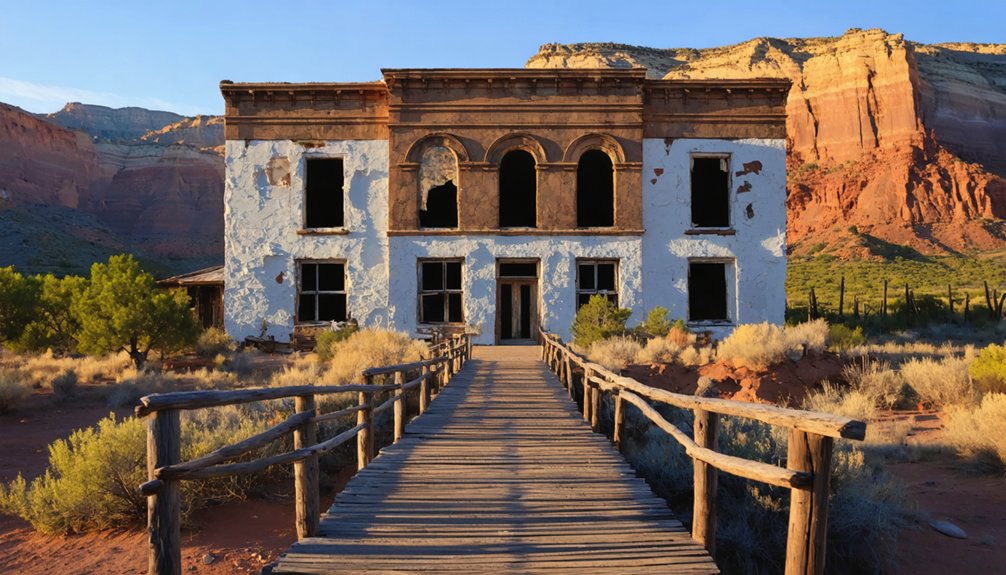
You’ll discover this rarity 15 miles northeast of St. George, where 2,000 fortune-seekers once crowded a boomtown complete with horse racing and shooting matches. The Wells Fargo building still stands with its original fortress doors, now housing artifacts you won’t find elsewhere.
Walk the grounds trails where mining equipment rusted after the 1888 collapse, when flooding and plummeting silver prices emptied the shafts.
The historic architecture tells stories of Chinese workers who built their own Chinatown, and union miners who seized the Savage mine pumps. Though the 30-year heyday ended over a century ago, you’re free to explore this preserved testimonial to human determination.
Planning Your Route: Latuda and the Carbon Corridor Ghost Towns
Deep in Carbon County’s Spring Canyon, Latuda stands as the most hauntingly preserved relic of Utah’s coal mining empire. You’ll find exceptional ghost town architecture here—that massive curved concrete wall dominates the landscape like a monument to 400 vanished souls. The 1927 avalanche that killed multiple miners still echoes through these ruins.
Your route from Helper takes about an hour along US Highway 6, linking several coal camps:
- Latuda: Most intact ruins with rock-walled dugouts and foundations
- Rains: Half-mile west; 18-foot coal veins and train trestle
- Mutual: North Fork Spring Canyon location
- Standardville: Additional corridor exploration
- Robinson Gulch: Lower mine junction site
Historical preservation remains minimal—exactly what freedom-seekers want. Navigate to coordinates 39.689505, -111.056725 and explore authentically crumbling structures untouched since 1967’s final abandonment.
Essential Packing Tips for Overnight Ghost Town Stays
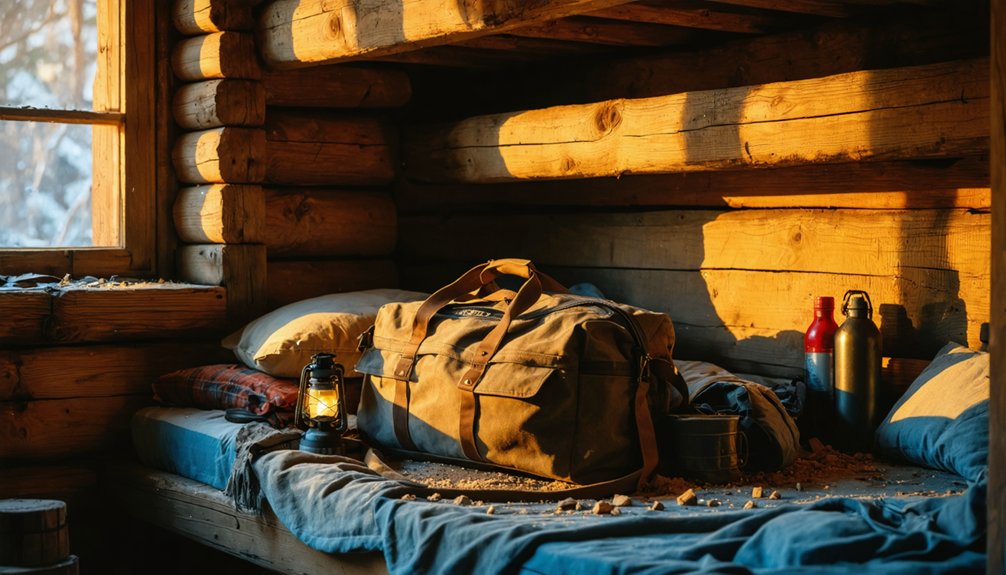
You’ve mapped your route through Carbon County’s abandoned coal camps—now let’s talk about surviving the high-desert night.
Temperature swings forty degrees between sunset and dawn out here. Your packing essentials start with clothing layers: moisture-wicking base layers, insulating mid-layers, and wind-resistant shells.
I’ve shivered through enough desert nights to know a quality sleeping bag rated for freezing temps isn’t optional.
Pack your truck camper or tent with ground insulation—those crumbling foundations radiate cold.
Bring two liters minimum for day hikes through abandoned structures, plus extra gallons for camp.
Headlamps with backup batteries illuminate pitch-black mines better than phones.
Sunscreen, first aid basics, and matches round out your gear.
These ghost towns don’t offer second chances. Pack smart, stay self-reliant, embrace total solitude.
Best Times of Year to Book Your Ghost Town Cabin Getaway
When the thermometer hits that sweet spot between 60-70°F, Utah’s ghost town cabins transform from rustic curiosities into perfect basecamp retreats.
You’ll find spring and fall offer unbeatable freedom to explore without summer’s crushing crowds or winter’s unpredictability.
Strategic booking windows release serious advantages:
- Spring wildflowers paint 800-acre properties while rates hover around $124 nightly.
- Fall’s 60-80°F comfort zone pairs perfectly with historical preservation sites and changing aspens.
- Summer commands premium prices ($286-$391) but delivers reliable access to destinations like Goblin Valley.
- Winter drops rates to $105-$136, though you’ll sacrifice seasonal flora for solitude.
Book 6-12 months ahead for peak season, or snag shoulder-season deals with 20-30% savings.
Target weekdays during spring or autumn. You’ll escape the crowds while exploring territories where ghost town legends actually lived.
Frequently Asked Questions
Are Ghost Towns in Utah Safe to Explore at Night?
Night exploration isn’t recommended due to safety concerns like decaying structures, razor wire, and poor visibility. While haunted legends might tempt you, stick to daytime visits when you’ll navigate crumbling buildings and desert terrain more safely and freely.
Can I Bring My Own RV to Any Utah Ghost Towns?
Hitting the open road, you can’t park your RV directly at most Utah ghost towns. Follow RV camping tips by staying at nearby resorts, then practice ghost town etiquette during daytime visits to these historic sites.
Do I Need Special Permits to Visit Utah Ghost Towns?
You won’t need special permits for most Utah ghost towns, but respect historic preservation rules. Each site carries local legends worth discovering. If camping overnight on surrounding public lands, you’ll need standard BLM permits—freedom with responsibility.
Are There Guided Tours Available for Utah Ghost Towns?
Shadows whisper through abandoned streets—yes, you’ll find guided tours exploring Utah’s ghost towns. From Grafton’s historic preservation efforts to Salt Lake’s tourist infrastructure, these adventures blend paranormal thrills with authentic Western history, letting you roam freely through haunted landscapes.
What Cell Phone Coverage Exists Near Utah Ghost Town Accommodations?
You’ll find cell phone reception varies wildly—Cisco offers surprisingly strong signals near the highway, while Iosepa’s spotty coverage demands AT&T. Pack emergency services contacts beforehand, since remote valleys can leave you beautifully disconnected from civilization’s digital tether.
References
- https://touristish.com/ghost-town-guest-house/
- https://www.vrbo.com/1616216
- https://stgeorgevacationrentals.com/blog/st-george-attractions-grafton-ghost-town/
- https://www.visitutah.com/things-to-do/history-culture/ghost-towns
- https://abbeyinncedar.com/1896/
- https://www.tripadvisor.com/Attractions-g28965-Activities-c47-t14-Utah.html
- https://www.scoutingny.com/utah-nevada-salt-lake-city-a-cursed-hotel-a-haunted-ghost-town-and-our-first-flat/
- https://www.youtube.com/watch?v=uimJssCqaAs
- https://www.beaver.utah.gov/274/Key-Sites
- https://www.placesthatwere.com/2016/02/spending-night-in-abandoned-ghost-town.html