You can’t exactly pitch a tent in Washington’s true ghost towns, but you’ll find something better—haunted historic hotels where the spirits never checked out. Port Townsend’s Palace Hotel and Manresa Castle let you sleep in actual 1889 buildings with phantom residents, while Index’s Bush House Inn offers mountain solitude among top-hatted apparitions. These Victorian-era lodgings serve as your base camp for exploring nearby abandoned sites like Northern State’s asylum ruins and remote ghost towns throughout the Cascades, where Washington’s paranormal past becomes your overnight adventure.
Key Takeaways
- Historic Port Townsend hotels like Manresa Castle and Palace Hotel offer overnight stays in Victorian-era buildings with documented paranormal activity.
- Water Street Hotel and Bush House Inn provide authentic 1889-1893 accommodations with preserved architecture and ghostly legends.
- Ann Starrett Mansion features Victorian grandeur and reported spirit encounters, allowing guests to experience haunted overnight stays.
- Captain Whidbey Inn combines maritime history with haunted reputation, offering lodging near Penn Cove on Whidbey Island since 1907.
- Northern State Recreation Area lacks overnight camping but nearby ghost town day trips to Molson and Bodie offer exploration opportunities.
Manresa Castle: Port Townsend’s Victorian Era Paranormal Retreat
Perched atop a hill overlooking Port Townsend’s Victorian seaport, Manresa Castle’s three-story silhouette cuts an imposing figure against the Pacific Northwest sky. You’ll find historical architecture that’d make Charles Eisenbeis proud—12-inch brick walls from his own brickworks, hand-crafted oak paneling, and Prussian-inspired turrets honoring his heritage.
But it’s the paranormal sightings that’ll quicken your pulse. Stay in rooms 302, 304, or 306 where guests report a monk’s footsteps echoing through halls. A heartbroken woman named Kate who jumped from a tower window still lingers. Unexplained phenomena include spontaneous glass explosions and glasses mysteriously turning upside down.
You’ll experience flickering lights, phantom whispers, and doors that open themselves. The tower rooms deliver the most activity, while the basement bar maintains its eerie atmosphere—perfect for adventurers seeking authentic supernatural encounters. After your ghost hunt, indulge in Northwest seafood and steaks at the Castle Key Restaurant, where exceptional cuisine meets historic ambiance.
Bush House Inn: Index’s Historic Mountain Lodge With Haunted Legends
Deep in the Cascade Mountains where the North Fork Skykomish River carves through granite cliffs, you’ll discover the Bush House Inn standing sentinel at 308 Index Avenue—a three-story wooden lodge that’s weathered gold rushes, railway booms, and over a century of mountain storms.
Built in 1893 by Amos and Persis Gunn, this last surviving hotel from Index’s five original establishments earned its spot on the National Register of Historic Places in 2017.
You’ll find eleven guest rooms decorated with early 1900s artifacts and antique fixtures, plus a ballroom perfect for paranormal investigations. The inn’s rooms contain period photographs and memorabilia that narrate its storied mining past.
After closing in 2002, dedicated owners spent years on historical preservation, finally reopening in 2022. The historic floors were restored in 2020, preserving the building’s original character while meeting modern standards.
The town’s population dropped from 500 to 150 when highways bypassed Index in the 1930s, leaving behind authentic ghost-town atmosphere without abandoning modern comfort.
Water Street Hotel: Port Townsend’s Top Hat Phantoms
Along Port Townsend’s Victorian waterfront, where sailing ships once unloaded cargo from around the world, the Water Street Hotel rises at 635 Water Street—an 1889 Italianate masterpiece that’s watched this seaport transform from Washington’s boom-time rival to Seattle into one of America’s three surviving Victorian-era maritime towns.
Architect Elmer H. Fisher crafted this ornate building with Grecian and Romanesque touches, creating historical architecture that’s housed taverns, long-term residents, and overnight guests since pharmacist N.D. Hill’s $25,000 investment. The ground floor became home to Town Tavern, the longest-running establishment that served patrons from 1929 until 2001.
You’ll find spacious Victorian-style suites with water views for $50-60 nightly, but the ghostly legends draw adventurous souls. Guests report top-hatted men vanishing through walls, disembodied footsteps echoing through hallways, and mysterious orbs captured in photographs—remnants of three documented deaths that haunt this waterfront landmark. The hotel offers panoramic water views perfect for storm-chasing experiences and witnessing dramatic rainbows sweeping across the bay.
Palace Hotel Port Townsend: Waterfront Stays With Spectral Guests
Just down the Victorian waterfront at 1004 Water Street, the Palace Hotel beckons from inside Captain Henry L. Tibbals’ 1889 Richardson Romanesque masterpiece.
Step through the doors of Captain Tibbals’ 1889 Richardson Romanesque marvel, where Victorian elegance meets scandalous history at 1004 Water Street.
This three-story beauty traded its scandalous past as the “Palace of Sweets” brothel (1925-1933) for respectable lodging, though some say the girls never truly left.
You’ll find yourself among haunted history‘s most colorful characters:
- Claire, the Lady in Blue from Room #4, who’ll flick your hair and send cool breezes your way
- Madam Marie’s corner suite, still commanding respect from the spectral residents
- Fifteen rooms named for working girls who serviced clients during Prohibition’s wild nights
With 14-foot ceilings, antique furnishings, and spectral sightings reported nightly, you’re guaranteed authentic encounters. The building’s interior rooms without windows are lit only by stained-glass skylights, a design feature that once concealed the brothel’s clandestine operations. The hotel’s distinctive red-yellow brick exterior still showcases the craftsmanship of its 1889 construction.
No elevator means climbing stairs—but that’s where Claire‘s portrait watches from above.
Ann Starrett Mansion: Victorian Elegance Meets the Supernatural
Where else can you sleep beneath frescoes that track the sun’s journey while ghosts drift past your four-poster bed? The Ann Starrett Mansion delivers historical architecture so stunning you’ll forget you’re sharing it with the deceased.
Built in 1889 as a $6,000 love letter from George to his bride Ann, this Queen Anne beauty features one of America’s last free-floating spiral staircases and Otto Chapman’s seasonal frescoes that function as a solar calendar. The mansion’s eight-sided dome tower stands as its most distinctive architectural feature, crowning the structure with Victorian grandeur.
You’ll wander halls where ghostly apparitions of the red-haired Ann and her devoted George still roam. The mansion also harbors the son’s nanny, whose spirit lingers in her former bedroom, occasionally appearing in mirrors and causing pictures to fall from walls. Since 1986, this upscale Victorian bed and breakfast has welcomed guests seeking both ornate elegance and supernatural encounters.
The spirits here feel peaceful—previous guests describe them as helpful rather than haunting. You’re not just visiting Port Townsend’s past; you’re sleeping in it.
Captain Whidbey Inn: Coupeville’s Haunted Harbor Hideaway
From Port Townsend’s Victorian grandeur, travel north to Whidbey Island where the Captain Whidbey Inn has anchored itself along Penn Cove’s shoreline since 1907. You’ll discover historical architecture crafted from Madrona logs and native stone, where haunted legends whisper through original pine paneling and around the two-sided fireplace that’s warmed guests for over a century.
This former boarding house, general store, and girls’ school has accumulated more than memories:
- The front door was originally the back entrance—steamship passengers arrived by boat.
- Original stone stairways descend to the water where spirits reportedly linger at dusk.
- Fifteen sleeping rooms upstairs maintain their rustic charm and unexplained footsteps.
Whether you’re chasing paranormal experiences or escaping into Pacific Northwest solitude, these log walls hold stories you’ll feel rather than read.
Northern State Recreation Area: Camping Near Sedro-Woolley’s Abandoned Asylum Town
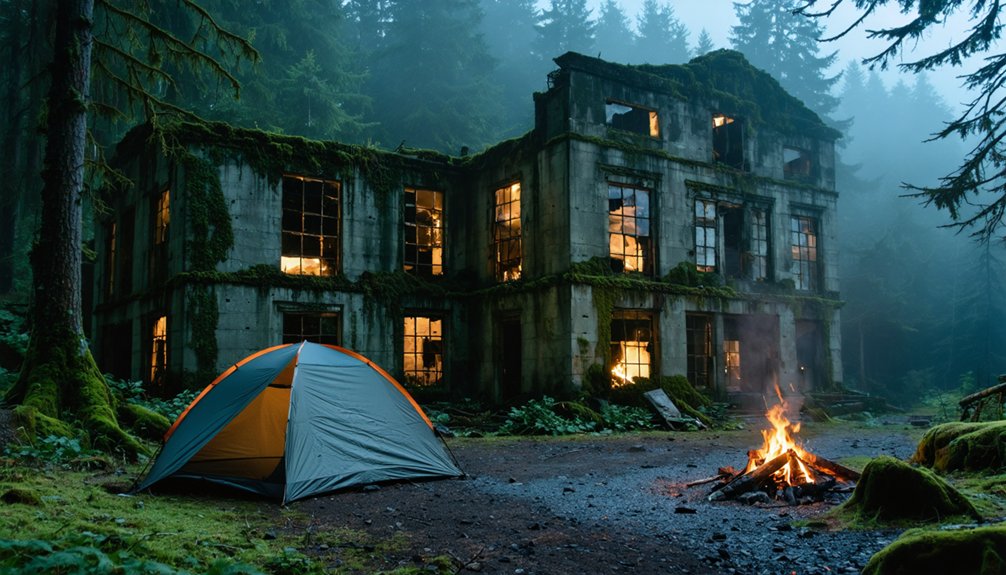
Hidden among the Cascade Mountain foothills lies one of Washington’s most unsettling historical sites—the Northern State Recreation Area.
Northern State Recreation Area rests in the Cascade foothills, where Washington’s psychiatric hospital history lingers among abandoned structures and forest trails.
This area was once home to a massive psychiatric hospital that operated as a self-contained town until the 1970s. You’ll find crumbling dairy barns from 1921 and a cemetery holding 1,500 souls scattered across 726 acres of meadows and forest.
While historical preservation keeps you out of unsafe buildings, you’re free to explore extensive trails, disc golf courses, and open spaces from dawn to dusk.
There’s no overnight camping allowed here, but you’ve got options nearby. Bay View Campground offers Salish Sea access, while forest sites near town provide horse corrals and fire rings. Deception Pass State Park delivers waterfront camping.
These recreational activities let you experience the area’s haunting history responsibly.
Exploring Nearby Ghost Towns: Day Trips From Your Haunted Hotel Base
When you’re staying at Port Townsend’s historic haunted hotels, you’ve positioned yourself perfectly for exploring northeastern Washington’s ghost towns—though you’ll need to embrace a solid four-hour drive to reach them.
Book a room at Manresa Castle or the Palace Hotel, then venture to Okanogan County where cultural preservation meets adventure.
Republic serves as your staging point for exploring:
- Molson Ghost Town – restored pioneer buildings from the 1901 railroad boom
- Bodie Ghost Town – photogenic ruins along Toroda Creek, twelve miles north of Wauconda
- Nighthawk and Chesaw – combine multiple sites into one epic road trip
Fall and winter offer prime conditions for photography without crowds.
Tourism development hasn’t overtaken these sites yet—they remain authentically abandoned, letting you wander freely through genuine frontier history.
Frequently Asked Questions
What Should I Pack for an Overnight Stay at a Haunted Location?
You’ll need essentials like a sleeping bag, flashlight, and first-aid kit, plus paranormal gear like EMF meters and spirit boxes. Research the location’s haunted history beforehand—I’ve had spooky encounters that required both practical supplies and investigation tools.
Are Ghost Town Accommodations Suitable for Children and Families?
You’ll find family-friendly activities at daytime ghost towns like Liberty, but overnight haunted hotels aren’t ideal for young kids. Take safety precautions by choosing lakeside resorts near Old Molson instead—they’re perfectly suited for adventurous families.
Do I Need Permits to Visit Ghost Towns in Washington?
You won’t need permits for most Washington ghost towns—freedom calls! Historical site access remains open on public land, though ghost town preservation means respecting posted boundaries. Private property requires owner permission, but daytime exploration typically flows unregulated and wonderfully spontaneous.
What’s the Best Season to Visit Washington’s Haunted Hotels?
Fall’s your best bet for haunted hotels—crisp seasonal weather amplifies eerie vibes, while historic festivals in towns like Port Townsend bring ghostly tales alive. I’ve found autumn’s shorter days perfect for spine-tingling overnight stays.
Are Paranormal Investigation Tools Allowed in These Historic Properties?
You’ll need to contact each property directly about their investigative equipment policies. Most haunted hotels welcome spectral evidence gathering with EMF detectors and cameras, but some historic sites restrict certain tools to preserve their aging structures and other guests’ experiences.
References
- https://929thebull.com/stay-in-this-haunted-house-washington/
- https://www.wahauntedhouses.com/real-haunts/hotels.aspx
- https://www.trailchick.com/bodie-ghost-town/
- https://www.aol.com/articles/hidden-washington-town-giving-major-165946222.html
- https://www.cascadeloop.com/ghost-towns-and-haunted-places-in-the-washington-cascades
- https://bushhouseinn.com
- https://seattleterrors.com/bush-house-inn-indexs-haunted-hotel/
- https://visitrainier.com/fairfax-ghost-town-2/
- https://www.tripadvisor.com/HotelsNear-g58660-d1547998-Old_Molson_Museum_Ghost_Town-Oroville_Washington.html
- https://scenesfromthelilypad.wordpress.com/2014/11/16/manresa-castle-port-townsend-washington/comment-page-1/