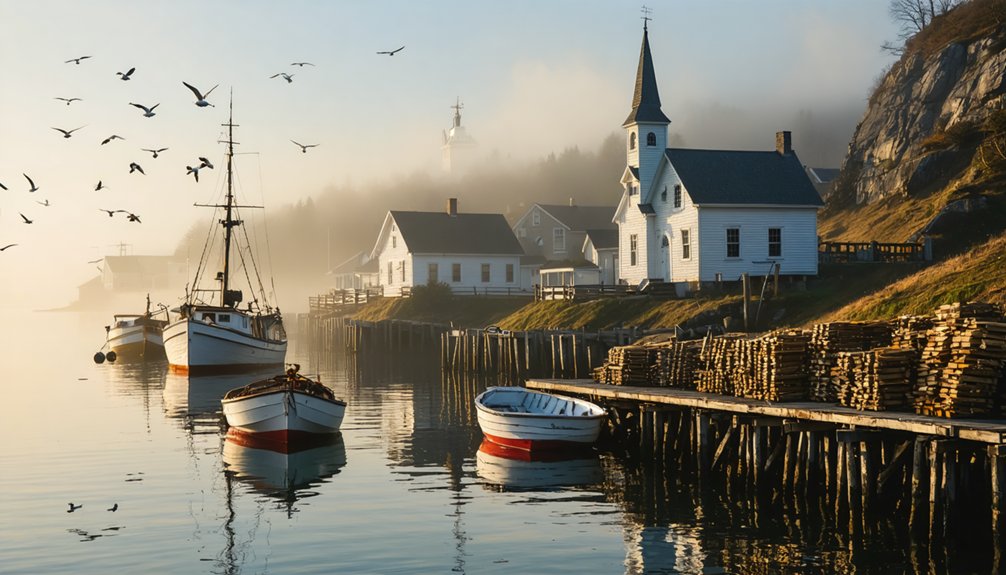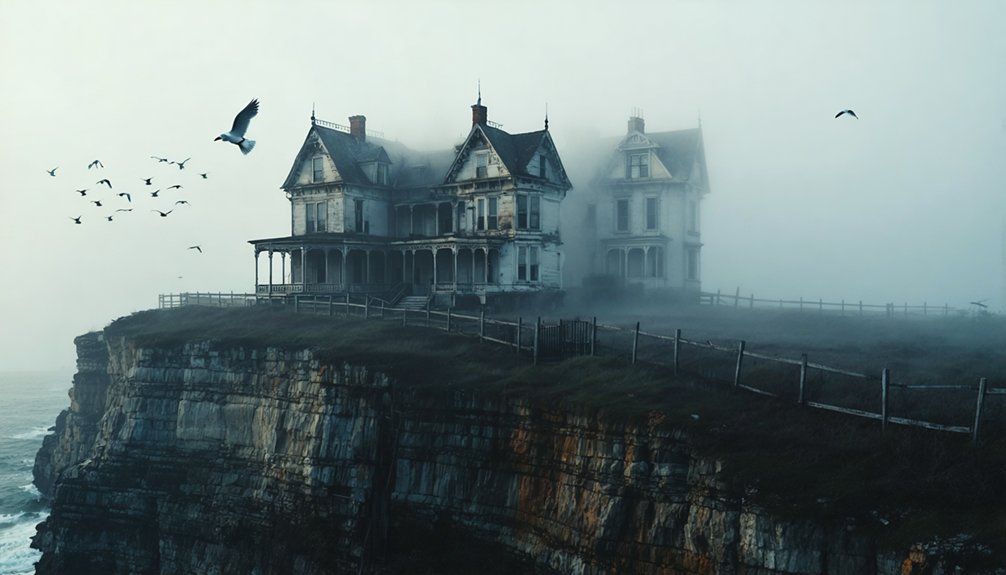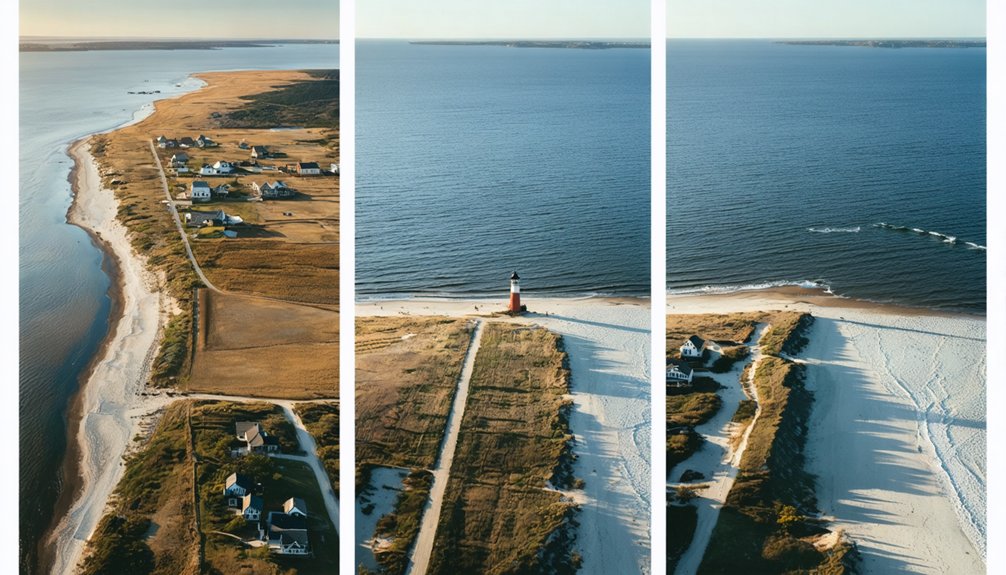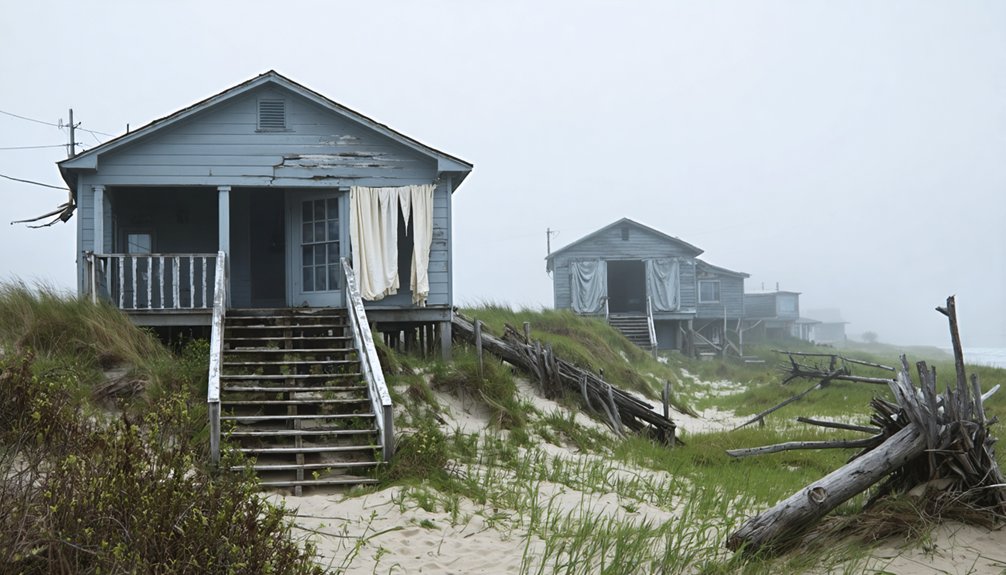
When exploring Eastern abandoned coastal settlements, pack protective gear including N95 respirators and waterproof equipment. Visit during winter when receding vegetation reveals hidden architectural elements, especially during extreme low tides near new and full moons. Photograph during golden hour using f/8-f/16 apertures and tripods for ideal depth of field. Always explore in pairs, researching site layouts beforehand. These ghost towns—from Cape Lookout’s Queen Anne structures to Sea Breeze’s vacant foundations—await your documented discovery.
Key Takeaways
- Winter months (December through March) offer the best exploration opportunities when structures are more visible.
- Wear protective gear including N95 respirators and bring sturdy flashlights when exploring deteriorated coastal structures.
- Visit during extreme low tides during new and full moons to access normally submerged elements.
- Cape Lookout Village preserves maritime heritage with 20 historic structures dating back to 1887.
- Document your findings using a tripod and apertures between f/8-f/16 for optimal depth of field.
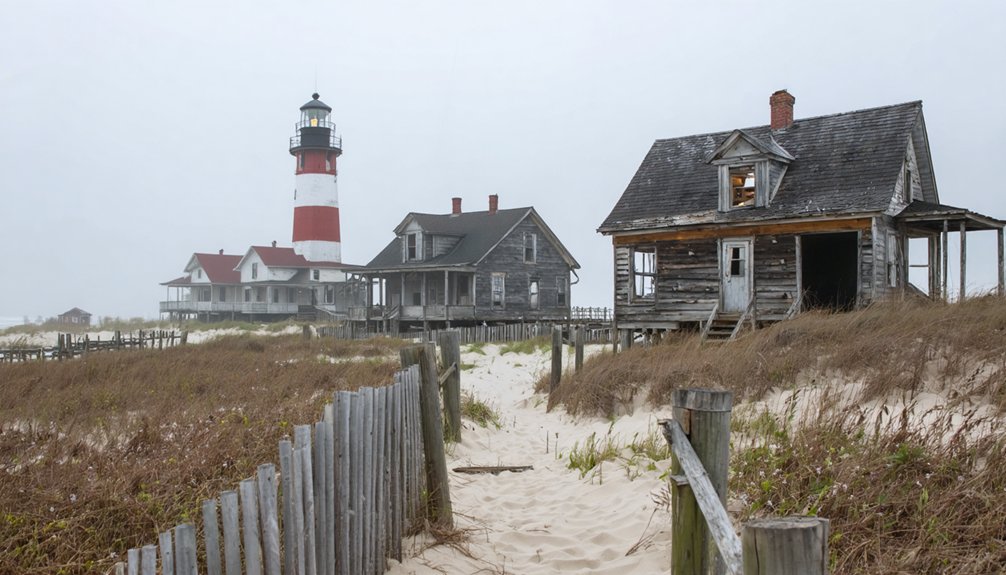
Nestled along the windswept shores of South Core Banks, Cape Lookout Village stands as a remarkable tribute to North Carolina’s maritime heritage since its establishment in 1887.
Weathered and proud, this coastal village preserves the story of maritime Carolina within its abandoned structures.
You’ll discover 20 contributing structures showcasing Queen Anne and Bungalow/American Craftsman architectural significance throughout this abandoned fishing community that thrived until 1960.
The village developed around the 1888 Life-Saving Station, later complemented by the 1917 Coast Guard Station. Notable landmarks include the Seifert-Davis “Coca-Cola House” and Baker-Holderness “Casablanca” residence, exemplifying fine beach bungalow design.
Though recognized on the National Register of Historic Places since 2000, historic preservation efforts keep buildings boarded and monitored by the National Park Service. Several historic structures including the Setzer-Dawsey House were demolished in 2021, highlighting the ongoing preservation challenges. Visitors often describe the area as a well-preserved ghost town offering glimpses into coastal life of the past.
The landscape is dotted with remnants of old West homesteads, each telling a story of resilience and adaptation. These structures stand as silent witnesses to the trials faced by early settlers, evoking a sense of nostalgia for a bygone era. As visitors explore these historical sites, they gain a deeper understanding of the challenges and triumphs that shaped the community.
Prepare for isolated hiking conditions with sturdy shoes and bug spray, as these time-capsule structures remain closed to interior exploration.
Safety Precautions When Exploring Deserted Coastal Ruins
Exploring Cape Lookout Village‘s preserved structures requires vigilance, a principle that extends to all deserted coastal ruins you’ll encounter. Always work in pairs while traversing these coastal vestiges, maintaining hazard awareness of potentially unstable flooring, compromised ceiling joists, and weathered structural elements dating to the settlement period.
Equip yourself with essential protective gear: N95 respirators protect against period asbestos insulation and maritime mold, while sturdy flashlights illuminate deteriorated passageways. Be sure to report any hazardous conditions you discover to appropriate authorities immediately.
Before entering any circa-1800s lighthouse keeper’s quarters or auxiliary buildings, research site layouts and identify exit routes. When exploring near coastal areas, be aware of red flags that indicate dangerous swimming conditions if you plan to visit nearby beaches.
Obtain proper permissions to avoid trespassing violations, as many Atlantic seaboard ruins remain privately owned despite abandonment.
Respect the architectural integrity by avoiding souvenir collection—these artifacts constitute protected historical elements within the maritime cultural landscape.
Photographing Abandoned Shorelines: Best Times and Techniques
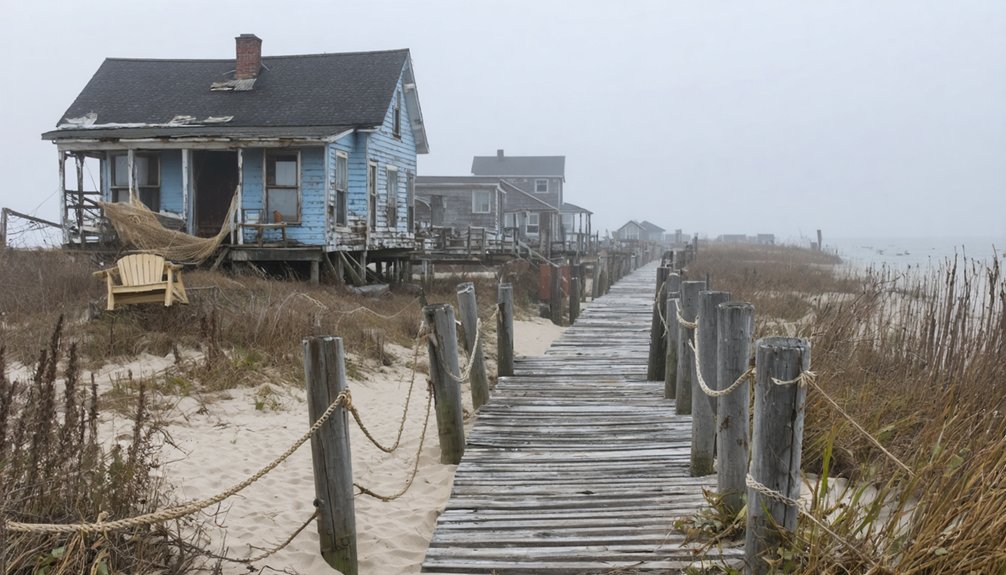
When is the ideal moment to capture the haunting beauty of abandoned shorelines? The golden hour—those fleeting moments after dawn or before sunset—presents prime conditions when warm light accentuates weathered facades and casts elongated shadows across decaying structures.
For technical precision, mount your camera on a tripod and select apertures between f/8-f/16 to maintain depth throughout architectural elements. Employ exposure bracketing (-2EV, 0, +2EV) to preserve both highlight and shadow details within high-contrast coastal scenes. Emphasize the abandoned structures by using negative space around them to create a stronger emotional impact.
Position yourself low to emphasize structural scale, utilizing leading lines from boardwalks or piers to guide viewers through the composition. Experimenting with Intentional Camera Movement techniques can add an ethereal quality that enhances the ghostly atmosphere of abandoned beach locations. During overcast conditions, focus on textural elements—peeling paint, rust formations, and erosion patterns.
In post-processing, consider monochromatic conversion to amplify the desolate atmosphere while selectively enhancing architectural details through judicious clarity adjustments.
Weather Patterns and Seasonal Access to Ghost Beach Communities
You’ll need to monitor predictable storm cycles that typically expose more abandoned structures during winter months when nor’easters strip away protective sand berms and vegetation.
The winter solstice through early March offers ideal documentation opportunities as receding shorelines reveal foundation remnants, structural pilings, and submerged infrastructure that remains hidden during summer accretion phases.
Timing your expedition to coincide with extreme low tides—particularly during new and full moon spring tides—provides critical additional hours of access to normally submerged architectural elements. The current powerful nor’easter moving up the Eastern Seaboard is creating significant coastal erosion that may reveal rarely seen historical structures.
Consider exploring areas near Bar Harbor, Maine where the rugged coastline has preserved remnants of early fishing settlements that are only visible during certain seasonal conditions.
Storm Cycles Matter
Although unpredictable in their precise timing, storm cycles follow recognizable patterns that directly impact access to abandoned coastal settlements. You’ll find the Atlantic hurricane season spans June through November, with peak intensity during August-October—when Portsmouth Island and similar ghost communities face their greatest vulnerability.
Plan your expeditions with meticulous attention to meteorological forecasts, as storm impact can rapidly compromise structural integrity of historic edifices and erode critical access points. Ferry services frequently operate on curtailed schedules or cease operations entirely during these periods. Northern beach communities offer cooler climates and may present fewer hurricane risks compared to their southern counterparts.
Your hurricane preparedness must include evacuation contingencies, as weather patterns can shift within hours. The historic designation of Portsmouth Island helps ensure these structures receive priority attention for restoration after major storms.
Winter months generally offer more reliable access, though nor’easters remain a consideration. Remember that abandoned architectural elements—from weathered Victorian porches to colonial foundations—stand particularly susceptible to storm-induced deterioration, potentially compromising your exploration opportunities.
Winter Reveals More
Winter’s stark character offers a paradoxical advantage for ghost town explorers—the very season that challenges access simultaneously reveals historical elements obscured during warmer months.
As coastal erosion accelerates without protective ice barriers, you’ll discover exposed foundation footprints and structural remnants that document architectural evolution across decades.
- Thinning sea ice creates brief windows of exploration between storm systems—plan accordingly with satellite imagery
- Seasonal changes reveal stratified construction periods through exposed cross-sections of eroded dune structures
- Winter storms uncover artifacts at former building sites, temporarily visible before spring tides reclaim them
Accessing these sites requires vigilance regarding weather patterns.
Without shorefast ice protection, abandoned communities face accelerated deterioration from winter wave action, paradoxically revealing more historical evidence even as it hastens their complete disappearance from the coastline.
Tidal Timing Essential
Timing your expeditions to coincide with extreme low tides creates essential windows for accessing abandoned coastal structures that remain submerged during normal tidal cycles.
Plan your visits by studying local tide charts, specifically targeting periods between king tide events when water levels retreat maximally.
You’ll find ideal exploration conditions during seasonal low tide sequences, typically occurring in spring and autumn along the Atlantic seaboard.
Consider that subsidence rates—particularly severe in Charleston at 4mm annually—continuously alter accessibility thresholds for these ghost communities.
Document tidal patterns methodically, as coastal ecosystems fluctuate dramatically between seasons.
Winter offers expanded access when beach erosion reveals previously concealed architectural foundations, while summer’s gentler tides often conceal critical structural elements.
The 70% of erosion attributable to inlet dynamics means that communities near former tidal inlets provide the most dramatic exploration opportunities.
What to Pack for Remote Beach Ghost Town Expeditions
Preparing for your expedition to coastal ghost settlements requires carefully selected equipment that balances protection against environmental hazards with documentation capabilities.
You’ll need a three-tier clothing system—moisture-wicking base layers, quick-drying mid-layers, and waterproof outer shells—to navigate the microclimate variations common to abandoned littoral zones.
Your gear inventory should include UV-protective accessories, waterproof storage for cartographic materials and photographic equipment, and a thorough medical kit suitable for locations where professional assistance may be hours away.
Essentials and Safety Gear
Exploring abandoned beach communities requires methodical preparation with specialized gear to navigate the unique hazards of these deteriorating coastal environments.
You’ll need a multi-layered approach to safety that balances protection against coastal elements with tactical mobility. Prioritize emergency signaling devices—satellite beacons or whistles—that function without cellular infrastructure, which dissipated from these locations decades ago.
Your hydration strategies must account for extended exposure to salt air and wind, incorporating both water caches and purification methods compatible with brackish sources.
- Wind-ravaged clapboard structures with compromised flooring requiring careful weight distribution during interior documentation
- Tide-eroded foundations exposing rusted rebar and deteriorated concrete piers from mid-century coastal construction
- Abandoned boardwalks with missing planks concealed by drifting sand deposits
Specialized Documentation Equipment
Effective documentation of abandoned beach communities extends beyond basic safety provisions into specialized equipment selection that preserves ephemeral historical evidence.
You’ll need a high-resolution digital camera with waterproof housing to capture architectural details that deteriorate rapidly in salt-laden environments.
Supplement visual documentation techniques with a portable audio recorder for ambient soundscapes and oral histories from remaining residents—critical for contextualizing the chronological decline of these coastal settlements.
GPS devices allow precise coordinate mapping of structural foundations now barely visible beneath shifting sands.
Maintain equipment vigilance in these corrosive environments; implement daily cleaning regimens for lens elements and electronic contacts exposed to salt spray.
Store all documentation tools in waterproof cases with silica packets when not actively recording.
This meticulous equipment maintenance guarantees your freedom to capture these vanishing coastal communities before tidal encroachment claims their remaining historical footprint.
Weather-Appropriate Clothing Layers
When venturing into abandoned beach communities, your clothing strategy must prioritize adaptability to rapidly shifting coastal microclimates. Your foundation begins with moisture-wicking merino or synthetic base layers that preserve core temperature while managing perspiration.
Implement mid-layer insulation through fleece or down components, enabling precise temperature management as architectural exploration shifts between exposed beachfronts and sheltered structural remains.
- Gore-Tex outer shells providing critical wind barrier properties while allowing vapor transmission through semi-permeable membrane architecture
- Convertible nylon expedition trousers featuring reinforced articulation points for unrestricted movement through degraded structural passages
- Quick-drying synthetic accessories with UV-protective properties for extended documentation in variable maritime conditions
Master these layering techniques for freedom to explore extensively regardless of whether conditions deteriorate to 50°F with precipitation or improve to sunny 70°F coastal perfection.
Ecological Transformations in Reclaimed Beach Settlements
As abandoned beach communities reclaim their ecological identity, extensive restoration efforts now transform these once-developed shorelines into vibrant coastal ecosystems.
You’ll witness nature’s recolonization through strategic beach nourishment where eroded areas receive carefully matched sediment, creating foundations for habitat enhancement.
Observe the integration of living shorelines where newly established eelgrass beds and oyster reefs function as natural breakwaters, reducing wave energy by 30-50%.
These biogenic structures facilitate sediment accretion, allowing shorelines to adapt to rising sea levels while supporting diverse food webs.
The managed realignment techniques, featuring removed coastal dikes and restored tidal flooding, convert former residential zones into productive salt marshes and meadows.
These transformations considerably reduce carbon emissions while creating refuges for migratory birds and marine fauna in these post-human architectural spaces.
Comparing Active vs. Abandoned Beach Communities: Cumberland County Case Study
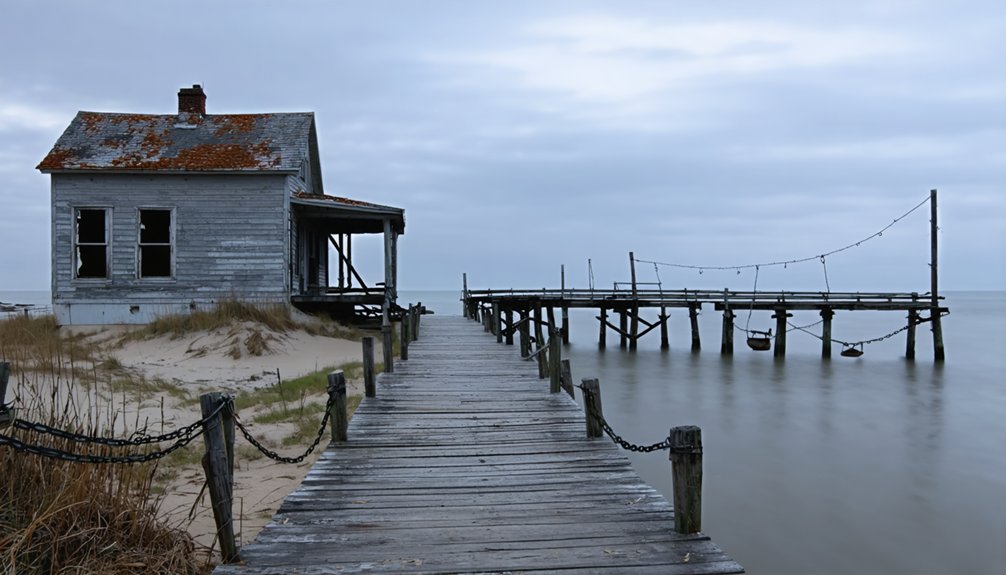
Cumberland County’s coastal settlements reveal striking contrasts between thriving and abandoned beach communities, with Sea Breeze serving as a quintessential case study of coastal abandonment.
While active communities maintained infrastructure investments after environmental disasters, Sea Breeze deteriorated following Hurricane Gloria’s devastation and subsequent government buyouts. By 2008, nineteen homeowners petitioned for property acquisition, resulting in complete demolition.
Once vibrant coastal havens, now reclaimed by nature following disaster and demolition.
- Unpaved Beach Avenue now stands silent, devoid of the bustling tourists who once patronized the historic Seabreeze Hotel.
- Former residential structures have yielded to nature preserves where only fishermen and birdwatchers now traverse.
- Contrasting 77% owner-occupied housing in active communities, abandoned settlements like Sea Breeze offer only vacant lots where 19th-century oyster industry workers once thrived.
You’ll find Cumberland County’s active communities maintaining 13% vacancy rates, while abandoned settlements have transformed into ecological preserves.
Frequently Asked Questions
Are Children Allowed in Abandoned Beach Communities?
No, children aren’t legally allowed in these sites. You’ll face trespassing charges regardless of age. Local regulations prohibit entry due to structural instability hazards. Prioritize safety precautions through authorized alternatives instead.
Can Metal Detectors Be Used at Ghost Beach Sites?
No, you can’t use metal detectors at ghost beach sites due to strict metal detecting regulations. Federal, state, and local laws protect these historic structures, requiring ethical treasure hunting approaches that preserve archaeological integrity.
Do Any Abandoned Beaches Allow Overnight Camping?
While abandoned beaches exist, camping regulations prohibit overnight stays at most ghostly sites. You’ll need to evaluate safety precautions regarding unstable foundations and architectural remnants before considering the liberating yet unauthorized experience.
Are There Guided Tours Available for These Locations?
You’ll find limited guided tours at select locations offering historical insights into these coastal ruins. Most exploration requires self-guidance, though specialty operators provide structured tours with architectural and chronological precision upon advance reservation.
How Do Locals Feel About Visitors to These Ghost Towns?
Like watchdogs of weathered history, locals harbor mixed sentiments about your presence. You’ll encounter protective wariness, especially where trespassing occurs. Respect visitor etiquette—obtain permission and leave structures undisturbed as you explore.
References
- https://wicproject.com/travel/10-abandoned-seaside-places-in-america-that-were-once-tourist-hotspots/
- https://www.youtube.com/watch?v=NNwOPGkUQ1Q
- https://marylandroadtrips.com/7-secluded-eastern-shore-beaches-worth-exploring/
- https://wpst.com/theres-an-abandoned-beach-town-off-the-delaware-bay-in-nj/
- https://samantha-brown.com/destinations/9-beautiful-east-coast-beach-towns/
- https://www.worldatlas.com/cities/9-secluded-towns-on-the-atlantic-coast.html
- https://backroadplanet.com/8-famous-east-coast-boardwalks-and-beach-towns-that-never-get-old/
- https://www.realtor.com/news/trends/americas-best-under-the-radar-beach-towns/
- https://www.beaufort-nc.com/cape-lookout-village-historic-district.html
- https://npplan.com/parks-by-state/north-carolina-national-parks/cape-lookout-national-seashore-park-at-a-glance/cape-lookout-national-seashore-historic-areas/cape-lookout-national-seashore-cape-lookout-village-historic-district/