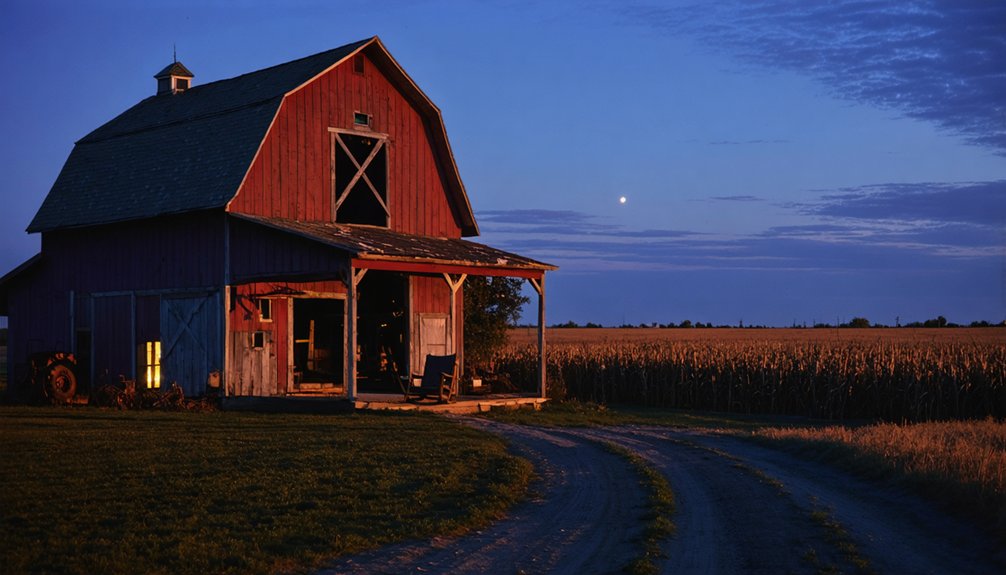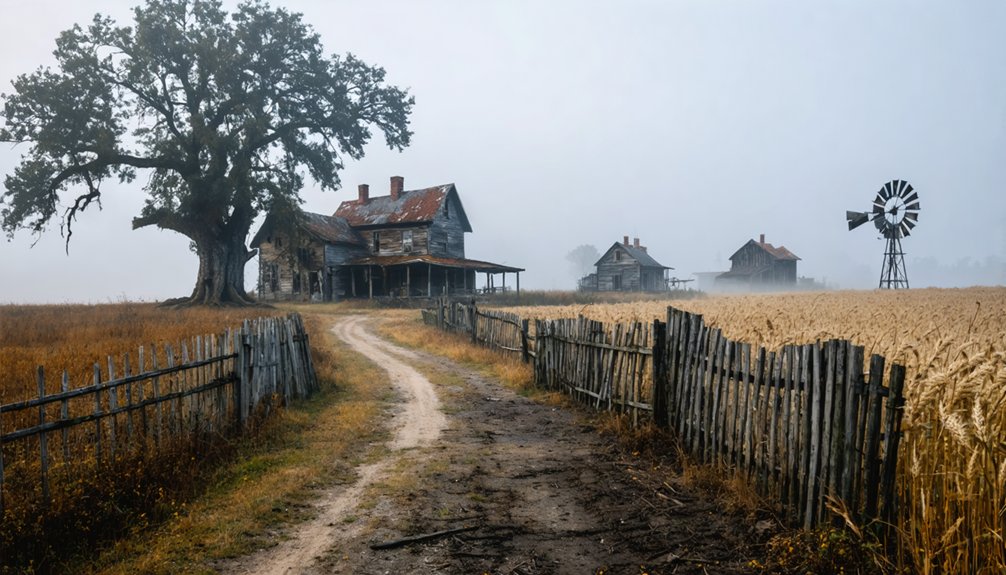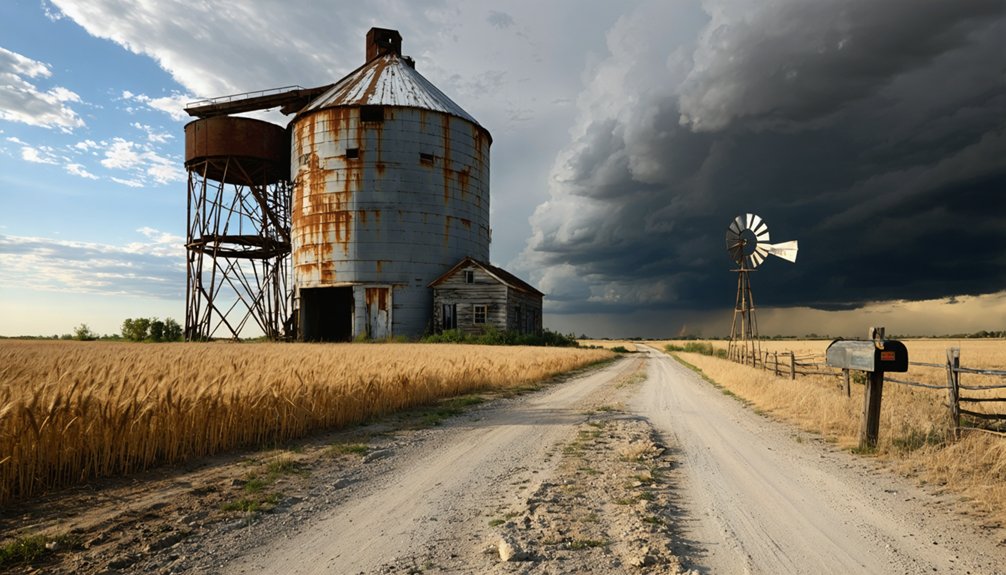
You’re witnessing the silent collapse of America’s agricultural heartland, where over 30 million acres of farmland have vanished since 1986. Water scarcity, particularly the depleting Ogallala Aquifer, has transformed vibrant farming communities into modern ghost towns. As families leave, businesses close, hospitals shut down, and schools consolidate. The exodus creates a domino effect—crumbling infrastructure, aging populations, and abandoned Main Streets tell a story of rural America’s transformation that continues to unfold today.
Key Takeaways
- Former agricultural towns become ghost towns as over 30 million acres of farmland have been abandoned since 1986.
- The Ogallala Aquifer depletion has triggered farm failures, economic collapse, and mass exodus from rural communities.
- Rural areas have lost half their farms since the 1980s, causing business closures and deterioration of essential services.
- Abandoned towns reflect significant demographic shifts, with rural America losing 10-20% of young people every decade.
- Texas, North Dakota, and Kansas lead in farmland abandonment, creating ghostly landscapes where thriving communities once existed.
The Great Plains Exodus: Mapping America’s Agricultural Abandonment
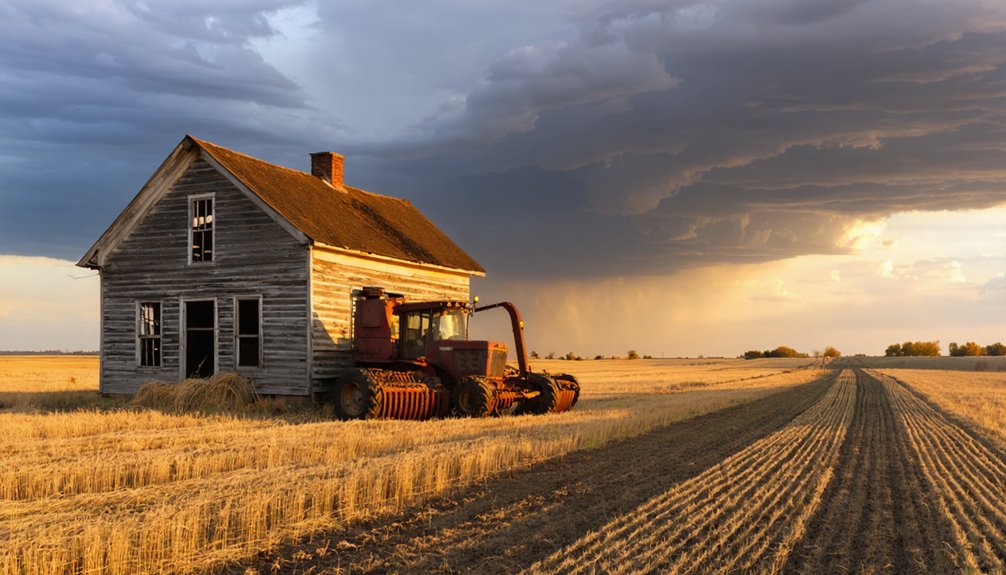
While analyzing the patterns of America’s declining agricultural regions, you’ll find the Great Plains experiencing an unprecedented transformation as cropland abandonment accelerates at alarming rates. The scale is staggering—over 30 million acres abandoned since 1986, with annual losses averaging 1.26 million acres.
You’re witnessing the epicenter of this exodus in the Great Plains and Mississippi River valley, where failing agricultural policies have collided with harsh climate realities. The land tells its own story: 53% converts to grassland, while less than 20% enters conservation programs. Farmers in North Dakota face particularly severe challenges as spring wheat yields plummet, forcing many to harvest early or convert crops to cattle feed.
America’s breadbasket empties as policy failures meet climate crisis, leaving abandoned fields to return to prairie rather than conservation.
Four Plains states have driven the highest winter wheat abandonment rates in a century. Last year’s harvested to planted ratio reached a dismal 75.2%, marking the lowest level since the 1937 Dust Bowl. This geographical redistribution reflects deeper systemic challenges to climate resilience.
As drought conditions intensify across the Northern Plains, you’re observing not just land abandonment but the dissolution of agricultural communities themselves.
Ghost Towns of the Ogallala: When Water and People Vanish Together
As you travel through the once-thriving agricultural communities that dot the Ogallala Aquifer region, you’ll encounter an increasingly common sight: abandoned homesteads, shuttered businesses, and dwindling populations that mark modern ghost towns.
These settlements—once vibrant hubs of rural life—are casualties of water scarcity as the Ogallala depletes at alarming rates. Since mid-century, some areas have lost over 40 feet of water depth, crippling agricultural sustainability. Research shows that corn and soybean yields decline significantly in areas with thinner aquifer layers during water deficit conditions.
When irrigation becomes impossible, approximately 24% of current farmlands face abandonment by 2100. The aquifer currently accounts for one-fourth of water used in total U.S. agricultural production.
You’re witnessing a domino effect: depleted aquifers lead to failed farms, which trigger economic collapse and community exodus. The $20 billion in potential losses isn’t just financial—it’s cultural disintegration.
These ghost towns represent the physical manifestation of an environmental crisis transforming America’s breadbasket into a landscape of remembrance.
ghost towns in the United States are often filled with stories of the past, echoing the lives once lived there. Each abandoned building and dusty road serves as a stark reminder of how rapidly communities can decline under pressure. As nature reclaims these spaces, they offer a haunting glimpse into a forgotten era, urging us to reflect on our current environmental choices.
Main Street Casualties: Economic Ripple Effects of Farm Consolidation
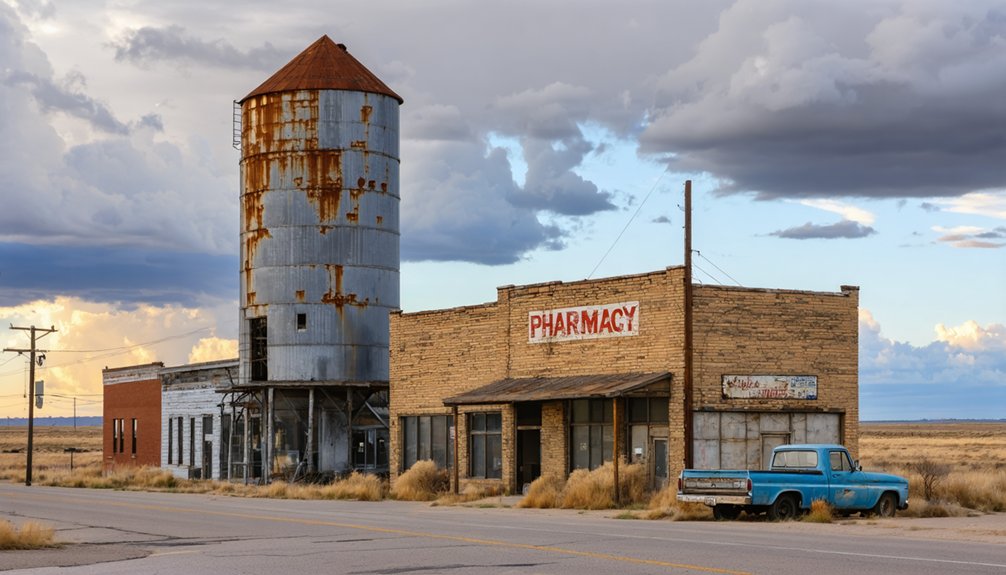
As you walk through any Midwestern town that’s lost half its farms since the 1980s, you’ll notice the skeletal remains of hardware stores, implement dealers, and family restaurants that once thrived on farm traffic and dollars.
When farms consolidate, your local economies lose not just agricultural businesses but essential services like rural hospitals, which have closed at a rate of nearly 140 facilities since 2010.
The cascading impact extends beyond commerce to the civic foundation of rural communities, where diminished tax bases from departing farm families have left schools underfunded and infrastructure crumbling throughout America’s agricultural heartland. This deterioration has accelerated as the U.S. lost 141,733 farms between 2017 and 2022 alone, representing a 7% decline in operations nationwide. Today’s economic pressure has only worsened conditions, with farmers facing declining cash receipts from $300 billion in 2022 to a projected $246 billion in 2024.
Lost Rural Businesses
Countless rural businesses have vanished from Main Streets across agricultural communities, creating economic desolation that extends far beyond shuttered storefronts.
You’ll find this rural decline starkly illustrated in the 2025 Rural Mainstreet Index, which dipped below growth neutral nine times, reflecting weakening economic conditions.
When farms consolidate, the ripple effects devastate local economies. Business closures accelerate as farm equipment sales have fallen below growth neutral for 27 consecutive months.
You’re witnessing a stark contrast—rural small business employment grew just 0.7% over a decade compared to 12.4% in metro areas.
As farmers face declining crop receipts, projected to drop $6.1 billion in 2025, their reduced purchasing power suffocates local businesses. Farm employment has experienced a troubling 3.4% decrease from March 2024 to April 2025, further straining rural economies. Nearly one-third of bankers report that the rural economy is in recession, further intensifying Main Street’s challenges.
When 75% of rural firms cite rising costs as their primary challenge, Main Street’s survival hangs in the balance.
Community Service Deterioration
While rural communities once thrived with vibrant public services, the ongoing consolidation of farming operations has systematically dismantled these essential support systems.
You’ll find your hometown schools shuttered as farm families dwindle, with children now bused hours away, severing vital community engagement opportunities.
Your local clinic that once treated generations now stands empty, forcing you to travel significant distances for basic healthcare.
Post offices—once social hubs—are closing, further isolating you from communication networks.
Roads deteriorate without adequate tax revenue for maintenance.
Service sustainability becomes impossible when population decline undermines the economic foundation supporting these institutions.
As fewer farmers remain to participate in local governance and volunteerism, the social fabric that once maintained your community’s resilience unravels, creating a downward spiral affecting every aspect of rural life.
Farm employment has plummeted from 4.4% to just 1.3% of total U.S. employment between 1969 and 2021, drastically reducing the population base needed to sustain community services.
The 30 Million Acre Question: What Happens to Abandoned Farmland?
Where exactly do America’s forgotten fields go after farmers abandon them? The abandonment impacts extend across 30 million acres of cropland that quietly disappeared from production between 1986-2018.
You’re witnessing America’s farmland futures unfold at nearly one million acres annually, with states like Texas, North Dakota, and Kansas leading this evolution. These changing landscapes offer significant opportunities for renewable energy projects without competing with active agricultural production.
While the USDA’s Conservation Reserve Program captures less than 20% of these lands, nature reclaims most without human intervention.
Nature quietly reclaims abandoned farmlands, orchestrating its own restoration while federal programs manage only a fraction.
- Great Plains wheat fields transforming into windswept prairie grasses that dance under endless skies
- Mississippi Delta cotton fields returning to cypress-filled wetlands teeming with herons and egrets
- Texan farmsteads slowly disappearing beneath encroaching mesquite and desert scrub
- Forgotten Appalachian tobacco plots now cloaked in young forests of pine and hardwood
From Breadbasket to Grassland: Natural Reclamation of Former Croplands
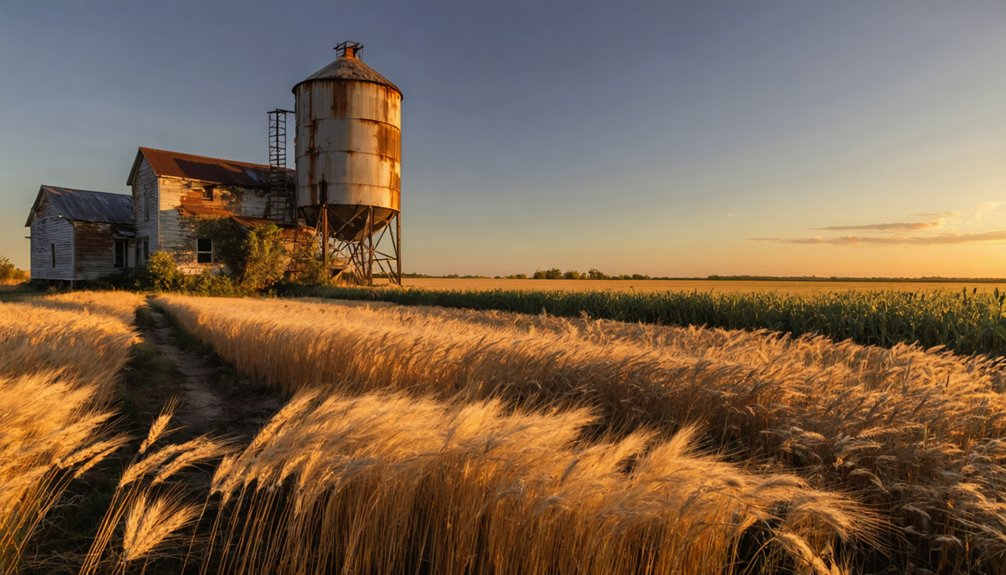
As abandoned croplands surrender to the forces of nature, a remarkable transformation unfolds across America’s agricultural landscape.
You’re witnessing an ecological renaissance across 30 million acres that once fed the nation.
When farmers depart, nature reclaims its territory with surprising efficiency—53% of abandoned farmland shifts to grassland, while nearly 19% evolves into shrubland and forest.
These abandoned ecosystems sequester significant carbon, potentially reaching old-growth forest levels after 60-80 years if left undisturbed.
Only a fraction of these lands—less than 20%—fall under formal conservation programs like the USDA Conservation Reserve Program.
The rest undergo grassland restoration through nature’s own design.
What you’re seeing isn’t merely land reverting to wilderness but the deliberate reassertion of ecological processes that existed long before the plow.
Beyond the Conservation Reserve Program: Unmanaged Land Transitions
You’ll find that once CRP contracts expire without renewal, unmanaged agricultural lands often follow natural succession pathways marked by invasive species establishment before native vegetation can reclaim the space.
These abandoned fields, when left without human intervention, create complex change zones that simultaneously generate dust hazards while developing novel ecosystems unlike either their agricultural past or native habitat future.
Your observation of these ghostly landscapes reveals a tension between ecological restoration potential and the practical concerns of dust management, where informal land stewardship practices by neighboring landowners sometimes become the only management these evolving spaces receive.
Natural Succession Processes
When agricultural fields fall into disuse beyond formal conservation programs, they undergo predictable yet complex natural succession processes.
You’ll witness a choreographed ecological dance as nature reclaims these lands through distinct stages: crabgrass giving way to Queen Anne’s lace, then blackberries and sumacs establishing by year three, culminating in hardwood forests over centuries.
Environmental factors dictate the direction of natural restoration.
In regulated river systems, the absence of flooding creates succession patterns that differ dramatically from unregulated floodplains, with elevation and distance from channels determining whether wet prairie or forest emerges.
- Seedlings pushing through cracked soil within months of abandonment
- Blackberry thickets creating impenetrable barriers after just three years
- Pioneer grasses bending in golden waves across forgotten fields
- Young trees forming green islands amidst fading agricultural ghosts
Ecological Restoration Potential
Beyond federally managed Conservation Reserve Program lands, abandoned agricultural areas hold remarkable potential for ecological regeneration through natural processes.
You’re witnessing a remarkable opportunity for carbon sequestration and biodiversity enhancement as these ghostly farms shift to unmanaged habitats.
Research shows these lands can increase carbon storage by up to two-thirds when properly restored, while providing critical wildlife corridors that connect fragmented ecosystems.
What’s particularly valuable about these forgotten parcels is that ecological revitalization happens more efficiently than on actively managed lands—nature reclaims its territory without displacing productive farmland.
For communities seeking sustainable futures, these abandoned landscapes offer promising habitat restoration opportunities that balance environmental recovery with food security needs.
The key lies in strategic mapping and thoughtful intervention to prevent invasive species while maximizing nature’s inherent regenerative power.
Informal Land Management
While official conservation programs provide structured pathways for land restoration, parallel systems of informal land management have emerged organically in America’s abandoned agricultural communities.
You’ll find residents reclaiming vacant parcels through unwritten arrangements that bypass formal land tenure processes. These informal agreements emerge from necessity as traditional ownership structures collapse amid economic decline.
- Elderly farmers passing down cultivation rights through verbal contracts
- Neighbors establishing community gardens on forgotten corporate holdings
- Migrant families cultivating crops on abandoned fields through handshake deals
- Livestock grazing freely across unmarked property lines, managed by communal understanding
These grassroots approaches represent adaptive resilience in forgotten places.
Without access to credit or legal protections, residents create their own systems of land stewardship, responding to immediate needs while inadvertently preserving agricultural knowledge that would otherwise disappear with formal institutions.
Demographic Collapse: Why Young People Fled Rural America
The dramatic exodus of young people from rural America since the 1990s represents one of the most significant demographic shifts in the nation’s recent history. Each decade, rural counties lost between 10-20% of their youth population as young adults sought education and employment opportunities urban centers could provide.
You’ll find this youth migration has fundamentally reshaped rural America, leaving behind aging communities struggling to maintain crucial services. Remote work briefly reversed these trends during the pandemic, but the long-term pattern persists.
As young families leave, rural schools empty and economies contract. The absence of domestic labor has made immigrant workers essential for agricultural production. Without meaningful rural opportunities, this demographic collapse continues unabated, transforming once-vibrant farming communities into increasingly elderly enclaves dependent on newcomers from abroad.
Satellite Witnesses: How Technology Tracks Agricultural Abandonment
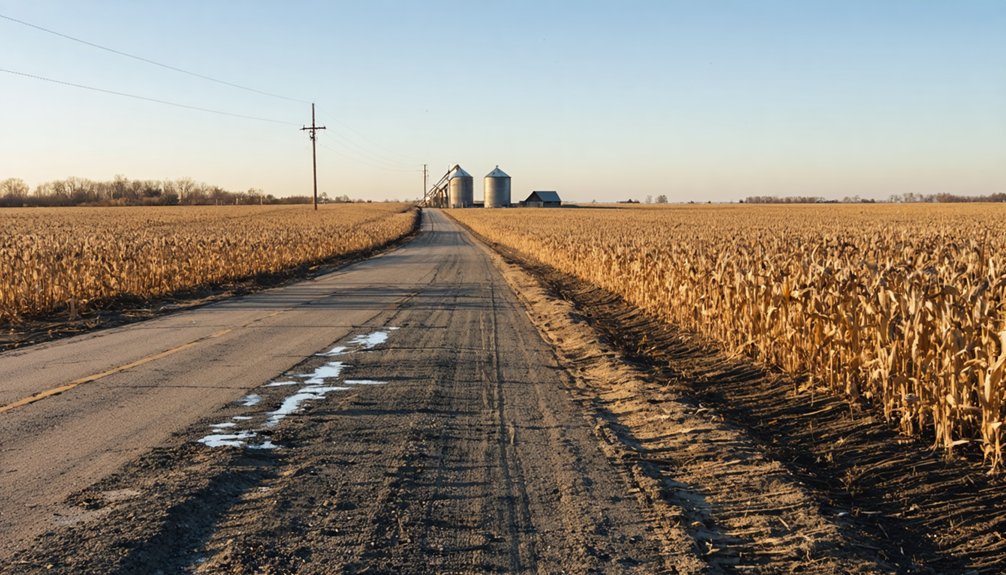
You’re witnessing a revolution in how we track abandoned farmland, as satellite platforms like Landsat and Sentinel-2 now provide continuous, global monitoring through the digital fingerprints of changing landscapes.
When you examine NDVI time series data, you’ll find these systems can detect cropland abandonment with over 89% accuracy, distinguishing between true abandonment and temporary fallowing.
These space-based observations have transformed our understanding of rural decline, allowing scientists to document the ghostly remains of once-thriving agricultural communities across Eastern Europe, China’s Jiangxi Province, and America’s own forgotten farmlands.
Eyes From Above
Observing Earth from hundreds of miles above, satellite technology has revolutionized how researchers track and understand agricultural abandonment across diverse landscapes worldwide.
You’re witnessing a technological revolution where remote sensing capabilities now detect the subtle signatures of forgotten farmland with over 89% accuracy.
Multiple satellites—Landsat, Sentinel-2, MODIS, and high-resolution Gaofen—work in concert to reveal abandonment drivers through vegetation patterns invisible to the naked eye.
- Landsat’s decades-long archive capturing once-thriving farms now reclaimed by nature
- NDVI time series showing the gradual greening of abandoned fields like a slow-motion surrender
- Eastern European landscapes transformed into patchworks of neglect visible only from space
- Small, fragmented plots in mountainous regions appearing as scattered puzzle pieces in satellite imagery
Digital Land Detectives
Behind every revealing satellite image stands a network of digital detectives—engineers, data scientists, and remote sensing specialists—who’ve transformed agricultural abandonment research through innovative detection methods.
You’re witnessing a revolution in digital mapping as these experts harness NDVI time series and machine learning algorithms like random forest to distinguish abandoned fields from cultivated ones. They’re creating automated systems that can process vast Landsat and Sentinel datasets, generating analysis in seconds rather than weeks.
Land monitoring has evolved beyond simple observation—it’s now a sophisticated science combining multi-feature stacking with temporal segmentation techniques.
Despite limitations from cloud cover and irregular management practices, these digital detectives persistently refine their methods, improving accuracy by combining multiple data sources. Their work directly supports conservation efforts, subsidy allocation, and sustainable rural revitalization across America’s changing agricultural landscape.
Southern Abandonment Belt: Counties That Lost One-Fifth of Their Farmland
Within America’s agricultural heartland, a distinct “Southern Abandonment Belt” has emerged, where 166 counties experienced the loss of more than one-fifth of their total cropland since 1990.
This southern abandonment stretches across the Southeast and extends through the Mississippi River valley, creating ghost landscapes where tractors once hummed. Texas suffered the most dramatic farmland loss at nearly 1.9 million hectares, while states like North Dakota and Montana follow closely behind.
- Fence posts leaning into overgrown fields where corn once stood tall against blue skies
- Abandoned barns with weathered wood, slowly reclaiming by nature’s persistent advance
- Empty grain silos standing as silent sentinels over forgotten agricultural communities
- Dirt roads leading to phantom homesteads, marked only by foundation stones and memories
Rural Infrastructure Crisis: The Hidden Costs of Population Decline
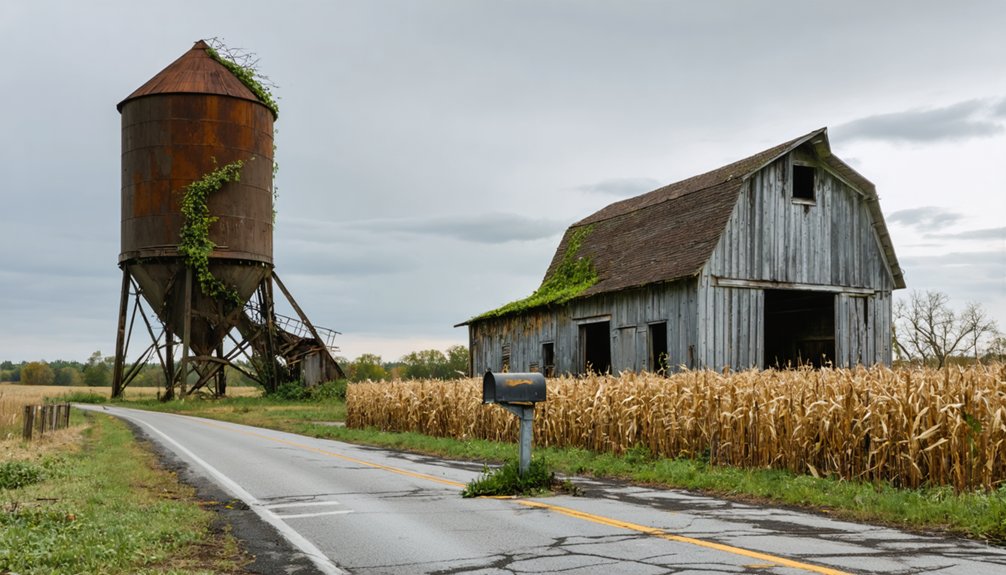
As abandoned farmland spreads across America’s Southern Belt, a more insidious crisis has taken root beneath the rural landscape.
You’re witnessing the collapse of crucial infrastructure as population decline hollows out America’s agricultural heartland.
When you travel these forgotten highways, you’re traversing a dangerous reality: despite containing 68% of America’s road miles, rural areas suffer nearly half of all vehicle fatalities.
Your communities bear disproportionate freight burdens, with rural interstate lanes experiencing nine times more freight volume growth than urban counterparts.
Meanwhile, your digital isolation intensifies as broadband access remains spotty, and aging water systems fail under increasingly extreme weather.
The infrastructure sustaining rural life—roads, internet, water—is crumbling precisely when fewer taxpayers remain to fund repairs.
This hidden crisis accelerates the very abandonment it reflects.
Frequently Asked Questions
Can Abandoned Cropland Be Used for Renewable Energy Development?
Yes, you’ll find abandoned cropland perfectly suited for renewable energy development. You can install solar farms or erect wind turbines, especially in the Midwest where 94% of turbines already occupy former agricultural lands.
How Has Agricultural Abandonment Affected Local Wildlife Populations?
As fields fall silent, you’ll witness wildlife resurgence through increased species richness in abandoned croplands. You’re seeing habitat diversification, though gains vary—lowlands flourish while high-precipitation areas and former pastures experience biodiversity declines.
What Policies Might Reverse Rural Population Decline?
You’ll revitalize rural populations through targeted immigration programs, broadband investment, remote work incentives, healthcare expansion, and community engagement initiatives that empower locals to shape their economic future with minimal government interference.
Are There International Examples of Successful Rural Revitalization?
China lifted 98.99 million rural residents from poverty through programs like community gardens and urban farming. You’ll find success stories in Japan’s Kamiyama village and America’s Cassopolis, proving rural revival’s global potential.
How Might Climate Change Influence Future Agricultural Abandonment Patterns?
You’ll witness intensified abandonment in drought-prone regions as climate resilience strategies fail to counter urban migration trends. Heat stress and precipitation variability will accelerate cropland losses, particularly in marginal agricultural zones.
References
- https://www.glbrc.org/data-and-tools/glbrc-data-sets/cropland-abandonment-between-1986-and-2018-across-united-states
- https://lter.kbs.msu.edu/docs/robertson/xie-et-al-2024-erl.pdf
- https://agcensus.library.cornell.edu/census_parts/1940-abandoned-or-idle-farms/
- https://www.technologynetworks.com/applied-sciences/news/new-us-map-shows-the-abandoned-farms-that-could-help-fight-climate-change-387249
- https://www.thenewlede.org/2025/06/the-role-of-farming-in-the-exodus-of-rural-america/
- https://farmdocdaily.illinois.edu/2024/09/loss-of-us-farmland-in-the-21st-century-the-national-perspective-from-the-census-of-agriculture.html
- https://e360.yale.edu/features/could-abandoned-agricultural-lands-help-save-the-planet
- https://carsey.unh.edu/publication/rural-america-lost-population-over-past-decade-first-time-history
- https://farmlandinfo.org/wp-content/uploads/sites/2/2020/09/AFT_FUT_StateoftheStates_rev.pdf
- https://ukragroconsult.com/en/news/u-s-usda-expecting-normal-wheat-abandonment-rates/