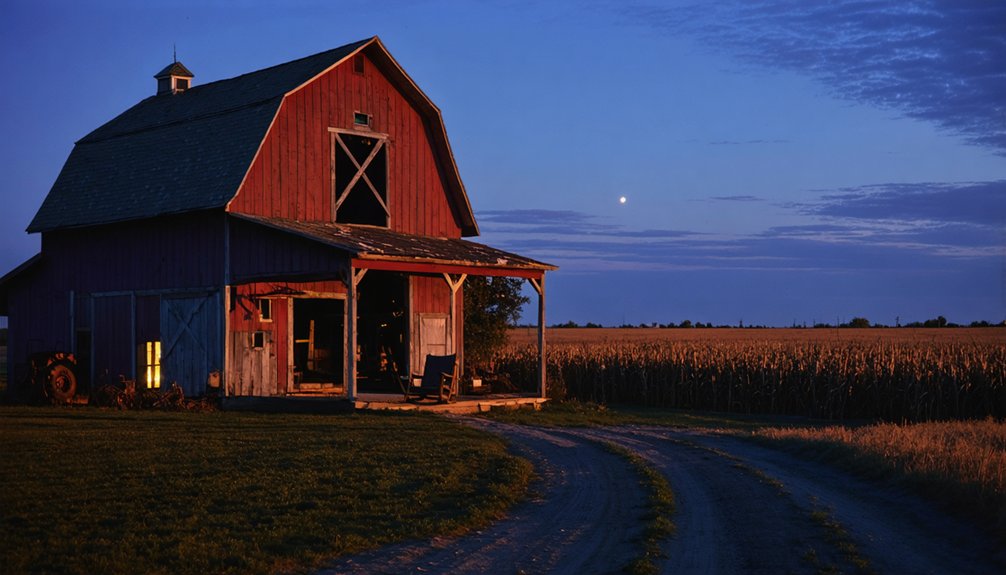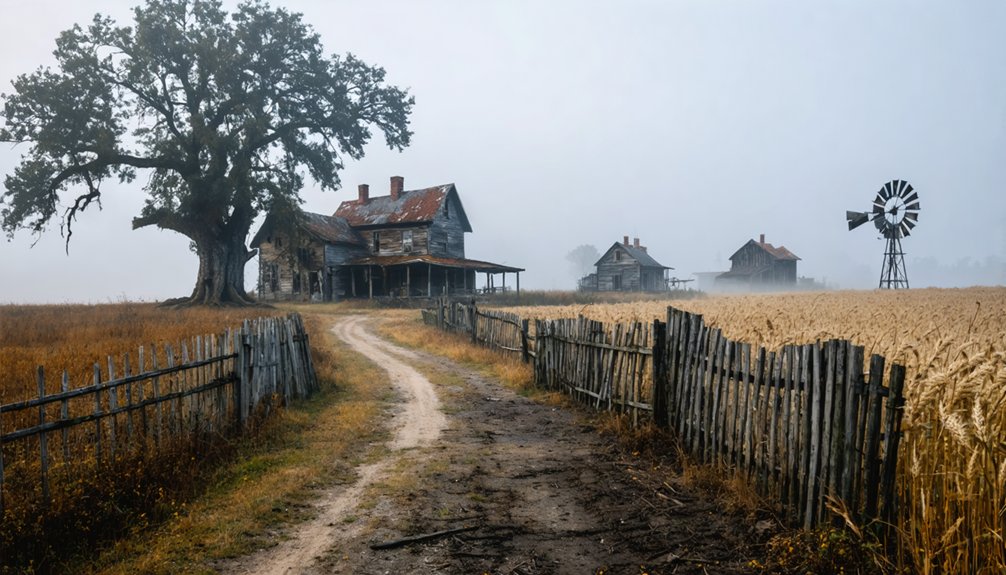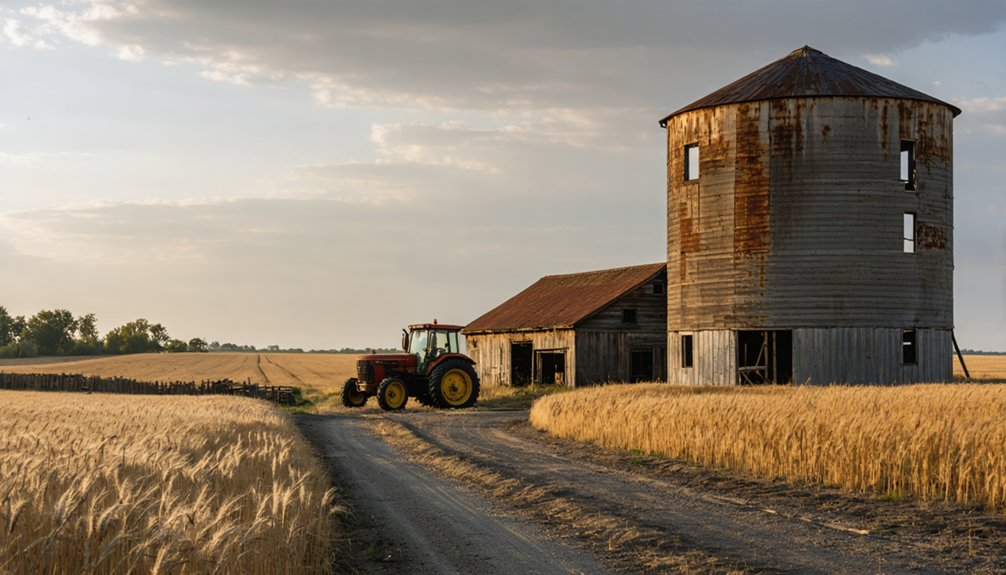
Across America’s heartland, you’ll find ghostly agricultural towns where abandoned barns and empty silos tell stories of rural transformation. These communities have faded as small farms succumbed to industrial agriculture, with 31 million acres lost between 1992-2012. Main Streets stand silent while croplands return to prairie through natural succession. Some towns disappear completely, while others find new purpose through tourism or conservation efforts—each empty building holds chapters of America’s changing agricultural narrative.
Key Takeaways
- Agricultural ghost towns emerged from economic decline, with 86% of Great Plains rural counties experiencing population loss between 1980-2010.
- Mechanization and the “Get big or get out” directive led to farm consolidation, abandonment of small farms, and eventual town desertion.
- Abandoned homesteads and empty Main Streets visually document the erosion of rural communities following farmer departures.
- Western United States contains numerous agricultural ghost towns where farming decline triggered community collapse and preserved historical structures.
- Ghost towns attract tourism while telling stories of agricultural heritage through remaining buildings, cultural artifacts, and community landmarks.
The Vanishing Agricultural Landscape: 30 Million Acres Gone
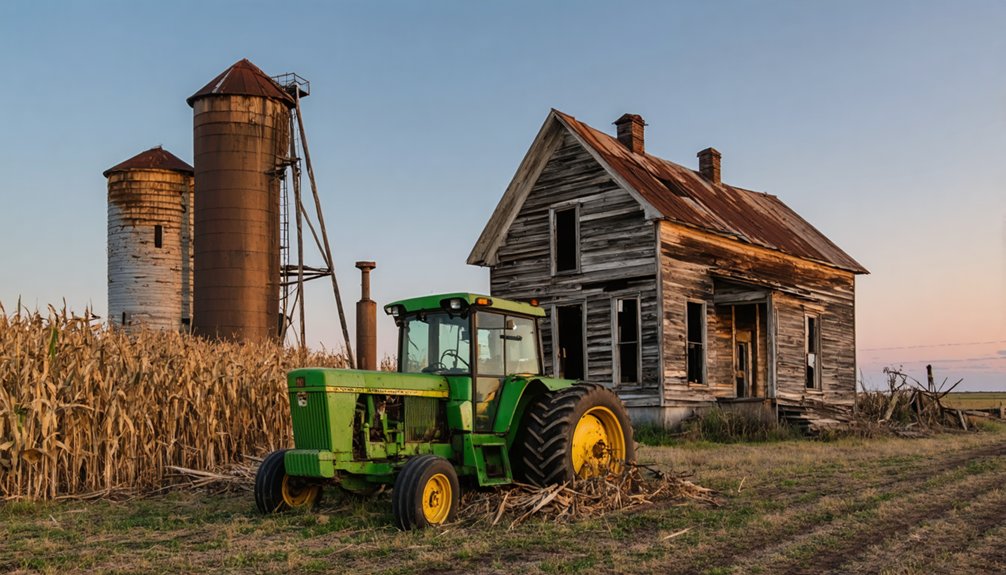
While America’s vast agricultural lands once seemed limitless, you’re now witnessing an unprecedented transformation of the rural landscape.
Nearly 31 million acres—equivalent to most of Iowa—have vanished beneath concrete and asphalt between 1992 and 2012, with an alarming 8% reduction overall in just 25 years.
You’re losing the foundation of agricultural sustainability as prime farmland disappears. Almost 11 million acres of the nation’s most productive soil now support housing developments and shopping centers rather than crops.
What’s particularly concerning is how low-density residential sprawl accounts for 41% of this loss, fragmenting once-continuous farming regions.
Land preservation efforts face mounting challenges as pastureland declined 13% and woodland 6% since 1997. The elimination of acreage set aside programs after the 1996 Farm Bill has contributed to these significant land use changes. This massive loss is even more concerning as wildlife habitat and environmental benefits like flood control are diminished when agricultural lands are converted.
The spatial patterns reveal a shrinking agricultural footprint that threatens both food security and the traditional American farming landscape.
From Crops to Ghosts: Mapping America’s Rural Exodus
As you explore America’s changing rural landscape, a striking transformation emerges in the spatial distribution of populations across once-thriving agricultural regions.
Since 2020, international immigrants have breathed new life into ghost towns, accounting for an astonishing 87% of rural population growth.
You’ll notice three distinct patterns reshaping these spaces:
- Texas, North Carolina, and Iowa leading rural immigrant integration, with Texas gaining 26,000 rural immigrants.
- Remote areas experiencing domestic outflows counterbalanced by international arrivals.
- Agriculture-dependent counties seeing population declines partially offset by immigrant workers.
While young families increasingly choose suburban areas near metropolitan centers, rural revitalization efforts continue. Counties with strong agricultural economies have seen immigration comprise almost two-thirds of their population growth in recent years.
This demographic shift creates a complex mosaic where some communities flourish through immigrant integration while others fade into ghostly remnants of their former agricultural identities.
Rural America’s recent revival, gaining nearly 200,000 new residents between 2020 and 2023, shows a promising reversal of the long-standing population decline trend.
The Great Plains Emptying: Counties in Decline
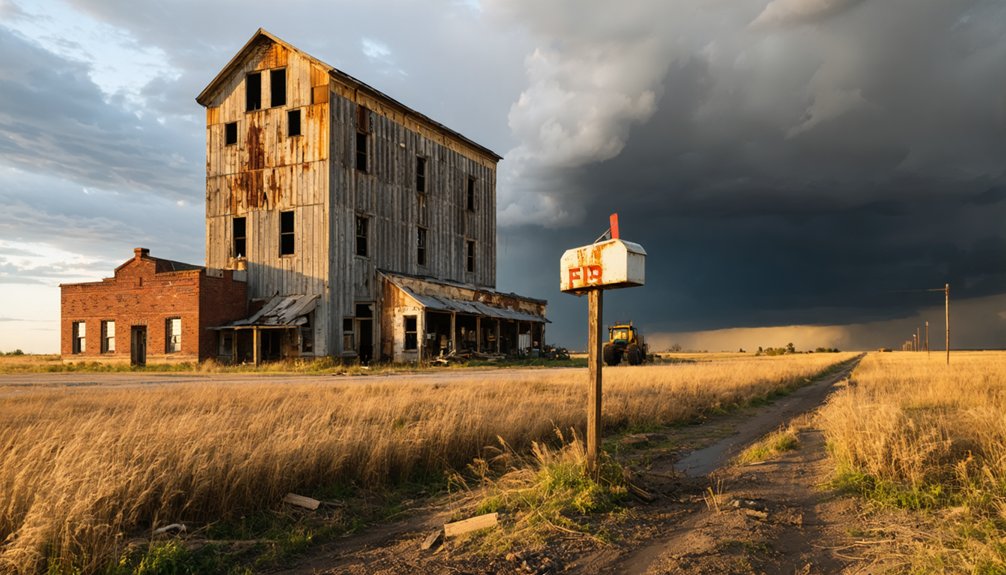
When you examine the Great Plains region today, you’ll discover a dramatic demographic hollowing that defines the modern rural landscape.
Nearly half of all counties are experiencing significant population loss, with 112 rural counties shedding over 10% of their residents between 2000-2010 alone.
This rural isolation isn’t randomly distributed—it’s geographically concentrated. More than 56% of all declining U.S. counties sit within the Great Plains, with states like Kansas and North Dakota particularly affected.
The demographic shifts create a stark spatial divide: metropolitan areas account for only 14% of counties but capture 92% of population growth.
Most troubling is the persistence of this emptying—40% of rural counties have continuously lost population since 1950, creating a landscape where natural decline (more deaths than births) now characterizes 56% of rural counties.
Environmental constraints like decreasing rainfall from east to west have historically shaped settlement patterns and continue to influence which areas can sustain agricultural communities.
The shift toward larger farming operations has accelerated this depopulation trend as mechanization reduces the need for agricultural workers.
When Farmers Leave: The Ripple Effect on Small Towns
The departure of farmers from America’s heartland creates concentric rings of economic and social decline that ripple outward through small towns. When farmers’ migration begins, you’ll witness the gradual unraveling of once-vibrant communities, as labor forces shrink and municipal budgets collapse.
Across the landscape, these patterns emerge:
- Local businesses fold first—farm supply stores, equipment dealers, and grain elevators close within months.
- Community institutions disappear next—schools merge, clinics shutter, churches consolidate.
- Cultural heritage fades last—annual harvest festivals cease, historical societies dissolve, generational knowledge vanishes.
Over time, you’ll notice abandoned homesteads dot the countryside while Main Streets empty. This trend is particularly evident in the Great Plains region, where 80% of rural farm counties are experiencing significant population loss.
This pattern mirrors European trends, where rural populations declined by 20% since 1960 as agricultural lands were abandoned.
Community resilience depends on adaptation—towns that diversify beyond agriculture sometimes survive, creating new identities around recreation or retirement living. Those that don’t become tomorrow’s ghost towns.
Forgotten Fields: What Happens to Abandoned Croplands?
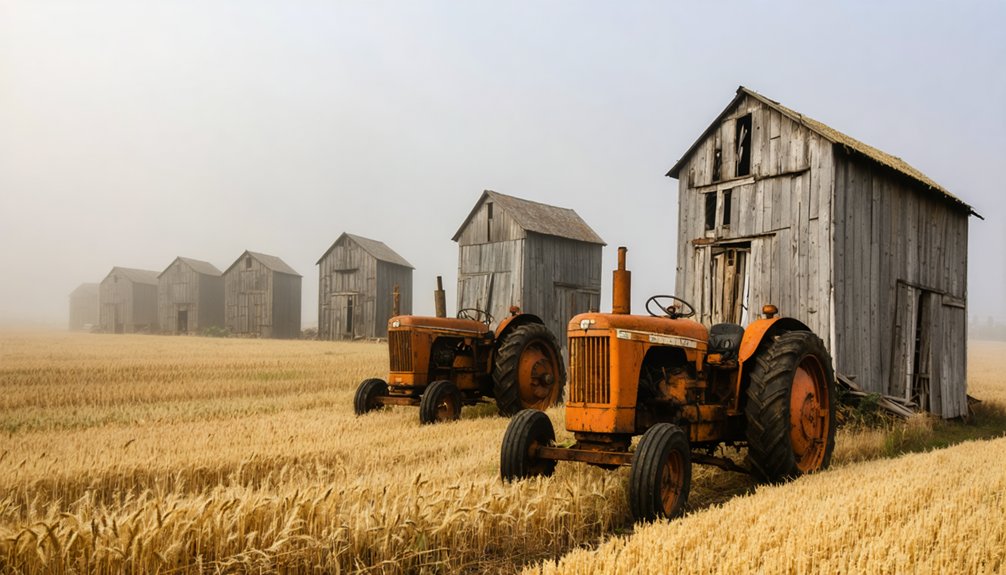
When you travel across America’s abandoned croplands, you’ll witness a patchwork of natural succession where over half the land transforms into grasslands while only 18.6% becomes forest or shrubland.
You’ll find economic contradictions where these forgotten fields sequester carbon worth billions but remain largely outside formal conservation programs, with less than 20% enrolled in initiatives like the Conservation Reserve Program.
The abandonment patterns you observe are typically temporary—lasting just over 14 years before recultivation—creating a landscape in flux where potential ecological benefits compete with economic pressures. These lands represent part of the 101 Mha of cropland abandoned globally from 1992 to 2020, showing America’s contribution to a worldwide phenomenon. Significant portions of this abandonment occurred around the Ogallala Aquifer where groundwater depletion and drought conditions forced agricultural retreat.
Natural Succession Patterns
Across America’s forgotten agricultural landscapes, abandoned croplands undergo remarkable transformations through natural succession, creating entirely new ecosystems where farms once stood.
You’ll witness nature’s resilience as it reclaims these spaces through natural regeneration, following predictable yet fascinating patterns.
The succession timeline unfolds in these distinct phases:
- Year 1-3: Herbaceous pioneers like crabgrass rapidly colonize, while soil quality initially declines.
- Years 3-10: Shrubs and tree seedlings establish, as fungal communities diversify and soil stability improves.
- Years 10-200: Forest development progresses from pines on dry sites to hardwoods on moist areas, with soil carbon and nitrogen eventually exceeding pre-abandonment levels.
These transformations create dynamic wildlife habitats while ecological restoration occurs naturally, though soil salinity can alter succession pathways in arid regions.
Economic Impact Analysis
Beyond the ecological succession patterns, a stark economic reality emerges when examining abandoned croplands across America’s rural landscape.
You’re witnessing the disappearance of potential food production that could feed hundreds of millions—a staggering 363 Peta-calories annually vanishing from these forgotten fields.
As you travel through regions like the South and Southeast, you’ll notice how abandoned lands create rippling economic effects.
Without proper land management, these once-productive spaces become vulnerability zones—eroding soil value while simultaneously missing carbon sequestration opportunities worth over 1,000 MtCO2 yearly.
Your freedom to choose different futures for these lands exists.
While conservation programs like CRP redirect some abandonment toward ecological benefits, the majority represent pure economic opportunity loss—ghostly reminders of agricultural prosperity that once sustained vibrant rural communities, now fading into memory.
Conservation Program Gaps
Despite covering millions of acres across the American landscape, conservation programs like the USDA’s Conservation Reserve Program (CRP) have failed to capture the majority of abandoned croplands.
These conservation gaps represent untapped potential for both ecological restoration and economic revitalization in rural America.
When you examine the spatial distribution of these forgotten fields, you’ll notice:
- Less than 20% of abandoned cropland participates in CRP programs
- Over half naturally converts to grassland without strategic management
- Nearly 30 million acres could support bioenergy crops or carbon sequestration
The timeline of land abandonment shows waves corresponding to economic shifts, yet enrollment incentives haven’t evolved to match these patterns.
Your freedom to choose how these lands evolve matters—whether through natural succession, targeted conservation, or innovative repurposing for climate solutions.
“Get Big or Get Out”: How Policy Shaped Rural Abandonment
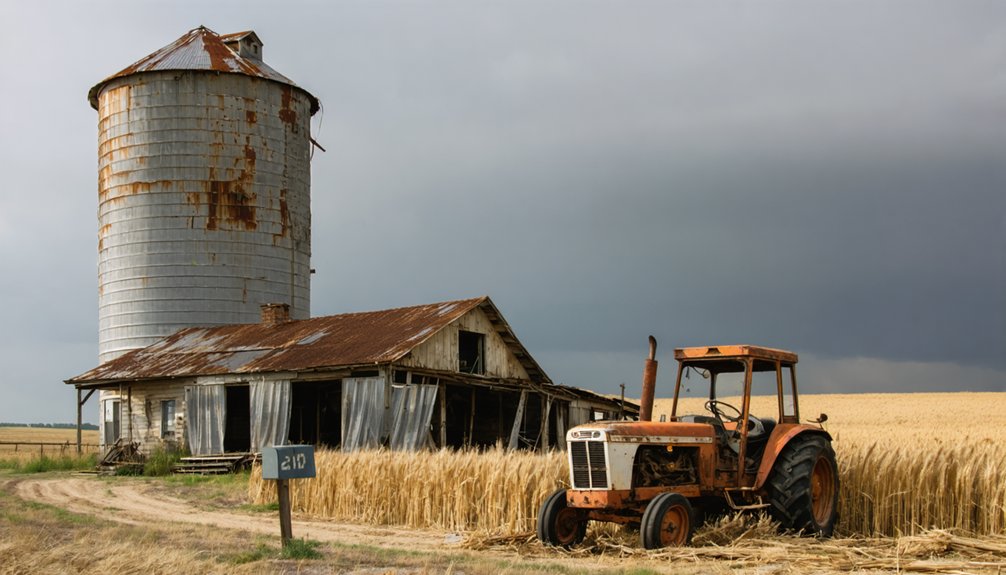
While America’s rural landscapes were once characterized by a patchwork of small family farms, the agricultural policy shift of the 1970s dramatically transformed this traditional pattern into vast expanses of industrialized farmland.
You can trace this transformation to Earl Butz’s infamous directive to “Get big or get out,” which prioritized production efficiency over rural resilience. The policy implications were swift and devastating—small farmers couldn’t compete with industrial operations.
As you drive through the Great Plains today, you’ll notice abandoned homesteads dotting the horizon, remnants of communities that once thrived. Between 1980 and 2010, population decline swept through 86% of Great Plains rural counties as families abandoned generations-old farms.
The landscape itself tells this story of consolidation—fencerows removed, individual properties merged, and Main Streets hollowed out, sacrificed for national productivity goals.
Reviving the Ghosts: Potential Futures for Abandoned Farmland
The abandoned farmlands that once symbolized rural decline now present unprecedented opportunities for ecological and economic revival across America’s landscape.
You’ll find these forgotten acres scattered across the nation, quietly awaiting transformation through land restoration techniques that balance human needs with ecological balance.
Three promising pathways for these ghost properties include:
- Carbon sequestration through reforestation or perennial crops
- Community-driven permaculture and agroforestry systems
- Strategic conversion to bioenergy production on marginal lands
The temporal window for maximum restoration impact requires long-term commitment—ideally 50+ years—though modern technologies like drone seeding and AI monitoring can accelerate recovery.
Patience meets innovation as we plant today what future generations will harvest from healed landscapes.
Across the countryside, these dormant landscapes aren’t just relics of the past but potential keystones in a resilient future where freedom and sustainability coexist.
Beyond the Census Numbers: Real Stories of Farming Communities

You’ll find abandoned farmhouses dotting the landscape across America’s Great Plains, where once-vibrant communities have seen their populations dwindle as young residents migrate to urban centers.
Between 1980 and 2010, these vacant structures became monuments to economic hardship as farm consolidation transformed the spatial organization of rural life, leaving fewer families spread across increasingly isolated properties.
Walking through these hollowing heartlands today, you’re witnessing not just statistical decline but the physical manifestation of demographic collapse—empty school buildings and boarded storefronts mapping the temporal progression of community disintegration.
Hollowing Rural Heartlands
Across America’s once-vibrant rural heartlands, farms and communities stand abandoned as agricultural consolidation reshapes the landscape and drains the lifeblood from small towns.
You’ll find the hollowing occurs through predictable patterns, stripping away community resilience while leaving ghostly reminders of what once thrived.
the secrets of appalachian ghost towns reveal the stories of lost hopes and faded ambitions, each crumbling facade a testament to a past full of life. Visitors often wander through these silent streets, feeling the echoes of history as they connect with the remnants of once-thriving communities. Exploring these forgotten places offers a unique glimpse into the resilience and eventual decline of the people who called them home.
The transformation unfolds in three stark stages:
- Family farms collapse under financial pressure, with 72% fewer farms since 1935.
- Young people flee, creating demographic voids where 86% of Great Plains counties shrink.
- Essential services vanish as customer bases erode, accelerating the exodus.
What you’re witnessing isn’t just economic evolution—it’s the systematic dismantling of a way of life.
Rural revitalization demands understanding this temporal sequence, where each abandoned structure tells a story of consolidation’s true cost.
Forgotten Farm Families
Behind each statistical data point of America’s farm decline lies a deeply personal story of upheaval, resilience, and often heartbreak.
You’ll find these forgotten legacies scattered across America’s landscape—families whose multi-generational agricultural heritage vanishes as elderly farmers outnumber young entrants. When you travel through former farming communities, you’re witnessing the aftermath of economic pressures that have transformed rural America’s spatial patterns.
The temporal analysis is stark: since 1950, we’ve lost 66% of our farms while mental health crises grip those remaining.
Look closely at the Great Plains and you’ll see communities hollowed out by consolidation—where fewer, larger operations replace the family farm mosaic that once defined these regions. Weather disasters, rising costs, and diminishing autonomy aren’t just economic challenges—they’re erasing centuries of rural cultural identity.
Frequently Asked Questions
How Did Climate Change Contribute to Farmland Abandonment?
Climate change intensified water scarcity through depleted aquifers and altered rainfall, causing soil erosion that’s transformed your rural landscape. You’re witnessing climate impact accelerate rural depopulation as farmlands convert to grasslands.
What Happens to Farm Equipment When Agricultural Land Is Abandoned?
You’ll find farm machinery left behind, transforming into rusting relics across abandoned fields. Equipment deteriorates in place, gets salvaged for parts, or sometimes finds new purpose as artistic installations in the landscape.
Are There Government Incentives to Reclaim Abandoned Agricultural Areas?
Yes, you’ll find government grants for land reclamation through CRP, ECAP, and climate-smart programs. These initiatives transform abandoned fields into restored landscapes, creating new temporal patterns across once-forgotten spatial territories.
How Has Technology Accelerated or Slowed Rural Agricultural Abandonment?
Technology has both accelerated rural depopulation through automation and slowed abandonment via precision farming. You’ll notice spatial patterns shifting as digital connectivity enables farmers to optimize land use despite temporal challenges in agricultural landscapes.
Are International Corporations Buying Abandoned American Farmland?
Yes, you’re witnessing international corporate landownership transform America’s landscape. Foreign investors have doubled their farmland investment since 2010, creating new spatial patterns where abandoned properties become corporate-controlled territories across your rural regions.
References
- https://www.glbrc.org/data-and-tools/glbrc-data-sets/cropland-abandonment-between-1986-and-2018-across-united-states
- https://www.technologynetworks.com/applied-sciences/news/new-us-map-shows-the-abandoned-farms-that-could-help-fight-climate-change-387249
- https://ci.uky.edu/irj/rural-blog/new-tool-finds-abandoned-farmland-could-be-used-fight-climate-change-30-million
- https://www.thenewlede.org/2025/06/the-role-of-farming-in-the-exodus-of-rural-america/
- https://www.thepublicdiscourse.com/2021/03/75087/
- https://farmdocdaily.illinois.edu/2024/09/loss-of-us-farmland-in-the-21st-century-the-national-perspective-from-the-census-of-agriculture.html
- https://agamerica.com/blog/family-farms/
- https://farmlandinfo.org/wp-content/uploads/sites/2/2020/05/AFT_FUT_SAF_2020final.pdf
- https://inthesetimes.com/article/america-farmland-trust-conservation-development-farms-under-threat
- http://www.ers.usda.gov/data-products/chart-gallery/chart-detail?chartId=58268