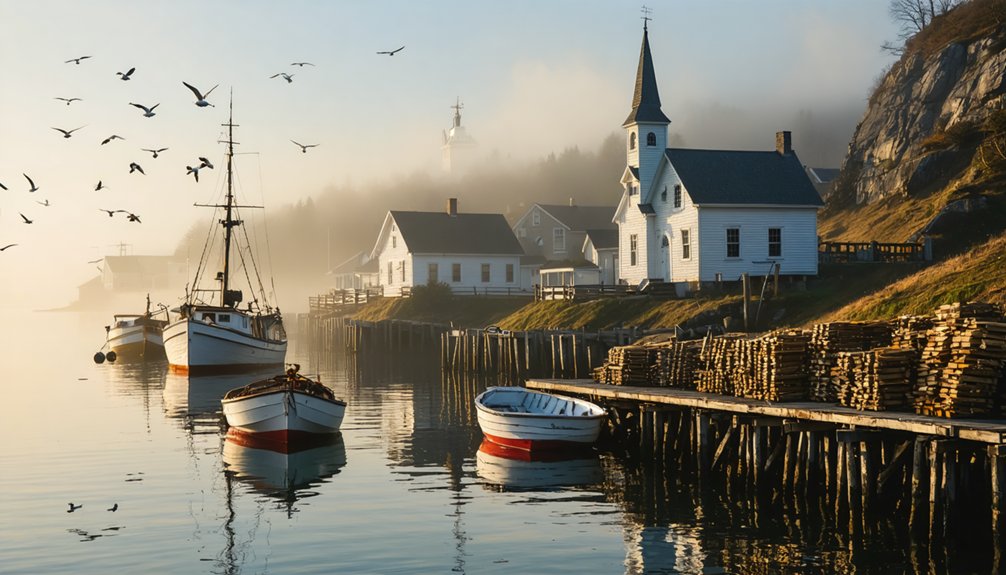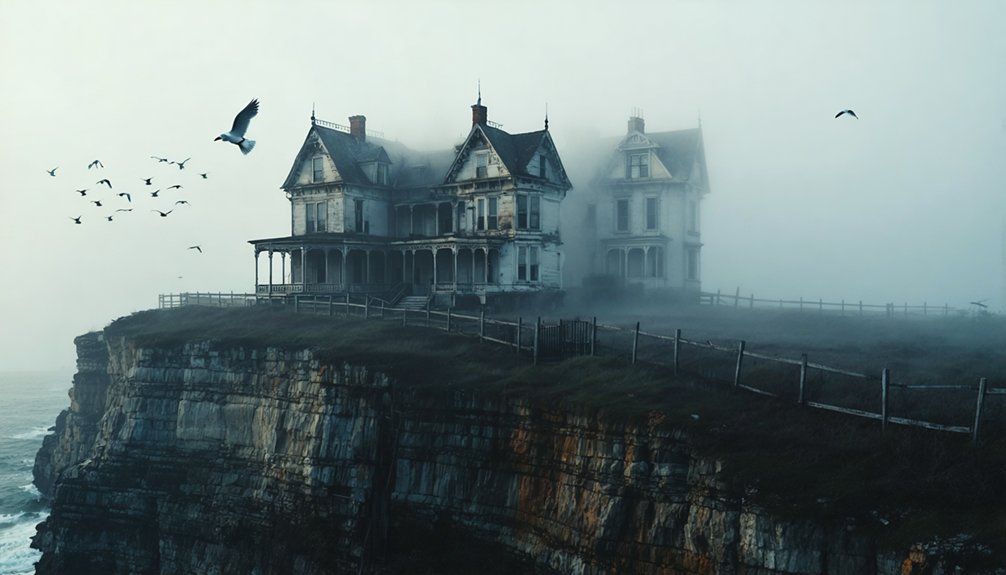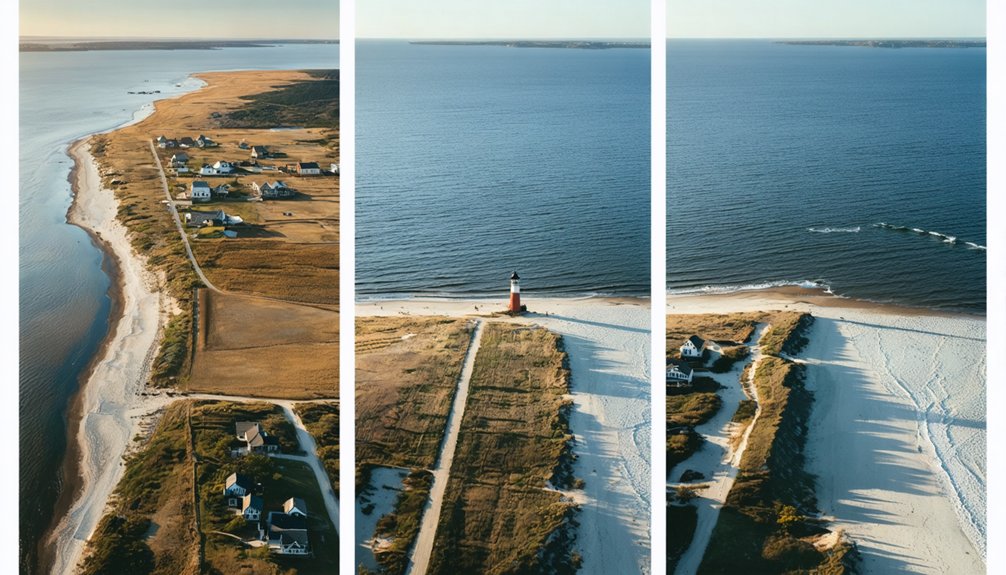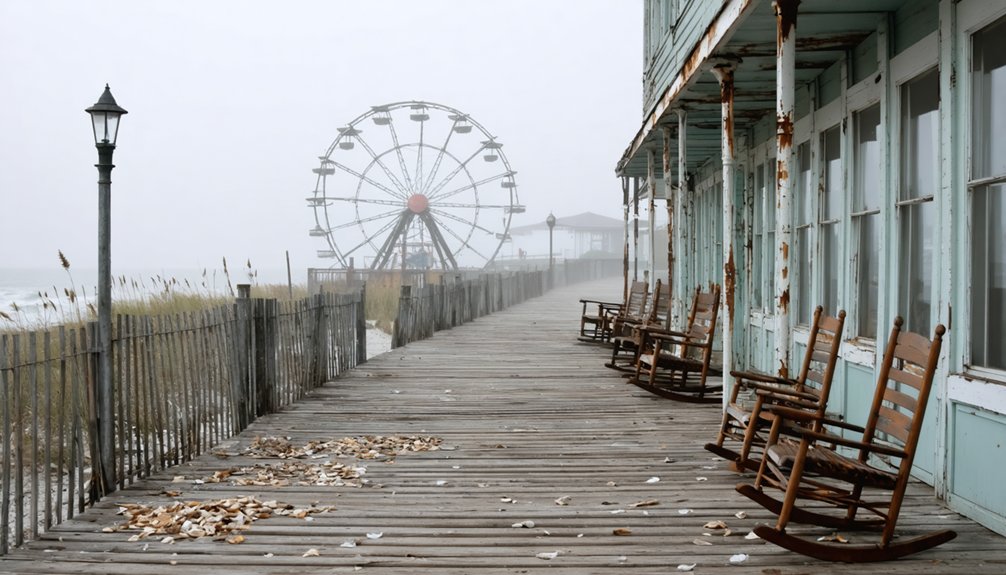
The East Coast harbors numerous ghostly beach towns, abandoned due to economic decline and natural disasters. Once-thriving coastal resorts like Sea Breeze, NJ have succumbed to erosion, hurricanes, and changing vacation patterns since the mid-20th century. You’ll find haunting remnants of boardwalks, hotels, and amusement piers slowly reclaimed by salt marshes and rising tides. These forgotten destinations offer both ecological resurrection stories and windows into America’s lost maritime leisure culture.
Key Takeaways
- Sea Breeze, NJ emerged as a coastal retreat in the 1880s before declining due to erosion and disasters, leaving behind abandoned structures.
- Natural disasters like hurricanes and economic downturns contributed to the abandonment of once-thriving East Coast resort communities.
- Abandoned coastal towns often transform into wildlife sanctuaries where nature reclaims buildings through saltwater erosion and vegetation growth.
- Former resort areas like Pleasure Beach, Connecticut closed after multiple fires, leaving ghost towns that attract dark tourism enthusiasts.
- These forgotten beach towns preserve rich cultural histories and architectural remnants that serve as reminders of America’s maritime heritage.
The Rise and Fall of Sea Breeze, New Jersey
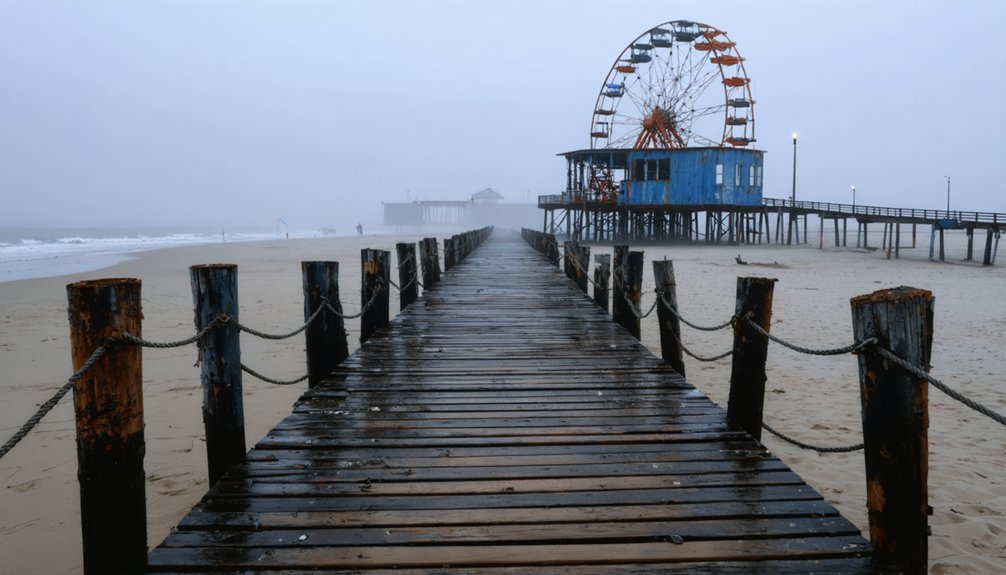
Once a shimmering jewel along New Jersey’s Cumberland County coastline, Sea Breeze emerged in the late 19th century as a quintessential American coastal retreat.
You’d have arrived via the restored Civil War steamboat John A. Warner, which began connecting Philadelphia directly to this bayfront haven in 1887—bypassing the tedious train journeys of that era.
The Warner House hotel’s grand opening that same year marked Sea Breeze’s golden age, offering seaside nostalgia through clambakes and boating races.
As the 20th century dawned, the town boasted an amusement pier and carousel, but this prosperity wouldn’t last.
Fires destroyed the hotels, Hurricane Gloria claimed the tavern in 1985, and abandoned architecture soon dominated the landscape. The town’s struggle against coastal erosion became increasingly futile as the ocean reclaimed more land each year.
Failed seawalls and government buyouts ultimately transformed this once-thriving resort into the ghost town you’ll find today. Today, the area serves as a wildlife refuge, offering visitors scenic views despite its haunting atmosphere.
the haunted history of cape may adds an intriguing layer to the visitor experience. Many are drawn to the old Victorian homes, where tales of restless spirits and ghostly encounters abound. This unique blend of beauty and eerie legend continues to attract those seeking both relaxation and a glimpse into the past.
Tides of Time: When Popular Resorts Become Ghost Towns
When you walk through the weathered halls of these once-thriving coastal destinations, you’ll witness the inexorable march of nature reclaiming its territory—saltwater erosion undermining foundations as vegetation bursts through cracked terrazzo floors.
The resplendent dance halls where celebrities performed and vacationers twirled under crystal chandeliers now stand silent, their glamour faded beneath layers of salt spray and neglect. Like the Salton Sea which transformed from a Hollywood celebrity playground into an ecological catastrophe, these sites reveal how quickly fortunes can change. Hampton Springs Hotel in Florida, once known as Dixie’s Famous Spa, now lies in ruins with only moss-covered stone foundations remaining where wealthy travelers once enjoyed mineral baths and casino entertainment.
What remains are architectural skeletons that serve as poignant reminders of mid-century leisure culture, where the echoes of laughter and music have been replaced by the steady rhythm of waves and wind reshaping these forgotten monuments to human recreation.
Nature Reclaims Resorts
Time, the great sculptor of abandoned landscapes, transforms once-bustling beach resorts into haunting monuments to faded glory.
At Pleasure Beach, Connecticut, you’ll find these abandoned treasures slowly surrendering to nature’s persistent advance, despite federal grants aimed at rehabilitation. After several devastating fires since 1907, the park ultimately closed in 1959, leaving behind decaying remnants of what was once a thriving amusement destination. Moss-covered ruins of the Hampton Springs Hotel in Florida stand as evidence to vegetation’s relentless conquest. Hog Island’s popular bathhouses and restaurants completely vanished into the Atlantic by the early 20th century after a devastating hurricane in 1893.
Nature’s reclamation efforts are often accelerated by catastrophic events—hurricanes devastated Kauaʻi’s Coco Palms and Miami’s Deauville, while rising saline waters turned the Salton Sea into an ecological disaster zone.
At Argentina’s Villa Epecuén, thirty feet of floodwater submerged an entire resort town for decades.
These sites illustrate nature’s undeniable power toward ecological restoration, as governmental priorities shift toward wildlife conservation rather than preserving human-made structures that once defined coastal leisure.
Glory Days Faded
Throughout the twentieth century, booming beach resorts symbolized the pinnacle of leisure and prosperity, only to transform into haunting shells of their former glory as economic downturns swept away their foundations.
You can trace this decline through catastrophic economic events—the 1929 crash and Great Depression ended many resort towns as leisure travel evaporated. Later, the 2008 housing crisis and post-9/11 tourism decline delivered fatal blows to already struggling destinations.
What remains are monuments to faded grandeur: The Colony resort’s $14 million repair bill rendering it financially unviable; Bayocean’s forgotten memories washing literally into the sea.
Environmental forces also played a crucial role in Bayocean’s demise when the construction of a single jetty system altered coastal erosion patterns and ultimately doomed the once-promising “Atlantic City of the West.”
The Colony Beach and Tennis Resort on Longboat Key followed a similar pattern of decline, with hurricane damage in 2004 initiating a downward spiral that ultimately led to its closure.
You’re witnessing a historical cycle where once-thriving communities succumb to combined forces of environmental degradation and financial abandonment.
These ghostly remains stand as sobering reminders that prosperity, even at its most opulent height, remains vulnerable to economic tides.
Nature’s Wrath: How Hurricanes Reshape Coastal Communities
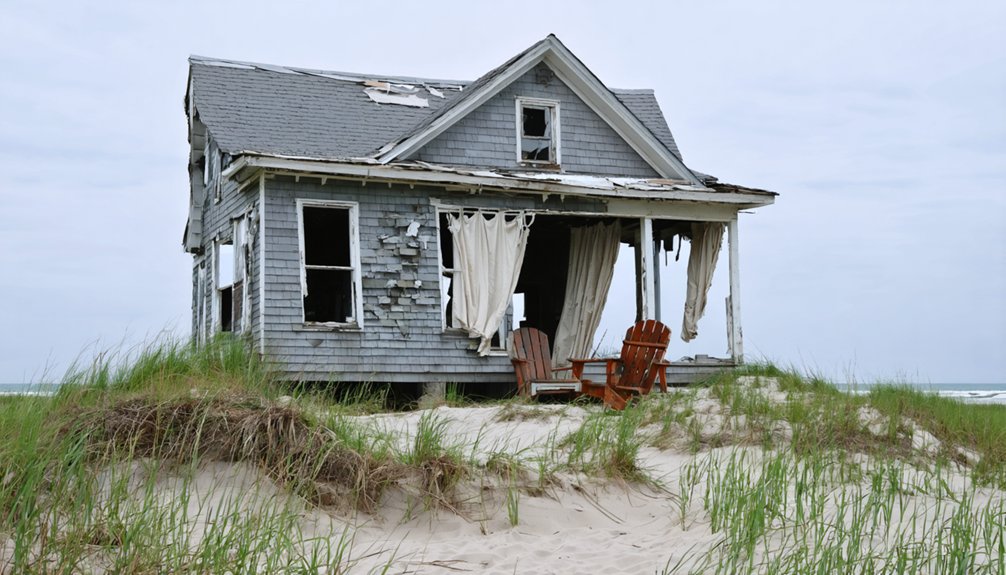
As hurricanes barrel toward coastlines with increasing frequency and intensity, they fundamentally transform the physical, social, and economic landscapes of beach communities.
You’ll witness barrier islands eroding at alarming rates—exceeding 20 meters yearly in Louisiana—stripping away natural defenses that once protected inland areas.
The vulnerability isn’t merely geographical. Nearly 40% of Americans now live in coastal counties where flood events have increased 500-1000% since the 1960s.
America’s coastal vulnerability crisis: 40% of population faces flood events that have skyrocketed 500-1000% in six decades.
Hurricane preparedness becomes particularly challenging for older adults, low-income residents, and mobile home dwellers who lack adequate resources.
Communities like those in the Gulf Coast face a double threat: their population growth outpaces coastal resilience efforts, while storms devastate ecosystems—mangroves, dunes, oyster reefs—that provided natural protection. Harris County exemplifies this problem, with its developed land increasing from 35% in 2000 to 50% in 2020.
The financial burden is substantial, with insurance premiums rising dramatically following major hurricanes, creating additional economic strain for residents already struggling to rebuild.
This environmental degradation creates a cycle of increasing vulnerability with each successive storm.
Abandoned Boardwalks and Empty Hotels
Once vibrant symbols of coastal prosperity, America’s historic boardwalks and oceanfront hotels now stand as haunting monuments to environmental and economic abandonment.
You’ll find Atlantic City’s northern boardwalk struggling through reconstruction while Atlantic Beach’s wooden piles succumb to decay. These aren’t isolated cases—the pattern of destruction spans centuries, from the 1875 collapse of East End Exclusion Pier to Hurricane Sandy’s devastation of South Inlet’s oceanfront in 2012.
Where visitors once spent billions, boardwalk decay now triggers catastrophic economic decline.
Tourism revenue plummets as hotel dereliction spreads—each abandoned property devalues its neighbors, creating a domino effect across coastal communities. The doubling of debris reduces visitor spending by up to 35%, translating to $84 billion in annual losses nationwide.
What you’re witnessing isn’t just deterioration—it’s the unraveling of entire economic ecosystems.
The Environmental Aftermath of Coastal Abandonment
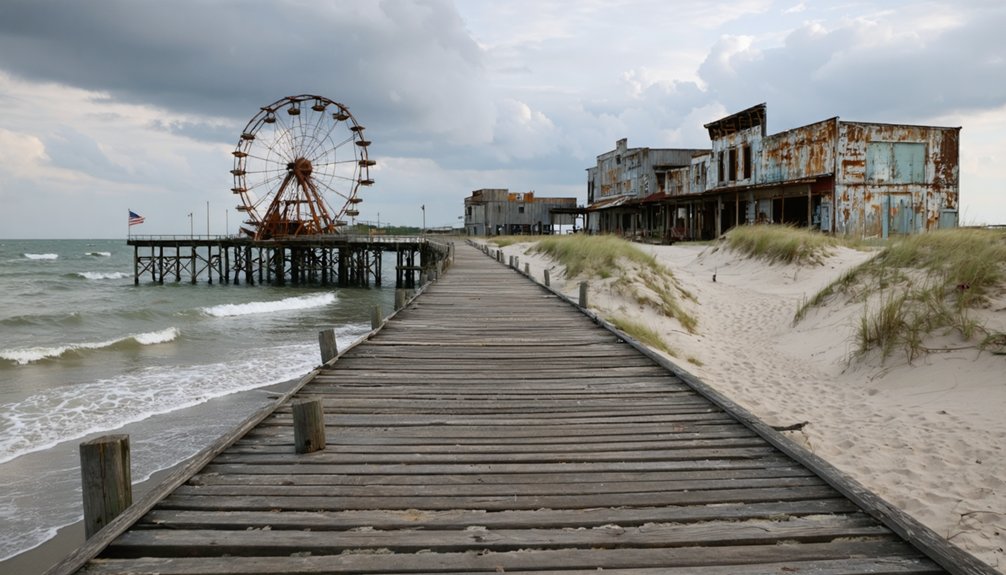
You’ll witness a complex environmental transformation as coastal towns fade into memory, where nature gradually reclaims abandoned boardwalks and concrete foundations through persistent wave action and resilient plant communities.
Erosion accelerates without human intervention, reshaping shorelines at unprecedented rates while saltwater intrusion creates eerie ghost forests where vibrant coastal woodlands once stood.
What once served as entertainment destinations now evolve into accidental wildlife sanctuaries, with shore birds nesting in collapsed structures and marine species colonizing submerged remnants of human habitation.
Nature Reclaims Sandy Shores
When humans retreat from coastal settlements, nature advances with remarkable speed and efficiency, transforming once-bustling beach towns into thriving ecological laboratories.
You’ll witness coastal ecology reasserting itself as dunes rebuild and native vegetation reclaims manicured lawns. The abandoned infrastructure gradually surrenders to natural processes—concrete crumbling under persistent waves, while buildings become habitats for small mammals and nesting birds.
Water quality improves dramatically without urban runoff and sewage systems leaching into the ocean. You’ll find marine ecosystems flourishing in these newly quiet waters, with seagrass beds expanding and fish populations rebounding.
The reclaimed wetlands and growing vegetation sequester carbon, creating a natural climate buffer. These ghost towns ironically become bastions of biodiversity, offering glimpses of what these shores looked like before human occupation.
Erosion’s Relentless March
As the tide of human habitation recedes from vulnerable shorelines, erosion emerges as the dominant sculptor of abandoned coastal landscapes, transforming them with unrelenting precision.
You’ll witness the double assault of rising seas and economic decline—a perfect storm leaving toxic legacies in its wake.
Where communities once thrived, you now find poisonous dust storms carrying the chemical ghosts of industry and agriculture.
By 2050, up to $64 billion in property value faces submersion along the Atlantic, with marginalized communities bearing the heaviest burden.
The retreating waters don’t just take land; they expose decades of environmental neglect.
Without economic rejuvenation, coastal resilience becomes impossible.
These ghost towns represent our collective failure to balance development with nature’s unstoppable forces—a cautionary tale written in sand and salt.
Wildlife Refuge Transformation
Nature’s resilience emerges triumphantly in the shadows of human departure, transforming abandoned coastal developments into vibrant wildlife refuges that stand as living monuments to ecological recovery.
You’ll witness this metamorphosis along the East Coast, where former naval golf courses and drained wetlands now pulse with returning life.
The ecological restoration process involves dismantling human infrastructure—berms, roads, drainage systems—allowing tidal flows to reclaim their ancient rhythms.
In these renewed sanctuaries, migratory birds find critical havens along their seasonal journeys.
Wildlife rehabilitation unfolds most dramatically in places like Buffalo City, where forests and swamps gradually erase human footprints.
Despite challenges of pollution and salinity in some regions, these abandoned landscapes demonstrate nature’s persistent capacity for regeneration when given space and time to heal.
Hidden History: Exploring America’s Forgotten Beach Destinations
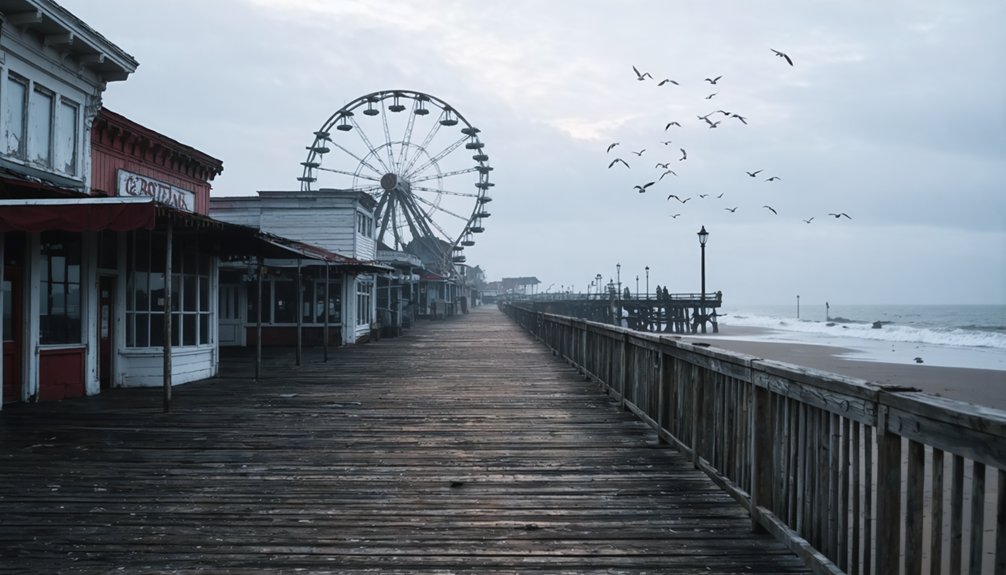
Along America’s vast coastlines lie forgotten beach towns with histories as deep as the waters that border them.
You’ll find forgotten landmarks like Carrabelle, where Allied forces prepared for D-Day, and St. Marks, a tiny fishing village whose significance in early Florida history belies its modest size.
Port St. Joe transformed from industrial mill town to tourist haven, while Apalachicola’s oyster legacy created coastal legends that persist today.
From industrial gears to beachfront bliss, coastal towns reinvent themselves while honoring traditions that shaped America’s shorelines.
Black’s Island, dating to 1717, survived Category 5 destruction to emerge as a luxury destination.
Beyond Florida, discover Beaufort’s antebellum charm as the “Queen of the Carolina Sea Islands,” Port Townsend’s Victorian splendor, and Southport’s historic waterfront—where shrimp boats still symbolize living maritime heritage.
These destinations offer authentic experiences free from overwhelming tourism, preserving the soul of America’s coastal culture.
Conservation vs. Preservation in Vanishing Shorelines
While coastal communities face the advancing threat of rising seas, a fundamental tension has emerged between preservation and conservation approaches to managing America’s vanishing shorelines.
You’re witnessing a historic confrontation between human ingenuity and natural forces along the East Coast, where communities grapple with difficult choices amid accelerating land loss.
Conservation strategies emphasize working with natural processes through:
- Beach nourishment mimicking natural sand deposition
- Preserving ecological function and recreational value
- Temporary interventions requiring periodic maintenance
- Protection of wildlife habitat and natural buffers
Meanwhile, preservation challenges arise from hardened infrastructure that disrupts coastal dynamics.
Seawalls and groins may protect immediate property but often transfer erosion problems elsewhere.
These competing approaches reflect deeper philosophical differences about humanity’s relationship with nature—whether we should resist change or adapt to inevitable coastal transformation.
Comparing Resilient Beach Towns With Their Abandoned Neighbors
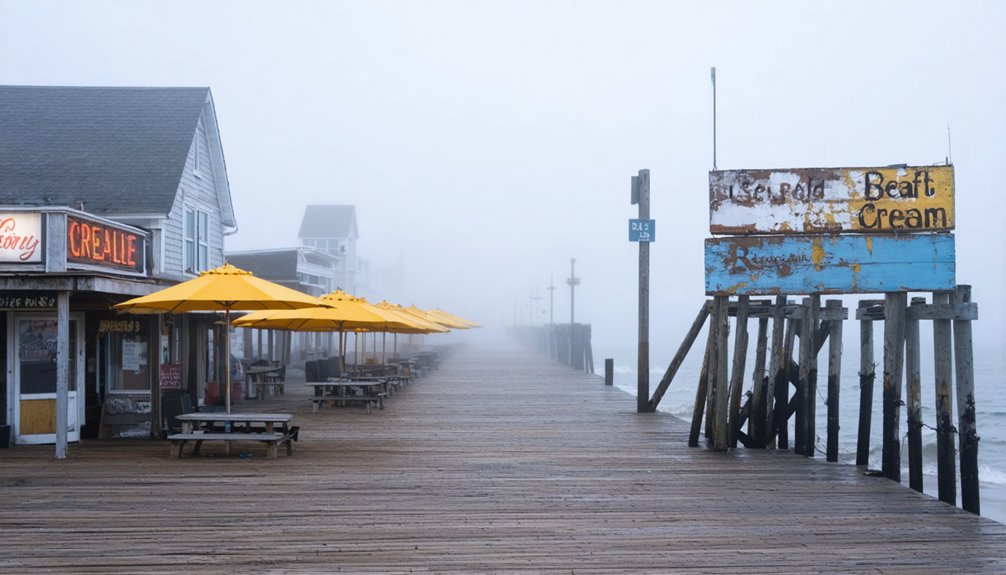
As coastal communities face increasingly harsh environmental challenges, a stark contrast has emerged between thriving beach towns and their abandoned neighbors, creating a natural experiment in resilience across America’s shorelines.
You’ll find economic disparity at the heart of this divergence. Resilient communities secure billions in infrastructure investment—Norfolk and Virginia Beach each require $4 billion over two decades—while abandoned towns spiral into decline without funding mechanisms for basic upgrades.
This coastal resilience gap manifests in tangible ways: North Miami residents pay $4,704 annually for homeowners insurance while facing repeated disaster declarations. Meanwhile, wealthier communities implement proper building codes and nature-based solutions that reduce long-term losses.
The result? A troubling pattern of resilience gentrification where capital concentrates in affluent areas while economically disadvantaged populations face impossible choices: unaffordable adaptation or abandonment.
Dark Tourism: The Appeal of Visiting Coastal Ghost Towns
The allure of standing amid abandoned coastal settlements prompts a troubling question: why are we drawn to places defined by collective trauma?
You’re participating in dark tourism—a practice where Haunted Histories become tangible through physical encounter with decaying beachfront structures that once thrived with life.
What compels visitors to these liminal spaces:
- The visceral tension between natural coastal beauty and human desolation creates Eerie Encounters that resonate with your sense of mortality.
- Abandoned resorts tell stories of economic collapse, military conflicts, and natural disasters that reflect broader historical currents.
- Theatrical ghost tours transform tragedy into accessible narratives, balancing somber history with engaging storytelling.
- These sites offer you freedom to confront impermanence while standing at the threshold between past and present.
Frequently Asked Questions
Is It Legal to Collect Artifacts From Abandoned Beach Towns?
Like shipwrecked dreams on shorelines of time, you can’t collect artifacts without permission. Artifact laws mandate that you’ll need proper authorization under historical preservation regulations, regardless of a town’s abandoned status.
What Paranormal Activities Have Been Reported in These Ghost Towns?
You’ll encounter numerous spectral sightings in these abandoned communities—from shadowy figures walking shorelines to phantom voices amid crashing waves—all reflecting their haunted history of maritime tragedies and forgotten lives.
Are There Successful Revitalization Stories of Once-Abandoned Beach Communities?
You’ll find revitalization success in North Wildwood’s emergency beach restoration, Boca Raton’s tri-municipal collaboration, and Greenport’s waterfront transformation—all demonstrating how community involvement transforms abandoned coastal spaces into thriving economic and ecological assets.
How Do Property Rights Work in Partially Abandoned Coastal Areas?
Your property ownership in partially abandoned coastal areas ends at the mean high tide line, where public trust begins. Coastal regulations like rolling easements may force removal when sea levels rise, challenging traditional boundaries.
What Underwater Ruins Exist From Coastal Towns Lost to Erosion?
With over 50 coastal towns disappearing since 1850, you’ll find submerged foundations, docks, and ghost forests beneath Atlantic waters—silent testimonies underwater archaeology reveals about our accelerating coastal erosion patterns and impermanent settlements.
References
- https://www.onlyinyourstate.com/experiences/new-jersey/abandoned-beach-town-nj
- https://wpst.com/abandoned-town-new-jersey/
- https://www.worldatlas.com/cities/9-secluded-towns-on-the-atlantic-coast.html
- https://samantha-brown.com/destinations/9-beautiful-east-coast-beach-towns/
- https://www.theopensuitcase.com/best-east-coast-beaches/
- https://www.businessinsider.com/best-alternatives-popular-travel-spots-east-coast-hidden-gems
- https://www.youtube.com/watch?v=vj0-iX7eCEY
- https://backroadplanet.com/8-famous-east-coast-boardwalks-and-beach-towns-that-never-get-old/
- https://thedigestonline.com/new-jersey/the-forgotten-beach-town-of-nj-sea-breeze/
- https://southjerseyadventures.wordpress.com/2012/09/03/sea-breeze-nj/