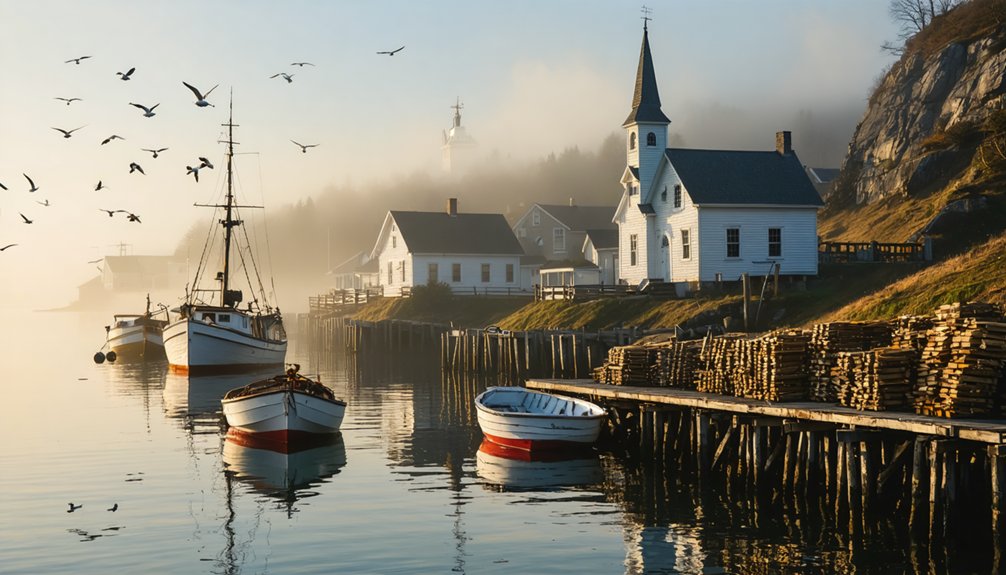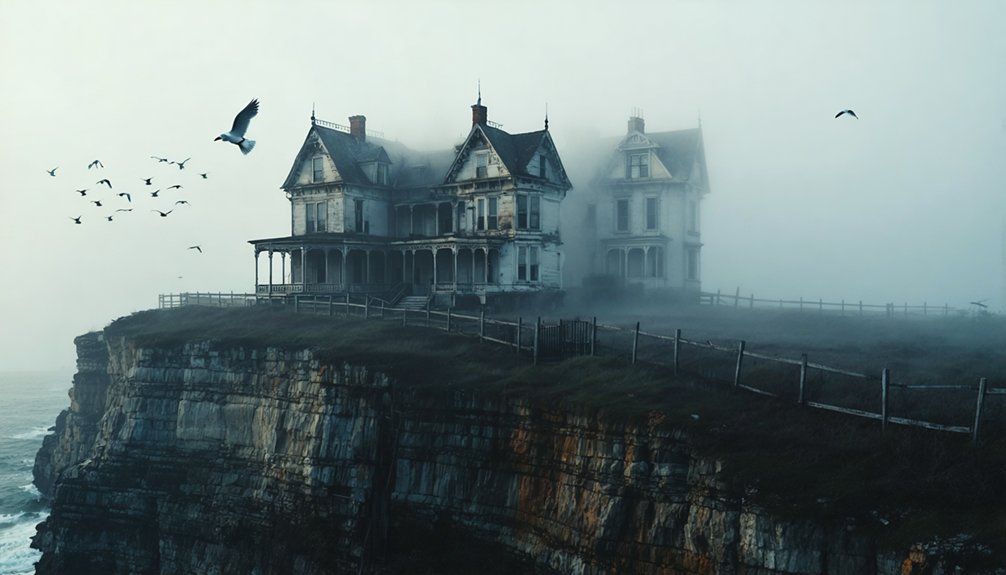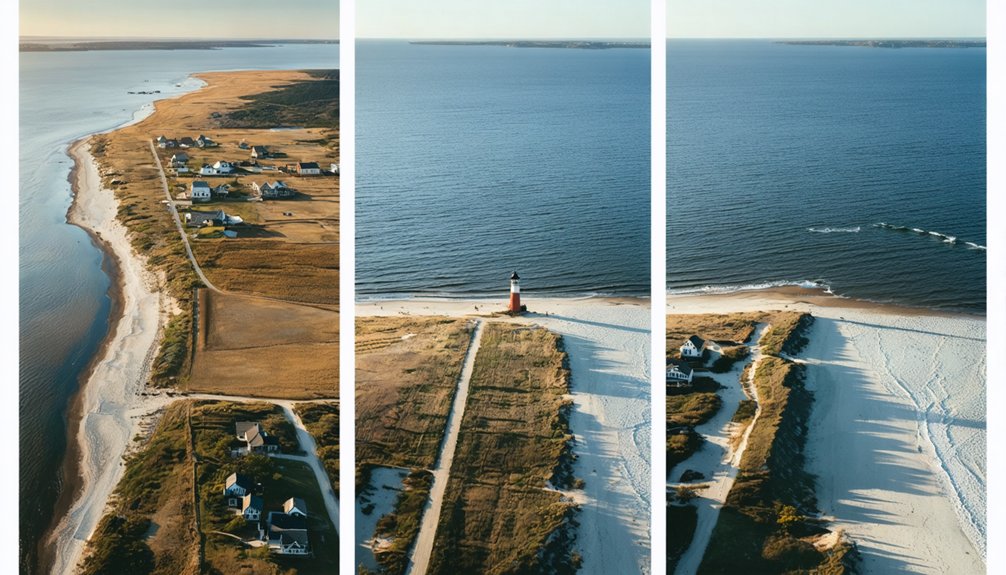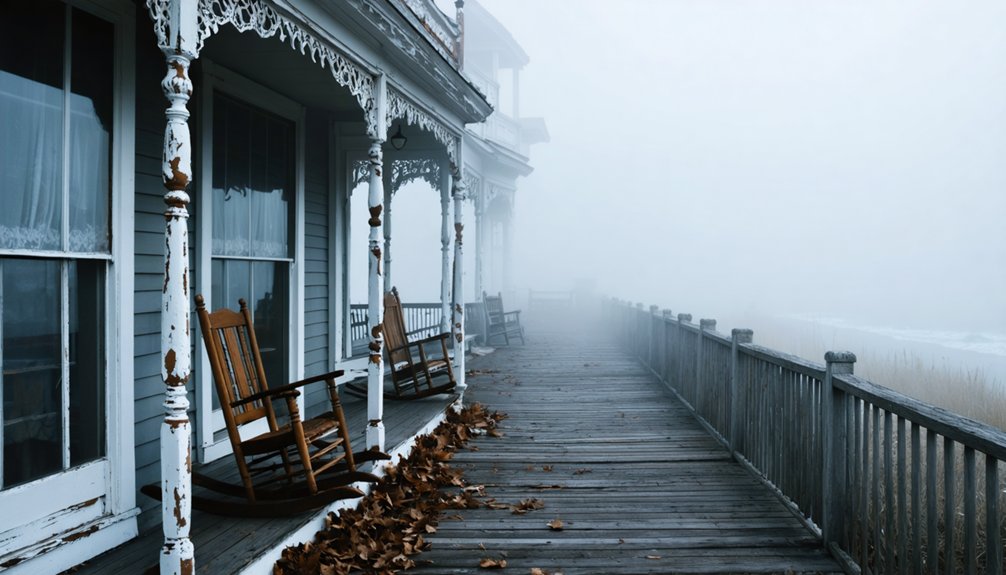
You’ll find America’s eastern shoreline dotted with haunting remnants of once-thriving resort towns. Atlantic City’s abandoned casinos, Cape Lookout Village’s weathered structures, and the Catskills’ crumbling “Borscht Belt” retreats tell tales of prosperity and decline. These ghostly destinations offer glimpses into a gilded past through peeling wallpaper and overgrown swimming pools. Venture through these spectral corridors to discover where nature reclaims what humans have left behind.
Key Takeaways
- Atlantic City experienced dramatic decline from its gambling heyday, with casino closures starting in 1999 despite once employing over 34,000 residents.
- Sea Breeze in Cumberland County became a ghost town after Hurricane Gloria destroyed its last establishment in 1985, leaving abandoned summer homes.
- The Catskills contain abandoned Borscht Belt resorts like Grossinger’s and Kutsher’s, with crumbling ballrooms and overgrown swimming pools.
- Cape Lookout Village features twenty weathered historic structures, now protected by the National Park Service as part of coastal preservation efforts.
- Safe exploration of ghost resorts requires joining historical society tours, seeking owner permission, or participating in restoration projects to avoid legal issues.
The Rise and Fall of Atlantic City’s Glittering Empire
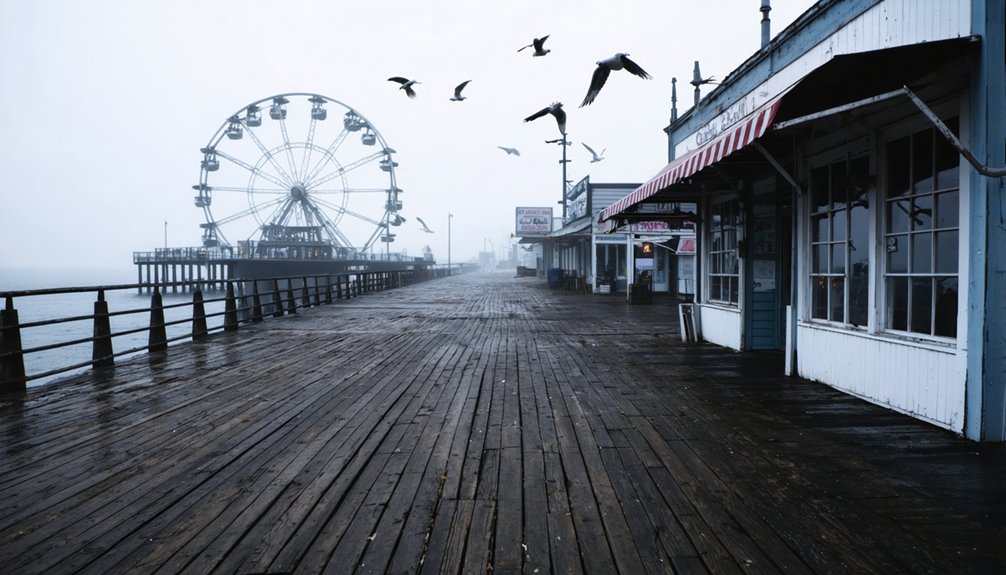
As you stand on Atlantic City’s weathered boardwalk today, you’ll find it hard to imagine that beneath your feet once pulsed the lifeblood of America’s first East Coast gambling empire—a glittering mirage that rose from the ashes of post-war decline.
After a failed 1974 attempt, gambling won legal status in 1976, and Resorts International opened its doors in 1978.
The 1980s unleashed a tidal wave of development—Trump Plaza, Tropicana, and the “eighth wonder” Trump Taj Mahal transformed the skyline.
But the spell couldn’t last. Casino closures began haunting the city by 1999, with Revel’s 2014 shutdown symbolizing the fading dream. Recent financial reports show declining profits across most Atlantic City casinos, with only two experiencing growth.
At its peak, the thriving casino industry employed over 34,000 New Jersey residents and pumped billions into the local economy.
Despite revitalization efforts like the Convention Center and Borgata’s 2003 opening, you’re now witnessing the ghostly remains of ambition abandoned to time and competition.
Salton Sea Beach: From Desert Paradise to Toxic Wasteland
As you walk through the crumbling remains of Salton Sea Beach, you’re haunted by whispers of its glamorous past where celebrities once frolicked before toxic agricultural runoff transformed paradise into poison.
You’ll notice skeletal docks stretching into waters where fish die en masse, their bones lining shores that once hosted vibrant yacht clubs and swimsuit-clad tourists.
Your exploration reveals ghostly foundations of abandoned resorts baking under the relentless desert sun, silent witnesses to nature’s reclamation of man’s failed attempt to create an oasis in the Colorado Desert. The surrounding air carries a distinctive hydrogen sulfide odor that permeates the region, a constant reminder of the environmental catastrophe unfolding in this once-thriving recreational destination. What began as a flourishing resort attracting 1.5 million visitors annually during the 1950s and 1960s has devolved into a public health crisis for nearby communities.
Glamour’s Toxic Aftermath
The glittering mirage of Salton Sea Beach vanished almost as quickly as it appeared, leaving behind a ghostly reminder to humanity’s hubris.
You’ll sense it immediately—the toxic legacy of agricultural runoff and chemicals that poisoned what was once a playground for Hollywood elite.
Where Frank Sinatra and Bing Crosby once cavorted, you’ll now discover abandoned marinas and rotting yacht clubs.
The environmental neglect is palpable as you explore shorelines littered with fish bones from massive die-offs.
The sea itself, a victim of increasing salinity and pollution, exhales foul odors across vacant lots that Penn Phillips mysteriously abandoned in 1960.
By 1985, the sea’s salinity exceeded 40 ppt, making survival increasingly difficult for the once-thriving fish populations that attracted tourists.
Wander through Salton City’s grid of empty streets, feeling the haunting presence of 1.5 million annual visitors who’ll never return to this paradise lost.
Locals now face severe health problems including asthma from the toxic dust kicked up by the receding waters of what was once California’s largest lake.
Ecological Disaster Unfolds
Once paradise beckoned with crystalline waters and endless recreation, Salton Sea now reveals nature’s grim vengeance against human interference.
You’ll witness the ecological consequences firsthand as you navigate shores where dead fish stretch like macabre carpets along beaches once crowded with celebrities and sun-seekers.
The sea’s transformation began in the 1960s when salinity levels crept upward, a silent killer stalking the waters.
By the 1980s, massive die-offs turned vacation dreams into ecological nightmares.
As you explore abandoned marinas, you’re haunted by agricultural runoff‘s invisible specter—pesticides and fertilizers that poisoned what they touched.
The sea’s salt content eventually rose to 25% more than ocean water, creating an inhospitable environment for most aquatic life.
Despite public perception of the Salton Sea as merely an engineering accident, research now reveals its formation was a natural, inevitable occurrence in the Colorado River’s floodplain.
Environmental restoration remains elusive as exposed lakebeds release toxic dust into communities where residents once dreamed of prosperity, their hopes now as dry as the receding shoreline.
Ruins Beneath Desert Sun
Walking through the decaying remnants of Salton Sea Beach today, you’ll find it hard to imagine this ghostly wasteland was once heralded as California’s premier desert playground.
Where celebrities like Frank Sinatra and The Beach Boys once performed, only spectral echoes remain. Crumbling nightclubs and yacht clubs stand as monuments to abandoned dreams, their foundations slowly sinking 227 feet below sea level. The area’s deterioration accelerated due to increasing salinity levels that devastated the local ecosystem and tourism potential.
The once-bustling Bombay Beach now invites only adventurous explorers seeking freedom among its ruins.
Follow the grid of optimistically named streets—Sea View Avenue, Sea Mist Place—and you’ll discover the skeletal framework of Penn Phillips’ vision, mysteriously abandoned in 1960.
Desert memories linger in every vacant lot where promised resorts never materialized, while the few remaining structures surrender to salt, sun, and time’s relentless march.
Cape Lookout Village: Where Lighthouse Keepers Once Dwelled
You’ll discover Cape Lookout Village standing in ghostly isolation, where the once-thriving maritime community now consists of weathered Queen Anne cottages and Craftsman bungalows slowly surrendering to salt air and time.
The 1859 lighthouse still casts its warning beam across treacherous shoals, a silent sentinel watching over abandoned keeper’s quarters and the decaying remains of World War II coastal defenses.
As you wander the windswept paths between boarded structures, you might sense the presence of lighthouse keepers, Coast Guard crews, and wartime soldiers who once called this remote barrier island outpost home. The historic district encompasses 20 contributing buildings and one contributing site that tell the story of this former coastal community.
Remote Maritime Community
Perched on the remote edge of North Carolina’s Outer Banks, Cape Lookout Village stands as a haunting relic of maritime history where lighthouse keepers and their families once carved out an isolated existence.
You’ll walk among twenty weathered structures—Queen Anne and Craftsman buildings slowly surrendering to coastal elements—each holding maritime memories of a community that thrived then vanished.
Founded in 1887, this ghostly settlement supported lighthouse personnel until 1960, when abandonment claimed these shores.
During your exploration, you’ll discover the 1907 Keepers’ Quarters and mysterious “Coca-Cola House,” coastal legacies now protected by the National Park Service.
The village’s spirit transformed during WWII when artillery units replaced fishermen, with submarine nets stretched across the bight—a fleeting military chapter in this forgotten community’s haunting narrative.
Coastal Architecture Withering
Though time has mercilessly eroded their grandeur, the architectural treasures of Cape Lookout Village remain as ghostly sentinels along this windswept shore.
You’ll discover the weathered skeletons of beach bungalows and Queen Anne structures slowly surrendering to salt air and hurricane winds.
Wander among these haunting remnants where board-and-batten siding peels away and boathouse doors disappear beneath hastily added modifications.
The Guthrie-Ogilvie House stands defiant yet deteriorating—a symbol of coastal architectural heritage loss that accelerates with each passing storm.
The village’s designation as a Historic District hasn’t spared it from nature’s relentless assault.
Many buildings teeter near collapse, victims of abandonment since the 1960s.
These silent witnesses to maritime life face overwhelming coastal preservation challenges, their stories fading like footprints in retreating tide.
Lighthouse Stands Vigilant
Rising above the weathered remains of Cape Lookout Village, the iconic black-and-white diamond-patterned lighthouse stands as a solitary guardian, its beam cutting through coastal fog since 1859.
You’ll feel the ghosts of lighthouse keepers who once tended this maritime sentinel through hurricanes and war, their 1907 quarters still haunting the shore.
When you explore this abandoned community, once home to nearly 1,000 souls, you’re walking among specters of a thriving coastal life that vanished after the Civil War.
The 1888 Life-Saving Station whispers tales of daring rescues, while the Lewis-Davis House—cobbled together from fishing shacks—reveals the resourcefulness of these isolated mariners.
The National Park Service now safeguards this maritime heritage, allowing you to roam freely through this ghostly memorial to coastal resilience.
Sea Breeze: The Forgotten Shores of Cumberland County
While vacationers once flocked to its sandy shores in the late 19th century, Sea Breeze now stands as a haunting reminder of Cumberland County’s forgotten past.
The Warner Hotel’s grandeur and Philadelphia ferry service established its historical significance before natural disasters claimed the town. Hurricane Gloria’s wrath in 1985 destroyed the Sea Breeze Tavern, the final bastion of this once-thriving resort community.
As you explore this ghostly settlement, you’ll encounter:
- Abandoned summer homes with tales etched into their weathered frames
- The futile seawall, a monument to humanity’s failed battle against nature
- Spectral echoes of clambakes and boat races that once animated the bay
- The Delaware Bay’s ominous waters that both birthed and consumed the town
The freedom of exploration awaits in this coastal ghost town where time stands still.
The Decaying Grandeur of the Catskill Resort Era
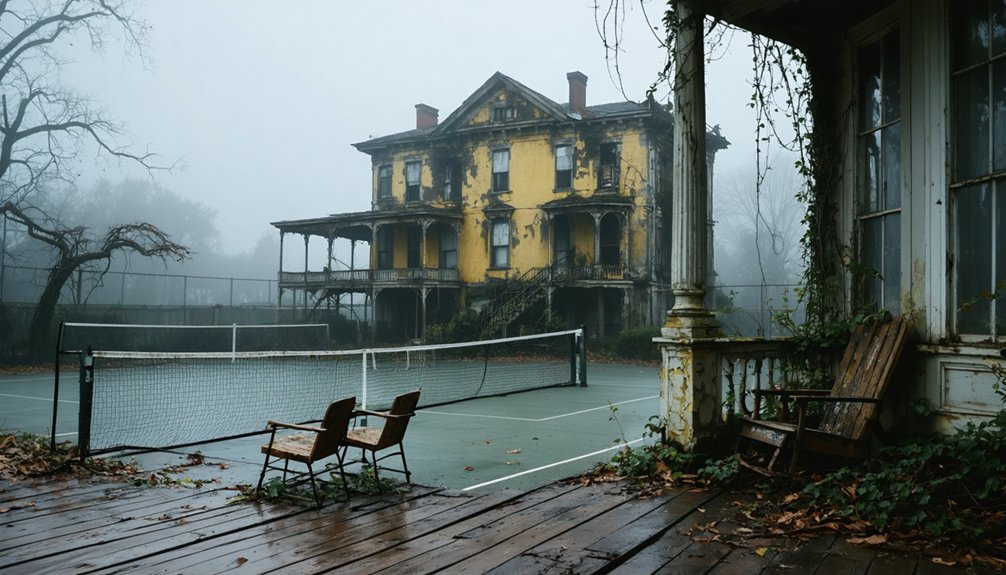
Just a hundred miles from the phantom beaches of Sea Breeze, the Catskill Mountains harbor their own haunting remains of America’s leisure past.
The quaint streets are lined with dilapidated shops and eerie lighthouses, evoking spooky vibes in coastal towns. Locals whisper tales of ghostly apparitions and secrets hidden within the fog. As dusk settles, the atmosphere thickens, inviting those brave enough to explore the mysteries that linger in the shadows.
You’ll discover crumbling ballrooms where celebrities once performed and abandoned swimming pools where laughter has long since evaporated.
These skeletal monuments of Borscht Belt glory—Grossinger’s, Kutsher’s, the Concord—stand as symbols to a vanished era when over 500 resorts transformed these mountains into America’s premier Jewish vacation destination.
Venture through overgrown paths where railroad tracks once delivered thousands of city dwellers seeking mountain air.
The grandeur of the Catskill Mountain House, which hosted presidents before being deliberately burned in 1963, lives only in Catskill nostalgia now.
Each decaying facade whispers stories of comedians launching careers and families creating summer memories—ghosts of midcentury American leisure that beckon explorers to uncover their secrets.
Hurricane Aftermath: Gilchrist’s Vanishing Coastal Community
After Hurricane Ike‘s devastating assault in 2008, Gilchrist transformed from a vibrant coastal haven into a haunting reminder of nature’s fury.
Walking the windswept shores today, you’ll witness the ghostly remnants of homes once perched on sturdy pilings, now scattered across the peninsula like forgotten memories.
The hurricane devastation didn’t just reshape landscapes—it erased communities.
Yet, whispers of community resilience echo through this spectral coastline, where some brave souls returned to rebuild among the ruins.
Amidst devastation’s echoes, determined spirits forge new beginnings from the skeletal remains of their coastal paradise.
- Explore the eerie 12-foot storm surge path where entire neighborhoods vanished overnight
- Witness the ghostly foundations of homes washed completely away
- Discover abandoned infrastructure frozen in time since the catastrophe
- Venture through areas repeatedly battered by cyclical storms, creating layers of haunting history
Hampton Springs Hotel: Ruins of a Bygone Spa Destination
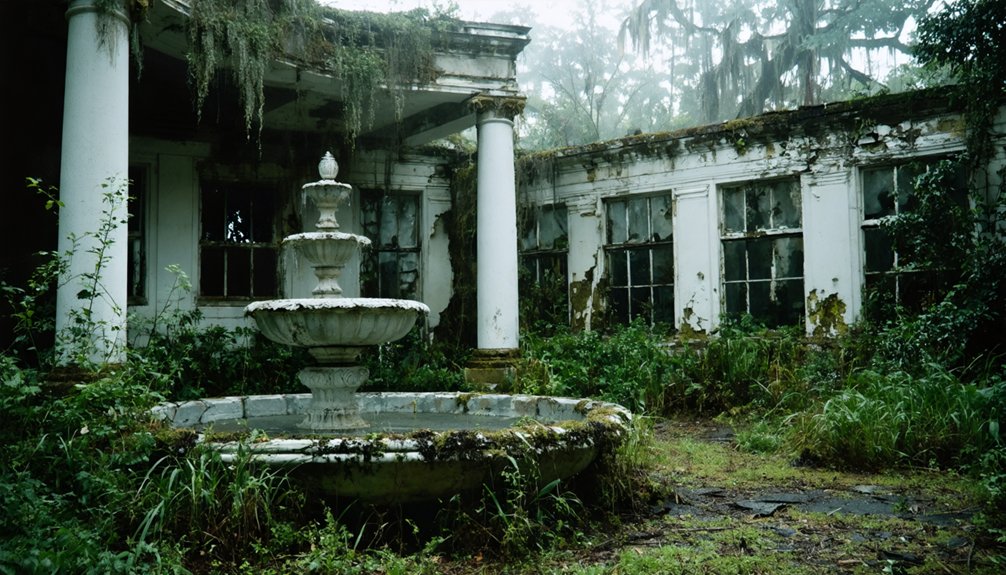
Deep within Taylor County’s verdant wilderness, the crumbling remains of Hampton Springs Hotel beckon to those brave enough to wander among its ghostly foundations.
Once a luxurious haven where the wealthy sought the legendary healing waters of sulfur springs, this forgotten paradise now whispers tales of its glamorous past.
You’ll discover concrete pools where the mineral-rich waters still flow, eerily inviting after decades of abandonment.
The Hampton Springs resort, valued at $1 million when it burned in 1954, has surrendered to nature’s reclamation.
Explore the remnants of ballrooms where celebrities once danced and casino floors where fortunes changed hands.
Today, the site exists as a hauntingly beautiful park where you’re free to picnic among the spirits of a forgotten era.
Marconi Hotel: From Communication Hub to Abandoned Landmark
Standing on the desolate California coast, you’ll find the forgotten Marconi Hotel where wireless communication roots linger in the weathered walls, whispering stories of its once-revolutionary telegraph station.
You might sense ghostly operators still tapping messages as you wander through hallways that have witnessed countless failed restoration attempts over decades of abandonment.
Your footsteps echo through grand spaces that shift between fleeting moments of renewal and long stretches of neglect, a tribute to the cursed cycle that has haunted this landmark since its ambitious beginning.
Wireless Roots Remain
As you wander along the fog-shrouded coastline, the abandoned Marconi Hotel emerges from the mist like a ghost from another era, its weathered façade still whispering secrets of communication revolutions that once connected continents.
Though the towering 270-foot steel sentinels have vanished, the invisible waves of wireless innovation still haunt this historic ground.
You’re standing where operators once transmitted life-saving maritime communications across vast Pacific expanses, where the impossible became routine.
- Trace the phantom footprints of pioneers who sent the first transatlantic wireless messages in 1901
- Feel the spectral energy of the mile-long antenna that once stretched across this landscape
- Discover hidden concrete anchors—silent witnesses to communication history
- Listen for ghostly Morse code echoing from walls that housed the revolutionaries of global connection
Slow Restoration Attempts
Though abandoned for decades, the once-majestic Marconi Hotel now stands in a curious limbo between decay and rebirth.
You’ll discover a century-old structure whose restoration challenges echo through empty halls—whispers of conflict between modern hospitality demands and historical preservation.
As you wander these ghostly corridors, you’ll sense the competing spirits of the building’s past: Marconi’s radio innovations, Synanon’s controversial community, and now preservation advocates battling structural deterioration.
The original architectural elements wait patiently, trapped between time periods.
Oliver Hospitality’s recent transformation attempts to resurrect this sleeping giant, introducing Sea Ranch design while preserving historic materials.
Even haunting Synanon-era tiles remain—not erased but embraced as shadows of history.
Local communities and state parks collaborate in this slow resurrection, promising freedom to explore a landmark that refuses to surrender to time.
Desolate California Coast
Along the windswept California shoreline, the Marconi Hotel rises like a ghost from another era, its weathered facade telling tales of technological revolution and abandonment.
This four-story sentinel once housed unmarried wireless operators who connected continents across vast Pacific waters. After serving as a critical communications hub during WWI, the property’s spirit darkened during Synanon’s cult occupation before falling into neglect.
You’ll sense the coastal legends as you explore these abandoned structures:
- The 37-room hotel, visible from Highway 1, standing as a silent witness to a century of change
- The mysterious powerhouse where electricity once pulsed through global communications
- The 35-room residence where telegraph operators lived while changing history
- Monterey cypress trees that whisper secrets of the site’s shift from indigenous land to technological pioneer
Photographing the Haunting Beauty of Abandoned Resorts
Where once laughter echoed through grand ballrooms and sunlight danced across pristine swimming pools, now only shadows and whispers remain.
To capture these haunting spaces through urban exploration, break away from conventional angles—shoot from floor level or peer down abandoned staircases for maximum intrigue.
Embrace unconventional perspectives—kneel in dust or gaze into stairwells to reveal the true soul of forgotten places.
On your photographic storytelling journey, embrace the bright sunlight as it pierces through collapsed ceilings, creating dramatic light beams that disclose the resort’s forgotten stories.
Mount your camera on a tripod for those essential long exposures (sometimes 30 seconds or more) that reveal hidden details in shadowy corridors.
Frame your shots through broken windows or doorways, creating layered compositions that blend decay with beauty.
Remember to focus on abandoned objects—old telephones, scattered books—that anchor your images in the human history that time forgot.
Exploring Safely: Legal Access to East Coast’s Ghost Resorts
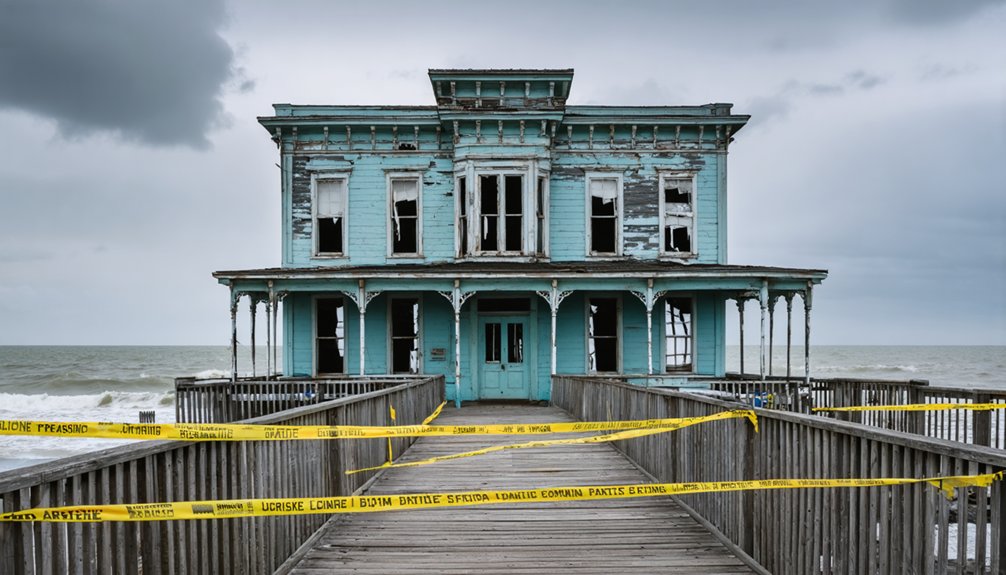
The decaying grandeur of East Coast ghost resorts beckons urban explorers with siren-like allure, yet venturing into these crumbling time capsules demands a careful approach to both legal and physical safety.
Trespassing risks aren’t worth the potential fines or misdemeanor charges that vary across states. Instead, seek legitimate pathways to these haunting locales.
- Look for historical society tours that open doors normally sealed to the public
- Contact property owners directly—sometimes permission is granted for respectful visitors
- Join volunteer restoration projects that offer behind-the-scenes access while preserving history
- Check for special open house events that temporarily lift access restrictions
Remember that safety precautions aren’t suggestions—they’re survival tools.
Structural instability, toxic materials, and wildlife don’t discriminate between authorized and unauthorized visitors.
Frequently Asked Questions
Are These Abandoned Resorts Legally Protected as Historical Sites?
You’ll find many abandoned resorts are protected under historical preservation laws, though not all. Your ghostly explorations may reveal spectral evidence of abandonment laws in action, especially at federally recognized sites.
What Paranormal Activity Has Been Reported in These Locations?
Dare to witness what others have fled? You’ll encounter ghost sightings of children playing, spectral encounters with women in white, unexplained noises, moving objects, and chilling sensations that defy rational explanation.
Can You Still Find Valuable Artifacts in These Abandoned Places?
You’ll discover untold treasures as you venture into these forgotten territories. Artifact hunting yields colonial relics and indigenous treasures, but beware—spectral guardians often protect their treasure recovery domains with otherworldly vigilance.
How Have Local Communities Attempted to Revitalize These Forgotten Resorts?
You’ll witness communities breathing life into spectral resorts through tourism initiatives like boardwalk revitalizations, historic preservation, and adaptive reuse of haunted structures. Community engagement transforms these ghostly shells into vibrant destinations once more.
Do Any Former Residents Still Maintain Connections to These Ghost Towns?
Picture Alice Matthews visiting her grandmother’s abandoned Catskills hotel annually. You’ll find former residents clinging to nostalgic memories and preserving family legacies through pilgrimages, reunions, and mysterious gatherings where spectral evidence of their past lives on.
References
- https://wicproject.com/travel/10-abandoned-seaside-places-in-america-that-were-once-tourist-hotspots/
- https://wpst.com/abandoned-town-new-jersey/
- https://www.businessinsider.com/abandoned-resorts-hotels-us-2018-6
- https://backroadplanet.com/12-abandoned-resorts-that-were-once-americas-favorite-vacation-escapes/
- https://www.islands.com/2012354/america-once-thriving-resort-destinations-now-abandoned-ghost-town-eerie-beauties/
- https://www.youtube.com/watch?v=PMJ_m0-NVdI
- https://acfpl.org/ac-history-menu/atlantic-city-heritage-collections/15-heston-archives/68-history-of-casino-gambling-in-atlantic-city.html
- https://downbeachbuzz.com/atlantic-city-hotel-casino-history-timeline/
- https://acfpl.org/ac-history-menu/atlantic-city-faq-s/15-heston-archives/68-history-of-casino-gambling-in-atlantic-city.html
- https://great.com/gambling/atlantic-city-casinos-through-the-years/