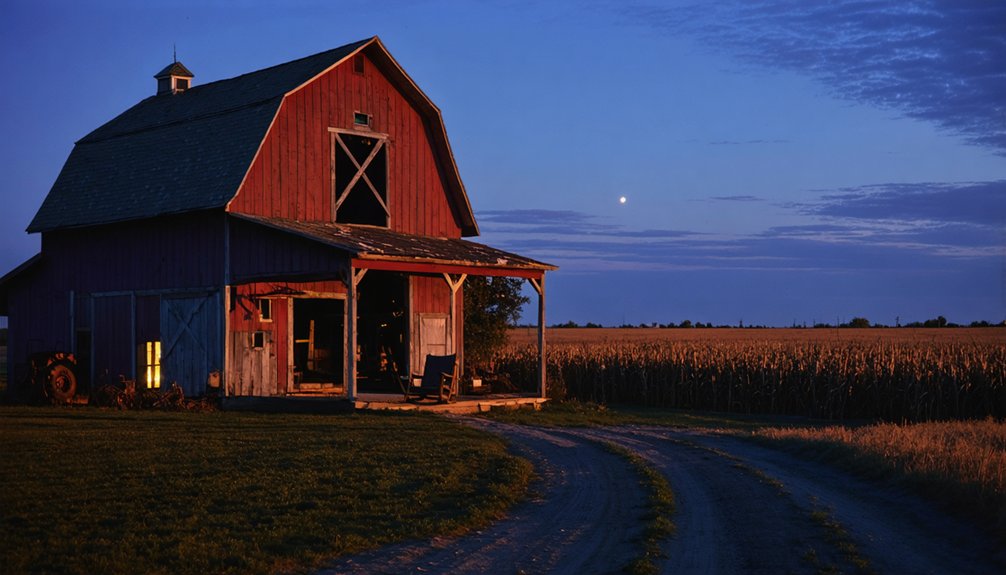
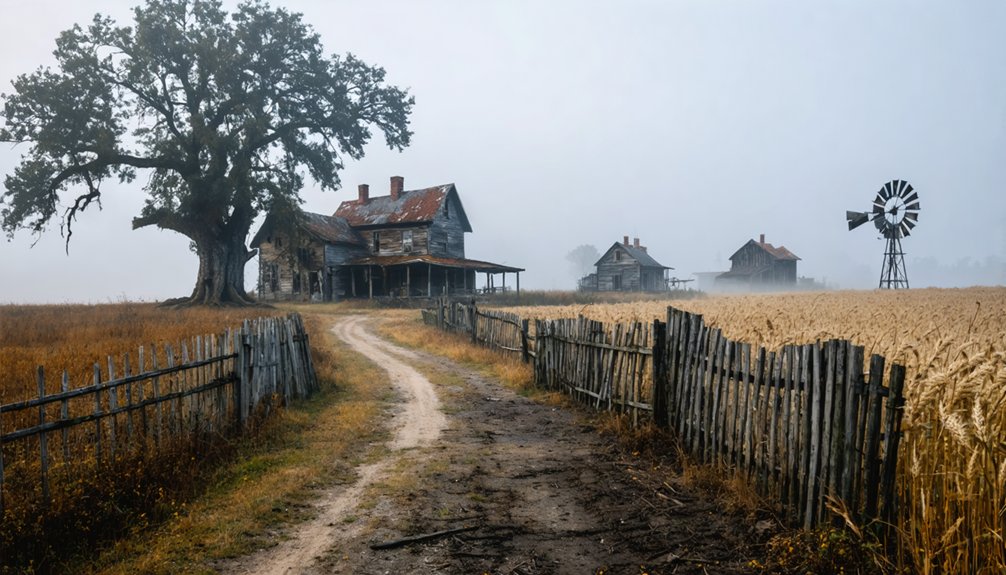
Across America’s landscape, you’ll find abandoned farming settlements that tell the story of agricultural boom and bust cycles. These ghostly remnants emerged from events like the 1930s Dust Bowl, when severe drought and poor farming practices forced 2.5 million people to flee westward. From weathered barn foundations to empty storefronts, these sites reveal how water access, economic pressures, and environmental challenges shaped rural communities. Their silent structures hold deeper lessons about America’s relationship with the land.
Key Takeaways
- Agricultural abandonment clustered in Great Plains states, where Dust Bowl conditions destroyed topsoil and farming viability.
- Water accessibility determined settlement survival, with communities near unreliable sources typically becoming ghost towns.
- Architectural remnants like fieldstone foundations, crumbling barns, and abandoned homesteads tell stories of failed farming communities.
- The 1930s exodus saw approximately 2.5 million people fleeing westward, leaving behind numerous ghost settlements.
- Preservation efforts now transform abandoned agricultural settlements into educational spaces showcasing America’s farming heritage.
The Birth and Death of America’s Rural Farming Communities
When European settlers established Jamestown in 1607, they laid the foundation for America’s enduring agricultural tradition. You’d have witnessed a remarkable rural transformation as settlers adopted indigenous companion planting techniques while introducing tobacco as a cash crop, forever altering the landscape.
Settlers cultivated America’s farming legacy, blending native wisdom with European crops to reshape the colonial landscape.
The farming evolution accelerated dramatically between 1850 and 1910, with farms increasing from 1.4 million to 6.4 million. Your ancestors likely participated in this westward expansion, often exhausting soil before moving on—a pattern that shaped America’s development.
Southern plantations built on enslaved labor created distinctive rural economies, while organizations like the Grange (1867) and Farm Bureaus (1912) later emerged to support farmer interests. Plantation owners became significant consumers of luxury goods from Great Britain, emulating European lifestyles as their wealth grew from profitable tobacco exports.
Throughout this period, communities balanced self-sufficiency with increasing market orientation, creating the intricate rural tapestry that would eventually fade with modernization. John Deere’s invention of the steel plow in the 1830s revolutionized farming in the Midwest by efficiently breaking the thick prairie soil that had previously resisted cultivation.
Dust Bowl Devastation: How Nature Transformed the Agricultural Landscape
You’ll find the Dust Bowl’s ecological devastation captured in abandoned homesteads where topsoil eroded to depths rendering millions of acres unfarmable by 1936.
Your grandparents might’ve witnessed these ghost towns forming as approximately 2.5 million people fled westward when drought combined with poor agricultural practices to create massive dust storms that suffocated livestock and buried farm equipment.
The government’s response included buying marginally productive farmland and paying farmers one dollar per acre (equivalent to $22 today) to implement soil conservation methods, yet countless rural communities never recovered.
These mass migrations and agricultural failures were triggered by three distinct drought periods in the 1930s, with particularly severe episodes in 1930-31, 1933-34, and 1936.
The most devastating of these storms, known as Black Sunday, occurred on April 14, 1935, bringing sudden darkness and near-zero visibility to communities across the Plains states.
Environmental Ruin Accelerated
As ecological disaster struck the Great Plains in the 1930s, human agricultural practices collided catastrophically with natural forces to create one of America’s most devastating environmental calamities.
You’d have witnessed topsoil vanishing before your eyes—over 75% eroded by decade’s end—as intensive plowing and drought exposed the earth to relentless winds.
The absence of sustainable practices proved catastrophic. Homesteaders, encouraged by misguided government policies, farmed marginal lands with deep-plowing techniques that destroyed natural soil structure. The transition to one-way disc plows significantly increased soil vulnerability to wind erosion and moisture depletion.
Dust traveled eastward, darkening skies in New York and leaving “red snow” in New England.
Environmental policies emerged too late to prevent widespread respiratory illness and agricultural collapse.
When you examine ghost towns of this era, you’re seeing not just economic failure but the physical manifestation of ecological disaster that fundamentally altered America’s relationship with its land.
Mass Migration Ensued
The devastating environmental collapse throughout the Great Plains triggered one of America’s most significant internal migrations during the 1930s.
You’d have witnessed 2.5 million people fleeing the Dust Bowl states, with half a million “Okies” departing Oklahoma alone.
These migration experiences reflect profound economic desperation—families lost $25 million daily by 1936 as topsoil disappeared and banks foreclosed on mortgages.
Entire families packed jalopies with belongings and traveled west on Route 66, the “mother road,” seeking California’s promise.
Census data confirms that nearly 287,000 people from the southern plains region migrated to California between 1935 and 1940, continuing a westward movement that had been ongoing since the Gold Rush.
Geographic Patterns of Abandoned Farming Settlements

You’ll find abandoned farming settlements concentrated in distinct regional clusters across the American landscape, with the Great Plains housing the densest concentration of ghost towns stemming from the catastrophic Dust Bowl exodus of the 1930s.
Water accessibility determined many settlement fates, as communities established near unreliable water sources often disappeared when wells ran dry or irrigation systems failed.
The transformation of rural America also reflects the decline of the family farm, as smaller properties were consolidated into larger agricultural operations, contributing to the abandonment of once-thriving farming communities. States like Kansas and Oklahoma were particularly affected during economic downturns that devastated agricultural communities in the Great Plains.
Regional Abandonment Clusters
Geographic patterns of farmland abandonment across the United States reveal distinct regional clusters, shaped by both physical landscapes and socioeconomic forces.
You’ll notice abandonment trends concentrate heavily in Texas, North Dakota, and Kansas, where over 3 million hectares vanished between 1986-2018. The Ogallala Aquifer region and Atlantic coastal areas stand as evidence to shifting rural dynamics. Abandonment rates reached one million acres per year throughout the study period, highlighting the alarming pace of agricultural land loss.
Three primary abandonment clusters emerge:
- Hilly and mountainous regions, where 16.83% of cultivated land suffers severe abandonment
- Northern settlements like Russell, NY, where partially abandoned farms maintain only minimal hayfield production
- Peri-urban zones near metropolitan centers, where urban development accelerates agricultural decline
Proximity to roads and settlements greatly impacts survival rates, with social factors ultimately outweighing physical limitations in determining which farms become tomorrow’s ghostly remnants. California’s once-productive Central Valley now shows alarming patterns of abandonment as water prices have surged to over $3,000 per acre-foot.
Water-Dependent Settlement Patterns
While examining the skeletal remains of America’s forgotten agricultural communities, you’ll find water’s inescapable influence on their birth, development, and eventual abandonment.
Settlements clustered along river valleys where water availability promised agricultural prosperity, yet this dependency proved fragile. You can trace America’s agricultural expansion through massive drainage projects—nearly 65 million wetland acres transformed under the Swamp Lands Act (1849-1860).
These engineering triumphs temporarily conquered waterlogged prairies that once stood uninhabitable, revealing fertile glacial soils beneath.
In the arid West, government reclamation projects created artificial oases through irrigation networks, but many communities withered when water demands exceeded supply.
Soil drainage technology dictated settlement patterns—the Grand Prairie remained unsettled until drainage innovations arrived. These ghost towns stand as monuments to water’s power to both nurture and abandon human ambition.
Everyday Life in Vanished Agricultural Towns
When farming towns dotted America’s rural landscape in the late 19th and early 20th centuries, they fostered intricate webs of daily life centered around agriculture and community interdependence.
You’d find yourself immersed in self-sufficient communities where daily routines revolved around seasonal agricultural demands and local business exchanges.
Your life would be structured around:
- Dawn-to-dusk labor cycles in fields or nearby mills, using primarily manual and animal power
- Weekly community gatherings in churches, schools, and general stores that served as social hubs
- Seasonal celebrations and dances that reinforced cultural bonds, especially in ethnically distinct settlements like Dearfield
Housing typically consisted of wooden structures clustered near central community features, while transportation relied on railroads or waterways for essential trade.
Though arduous, this lifestyle fostered remarkable resilience until environmental catastrophes and economic depression overwhelmed many communities.
Architectural Remnants: What Farming Ghost Towns Leave Behind
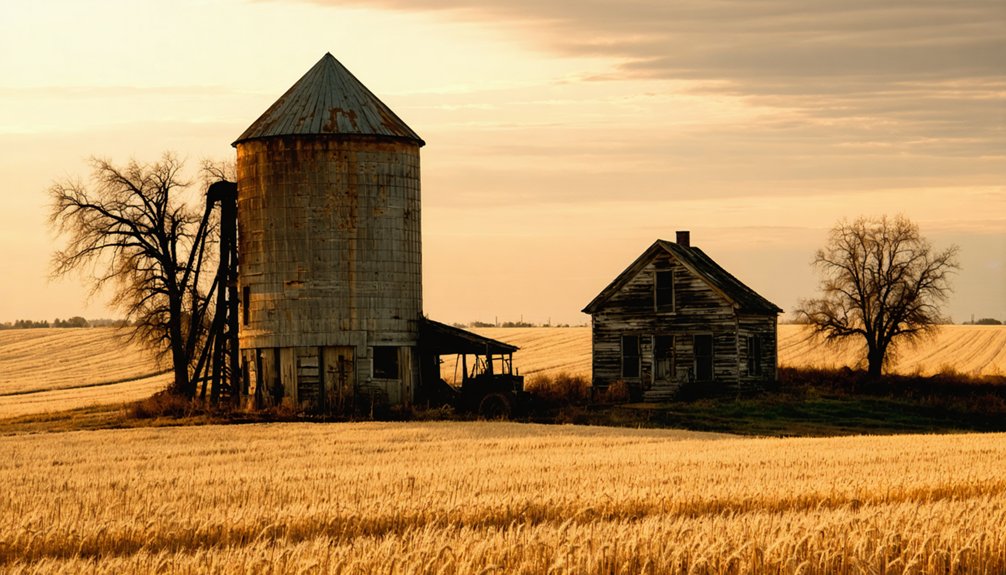
The architectural remnants of America’s ghost farming towns tell powerful stories through their silent, weathered foundations and crumbling structures.
Among these historical treasures in ghost towns, one can find forgotten artifacts that offer a glimpse into the lives of those who once thrived in these now-desolate places. Each item, from rusted tools to faded photographs, serves as a reminder of a vibrant community that has long since faded away. Exploring these remnants invites a reflection on the passage of time and the stories etched into the landscape.
You’ll find house cellar holes with intact fieldstone walls and barn foundations that have withstood decades of abandonment, their structural significance evident in surviving masonry work like arched entryways.
These sites reveal diverse architectural styles—from utilitarian farmhouses never wired for electricity to robust barns with hay lofts and feed troughs.
The buildings’ layouts reflect both traditional folk patterns and progressive 19th-century farming innovations, adapted to local topography and agricultural purpose.
“Demolition by neglect” has left stone elements standing while wood frames collapse.
Regional variations are striking: New York’s progressive farming architecture contrasts with the High Plains’ simple structures built for cattle grazing rather than crop cultivation.
Preserving Agricultural Heritage: From Ruins to Living History
Preservation efforts across abandoned farming settlements have evolved beyond merely salvaging architectural remnants to embrace extensive heritage conservation approaches.
You’ll find these initiatives bridging past and future through programs like the Agricultural Conservation Easement Program, which protects working farms while honoring traditional farming techniques.
These preservation efforts showcase America’s agricultural evolution through three distinct approaches:
America’s agricultural story unfolds through preservation strategies that honor tradition while embracing innovation.
- Adaptive reuse of historic barns and structures while maintaining architectural integrity
- Documentation and revival of sustainable practices including crop rotation and terracing developed by earlier generations
- Living history demonstrations incorporating rotational grazing systems and commons-based resource management
Conservation partnerships between farmers and government agencies have created a framework where abandoned settlements transform into educational spaces.
Through these efforts, you’re witnessing the practical application of heritage conservation that balances freedom of land use with responsible stewardship.
Frequently Asked Questions
Can Abandoned Farming Settlements Be Legally Homesteaded Today?
Like ghosts of the past, abandoned properties can’t be freely homesteaded today. You’ll need formal legal claims through tax sales, municipal programs, or conventional purchases instead of simply claiming them.
What Paranormal Phenomena Are Commonly Reported in Farming Ghost Towns?
You’ll encounter spectral sightings around farmhouses, phantom machinery sounds, temperature fluctuations in barns, ghostly livestock, unexplained crop patterns, and haunted harvests where abandoned tools seemingly resume work without human presence.
How Did Indigenous Communities Interact With These Farming Settlements?
You’ll find Indigenous communities engaged in complex cultural exchange with settlers, sharing agricultural practices like Three Sisters farming while experiencing displacement through treaties and the Dawes Act’s forced assimilation of communal farming traditions.
Which Farming Ghost Towns Have Inspired Literature or Films?
Desolate dustbowls directly inspired Steinbeck’s “Grapes of Wrath,” while you’ll find Oklahoma’s abandoned farms providing literary inspirations for Cather’s Nebraska novels and cinematic adaptations like “Field of Dreams” from farming’s forgotten past.
How Did Mail Delivery Function in Isolated Farming Communities?
You’d receive mail through rural routes established in 1896, where carriers on horseback connected isolated farms, creating essential community networks despite harsh conditions. The system liberated you from dependence on distant post offices.
References
- https://en.wikipedia.org/wiki/Ghost_town
- https://www.geotab.com/ghost-towns/
- https://www.notesfromthefrontier.com/post/untitled
- https://www.cbsnews.com/pictures/ghost-towns-of-america/
- https://www.legendsofamerica.com/gt-hiddentales/
- https://www.youtube.com/watch?v=yeTVfoQxqJc
- https://jasontdunn.com/files/ghost_towns_big_cities.pdf
- https://wildwestcity.com/old-west-ghost-towns/
- https://www.loveexploring.com/gallerylist/188219/the-us-state-with-the-most-ghost-towns-revealed
- https://www.atlasobscura.com/lists/americas-best-preserved-ghost-towns