You’ll find abandoned agricultural communities across America’s rural landscape—from Great Plains ghost towns ravaged by the Dust Bowl to depleted settlements over the Ogallala Aquifer. These forgotten places tell stories of water scarcity, economic pressure, and technological change that transformed family farming. While weathered grain elevators and empty storefronts mark their physical decline, local museums and conservation efforts preserve their heritage. The transformation of these landscapes reveals both what we’ve lost and what might be reclaimed.
Key Takeaways
- Once thriving Great Plains farming towns became ghost towns after the Great Depression and Dust Bowl, leaving only weathered structures behind.
- The Ogallala Aquifer’s depletion threatens numerous agricultural communities with extinction unless significant conservation efforts are implemented.
- Delta settlements along the Mississippi declined as mechanization and federal subsidies favoring large operations led to massive population exodus.
- Southwest agricultural communities face abandonment due to water scarcity, with over a million acres of Arizona farmland already deemed economically unviable.
- Small town museums and oral history projects preserve agricultural heritage through artifacts, equipment displays, and personal narratives of rural life.
The Ghost Towns of the Great Plains
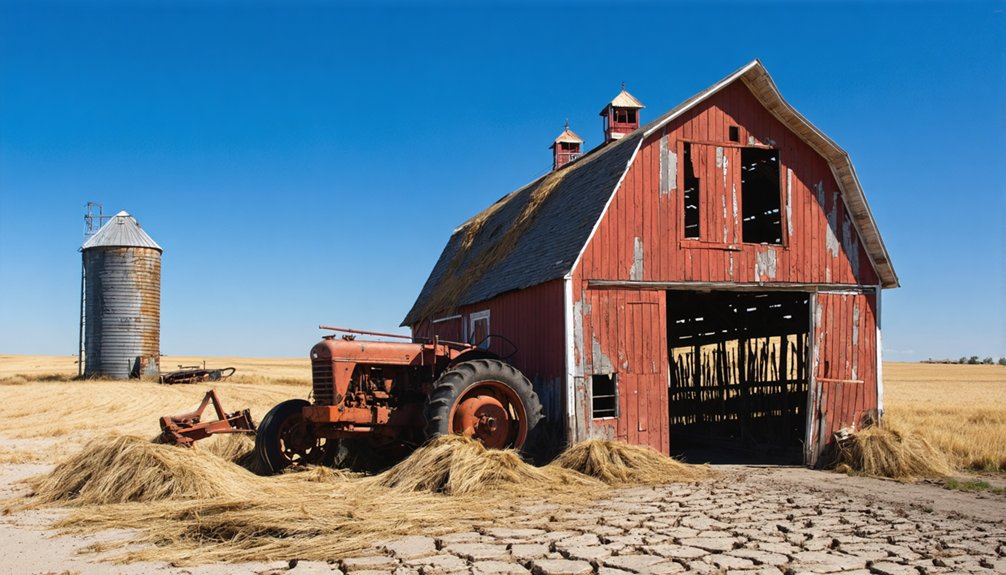
The vast, windswept Great Plains—once teeming with hopeful agricultural communities—now hosts hundreds of abandoned settlements that stand as silent reminders to America’s agricultural past.
You’ll find these ghost town origins rooted in a perfect storm of circumstances: initially thriving communities established through homestead laws and railroad expansion collapsed when faced with the dual devastation of the Great Depression and Dust Bowl.
Towns that flourished in the relatively wet period of the late 19th century couldn’t survive when seasonal creeks dried up and wells failed. Agricultural decline accelerated as mechanization reduced labor needs and farm consolidation eliminated small operations. These settlements stretched across 1,100,000 square miles of predominantly grassland ecosystem, creating a pattern of boom and bust that defined the region’s development. Dearfield, Colorado, once a prosperous African-American farming community with 700 residents at its peak, suffered this fate when water scarcity led to crop failures.
Communities without rail access disappeared first, while others faded as essential services—grocery stores, schools, churches—became unsustainable amid dwindling populations.
What remains are weathered structures scattered across Kansas, Oklahoma, and the Dakotas—testaments to broken dreams.
Abandoned Communities Over the Ogallala Aquifer
Beneath the fertile topsoil of America’s heartland lies a hidden crisis that’s reshaping rural landscapes across eight states.
You’re witnessing the slow death of communities built atop the rapidly depleting Ogallala Aquifer—where 200,000 irrigation wells are draining water 500-1,300 years faster than it recharges.
These towns, once thriving on $35 billion in annual agricultural production, face extinction as their life-giving water disappears.
Without dramatic water conservation efforts, like reducing pumping by 80%, many communities simply won’t survive.
The semi-arid region that produces a quarter of America’s crops could revert to Dust Bowl conditions, threatening both rural sustainability and global food security.
This fertile breadbasket stands at a crossroads—return to dust or revolutionize how we value water in American agriculture.
Kansas communities are particularly vulnerable with water levels having dropped an alarming 28.2 feet below the surface since the mid-20th century.
Local Enhanced Management Areas have demonstrated success in reducing water use by approximately 23 percent compared to control areas.
Local initiatives show promise, but the clock is ticking—communities must adapt or join the growing list of agricultural ghost towns above America’s dwindling underground sea.
Forgotten Delta Settlements Along the Mississippi
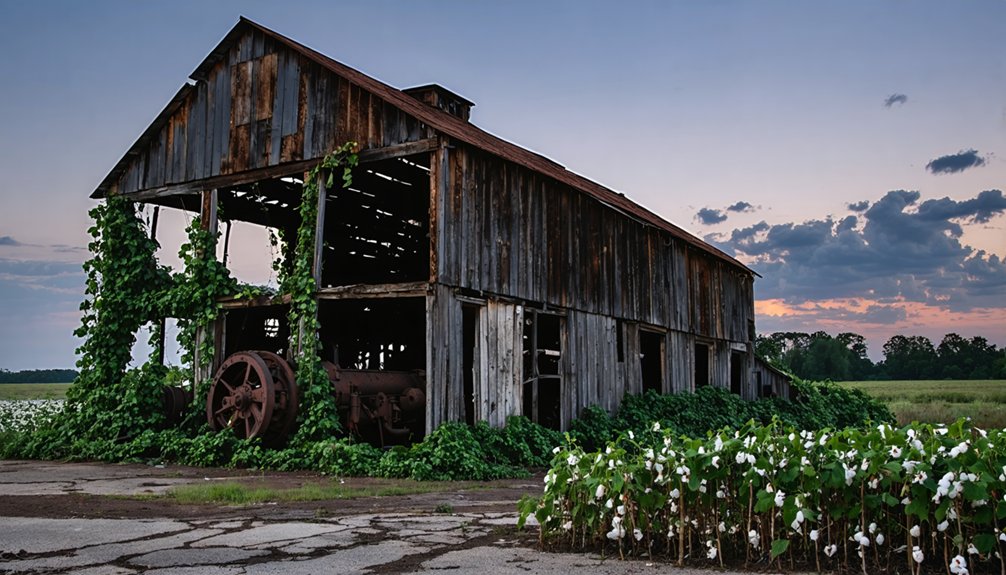
Along the winding banks of the Mississippi River, once-vibrant agricultural settlements now stand as hollow reminders of a complex agrarian past.
You’ll find towns like Shelby and Mound Bayou where boarded-up storefronts tell the story of Delta decline—communities hollowed by mechanization and farm consolidation.
These settlements emerged from plantation legacies where wealthy landowners cleared swampland and exploited enslaved labor, later evolving to sharecropping systems that perpetuated economic bondage. The second Great Migration during the 1950s and 1960s saw nearly half the population leave these communities as agricultural jobs disappeared due to mechanization.
The physical remnants—shotgun houses, abandoned gins, and simple three-room cabins with full porches—document this difficult history.
Despite $1.2 billion in federal agricultural subsidies (2001-2005), 95% went to large white-owned operations, accelerating the exodus of workers and the disintegration of community bonds as agriculture shifted from labor-intensive to capital-intensive production. Approximately 100,000 residents have left the region in a painful death spiral of poverty, crime, and unemployment as they search for better opportunities elsewhere.
When the Water Ran Out: Stories From the Southwest
As water tables plummeted beneath the arid Southwest landscape, entire agricultural communities began to vanish—their stories etched in abandoned homesteads and fallow fields that stretch across states like Arizona, Oklahoma, and New Mexico.
You’ll find this pattern recurring throughout southwestern history—from the Hohokam civilization’s collapse around 1450 CE to the Dust Bowl exodus of 2.5 million people in the 1930s.
Today, a million acres of Arizona farmland sit abandoned due to water scarcity, particularly in Cochise and Pinal counties where pumping costs exceeded economic returns.
Arizona’s agricultural ghost towns stand as silent monuments to the economic breaking point where water’s scarcity finally outweighed its worth.
The pattern continues as climate change pushes temperatures upward, increasing vapor pressure deficits and reducing vegetation productivity.
Indigenous communities face disproportionate impacts despite minimal contributions to emissions, highlighting the urgent need for climate resilience strategies in a region where water has always determined survival.
The two-decade megadrought has accelerated agricultural abandonment across the region, pushing many multi-generational ranching operations beyond financial viability.
The loss of native vegetation during land development has severely disrupted natural seed dispersal mechanisms, hampering the natural recovery of these abandoned agricultural landscapes.
Family Farms to Grasslands: The Human Impact of Cropland Loss
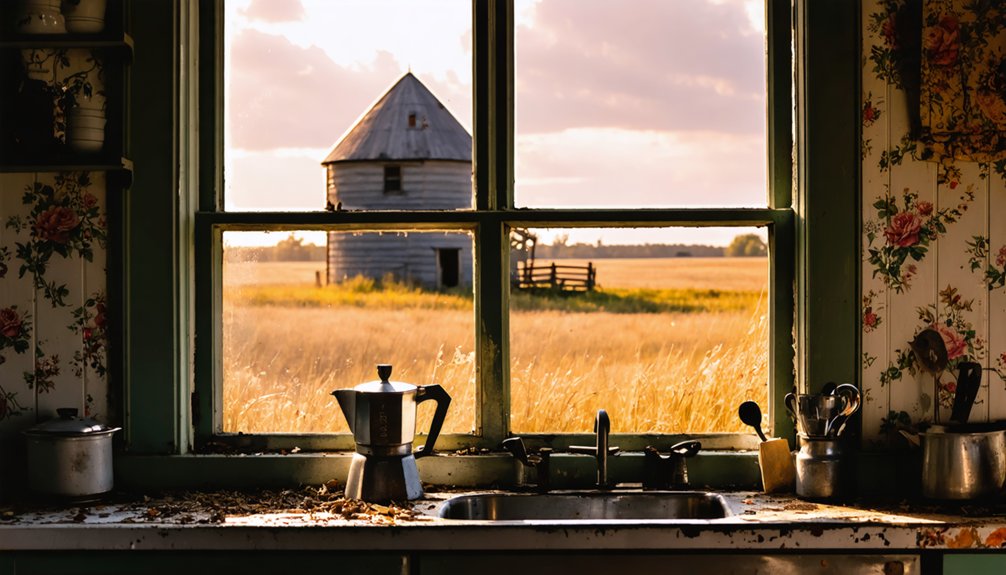
If you visit the once-thriving agricultural communities across America’s heartland, you’ll find ghost towns where family farms have been replaced by expansive grasslands through both voluntary and forced conversions.
These areas are steeped in a haunted history of farming towns, where echoes of harvest celebrations once filled the air. The remnants of old silos and abandoned homes tell stories of resilience and decline over generations. As you wander through these landscapes, you can almost hear the whispers of those who toiled under the vast skies, their lives intertwined with the fertile soil.
These abandoned homesteads tell stories of generational farming families who departed when economic pressures, water scarcity, or conservation initiatives transformed cropland back to prairie. The return to natural landscapes has helped combat habitat loss, though over 1 million acres of grasslands and prairies are still lost annually in the U.S. In areas like Southwest Kansas, center pivot irrigation has dramatically transformed over 500 square miles of native rangeland into croplands.
The empty storefronts and decaying grain elevators stand as monuments to communities that collapsed when the agricultural foundation supporting local economies eroded.
Farming Families Left Behind
Behind the statistics and policy changes driving cropland-to-grassland conversion lies a profound human story of farming families adapting to changing agricultural realities.
You’ll find family farms—representing 96% of U.S. agricultural operations—making difficult shifts as economic pressures mount.
When your cropland shifts to grassland, you’ll need less equipment and labor but more grazing expertise. For some families, this conversion has actually increased profitability and control over their land.
The decision often depends on your farm size; larger operators (2,400+ acres) plan more extensive conversions in coming years than smaller farms.
These shifts reflect broader farming challenges and contribute to rural depopulation as agricultural practices change.
Government programs like CRP offer support, with families on lower-quality land four times more likely to maintain grasslands long-term after program participation.
Ghost Towns’ Agricultural Past
Though once vibrant centers of agricultural activity, today’s rural ghost towns vividly illustrate the human consequences of cropland abandonment. You’ll find these communities scattered across the Great Plains and Mississippi River regions, where over 30 million acres of farmland have been abandoned since 1986.
As economic pressures mounted, families departed, leaving behind empty storefronts and silent grain elevators. The agricultural decline transformed once-productive fields into grasslands and shrublands, with over half of abandoned cropland now reverting to pasture.
Only about 20% entered formal conservation programs. These ghost towns represent more than lost livelihoods—they embody broader shifts in America’s agricultural landscape.
While urbanization claimed some communities, many others simply faded as competitive pressures, changing policies, and economic realities reshaped rural America’s geography.
Cultural Heritage Preserved in America’s Agricultural Ruins
In these weathered structures and quiet rural museums, you’ll find America’s agricultural history preserved through carefully maintained artifacts, handwritten ledgers, and worn implements that document generational farming practices.
The narrative threads of these communities live on through recorded interviews with former residents who witnessed the change from bustling farm economies to abandoned homesteads.
When you explore these cultural repositories, from the restored barns of the Midwest to the community archives of former farming towns, you’re engaging with the tangible evidence of agricultural heritage that continues to shape regional identities.
Abandoned Barns Tell Stories
Across America’s forgotten farmlands, abandoned barns stand as weathered sentinels of agricultural heritage, telling stories that stretch back generations.
You’ll find these once-vital structures—now orphaned from their purpose—representing a Jeffersonian vision of virtue through working the land. Their regional architectures—from gambrel-roofed Midwestern dairy barns to tobacco barns in the Southeast—reflect the immigrant communities who built them.
These rural echoes have drastically declined, from 6.8 million farm barns in 1935 to just 650,000 by 2007.
Yet preservation efforts through organizations like the National Barn Alliance are helping transform these spaces into community gathering places.
Each weathered beam and worn floorboard holds barn memories of prosperity, hard work, and community spirit—a talisman of American agricultural identity that persists even as their practical function fades.
Small Town Museum Treasures
While abandoned barns stand as silent witnesses to America’s agricultural past, small town museums have become essential repositories safeguarding the artifacts, stories, and practices of rural communities.
You’ll discover rural museum collections like the Mountain Farm Museum showcasing authentic 19th-century Appalachian structures, or the MS Ag Museum’s impressive display of 10 antique tractors and 15 historical farm implements across 5,000 square feet.
Small town legacies thrive in places like the Fortenberry-Parkman Farmstead, designated a Mississippi Landmark after operating for over a century.
These institutions—from New Mexico’s Farm and Ranch Heritage Museum covering 3,000 years of agricultural history to Garfield County Agricultural Museum’s preservation of equipment dating to the late 1800s—maintain critical connections between contemporary Americans and the agricultural foundations that shaped our national identity.
Oral Histories Capturing Transitions
Voices echoing from America’s abandoned agricultural landscapes have become essential repositories of cultural memory through systematic oral history projects.
You’ll discover these oral narratives span communities like The Dry in Colorado and the Ransom Williams Farmstead in Texas, preserving experiences that physical artifacts alone can’t capture.
When you explore these collections, you’ll find recurring themes of community resilience against drought, economic hardship, and systemic racism.
Projects like the Southern Agriculture Oral History Project, with its 159 interviews across eight states, connect individual stories to broader historical patterns.
These preserved voices—from Black sharecroppers in Arkansas to immigrant farmworkers documented by ASU—provide context for archaeological findings while ensuring diverse perspectives aren’t erased from America’s agricultural heritage.
Through their words, you experience both the social fabric and challenges of rural life.
From Fields to Forests: Ecological Succession of Rural Communities
When agricultural lands fall into disuse, nature doesn’t hesitate to reclaim its territory through a process known as ecological succession.
You’ll witness a predictable transformation as pioneer species like crabgrass establish during the first year, followed by Queen Anne’s lace and asters in the second. By year three, blackberries and sumacs create thickets where wildlife begins to thrive.
Within a decade, tree seedlings emerge, initiating forest development that varies dramatically by region—from Missouri floodplains to Virginia farmsteads.
The pace and direction of this revival depend on soil properties, elevation, and climate. Communities nationwide are discovering the value of these transforming landscapes, where management can guide succession toward wildlife habitat or restoration of native ecosystems, rather than allowing invasive species to dominate.
Beyond the Conservation Reserve Program: Untold Stories
Although the Conservation Reserve Program (CRP) remains the most recognized federal initiative for agricultural land retirement, it represents just one option in a diverse ecosystem of conservation programs that often go unnoticed.
You’ll find alternatives like EQIP, ACEP, and RCPP offering pathways to integrate conservation strategies while maintaining working lands. The economic case is compelling—MSU research shows farmers who enrolled their least profitable acres into conservation programs saw average revenue increases of 24%, with some fields yielding up to 265% more.
Beyond financial incentives, innovative approaches to agricultural resilience include mob grazing with seasonal rotation and broadcast seeding of diverse plant species. These practices don’t just restore land—they transform it.
Conservation isn’t just preservation—it’s active transformation through innovative land management techniques that revitalize our agricultural systems.
With year-round enrollment flexibility and free technical assistance through local USDA Service Centers, your ability to reimagine land management extends far beyond CRP’s boundaries.
Frequently Asked Questions
What Cultural Ceremonies Marked the Closing of Rural Farming Communities?
You’d witness harvest festivals with shared meals, community farewells featuring bell-ringing ceremonies, seed-planting rituals, tool burning ceremonies, and creation of memorial quilts preserving your agricultural heritage and cultural identity.
How Did Abandoned Agricultural Communities Maintain Postal Services?
You’d use Rural Free Delivery where passable roads existed, petition representatives for service, and create makeshift mailboxes. This postal delivery system maintained essential rural communication despite dwindling populations.
What Artifacts Remain in Abandoned Cropland Homes Across Different Regions?
You’ll find farm tools like blacksmith equipment and plow parts alongside household relics including tobacco pipes, ceramic dishware, and food storage containers that reflect regional dietary and cultural patterns.
How Did Railroad Closures Impact Agricultural Abandonment Patterns?
You’ll find railroad closures concentrated agricultural decline, forcing farmers to abandon distant fields first. The economic impact radiates outward, with communities farthest from remaining rail infrastructure experiencing quicker depopulation.
What Role Did Indigenous Communities Play in Reclaiming Abandoned Farmland?
Like phoenix from ashes, you’ve witnessed indigenous nations lead essential land restoration efforts, reclaiming abandoned farms to revitalize cultural heritage, agricultural traditions, and sovereignty while healing landscapes damaged by colonial farming practices.
References
- https://www.glbrc.org/data-and-tools/glbrc-data-sets/cropland-abandonment-between-1986-and-2018-across-united-states
- https://advancedbiofuelsusa.info/tens-of-millions-of-acres-of-cropland-lie-abandoned-study-shows
- https://www.technologynetworks.com/applied-sciences/news/new-us-map-shows-the-abandoned-farms-that-could-help-fight-climate-change-387249
- https://ci.uky.edu/irj/rural-blog/new-tool-finds-abandoned-farmland-could-be-used-fight-climate-change-30-million
- https://agcensus.library.cornell.edu/census_parts/1940-abandoned-or-idle-farms/
- https://farmdocdaily.illinois.edu/2024/09/loss-of-us-farmland-in-the-21st-century-the-national-perspective-from-the-census-of-agriculture.html
- https://drought.unl.edu/dustbowl/
- https://www.kbia.org/agriculture/2017-03-22/great-plains-ghost-town-sheds-light-on-forgotten-piece-of-african-american-history
- https://en.wikipedia.org/wiki/Great_Plains
- https://www.legendsofamerica.com/gt-emergingghosttowns/