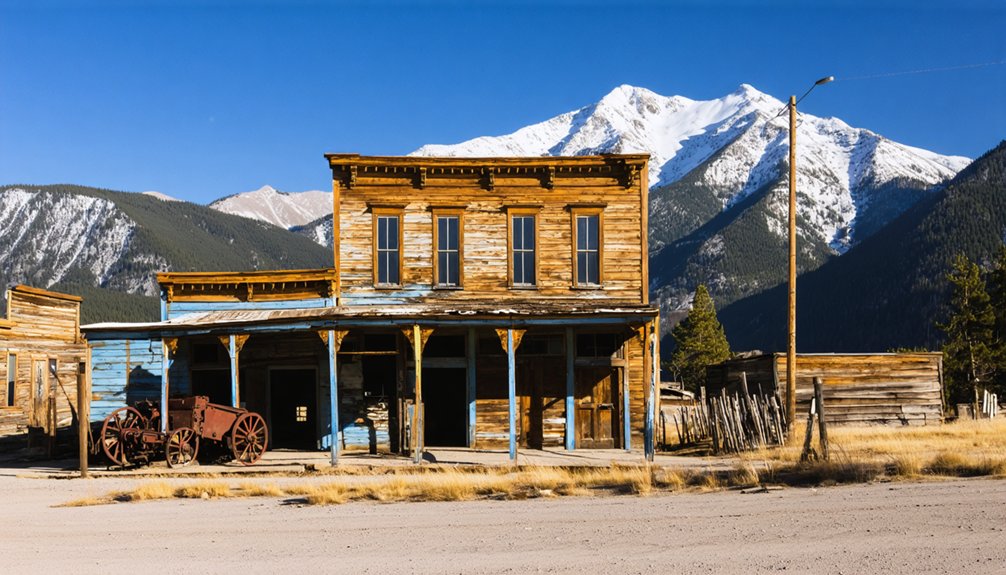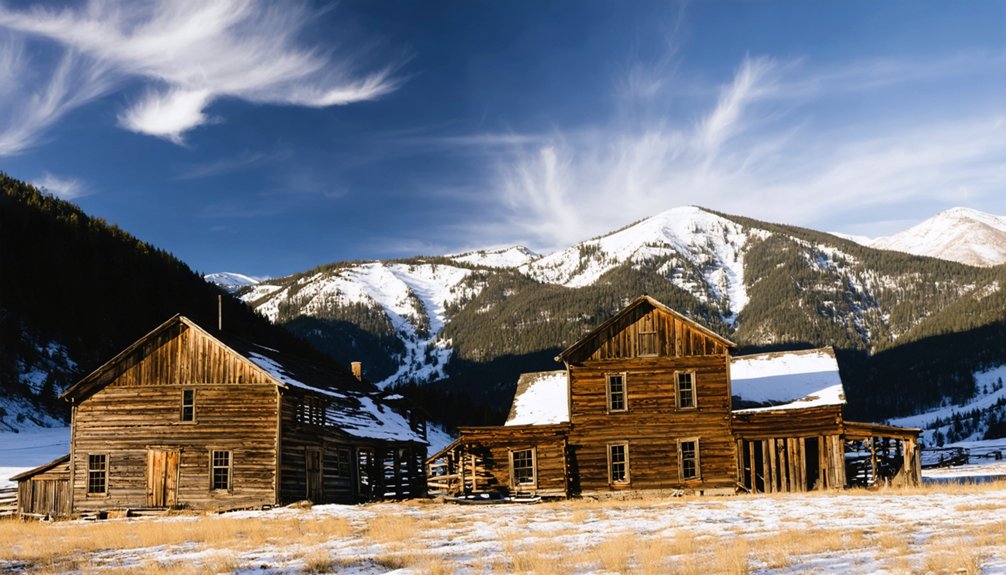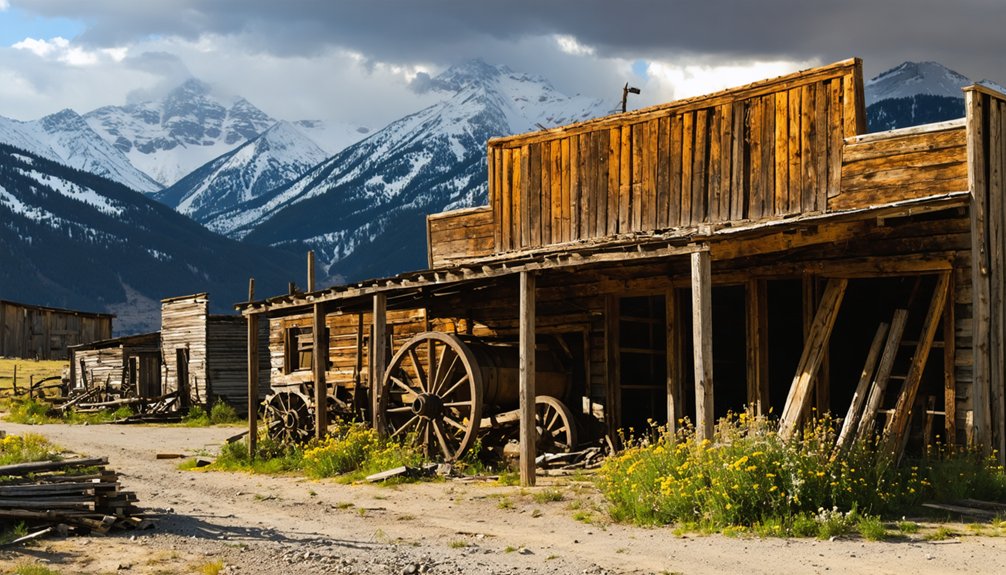
Gold Park boomed in Colorado’s Holy Cross District around 1880 when the Gold Park Mining and Milling Company invested $500,000 and employed 400 miners. You’ll find this ghost town abandoned by 1890 after engineering failures led to flooded tunnels and disappointing ore quality that produced only $6,400 worth of gold. Despite harsh conditions, residents built a resilient community with log cabins and saloons. The mountain ruins tell tales of boom-to-bust frontier determination.
Key Takeaways
- Gold Park was established during the Colorado gold rush around 1880 but became a ghost town by 1890.
- The Gold Park Mining and Milling Company employed 400 miners and consolidated 23 claims on French Mountain.
- Technical failures and environmental miscalculations, including tunnel flooding, contributed to the settlement’s downfall.
- Gold production reached only $6,400 by 1884, with the mining company admitting ore quality couldn’t sustain profitable operations.
- Today, Gold Park attracts tourists who explore historical remnants, hike, and participate in educational tours about mining heritage.
The Rise of Gold Park: Colorado’s 1880s Mining Boom
While fortune-seekers had long been drawn to Colorado’s mineral-rich mountains, the discovery of gold in the Holy Cross District around 1880 ignited a flurry of excitement that would transform this remote alpine region.
You’d have witnessed the rush of prospectors enticed by promising assay results—up to $100 per ton from surface ore—and whispers of rich silver veins by 1882.
The district quickly evolved beyond individual placer claims when the Gold Park Mining and Milling Company formed with $500,000 capital. By the height of the boom, the company employed 400 miners working throughout the district.
This corporate investment consolidated 23 claims on French Mountain, hiring professional engineers to maximize extraction efficiency.
As operations expanded, newspapers trumpeted the district’s potential, proclaiming “lively times” ahead for the Holy Cross mines—a sentiment that echoed throughout the Roaring Fork Valley during Colorado’s mineral exploration surge. Like many mining operations in the region, Gold Park faced significant challenges due to difficult terrain and isolation, requiring valuable ore to justify transportation costs.
Mining Challenges and Infrastructure Failures
Despite the initial promise and corporate investment, Gold Park’s mining operations soon encountered formidable obstacles that would ultimately contribute to its downfall.
Gold Park’s promising venture crumbled under the weight of technical failures and environmental miscalculations.
You’d have witnessed firsthand how miners routinely misjudged water levels, relying dangerously on surface seepage observations rather than direct measurement—a fatal miscalculation that plagued operations throughout the district.
The mine infrastructure failures were particularly devastating.
Portal closures lacked proper engineering, failing to account for water pressure behind poorly designed plugs. When excavations reached fracture points, pressurized mine water would burst through within minutes, flooding tunnels and destroying equipment. Similar to the Gold King Mine incident, these breaches released toxic waste water containing dangerous levels of heavy metals into nearby watersheds.
Clay-rich backfill materials only compounded these problems, reducing visible seepage while masking dangerous pressure buildup.
These technical shortcomings, paired with regulatory oversights and unclear ownership responsibilities, sealed Gold Park’s fate long before the last prospector departed. The area’s complex tunnel network, like that of the American Tunnel near Silverton, created interconnected waterways that complicated any remediation efforts.
Daily Life in a Mountain Mining Camp
Life in Gold Park demanded grit and resilience from anyone brave enough to call the mountain mining camp home. You’d rise before dawn, working until darkness fell in dangerous conditions illuminated only by small lamps.
Your shelter would’ve been modest—a simple log cabin with homemade furniture, offering basic protection from harsh mountain elements. The occasional trips to the ore sorting building provided a break from the monotony of mining labor.
- Food scarcity was constant, with fresh produce rare and meals dependent on preserved supplies.
- You’d manage the delicate balance between independence and community bonding in the 400-person settlement.
- Your workday involved explosive handling, ore hauling, and traversing treacherous shafts.
- Social connections formed in the saloon—your center for news, relaxation, and fellowship.
- Despite isolation, you’d find optimism in naming claims and supporting neighbors through unemployment periods.
Many miners sought solace in local churches, with women regularly attending services and family church activities providing spiritual comfort amid the harsh realities of mining life.
Relationship With Holy Cross City and Surrounding Settlements
Although separated by rugged terrain, Gold Park and Holy Cross City formed the beating heart of a tightly connected mining network throughout Eagle County’s wilderness.
You’d find miners traveling between these settlements on difficult trails that now serve as historic hiking routes, exchanging news and sharing resources during harsh mountain winters. The area gained notoriety when Michelle Vanek disappeared while attempting to summit Mount of the Holy Cross in 2005.
Economic interdependence defined these ghost towns, with shared infrastructure like general stores and blacksmiths serving multiple camps despite challenging conditions.
The history of Calumet, Colorado ghost town is a testament to the resilience of its former inhabitants. As miners flocked to the area in search of fortune, they relied heavily on those essential services that connected their isolated lives. Today, the remnants of their endeavors offer a glimpse into the vibrant community that once thrived amid the rugged terrain.
Miners created economic networks across hostile terrain, pooling scarce resources and turning isolation into interdependence.
When Holy Cross City boasted 300 residents with bustling saloons, Gold Park’s community benefited from these nearby amenities. The unprofitability of gold mines eventually led to Holy Cross City’s abandonment.
Community interactions thrived despite isolation, creating social bonds forged in mutual struggle against pyrite-laden ore and brutal weather.
As mining profitability waned, these settlements emptied together—families departing for better prospects but leaving behind an intertwined legacy that still echoes through the Holy Cross Wilderness.
Gold Park’s Rapid Decline and Modern Legacy
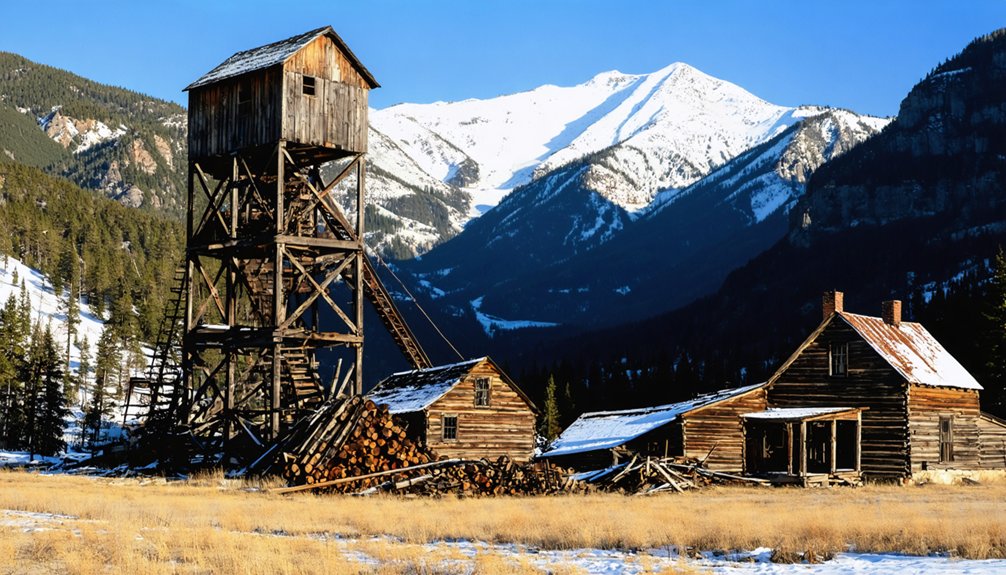
While gold fever initially sparked the establishment of Gold Park, the settlement’s prosperity proved tragically fleeting as fundamental economic realities emerged by 1883. The mining company’s admission that ore quality couldn’t sustain profitable operations sealed the town’s fate, with most investors and miners quickly abandoning their claims.
- Harsh environmental challenges at high elevation made winters nearly unbearable.
- Difficult mountain terrain and impassable roads isolated the settlement from supplies.
- Total gold production reached a mere $6,400 by 1884, a pittance compared to successful mining towns.
- Economic factors including expensive ore processing doomed revival attempts.
Much like Ironton, the town suffered from the unpredictable nature of mining economics that characterized the era.
By 1890, Gold Park stood nearly deserted, its brief flame extinguished.
Today, Gold Park exists as a reflection of the boom-and-bust cycle that defined the American frontier—where dreams of freedom and fortune often collided with unforgiving reality. The silver panic of 1893 further crushed any lingering hopes for the town’s resurrection, as similar economic downturns devastated mining communities throughout the West.
Frequently Asked Questions
Are There Any Accessible Ruins Remaining at Gold Park Today?
Yes, you’ll find numerous accessible ruins across 90 acres. During your ruins exploration, you’ll discover deteriorating historic homes and mining structures, though remember historical preservation requires respecting private property and avoiding artifact removal.
Did Any Famous Historical Figures Visit Gold Park?
No famous historical figures are documented as having visited Gold Park. You won’t find accounts of notable visitors contributing to this camp’s limited historical significance despite its once-bustling population.
What Happened to Gold Park’s Residents After Abandonment?
You’d be utterly shocked by the mass historical migrations that scattered Gold Park’s residents. They’ve vanished to Aspen, Leadville, and eastward—carrying their community legacies while seeking freedom from economic hardship elsewhere.
Were There Any Major Crimes or Notable Lawlessness?
You’ll find no documented major crimes in Gold Park’s history. Unlike infamous boomtowns nearby, available records suggest relatively low crime rates and few lawless incidents worth recording for posterity.
Did Indigenous Peoples Have Connections to the Gold Park Area?
Like roots beneath the mountain soil, Indigenous history runs deep here. You’ll find Ute and Arapaho tribes had profound cultural significance in this area before miners arrived, summering in these valleys for thousands of years.
References
- https://southparkheritage.org/where-have-all-the-ghost-towns-gone-by-christie-wright/
- https://www.durango.com/colorado-ghost-towns/
- https://eaglecountyhistoricalsociety.com/holy-cross-city/
- https://www.visitnorthparkco.com/ghost-towns-of-jackson-county/
- https://www.youtube.com/watch?v=C6d838Wa8Ag
- https://www.americansky.co.uk/colorado-holidays/explore-colorados-most-fascinating-gold-rush-towns
- https://www.colorado.com/articles/colorado-ghost-towns
- https://en.wikipedia.org/wiki/List_of_ghost_towns_in_Colorado
- https://www.uchealth.org/today/ghost-towns-abound-in-colorado/
- https://www.legendsofamerica.com/early-southwestern-colorado-mining/