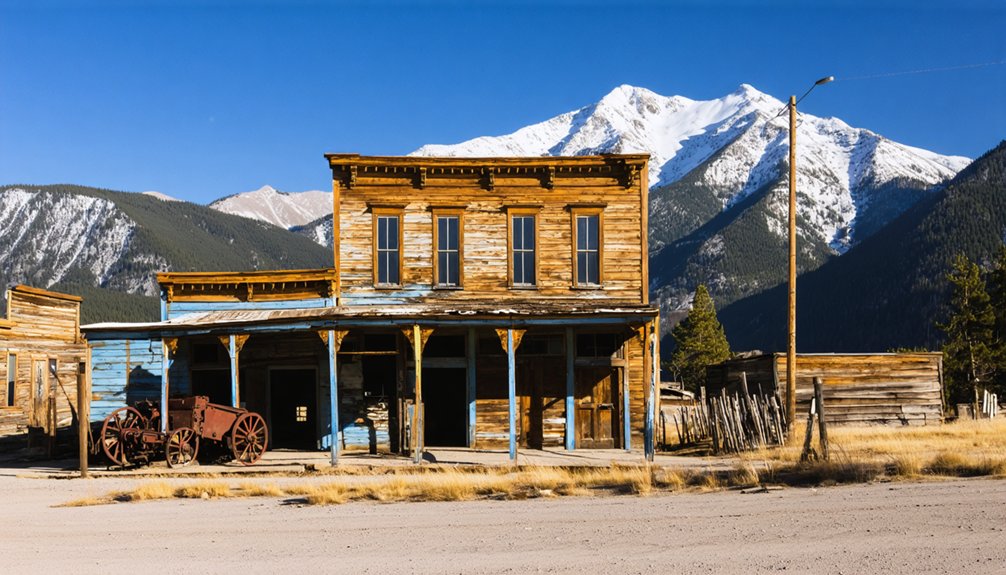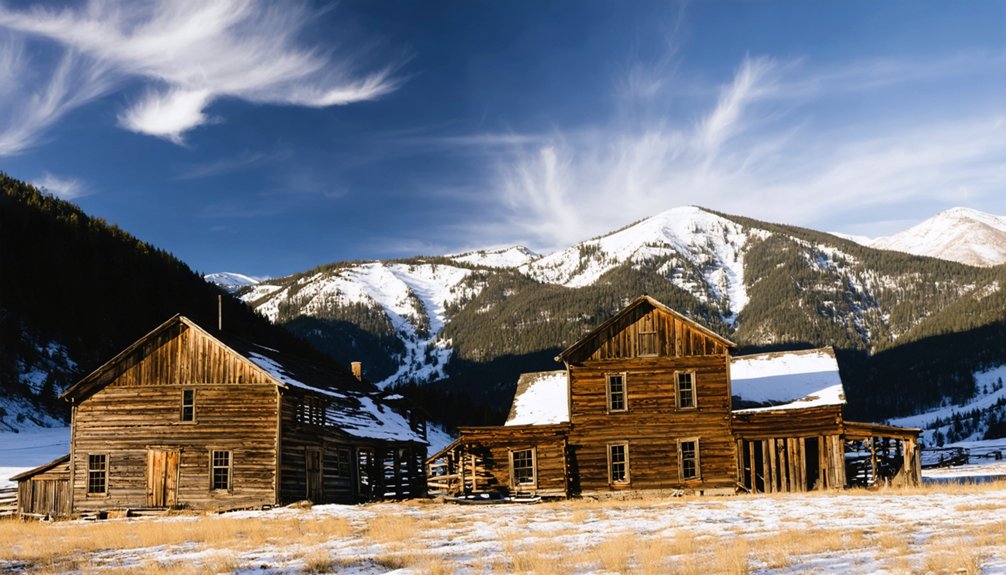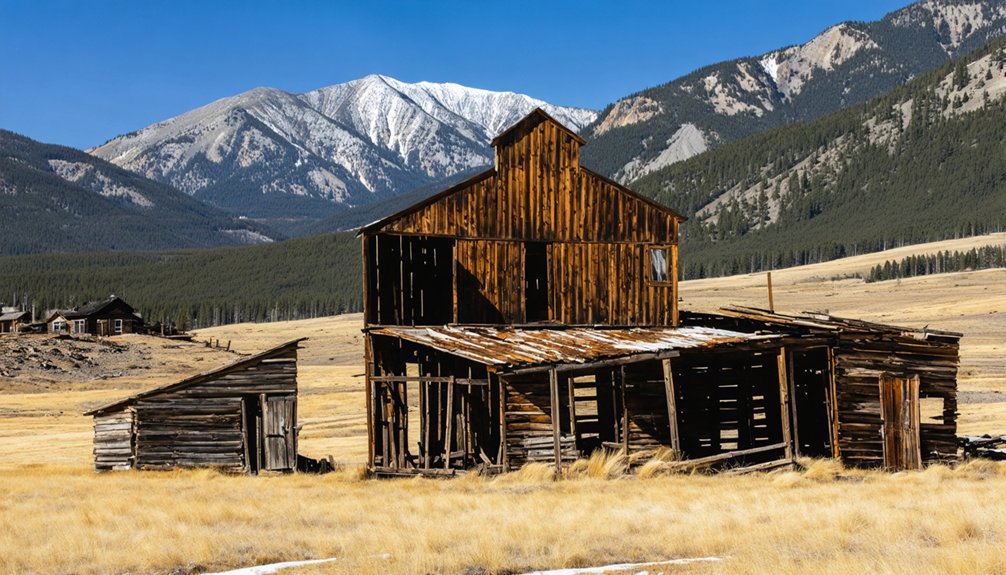
You’ll find Gould tucked along Highway 14 in North Park’s high country, where a few weathered structures and scattered foundations are all that remain of a settlement that once housed 1,500 souls chasing silver dreams in the 1880s. The town boomed following an 1879 gold strike, then pivoted to timber with LaFever’s sawmill in 1886, peaking at 300 residents by 1949. The 1884 silver crash triggered its decline, and by 1902, Gould had joined Colorado’s roster of abandoned communities—though there’s more to this story than economic collapse alone.
Key Takeaways
- Gould became a ghost town by 1902 after silver prices crashed in 1884, causing population to drop from 1,500 to 300.
- Founded after a July 4, 1879 gold strike, the settlement featured dispersed log cabins designed for harsh high-altitude winters.
- Timber industry peaked in 1955 with nearly 10 million board feet harvested before closing in the early 1970s.
- Located 20 miles southeast of Walden on Highway 14, Gould remains accessible with scattered ruins to explore year-round.
- Nearby attractions include Teller City’s substantial ruins, State Forest State Park, and North Park Pioneer Museum for historical context.
From Homestead to Lumber Hub: The Early Years of Gould
Why would anyone choose to build a life at 10,900 feet, where snow blankets the ground from October through May and the thin air makes every breath a conscious effort? For Gould’s earliest settlers, the answer was simple: opportunity.
When gold was struck at a nearby mine on July 4, 1879, prospectors and homesteaders rushed to this remote Jackson County crossroads in North Park. They erected hundreds of log cabins alongside their mining claims, creating a dispersed settlement pattern through the forested terrain.
The local architecture reflected harsh realities—thick-walled timber structures built to withstand relentless winters. Pioneer lifestyles demanded resilience as miners, ranchers, and entrepreneurs carved out existence in this inhospitable location, transforming wilderness into community despite elevation’s brutal challenges. Living at such extreme altitude mirrored conditions in Independence, where over 1,500 residents endured similar hardships at 10,900 feet during the early 1880s gold rush. Like Carson, which sat at nearly 12,000 feet, Gould’s residents faced accessibility issues and harsh winter conditions that tested even the most determined settlers.
The Timber Industry and Population Boom
The screaming whine of LaFever’s saw-mill shattered Gould’s wilderness quiet in 1886, marking the beginning of an industry that would define the settlement for nearly a century. You’d have witnessed the transformation as lodgepole pines fell to supply railroad ties and lumber for mining operations throughout the West.
By 1949, nearly 300 residents called this place home, drawn by the Bockman Lumber Camp—Colorado’s largest logging operation, housing over 100 workers and their families.
At its height, Bockman Lumber Camp supported 300 residents, operating as Colorado’s most expansive logging community in the late 1940s.
The peak came in 1955 when logging technology harvested nearly 10 million board feet. Yet forest conservation concerns emerged by the mid-1960s as visible clear-cutting sparked public controversy.
The Land Board’s foresters tried balancing extraction with sustainability, but the boom couldn’t last forever. The last lumber camps closed by the early 1970s, ending the active logging period that had sustained the community for generations. The settlement’s place name disambiguation reflects its connection to other Gould locations throughout North America, sharing a common nomenclature that would later require clarification in historical records.
German Prisoners of War in the Colorado Wilderness
What could’ve been more surreal than watching thousands of Rommel’s battle-hardened Afrika Korps veterans trudge through Colorado’s Front Range in their “PW”-stamped fatigues? Camp 202 near Greeley held over 3,000 Germans and Austrians behind twelve-foot barbed-wire fences, guarded by watchtowers with machine guns and patrol dogs.
Prisoner labor filled the wartime void, with trucks hauling captives to local farms each morning. These men earned ten cents daily in coupons—not currency—purchasing tobacco and toothpaste. Some spoke English, forging unexpected bonds with Americans. Farmers paid 80 cents per day in script for the prisoners’ work in wheat, corn, and beet fields.
Camp security couldn’t stop all escape attempts. Two prisoners broke into a Gould house, found the liquor cabinet, and faced seven days on bread and water. Another wasn’t so lucky—shot dead re-entering camp.
When peace came, some stayed, marrying American women and choosing Colorado freedom over shattered Germany. The camp closed in 1946, leaving only two stone entrance pillars standing sentinel beside Highway 34’s business loop—silent witnesses to this forgotten chapter of wartime Colorado.
The Slow Fade: What Led to Gould’s Abandonment
While German POWs eventually returned home to rebuild their lives, Gould’s residents faced their own exodus—one driven not by war’s end but by economic collapse. Mining decline hit hard when silver prices crashed in 1884, transforming a thriving community of 1,500 into a struggling outpost of 300 within three years.
Silver’s crash didn’t just empty Gould’s mines—it erased four-fifths of its population in barely a thousand days.
Economic pressures mounted as operational costs exceeded revenue. You’d have witnessed:
- The mill’s dismantling in 1917, sold piece by piece for scrap
- Post office closure in 1915, severing Gould’s last official connection
- Population dropping to eight souls by 1915, clinging to fading hope
The 8,200-foot elevation made survival harder still. Winter snow buried the town from October through May, and when brief mining revivals failed, even the most stubborn prospectors abandoned their claims to seek fortune elsewhere. The harsh weather conditions and long winters typical of high-altitude mining communities left residents struggling with transportation difficulties and limited access to supplies during the extended snow season. By 1902, Gould had completely become a ghost town, marking the final chapter of this boom-and-bust mining era.
Exploring Gould and Surrounding Ghost Towns Today
Though Gould’s population dwindled to near-extinction, you’ll find the ghost town still clinging to existence 20 miles southeast of Walden along Highway 14. It’s now an unincorporated community with scattered remains amid local flora that’s reclaimed much of the settlement. You can access the area year-round in your passenger vehicle, making it perfect for spontaneous exploration.
Just 8 miles away, Teller City offers more substantial ruins—follow Highway 14 to County Road 21 and explore on foot among structures that once housed 1,500 residents. State Forest State Park sits 5 miles from Gould for outdoor activities, while Cameron Pass winds through alpine scenery between State Forest and Roosevelt National Forest. The Moose Visitor Center within the park offers information and souvenirs, plus gear rentals and picnic facilities for day visitors. Many Colorado mountain towns now face rising vacancy rates as second homes remain unoccupied year-round, creating modern ghost town conditions.
North Park Pioneer Museum, 21 miles away, provides historical context for your ghost town adventures.
Frequently Asked Questions
Is Gould, Colorado Still Inhabited or Completely Abandoned Today?
You’ll find Gould still has minimal inhabitants today, unlike completely abandoned ghost towns. It’s not a major tourist attraction with historic preservation efforts, but you can explore this quiet settlement’s remaining structures surrounded by Colorado’s wilderness freely.
Just a few miles away lies the history of Robinson, Colorado town, which offers a different glimpse into the past. With remnants of early mining operations still visible, visitors can appreciate the rugged spirit of the area. This small yet significant site invites exploration and reflection on the challenges faced by early settlers in the region.
As you delve deeper into the ghost towns in Colorado history, you’ll uncover many other fascinating sites that tell the stories of the state’s rugged past. These remnants of human settlement reflect the dreams and struggles of those who sought fortune in the unforgiving terrain. Each ghost town, with its unique narrative, further enriches the tapestry of Colorado’s heritage and invites more curious explorers.
Can Visitors Access the Original POW Camp Structures or Foundations?
You won’t find any original POW camp structures or foundations to explore at Gould—there’s no camp site preservation or designated visitor access. The buildings vanished decades ago, leaving you with only historical records to satisfy your curiosity.
What Happened to the German Prisoners After the Camp Closed?
Most prisoners returned to Germany by 1946, but some chose freedom in Colorado, forming bonds with German-descended locals through farm work. Their prisoner integration created lasting camp legacy—descendants still make pilgrimages to visit those historic stone pillars today.
Are There Any Guided Tours Available for Gould’s Historical Sites?
You won’t find guided tours here—local legends and historic preservation rely on self-guided exploration. You’ll discover Teller City’s artifacts independently, respecting the freedom to wander among cabins and foundations at your own pace.
Why Was Gould Never Officially Incorporated as a Town?
Records don’t reveal why incorporation never happened, but you’ll find that remote settlements often skipped formal urban development. Gould’s isolation and declining population likely made historical preservation through community memory more practical than official town status.
References
- https://www.amli.com/blog/abandoned-mines-and-ghost-towns-near-denver
- https://www.visitnorthparkco.com/ghost-towns-of-jackson-county/
- https://janmackellcollins.wordpress.com/category/colorado-ghost-towns-2/
- https://www.uncovercolorado.com/towns/gould/
- https://www.ghosttowns.com/states/co/gould.html
- https://www.youtube.com/watch?v=Q2_dJ2LGsHs
- https://www.colorado.com/cities-and-towns/gould
- https://www.coloradolifemagazine.com/printpage/post/index/id/172
- https://www.denver7.com/news/local-news/colorado-ghost-towns-their-past-present-and-future-in-the-rocky-mountains
- https://www.uncovercolorado.com/ghost-towns/teller-city/