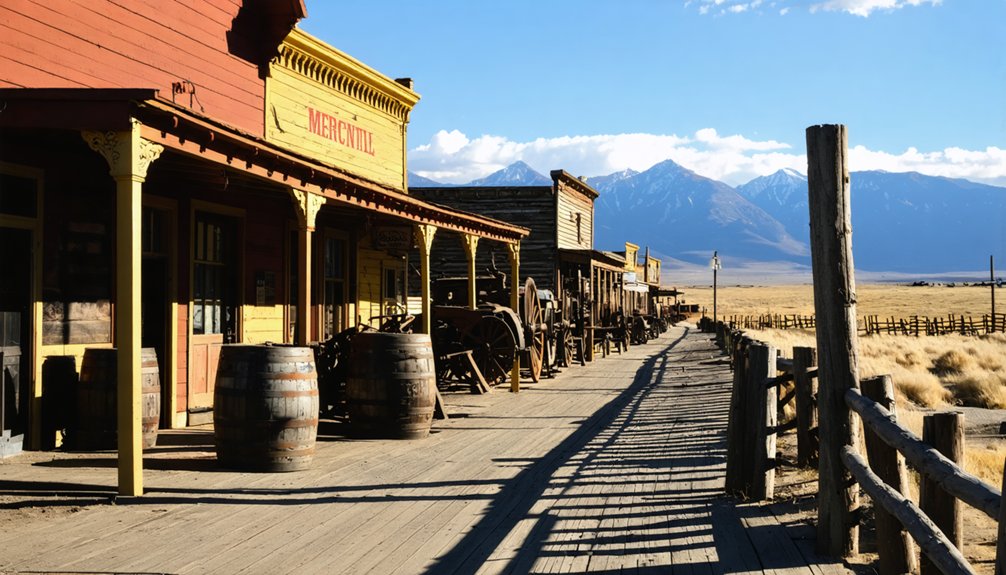
Greenwich, California doesn’t exist in historical records as an actual ghost town. You won’t find it in legitimate ghost town registries or state archives. It’s likely a confusion with East Coast locations or entirely fabricated. Unlike authentic California ghost towns like Bodie or Calico, Greenwich lacks verified photographs, consistent land records, or census documentation. The absence of archaeological evidence hasn’t stopped this non-existent location from capturing public imagination through compelling but fictional narratives.
Key Takeaways
- Greenwich, California does not exist in any historical record and is absent from legitimate ghost town registries.
- No authenticated photographs or consistent land ownership records of Greenwich have been found.
- The name likely stems from confusion with East Coast locations or represents a conflation of several abandoned California settlements.
- Unlike authentic ghost towns like Bodie and Calico, Greenwich has no archaeological substantiation.
- Public interest in Greenwich demonstrates how invented history can create compelling tourism narratives despite lack of evidence.
The Mysterious Origins of Greenwich: Fact vs. Fiction
Three distinct facts emerge when investigating Greenwich, California: it simply doesn’t exist in any historical record, has never been documented in state archives, and appears in no legitimate ghost town registry.
You’ll find that historical accuracy has been sacrificed in tales referencing this non-existent settlement. Unlike authentic ghost towns like Bodie or Calico with verifiable populations and economic histories, Greenwich exists only in fictional accounts and misinformation. This differs greatly from the authentic Greenwich, Connecticut, which has a rich history dating back to 1640 when Massachusetts settlers purchased land between the Asamuck and Patomuck rivers.
Cultural perceptions of ghost towns often lead people to accept legendary tales without questioning their authenticity. When you research California’s abandoned settlements, you’ll encounter numerous documented locations with mining origins and clear timelines of boom and bust—Greenwich isn’t among them. Modern enthusiasts often share ghost tales connected to Washington Square Park and other verified haunted locations instead.
The name likely stems from confusion with East Coast locations or represents a completely fabricated setting.
Searching California’s Historical Records: Missing Evidence
When investigating California’s historical ghost town records, the absence of Greenwich becomes even more conspicuous.
You’ll face significant archival challenges as you attempt historical verification of this settlement’s existence. The fragmentary nature of California’s ghost town documentation creates a frustrating research landscape where Greenwich seems to vanish into the gaps between official records. Unlike well-documented ghost towns such as Bodie and Calico, established in the late 1800s during California’s mining boom, Greenwich lacks any comparable historical foundation. In contrast, some remnants of utopian communities like Llano del Rio still exist as physical ruins that testify to their historical presence.
- Exact coordinates remain elusive, with conflicting mapping data complicating your search
- Census and newspaper references are virtually nonexistent, leaving population questions unanswered
- Wildfires and environmental changes have destroyed physical evidence essential to verification
- Undigitized materials scattered across institutions make thorough research nearly impossible
- Inconsistent cataloging systems prevent efficient cross-referencing of what little data exists
Gold Rush Era Settlement Patterns in California
California’s dramatic transformation during the Gold Rush era created distinct settlement patterns that might help explain Greenwich’s mysterious absence from historical records.
You’ll find over 300,000 people flooded into California by 1852, creating boomtowns like Weaverville that thrived solely on nearby gold deposits.
Mining town evolution followed a predictable pattern—rapid emergence near goldfields, followed by either permanence or abandonment.
Many settlements lacked formal documentation initially, existing in a legal gray area until establishing governance.
Ghost town legends often begin with these temporary settlements that vanished once gold ran out.
If Greenwich followed this common trajectory, it might’ve been one of countless temporary camps that disappeared when miners moved on, leaving little official trace beyond local memory and scattered artifacts.
The transition from simple panning to hydraulic mining techniques by 1853 often determined which settlements would survive as mining operations evolved to extract deeper gold deposits.
The influx of diverse populations from the United States, China, Mexico, and Europe created cultural exchanges that shaped the identity of many mining settlements.
Similar Ghost Towns That Actually Existed
If you’re fascinated by Greenwich’s story, you’ll find striking parallels in Bodie, an Eastern Sierra Nevada gold-mining town where over 8,000 residents once thrived, leaving behind remarkably preserved buildings with untouched interiors.
Calico offers another compelling comparison as a San Bernardino County silver boomtown that exemplifies the dramatic rise-and-fall cycle typical of mining settlements.
Both sites now serve as protected historical landmarks where you can witness authentic California mining heritage, with Bodie’s buildings preserved in a state of “arrested decay” and Calico functioning as a popular tourist destination. Like Timbuctoo, these towns declined after their mining operations ceased due to environmental concerns and depleted resources. Visitors to Randsburg can experience a living ghost town where antique shops and the historic General Store with its 1904 soda fountain continue to operate.
Bodie’s Mining Legacy
Unlike fictional ghost towns portrayed in media, Bodie stands among several authentic mining settlements that once thrived in the Sierra Nevada region.
When you visit Bodie’s Ghost Town today, you’re witnessing the aftermath of a dramatic boom-and-bust cycle that defined California’s gold rush era. Mining Techniques evolved from simple panning to industrial-scale extraction that pulled nearly 10,000 tons of ore from Bodie’s mines during its peak. The town featured over 2,000 buildings at its height, including numerous saloons, restaurants, and hotels serving the mining community. The preserved structures stand as a testament to the authentic history of California’s gold mining era.
- Discovered in 1859 by Waterman S. Bodey, whose name was misspelled to create “Bodie”
- Transformed from a 20-miner camp to a bustling town of 10,000 after an 1875 cave-in revealed rich deposits
- Standard Company’s 1877 purchase accelerated the town’s explosive growth
- Depleted mines by 1881 triggered rapid decline, followed by devastating fires in 1892 and 1932
- Now preserved in “arrested decay” as California’s official gold rush ghost town
Calico’s Desert Preservation
While Bodie showcases the authentic decay of a mining boomtown, Calico stands as an exemplar of deliberate historical preservation in California’s Mojave Desert. When silver prices collapsed in the 1890s, this once-thriving town of 3,500 residents was abandoned by 1907.
Walter Knott’s $700,000 restoration in 1951 transformed Calico into a model for historical tourism. Using photographs, oral histories, and relocated original structures, preservationists meticulously reconstructed the town’s hotels, saloons, and mining operations.
Today’s visitors experience functional historical elements like the operational blacksmith shop.
Calico’s preservation approach has influenced other mining ghost towns like St. Elmo (Colorado), Jerome (Arizona), and Virginia City (Nevada). Each balances educational authenticity with accessibility, demonstrating how dedicated restoration can breathe life into America’s forgotten frontier communities.
Why Ghost Towns Are Misidentified in Popular Culture
Misconceptions about ghost towns permeate popular culture, distorting how these abandoned settlements are understood by the general public.
Popular media creates narrative distortion through romanticized portrayals that emphasize hauntings over historical accuracy. You’ll find these places aren’t uniformly deserted ruins—many maintain active tourism or preservation efforts, serving as sites of cultural memory rather than forgotten wastelands.
– Film and television frequently misrepresent ghost towns as frozen in time or supernaturally charged.
- Western U.S. ghost towns dominate popular imagery, ignoring global examples with different histories.
- “Abandoned mining town” oversimplifies diverse causes including economic shifts, disasters, and war.
- Many “ghost towns” actually have seasonal businesses or preservation activities.
- The term “ghost town” is often incorrectly conflated with “haunted location.”
- Not all ghost towns resulted from mining failures – some were former prison facilities or movie sets.
- Many towns experienced gradual decline rather than sudden abandonment.
- Official census data often contradicts popular claims about peak populations.
- Numerous structures remain intact in many ghost towns, defying the “complete ruins” stereotype.
- State and national parks preserve many ghost towns, challenging notions they’re unmanaged ruins.
- You’re not witnessing untouched ruins—most sites undergo conservation or stabilization.
- Those “authentic” ghost stories are typically folklore created to enhance tourism appeal.
- Many “abandoned” towns actually maintain small permanent populations or staff.
- The mining boom-bust narrative overlooks diverse origins like Pioneertown (film set) or Alcatraz (prison).
- Tourism misconceptions package sanitized histories that emphasize heroic narratives while omitting uncomfortable truths about violence, discrimination, or environmental destruction.
- Historical records lack definitive information about Greenwich’s precise founding date and early settlement patterns.
- Archaeological findings remain limited due to minimal excavation work at the presumed site.
- Personal accounts and journals from former residents are virtually non-existent in state archives.
- Period photographs of Greenwich are exceedingly rare, with none definitively authenticated.
- Land records show inconsistent ownership claims, complicating efforts to establish ghost town origins.
- Local businesses create themed souvenirs and experiences mimicking genuine historical artifacts
- Digital platforms amplify visibility of non-existent historical sites through social sharing
- AR/VR technologies enable immersive fabricated heritage experiences that feel authentic
- Economic incentives drive communities to develop pseudo-heritage attractions
- Your natural curiosity about “hidden” or “forgotten” places makes these invented sites appealing
- https://www.boweryboyshistory.com/2017/10/ghosts-greenwich-village-four-tales-haunted-houses-forgotten-graveyards.html
- https://podcasts.apple.com/us/podcast/240-the-ghosts-of-greenwich-village/id258530615?i=1000393757729
- https://www.youtube.com/watch?v=OD9M6MP6RRU
- https://www.greenwichlibrary.org/ghost-stories-of-greenwich/
- https://www.villagepreservation.org/2024/10/07/a-shiver-down-your-spine-haunted-greenwich-village/
- https://www.youtube.com/watch?v=82e18z36Fq0
- https://en.wikipedia.org/wiki/Ghost_town
- https://www.sfgate.com/news/article/greenwich-ghost-story-field-point-road-18457357.php
- https://en.wikipedia.org/wiki/List_of_ghost_towns_in_California
- https://greenwichhistory.org/short-history-of-greenwich/
Mapping California’s Lost Communities
California’s extensive network of lost settlements presents a cartographic challenge that historians and preservationists have tackled through increasingly sophisticated mapping technologies.
When researching places like Greenwich, you’ll find that digital databases have revolutionized how these forgotten communities are documented and shared with the public.
Interactive maps now allow you to explore these abandoned places virtually before visiting, though historical inaccuracies often persist when official records are scarce.
Ghost town legends frequently complicate accurate mapping efforts, as oral histories sometimes conflict with archaeological evidence.
While Greenwich itself lacks substantial documentation in current databases, this reflects a broader issue in cataloging California’s estimated 300+ abandoned settlements.
For serious explorers, cross-referencing multiple mapping sources remains essential, as even modern GIS systems struggle to definitively locate some of these vanished communities.
Debunking Common Myths About California Ghost Towns
You’ll find that ghost towns in California aren’t always what they seem, with a fact-versus-fiction divide created by persistent historical confusion.
Tourism’s false narratives have perpetuated myths about total abandonment, universal mining origins, paranormal activity, and remote desert locations.
Understanding the true diversity of California’s ghost towns—from preserved structures to varied environmental settings—reveals a richer historical tapestry than commonly portrayed.
Fact vs. Fiction Divide
When separating fact from fiction in the domain of California ghost towns, visitors and historians alike encounter a complex web of myths that have distorted public understanding of these abandoned settlements.
Greenwich Legends often exaggerate population figures and economic prosperity, just as seen with Bodie’s disputed population claims. Ghost Towns Today represent diverse realities rather than uniform abandonment stereotypes.
Persistent Historical Confusion
The persistent myths surrounding California ghost towns mirror a broader historical confusion that affects our understanding of these abandoned places.
When historical records are scarce, cultural narratives often fill the gaps, creating a blend of fact and fiction that becomes difficult to untangle over time.
You’ll find that ghost towns frequently become victims of embellishment, with tales of overnight abandonment or dramatic events overshadowing the typically gradual decline these communities experienced.
Historical misconceptions persist because they often tell more compelling stories than the documented reality.
This pattern of mythmaking reveals our human tendency to romanticize the past, particularly the frontier experience.
The absence of thorough records allows these narratives to take root, creating persistent historical confusion that requires careful research to resolve rather than perpetuate.
Tourism’s False Narratives
While many visitors trek to California’s ghost towns expecting to find completely abandoned settlements frozen in time, tourism has perpetuated several misconceptions that distort historical reality.
Ghost town narratives often oversimplify complex histories to create marketable experiences that align with visitor expectations rather than historical accuracy.
California’s ghost towns are fascinating glimpses into the past, but always question the packaged narratives you’re being sold.
Historical Preservation Challenges in the Golden State
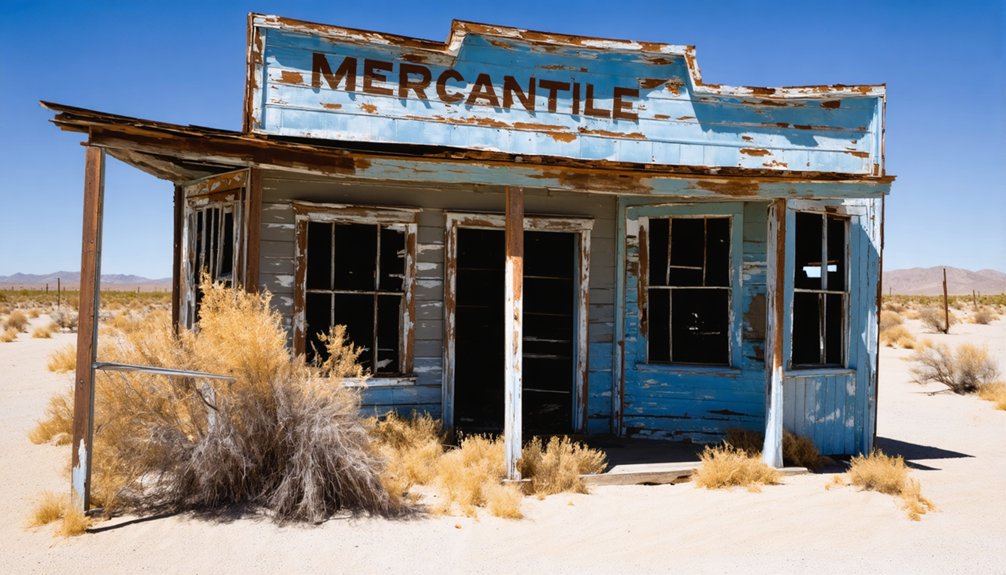
Preserving California’s ghost towns presents a complex web of challenges that extend far beyond mere building maintenance.
You’ll encounter state parks and preservation organizations battling limited funds, forced to choose stabilization over restoration while facing extreme environmental conditions. High-altitude locations endure snow and subzero temperatures, while desert ghost towns weather erosion from scorching temperature fluctuations.
The “arrested decay” approach maintains authenticity but requires constant vigilance against irreversible deterioration.
You’re witnessing preservation strategies that must balance public access with protection of fragile structures, all while addressing funding solutions through tourism revenue that simultaneously threatens these delicate sites.
Perhaps most challenging is ensuring these preservation efforts tell complete stories—not just romanticized pioneer narratives, but authentic multicultural histories that acknowledge both achievements and uncomfortable truths.
Documentary Evidence and Archaeological Considerations
Documentary evidence for Greenwich, California remains surprisingly scarce, presenting unique challenges for historians and archaeologists attempting to piece together its story.
When researching this elusive ghost town, you’ll discover that documentation gaps have hampered thorough understanding of its origins and decline.
The archaeological community continues to debate whether Greenwich qualifies as a true ghost town or represents a conflation of several abandoned California settlements.
Modern Interest in Non-Existent Historical Locations
You’ll find that Greenwich, California exemplifies how invented history creates appealing tourism narratives despite lacking archaeological substantiation.
This fabricated ghost town demonstrates the public’s willingness to embrace pseudohistorical accounts when they’re packaged with compelling storytelling and visual elements.
Greenwich’s mythology continues to spread through social media and amateur history blogs, illustrating how non-existent locations can gain legitimacy through repetition rather than evidence.
Invented Historical Tourism
While ghost towns typically emerge from genuine historical circumstances, a fascinating modern phenomenon has developed in the domain of heritage tourism—the deliberate creation of invented historical narratives.
You’re increasingly likely to encounter fabricated narratives designed specifically to attract visitors seeking novel experiences. Tourism authenticity becomes deliberately blurred as entrepreneurs capitalize on your desire for unique cultural encounters.
This commercial creation of non-existent historical sites satisfies your desire for distinctive travel experiences, even when they lack historical foundation.
Mythmaking Through Pseudohistory
Modern interest in non-existent historical locations thrives at the intersection of folklore, urban legend, and historical fragments, creating a rich landscape of pseudohistorical narratives that captivate public imagination.
When you explore Greenwich’s mythmaking, you’ll encounter ghostly legends that materialize without archaeological evidence. Media platforms—podcasts, YouTube channels, urban explorers—amplify these tales, blurring fact and fiction while strengthening the site’s cultural allure.
The attachment of spectral artists, revolutionaries, and marginalized figures to these locations symbolically deepens their significance beyond actual history.
Even without verifiable documentation, abandoned structures and weathered remnants provide visual authenticity for supernatural narratives. This phenomenon reflects our collective desire to connect with mysterious pasts, transforming obscure locations into meaningful cultural landmarks despite their questionable historicity.
Frequently Asked Questions
Was Greenwich Connected to Any Native American Settlements or Conflicts?
No, you won’t find evidence connecting Greenwich to specific Native Tribes or Settlement Conflicts. The Tongva inhabited the broader region, but no documented settlements or conflicts exist at Greenwich itself.
Could Greenwich Have Been Known by Another Name Historically?
Ever wonder what names echo through forgotten places? You’ll find little evidence of alternate identities for Greenwich, though Captain William Bush’s land ownership might’ve influenced historical names before “Greenwich” became established.
Have Any Artifacts Allegedly From Greenwich Appeared at Auctions?
You won’t find auction records explicitly listing Greenwich, California ghost town artifacts. While collections from “Distinguished Greenwich Collectors” exist, they’re likely associated with Greenwich, Connecticut rather than the California location.
What Role Did Social Media Play in Spreading Greenwich Myths?
While traditional folklore existed previously, you’ll find social media has dramatically amplified Greenwich urban legends through viral sharing, influencer promotion, and interactive communities that validate supernatural claims without historical verification.
Are There Legal Consequences for Promoting Fictional Ghost Towns?
You can face legal implications for promoting fictional representations that mislead consumers, infringe on trademarks, defame real entities, or encourage trespassing. Always distinguish fiction from reality to avoid liability.
References