Gyle, California stands as one of the state’s most authentic mining ghost towns, established after W.S. Bodey’s 1859 gold discovery and abandoned when coal quality deteriorated. You’ll find weathered wooden structures and oxidized mining equipment that tell stories of Cornish immigrants, Chinese laborers, and frontier entrepreneurs like Craven Lee. The town’s preserved 19th-century facades offer you a glimpse into California’s industrial evolution during the boom-and-bust cycle that defined this remarkable historical site.
Key Takeaways
- Gyle originated during California’s Gold Rush when W.S. Bodey’s 1859 gold discovery transformed it from a mining camp to a community.
- The ghost town features weathered 19th-century buildings and industrial mining remnants showcasing original architectural features and machinery.
- Mining operations declined when coal quality deteriorated, leading to Gyle’s abandonment and eventual ghost town status.
- Preservation efforts focus on “arrested decay” to maintain authenticity while documenting the site’s historical significance to California’s mining heritage.
- Visiting requires careful planning due to remote location, with no public transit options and limited amenities available on-site.
The Rise and Fall of Gyle’s Mining Industry
While the California Gold Rush of 1848 triggered widespread mining ventures throughout the state, Gyle emerged as a distinctive settlement whose fortunes rose and fell with the precious metals beneath its soil.
You’ll find that Cornish immigrants greatly shaped the town’s development, introducing essential technologies like the Cornish pump that enabled deeper exploration despite challenging groundwater conditions. The town experienced a significant revival in the late 19th century when technological advancements and foreign capital allowed for large-scale underground mining operations. The shift away from mining occurred when coal quality deteriorated, ultimately leading to the community’s transformation into another California ghost town.
Daily Life in a 19th Century Boom Town
The harsh clang of pickaxes and rumble of ore carts represented only one dimension of Gyle’s vibrant existence during its heyday.
You’d encounter a stratified society where mining labor defined daily rhythms, with workers trudging to shafts before dawn and emerging long after dusk, their faces blackened with coal and determination.
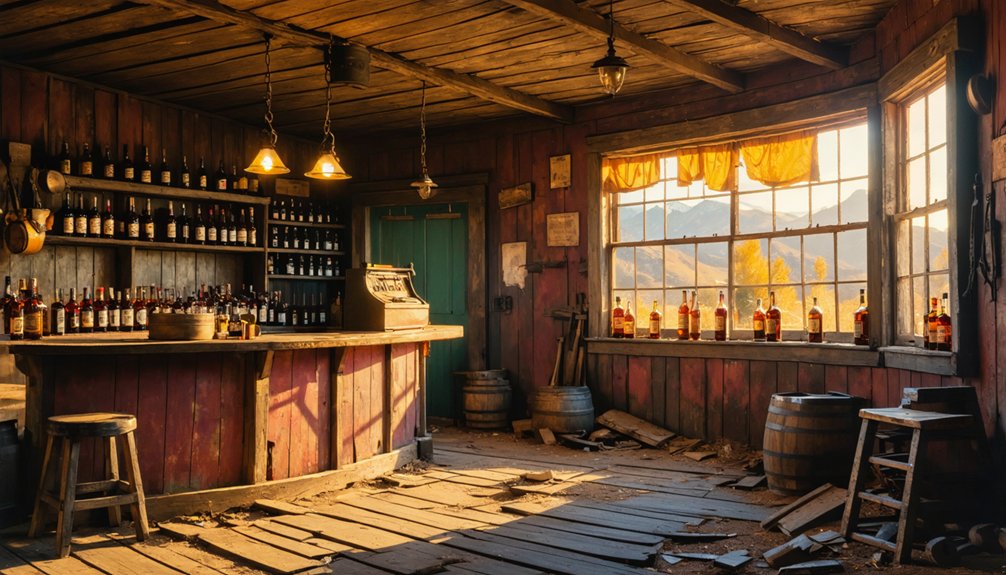
Social dynamics flowed through Gyle’s establishments: saloons and gambling halls stayed lit through night, while merchants hawked overpriced necessities to desperate miners.
You might witness vigilante justice dispensed on Main Street, or find comfort in fraternal organizations that provided structure amid chaos.
Churches competed with brothels for souls and dollars.
The town functioned as a complex ecosystem where miners, merchants, gamblers, and service providers coexisted in precarious balance until the gold inevitably disappeared, much like the communities of Julian that threatened to overshadow San Diego before their limited gold supply led to decline.
Local newspapers like The Morning News reported on everything from mining yields to the last night’s killings that characterized the town’s notorious lawlessness.
Architectural Remnants and Preserved Structures
As you explore Gyle’s weathered mining-era buildings, you’ll notice the meticulous preservation of original architectural features despite decades of abandonment and harsh climate exposure.
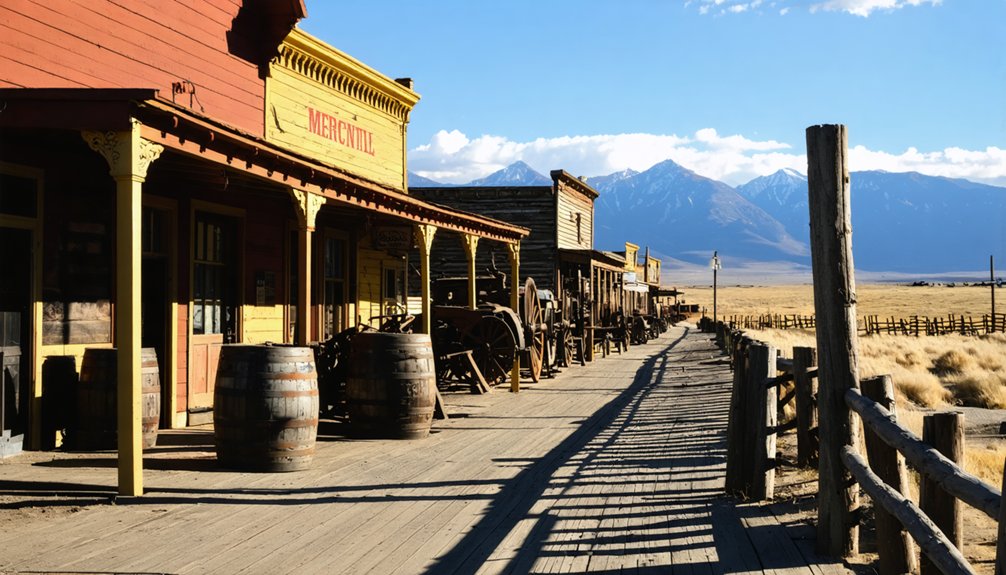
The main street facades maintain their distinctive 19th-century commercial aesthetic, with wooden storefronts, false fronts, and period signage offering glimpses into the town’s prosperous past. Visitors can witness the town in a state of decay as buildings are protected but deliberately not restored to maintain authenticity. Many structures are covered by chicken wire protection to prevent further damage while still allowing natural deterioration to proceed.
Throughout the site, industrial machinery ruins—including stamp mills, ore crushers, and mining equipment—remain frozen in time, documenting the technological systems that once powered this bustling gold rush community.
Weathered Mining-Era Buildings
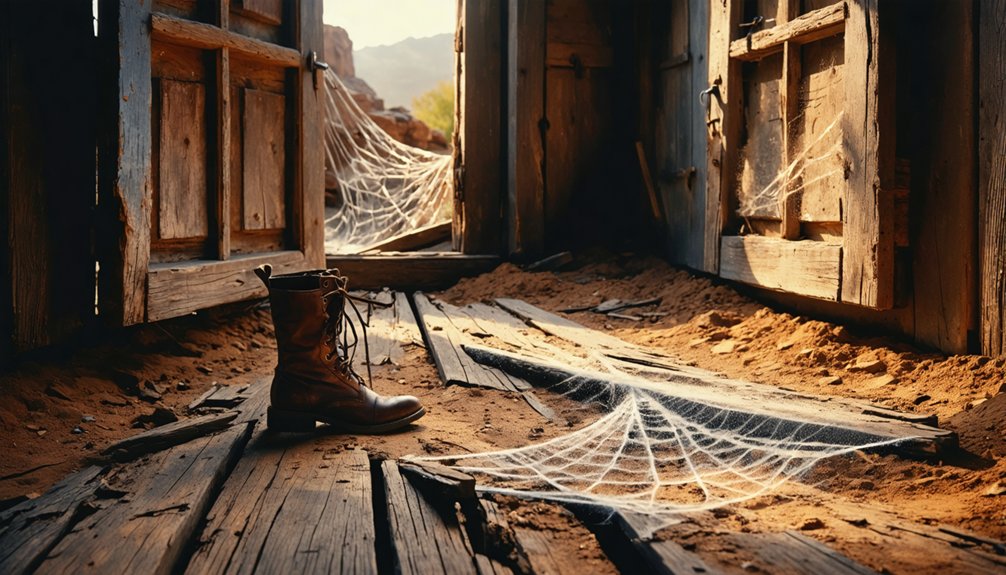
Weathered by decades of abandonment and harsh California elements, Gyle’s mining-era buildings stand as silent monuments to the town’s once-thriving past.
The deteriorated structures exhibit characteristic weathered wood siding, warped window frames, and crumbling masonry foundations typical of California ghost towns.
You’ll notice the utilitarian designs with false fronts that once projected prosperity and ambition despite their simple construction.
Preservation approaches in Gyle follow three distinct patterns:
- “Arrested decay” stabilization similar to Bodie’s approach, preventing collapse while maintaining authentic aging
- Minimal intervention to structural elements, allowing natural weathering processes to continue
- Documentation of deterioration patterns for historical research purposes
Unlike fully restored towns like Calico, Gyle’s buildings retain their authentic patina of age, giving you an unfiltered glimpse into the genuine mining-era aesthetic.
The site has attracted filmmakers seeking authentic abandoned settings, most notably serving as a filming location for Christopher Nolan’s science fiction thriller Tenet in recent years.
Similar to Dublin Gulch, some structures were cleverly built into the natural landscape to provide insulation against the region’s extreme temperatures.
Preserved Main Street Facades
Walking along Gyle’s main thoroughfare today, visitors encounter a compelling patchwork of nineteenth-century architectural remnants, where partially preserved false-front facades create an atmospheric tableau of Western commercial design.
Unfortunately, detailed information about Gyle’s preserved structures isn’t currently documented in accessible historical records. To fully appreciate this ghost town’s historical architecture, you’ll need to conduct specialized research through California historical societies or county archives.
Ghost town exploration enthusiasts should contact regional mining history organizations that may hold undiscovered photographs or documentation of Gyle’s architectural heritage.
The preservation status of main street buildings remains unclear from available sources, though similar mining-era settlements like Bodie showcase how such facades typically featured utilitarian designs with decorative elements reflecting the town’s economic peak. Unlike Gyle, Bodie has been carefully preserved as a ghost town in a state of “arrested decay” since becoming a State Historic Park in 1962. The eerie atmosphere is reminiscent of Eagle Mountain, which has been referred to as California’s newest Ghost Town.
Consider reaching out to preservation groups specializing in California’s forgotten mining communities for more definitive information.
Industrial Machinery Ruins
Deep beneath the overgrown landscape of Gyle, scattered remnants of once-thriving mining apparatus punctuate the terrain, offering silent testimony to the town’s industrial past.
These mechanical ghosts, gradually reclaimed by nature, represent California’s industrial evolution during the late 19th century boom period. Fractured machinery components reveal the technological advancement trajectory that once characterized this frontier settlement.
- Oxidized ore crusher fragments remain visible near the western gulch, showcasing primitive industrial equipment designs predating modern mechanization.
- Cast iron boiler segments, measuring approximately eight feet in diameter, demonstrate early steam power implementation.
- Remnants of pulley systems and tramway machinery components illustrate the sophisticated mineral extraction network that connected Gyle’s primary industrial zones.
The machinery remnants provide researchers unprecedented access to preservation-in-place industrial archaeology, unaltered by subsequent development or historical intervention.
Notable Figures and Legends of Gyle

Although Gyle’s physical structures have largely disappeared into California’s desert landscape, the town’s historical narrative continues to thrive through the remarkable individuals who shaped its boom-and-bust trajectory.
W.S. Bodey’s 1859 gold discovery ignited the settlement that would eventually bear his name, while figures like Craven Lee established the organized mining operations that transformed Gyle from camp to community.
The pioneering spirit of Bodey and Lee transformed a mere gold discovery into a thriving frontier community.
The town’s lore includes legendary outlaws who found refuge in its remote location, alongside the Chinese immigrant leaders who created enduring spaces of cultural survival despite discrimination.
Today, caretakers like Martin Gianettoni preserve Gyle’s physical remnants, while ghost stories of phantom mining sounds and apparitions of deceased miners continue to fascinate visitors and maintain the town’s mystique in California’s historical consciousness.
Visiting the Ghost Town Today: Access and Attractions
While Gyle’s historical significance remains intact through its colorful past and legendary figures, accessing this remote California ghost town today requires careful planning and preparation.
The primary access routes remain underdocumented, with visitors typically needing private transportation as public transit options are nonexistent. Seasonal road conditions may impact your journey.
When exploring this vestige of California’s mining era, consider these visitor tips:
- Bring essential supplies including water, food, and emergency provisions as amenities are extremely limited.
- Download offline maps before departure as mobile coverage is unreliable in this secluded location.
- Respect historical structures by observing from safe distances and avoid disturbing any artifacts you encounter.
Photography opportunities abound among the weathered structures that once housed Gyle’s pioneering population.
Preservation Efforts and Historical Significance

Despite Gyle’s remote location and limited documentation, preservation efforts have established this ghost town as a significant cultural landmark within California’s mining heritage.
You’ll find that unlike Bodie’s “arrested decay” approach, Gyle’s preservation techniques focus on maintaining what remains while carefully documenting existing structures through photographic archives and detailed mapping.
The town’s cultural impact extends beyond its physical remnants, offering insights into the boom-and-bust cycle characteristic of Gold Rush communities.
Local historical societies collaborate with state agencies to protect Gyle from vandalism and environmental degradation, while educational initiatives highlight the complex social dynamics of 19th-century mining life.
When visiting, you’ll appreciate how preservation balances authentic historical representation with accessibility, allowing you to experience California’s rugged pioneering spirit while ensuring these fragile remnants endure for future generations.
Frequently Asked Questions
Are There Any Paranormal or Haunting Reports From Gyle?
As quiet as the grave, there are no documented ghostly encounters or haunted history associated with Gyle. Available records don’t indicate any paranormal reports in this lesser-known California ghost town.
What Happened to Gyle’s Residents After the Town Was Abandoned?
You’ll find Gyle’s residents mainly migrated to nearby mining towns or urban centers following abandonment. Their dispersal followed typical patterns in California ghost town history, with families seeking new economic opportunities elsewhere.
How Did Gyle Get Its Distinctive Name?
Like gold dust settling on river rocks, Gyle’s naming origins stem from Joshua Gyle’s 1856 silver strike. The town adopted his surname, reflecting the historical significance of individual prospectors in California’s mining heritage.
Were There Any Major Disasters or Epidemics in Gyle’s History?
No major disasters or epidemic impacts appear in Gyle’s historical disaster timeline. You won’t find documented evidence of significant catastrophes that affected this settlement’s development or hastened its abandonment.
Can Artifacts Be Collected From the Gyle Site?
You’d relish freedom to collect souvenirs, yet artifact preservation demands restraint. Legal regulations explicitly prohibit removing historical objects from ghost town sites without proper permits—a scholarly consensus protecting collective heritage.
References
- https://theazjones.com/the-ghost-town-of-helena-california/
- https://www.islands.com/1878743/one-lagest-ghost-towns-eerily-modern-abandoned-california-mining-town-eagle-mountain/
- https://www.youtube.com/watch?v=OD9M6MP6RRU
- https://en.wikipedia.org/wiki/Bodie
- https://www.staxupstorage.com/blogs/exploring-ghost-towns-near-homeland-california/
- https://www.youtube.com/watch?v=ElbXVNDurPc
- https://www.visitmammoth.com/blogs/history-and-geology-bodie-ghost-town/
- https://www.parks.ca.gov/?page_id=21648
- https://claytonhistory.org/history/coal-mining/
- https://www.calaverashistory.org/mining